Holistic Review in College Admissions: What CDS C7 Shows
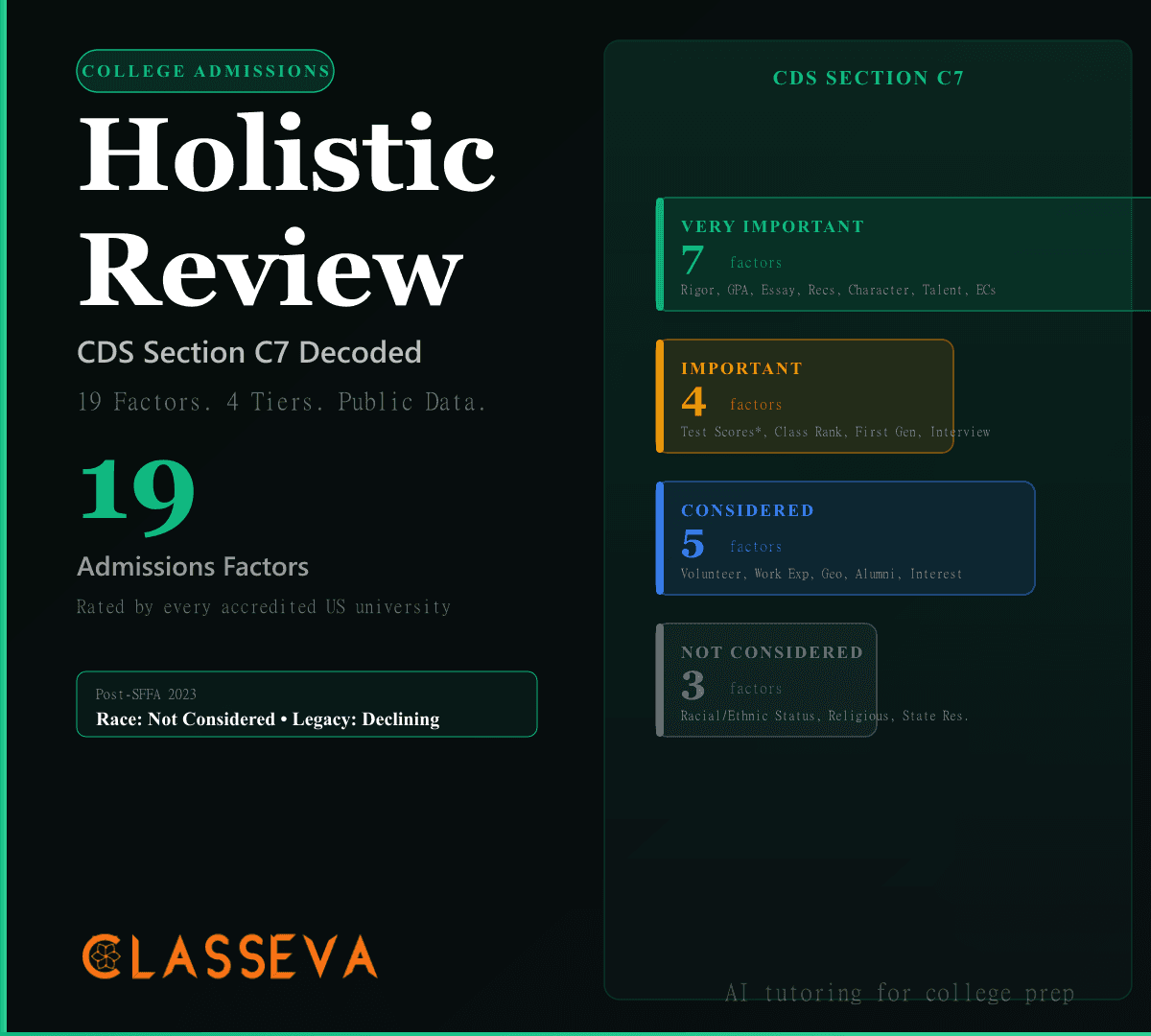
The phrase “holistic review” appears on nearly every selective university's admissions page, typically with little explanation. Most students read it as a polite way of saying the process is mysterious or subjective. That reading is wrong. Every accredited US university publishes exactly how they weight 19 specific admissions factors in a document called the Common Data Set, and Section C7 of that document lists each factor alongside its official importance tier: Very Important, Important, Considered, or Not Considered. The phrase “holistic review” is not admissions poetry. It is a structured rubric with public documentation that any student can read before applying.
What Is Holistic Review in College Admissions?
Holistic review in college admissions is a multi-factor evaluation process that weighs academic and non-academic criteria when deciding which applicants to admit. The process exists because universities want to build classes, not just rank students by GPA. A school admitting 1,700 students from 37,000 applications cannot simply sort by one number; it selects for the combination of factors that produces the incoming class it wants.
The structure is less ambiguous than the name suggests. The Common Data Set Initiative, a collaborative project between major data providers and US higher education institutions, requires participating universities to report how they weight 19 specific factors in admissions decisions. Section C7 of the CDS form makes holistic review concrete. What one university rates Very Important, another rates Considered. The CDS makes that difference visible and verifiable.
The 19 Factors in CDS Section C7
Reading CDS Section C7 across dozens of university publications, the consistency of the framework stands out immediately. Every school rates the same 19 factors. What varies is how heavily each school weights them and whether a given factor lands in the Very Important, Important, Considered, or Not Considered tier.
The Academic Factors
The first group covers academic credentials directly. These appear at the top of every admissions reader's evaluation process:
- Rigor of secondary school record: The difficulty of the courses you took. AP, IB, dual enrollment, and honors courses signal you sought the hardest path available at your school.
- Class rank: Where you finished relative to your graduating class. Less weighted than it once was, because many competitive high schools no longer report rank.
- Academic GPA: Your grade performance in those courses, typically reviewed on both weighted and unweighted scales.
- Standardized test scores: SAT or ACT results. Weight here depends entirely on the school's test policy for the 2026 cycle.
The Non-Academic and Context Factors
The remaining 15 factors cover personal, extracurricular, and contextual dimensions:
- Application essay: The Common App personal statement and any school-specific supplements.
- Recommendations: Teacher and school counselor letters.
- Interview: Alumni or admissions officer evaluation; varies widely across schools.
- Extracurricular activities: Clubs, sports, arts, and community involvement.
- Talent/ability: Demonstrated excellence in a specific area, often arts or athletics.
- Character/personal qualities: Leadership, integrity, resilience, and intellectual curiosity.
- First generation: Whether you would be the first in your immediate family to earn a four-year college degree.
- Alumni/ae relation: Legacy connection. Declining at many schools post-2023.
- Geographical residence: Where you live. Private schools use this to seek geographic diversity.
- State residency: Relevant primarily at public universities with in-state enrollment mandates.
- Religious affiliation/commitment: Rarely a factor except at schools with explicitly religious missions.
- Racial/ethnic status: Post-SFFA (2023), this can no longer be a lawful admissions factor. All schools now rate it Not Considered.
- Volunteer work: Community service that extends beyond required school hours.
- Work experience: Part-time or summer employment.
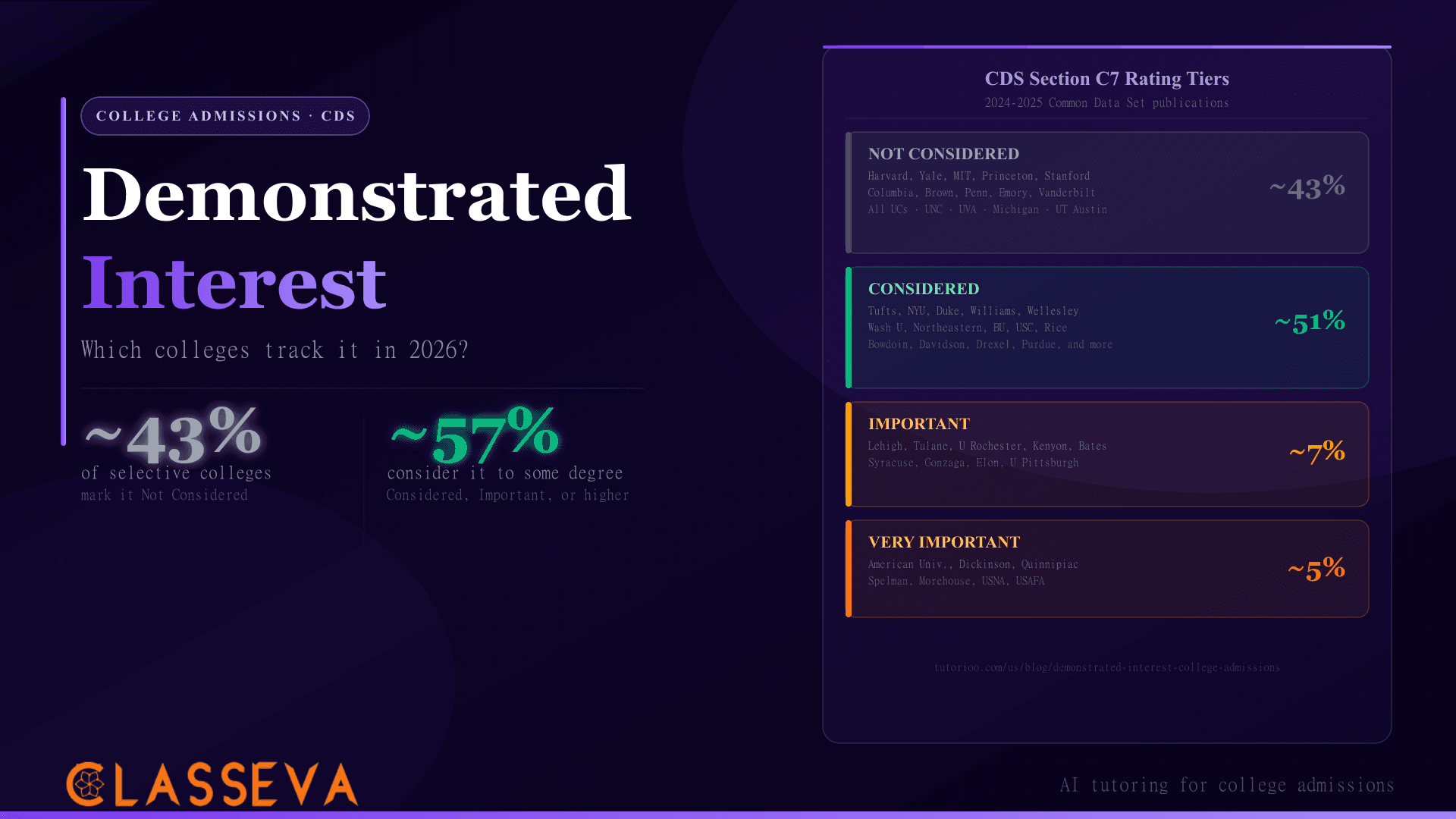
- Level of applicant's interest: Demonstrated interest. Only relevant at schools that officially track it.
Which Factors Are “Very Important” at Top Universities?
Reading CDS Section C7 across Harvard, Yale, Princeton, MIT, and Stanford, a consistent pattern holds at the top of the rubric. All five schools rate rigor of secondary school record and academic GPA as Very Important. Every application enters the review with those two factors already set. They determine whether a file gets a serious read or a quick one.
The Academic Tier That Stays Consistent
Beyond rigor and GPA, four more factors appear as Very Important at all five schools: application essay, recommendations, character/personal qualities, and talent/ability. The consistency here matters. Students who assume extracurricular activities are the primary differentiator underweight the essay and recommendation factors that every elite school places in its highest tier.
Extracurricular activities also rank Very Important at most of these schools. The nuance is that the C7 rating covers the category broadly. One genuinely exceptional activity signals more than 12 average ones listed across ten Common App activity slots.
Where Schools Diverge in Their Weighting
The most visible divergence appears on test scores. Harvard, Yale, MIT, and Stanford all reinstated test requirements for 2026, and their CDS publications rate standardized test scores as Very Important. Princeton remains test-optional in 2026, and its C7 reflects that: test scores rank Important rather than Very Important because roughly 35-40% of applicants do not submit them. A factor cannot be Very Important at a school that does not require the data from all applicants.
Class rank shows another meaningful split. Harvard and Stanford rate class rank as Considered, partly because many competitive high schools no longer calculate or publish it. Yale and Princeton rate it Important, signaling that rank data adds genuine signal to those schools' evaluations when it is available.
What's the Difference Between “Important” and “Considered”?
The gap between Important and Considered is more meaningful than it looks on paper. Important means a factor can genuinely alter an admissions decision. Considered means the factor gets noted, might add color to an application, but rarely changes an outcome on its own.
What “Considered” Actually Means in Practice
Picture an admissions reader comparing two strong applications. Both students have equivalent rigor, GPA, and essays. One has a campus visit logged in the enrollment management system; the other does not. At a school that rates demonstrated interest as Considered, that campus visit data gets noted. It does not move a borderline decision. It might add a data point when everything else is equal, and even then only at schools where yield modeling is tight.
Compare that to a factor rated Important, like first-generation status at most Ivies. A first-generation applicant gets substantive, not token, consideration. The committee discusses it. It can genuinely tip a borderline file. The word “Considered” in the CDS signals that the factor enters the room; “Important” signals it can change the verdict.
Important
- •Can genuinely change an admissions outcome
- •Gets substantive committee discussion
- •Can compensate for mild weaknesses in other areas
- •Examples: first-generation status, class rank, interview at interview-focused schools
Considered
- •Noted but rarely changes outcomes on its own
- •Adds color to otherwise comparable applications
- •Provides context, not compensation
- •Examples: volunteer work, work experience, alumni relation, demonstrated interest
Where Do Test Scores Fit in the Holistic Rubric?
Test scores occupy an unusual position in holistic review because their weight depends on whether a school requires them. At schools that reinstated test requirements for 2026, the SAT or ACT appears as Very Important alongside GPA and rigor. At test-optional schools, the factor carries less structural weight because a significant fraction of the applicant pool opted out.
| University | Test Policy 2026 | C7 Test Score Rating |
|---|---|---|
| Harvard | Test Required | Very Important |
| Yale | Test Required | Very Important |
| Princeton | Test Optional | Important |
| MIT | Test Required | Very Important |
| Stanford | Test Required | Very Important |
| Columbia | Test Required | Very Important |
| Brown | Test Required | Very Important |
| Dartmouth | Test Required | Very Important |
Source: 2024-25 Common Data Set publications and official admissions policy pages. Test policies confirmed for the 2026 admissions cycle.
For test-optional applicants, the practical implication is clear: submitting a strong score upgrades it from absent to a positive data point. Withholding a score that falls below the school's 25th percentile for submitters is the correct call. Submitting a score at or above that threshold adds to the holistic picture without creating a liability. The full test-optional policy breakdown covers which schools genuinely treat non-submitters equally and which still show submission rate differences in their acceptance data.
What Changed After SFFA v. Harvard in 2023?
The Supreme Court's June 2023 ruling in Students for Fair Admissions v. Harvardheld that Harvard's and the University of North Carolina's race-conscious admissions programs violated the Equal Protection Clause of the Fourteenth Amendment. The decision applied to all US colleges receiving federal funding, which covers virtually every accredited institution. Two of the 19 C7 factors were directly affected.
Racial and Ethnic Status Post-SFFA
Before SFFA, many universities rated racial/ethnic status as Considered or Important in Section C7. After the ruling, no university may lawfully factor in an applicant's race or ethnicity as an admissions consideration. Every major university updated its CDS to reflect Not Considered on this line.
The ruling did not eliminate the ability for applicants to write about their racial or ethnic background in essays. The Court held that race cannot be a standalone factor; but an essay describing how an applicant's background shaped their intellectual development or perspective remains permissible when the content itself demonstrates character, resilience, or achievement. Schools responded by expanding weight on adjacent factors: socioeconomic context, first-generation status, and geographic origin now carry more explicit weight as diversity proxies at schools that previously used race as a direct lever. First-generation status moved from Considered to Important in several schools' CDS publications between 2022-23 and 2024-25.
Legacy Preferences Under Pressure
Alumni/ae relation (the legacy factor) was not directly addressed by SFFA, but the ruling applied institutional pressure. Harvard still rates alumni/ae relation as Considered in its 2024-25 CDS. MIT never considered alumni relation and still does not. Columbia, Amherst, Carnegie Mellon, and Johns Hopkins all announced elimination of legacy preferences in 2023 or 2024.
The CDS is the definitive record of where each school now stands. Check the alumni/ae relation row in Section C7 for every school on your list. A Considered rating means legacy still enters the room at that school; Not Considered means it has been formally removed from the rubric.
What This Means for Your Application Strategy
The CDS Section C7 framework changes how you should approach your application in concrete ways. Building a strategy from the factor weighting rather than from college rankings produces a better-fitted college list and more efficiently prepared applications.
Double Down on the “Very Important” Factors
At every selective school, rigor of secondary school record and academic GPA land in the Very Important tier. These two factors set the floor for every application. A student with weak rigor and GPA will not overcome that deficit by building a spectacular extracurricular profile. The reverse is also true: a student with exceptional rigor and GPA, a strong essay, and strong recommendations is a competitive applicant at elite schools even without a standout single activity.
Where students systematically underinvest is in recommendations and essays, both of which appear as Very Important at most elite schools. Most students spend 10-20 hours on their Common App personal statement and minimal time cultivating the relationships that produce strong teacher recommendations. The CDS weighting suggests those priorities should shift: the essay and the relationship management that yields a recommendation describing specific intellectual growth belong in the same tier of effort as the GPA work itself.
Read CDS Section C7 for every school on your list. Build a simple spreadsheet: schools as rows, the 19 factors as columns. Where a factor is Very Important across multiple schools, it deserves your highest application investment. Where factors appear as Considered at every school on your list, treat them as finishing touches, not foundations.
Building a List That Matches Your Strengths
The CDS also helps build a balanced college list. NACAC's annual State of College Admission research documents how factor weighting has shifted across US institutions over time. Some schools weight demonstrated interest as Important or Very Important. At those schools, campus visits, virtual event registrations, and specific supplemental essays contribute meaningfully. At the Ivies, MIT, and Stanford, demonstrated interest is explicitly Not Considered. Spending money on campus visits to schools that have published those visits carry zero admissions weight is a misallocation of time and travel budget.
The full breakdown of which colleges track demonstrated interest uses the same CDS framework to map the roughly 40% of selective colleges where it can move a needle versus the 60% where it cannot. The early decision vs. early action guideexplains how applying early interacts with holistic review at different tier schools, since ED signals commitment in a way that some schools' rubrics reward more than others.
College Application Cost Calculator
Applying to 12-15 schools adds up fast. Calculate total application fees, test score sends, and campus visit costs across your college list to see where demonstrated interest investments actually make financial sense.
Key Takeaways
- Holistic review is a structured 19-factor rubric published in CDS Section C7 annually, not a vague or subjective evaluation process.
- Rigor of secondary school record and academic GPA appear as Very Important at virtually every selective US university and set the floor for every application file.
- Essays, recommendations, character/personal qualities, and talent/ability all land in the Very Important tier at most elite schools; most students underinvest in them relative to the GPA work they prioritize.
- Test score weight depends on school policy: Very Important at test-required schools, Important at test-optional schools for applicants who submit scores.
- The 2023 SFFA ruling removed racial and ethnic status from lawful holistic review; all schools now reflect Not Considered on that C7 line, and many have shifted weight toward first-generation status and socioeconomic context.
- Legacy preferences are declining: MIT never considered alumni relation; Columbia, Amherst, Carnegie Mellon, and Johns Hopkins removed it in 2023-24. Harvard still lists it as Considered per its 2024-25 CDS.
- Reading Section C7 for every school on your list before applying tells you exactly where to invest application effort and where demonstrated interest tactics are actually worth the cost.
The Classeva college admissions resource hub covers score targets, application timelines, and the tools that help you build a financially realistic list alongside the strategically optimized one. The Scholarship Probability Estimator connects academic factors in holistic review to merit aid probability at schools that offer it. For the school-specific breakdown of how individual universities apply this framework, the posts for Harvard, Yale, MIT, Princeton, Stanford, and Columbiaeach walk through that school's CDS data in detail.