Demonstrated Interest: Which Colleges Track It in 2026
Reading Common Data Set Section C7 across the top 50 universities, what stands out is how cleanly the schools divide into two camps. On one side sit the Ivies, MIT, Stanford, and most flagship state universities. On the other sit Tufts, Lehigh, Tulane, and hundreds of selective private colleges. The difference is whether the school bothers to track whether you care. Knowing which camp your target schools fall into changes how you spend your time in junior and senior year.
What Is Demonstrated Interest in College Admissions?
Demonstrated interest refers to the signals a student sends to a college showing genuine intent to enroll. These signals range from visiting campus and attending information sessions to emailing admissions officers, registering for virtual events, and writing specific supplemental essays that reference the school's actual programs.
Colleges track this data for a practical reason: yield rate. Admissions offices need to predict how many admitted students will enroll. A school with 10,000 seats must admit far more than 10,000 applicants, and the accuracy of that forecast affects everything from housing capacity to financial aid budgeting. Students who have demonstrated interest historically enroll at higher rates, so tracking it gives yield models better accuracy.
That said, "tracking interest" and "weighting it in admissions" are different things. Some schools log every campus visit without it affecting a single admissions decision. The only reliable signal is the CDS.
How the Common Data Set Reveals Whether a School Tracks It
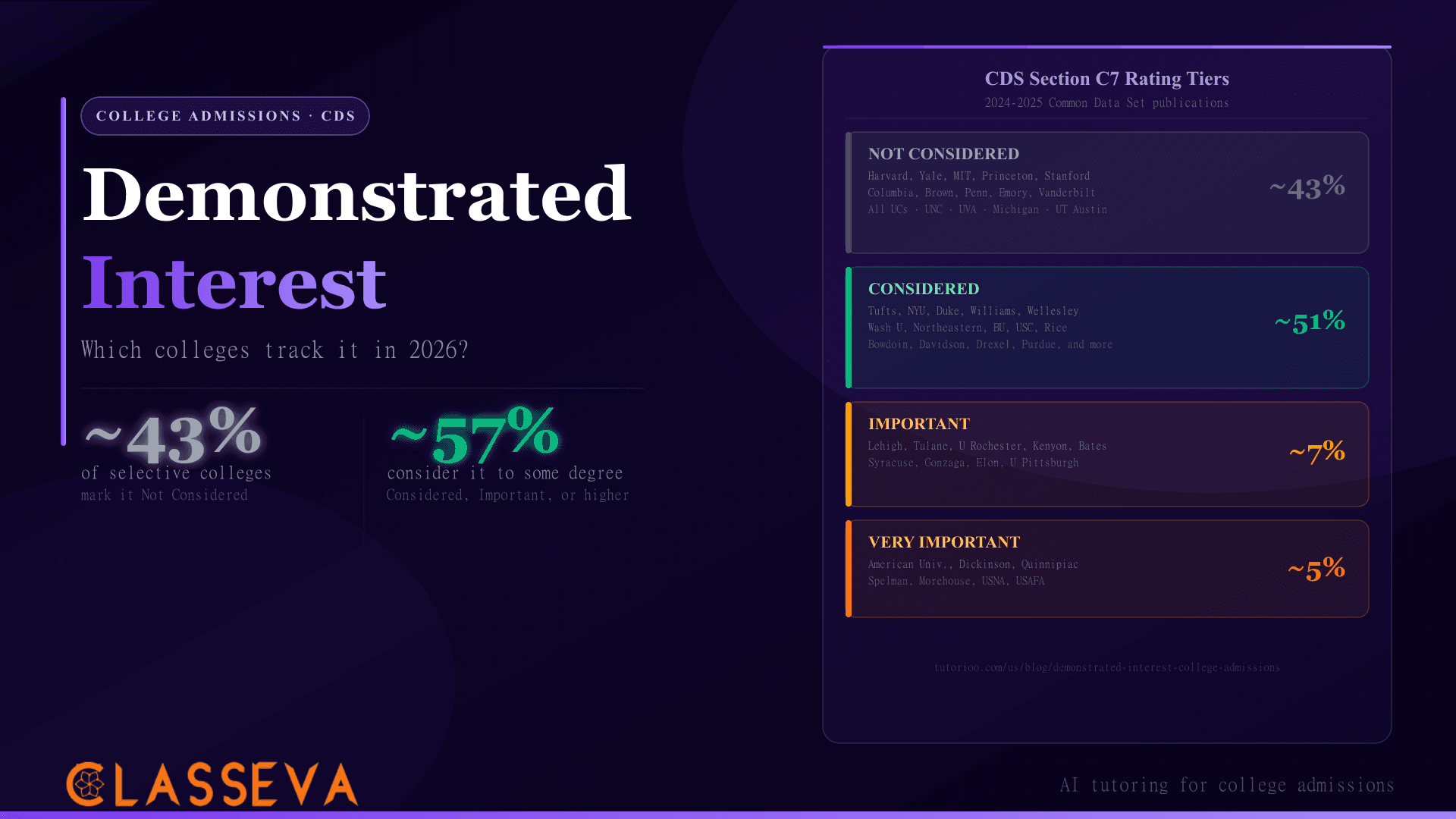
The Common Data Set Initiative publishes a standardized questionnaire that colleges complete annually. Section C covers admissions factors. Section C7 specifically asks institutions to rate the relative importance of "level of applicant's interest" using four fixed options: Very Important, Important, Considered, or Not Considered.
This is primary-source data, self-reported by the institution. A school cannot claim it ignores demonstrated interest while marking it "Important" in C7, and a school cannot pretend to track it while marking it "Not Considered." The CDS creates a publicly verifiable record.
Reading Section C7 Yourself
To find any school's rating, search "[School Name] Common Data Set [year]" and locate their institutional research office. Most schools post CDS PDFs annually. Open the document and scroll to Section C7. The relevant row reads: "Level of applicant's interest." The checkbox in the column for Very Important, Important, Considered, or Not Considered tells you exactly where that school stands.
Most universities host their CDS on an Office of Institutional Research page. Search for "[School Name] common data set site:[school.edu]" to skip aggregator sites and land on the primary PDF. Section C7 appears roughly one-third of the way through the document.
Which Top Universities Don't Consider Demonstrated Interest?
The most selective research universities in the US almost universally mark demonstrated interest "Not Considered" in their CDS. This makes strategic sense: these schools receive 50,000 to 60,000 applications and admit under 5%. Their yield rates are already high enough (Harvard enrolls roughly 80% of admitted students) that they do not need yield-management signals from applicants.
The Ivies and Elite Research Universities
| School | C7 Rating | Acceptance Rate | CDS Year |
|---|---|---|---|
| Harvard University | Not Considered | 3.6% | 2024-25 |
| Yale University | Not Considered | 4.2% | 2024-25 |
| Princeton University | Not Considered | 4.6% | 2024-25 |
| MIT | Not Considered | 3.9% | 2024-25 |
| Stanford University | Not Considered | 3.7% | 2024-25 |
| Columbia University | Not Considered | 3.9% | 2024-25 |
| Brown University | Not Considered | 5.1% | 2024-25 |
| University of Pennsylvania | Not Considered | 6.5% | 2024-25 |
| Caltech | Not Considered | 3.1% | 2024-25 |
| Johns Hopkins | Not Considered | 6.8% | 2024-25 |
| Northwestern | Not Considered | 6.8% | 2024-25 |
| Emory University | Not Considered | 10.3% | 2024-25 |
| Vanderbilt University | Not Considered | 6.3% | 2024-25 |
| Boston College | Not Considered | 15.4% | 2024-25 |
Schools marking demonstrated interest 'Not Considered' in C7. CDS data via each school's Office of Institutional Research. Acceptance rates approximate from 2024-2025 CDS.
Cornell and Dartmouth are not included above because their C7 ratings for the most recent cycle differ across data sources. For those schools, verify directly through Harvard's OIRA model and the equivalent institutional research page at each school. The pattern holds for the full Ivy League: none of the eight schools weights demonstrated interest.
The implication for applicants targeting these schools: do not rearrange your application strategy to signal interest to Harvard or MIT. Emailing their admissions offices, attending their virtual events, or visiting campus does not affect your file. Harvard's full admissions picture shows where applicants should actually focus their effort. Spend that time on your essays instead.
Major Public Flagships
State flagship universities almost never track demonstrated interest. The University of California system explicitly does not consider it across all nine undergraduate campuses. The same holds for UNC Chapel Hill, the University of Virginia, the University of Michigan, and the University of Texas at Austin. Public university admissions offices process tens of thousands of in-state and out-of-state applications; yield-tracking interest is structurally impractical at that volume.
Which Colleges Do Consider Demonstrated Interest?
Liberal arts colleges, selective private universities outside the Ivy-MIT-Stanford tier, and schools with acceptance rates between 10% and 40% are far more likely to weight demonstrated interest. Their smaller applicant pools make yield modeling both more feasible and more financially consequential.
The "Considered" Tier: Selective Schools Where It Can Matter
"Considered" means demonstrated interest enters the admissions decision but carries less weight than academic factors. At these schools, strong interest probably will not save a weak application, but it can tip borderline cases. The "Considered" category contains a surprisingly large number of well-regarded schools.
The "Considered" list includes several schools that applicants routinely overlook. Yale marks demonstrated interest as "Not Considered", but Tufts, NYU, Northeastern, Duke, Williams, Wellesley, Washington University in St. Louis, Rice, and the University of Southern California all rate it as "Considered." These are schools with acceptance rates between 10% and 25%: selective enough that every factor matters, but large enough applicant pools that yield management is a genuine concern.
Important and Very Important: Where It Can Move the Needle
A smaller group goes further. Schools marking demonstrated interest "Important" in their CDS treat it as a genuine admissions factor rather than a tiebreaker. Schools marking it "Very Important" treat it comparably to extracurriculars or recommendation letters.
| School | C7 Rating | Type |
|---|---|---|
| Lehigh University | Important | Private research university |
| Tulane University | Important | Private research university |
| University of Rochester | Important | Private research university |
| Kenyon College | Important | Liberal arts college |
| Bates College | Important | Liberal arts college |
| Syracuse University | Important | Private research university |
| Gonzaga University | Important | Private university |
| American University | Very Important | Private research university |
| Dickinson College | Very Important | Liberal arts college |
| Quinnipiac University | Very Important | Private university |
| Spelman College | Very Important | HBCU liberal arts |
| Morehouse College | Very Important | HBCU liberal arts |
Schools where demonstrated interest rates as Important or Very Important in C7. Source: College Transitions Dataverse, 2024-2025 CDS publications.
At schools in this group, demonstrated interest functions more like a campus interview or a strong teacher recommendation. It signals something about fit and yield probability that academic numbers alone do not capture. If Dickinson or Kenyon sit on your college list, the effort you put into demonstrating interest has a measurable return.
How to Demonstrate Interest Ethically
"Demonstrating interest" does not mean sending a school an email every week or visiting four times. It means creating a clear, authentic record of engagement with the institution. There are five methods that actually register in enrollment management systems, ranked roughly by trackability.
Campus Visits: The Most Trackable Signal
Signing in at the admissions office during a campus visit creates a timestamped record that links your name to a visit date. Take the official tour, attend an information session, and if possible, sit in on a class. The admissions office sees all of it. Students who visited in junior year and again at an admitted-students event tell a clear yield story.
If distance or cost makes visiting difficult, that does not disadvantage you at most schools. Admissions offices at selective universities understand that a student in rural Montana cannot fly to Boston twice a year. Virtual alternatives carry real weight at schools that track interest.
Virtual Events and Email Outreach
Most schools log virtual info session attendance through registration systems. Use the same email address for every registration that you will use on your application. The link between your event attendance and your application file depends on consistent email use.
Email outreach works differently. One well-written email to your regional admissions representative carries more weight than ten generic "I'm very interested in your school" messages. The goal is a substantive question: something you could not answer by reading the school's website, something that shows you have done genuine research. Ask about a specific research lab, a unique major structure, or a program you found during your exploration. Keep it short (three sentences maximum) and professional.
Supplemental Essays as Demonstrated Interest
The "Why Us?" supplemental essay carries the strongest qualitative signal of interest for applicants who cannot visit campus. Admissions officers read hundreds of essays about "the vibrant campus community" and "the distinguished faculty." They remember the ones that name a specific professor's research, reference a specific club by its actual name, or describe a specific course in the catalog.
Specificity does more work than length here. A 250-word "Why Tufts?" essay that names two professors and a specific dual-degree program signals more interest than a 650-word essay about "the energy of Boston." The research required to write a specific essay is itself the demonstration of interest.
Visit campus and sign in at the admissions office
This creates the most direct, timestamped record in the enrollment management system. Pair it with a campus tour and information session.
Attend virtual events using your application email address
Register with the same email you will use on your application. Most schools link virtual event registrations to application files by email.
Email your regional admissions rep with one specific question
Keep it under three sentences. Ask something that shows you have read past the admissions homepage. Use your application email address.
Write a specific "Why Us?" supplemental essay
Name specific professors, programs, labs, or courses. Generic essays signal exactly the opposite of interest. The research required to write a specific essay is itself the demonstration.
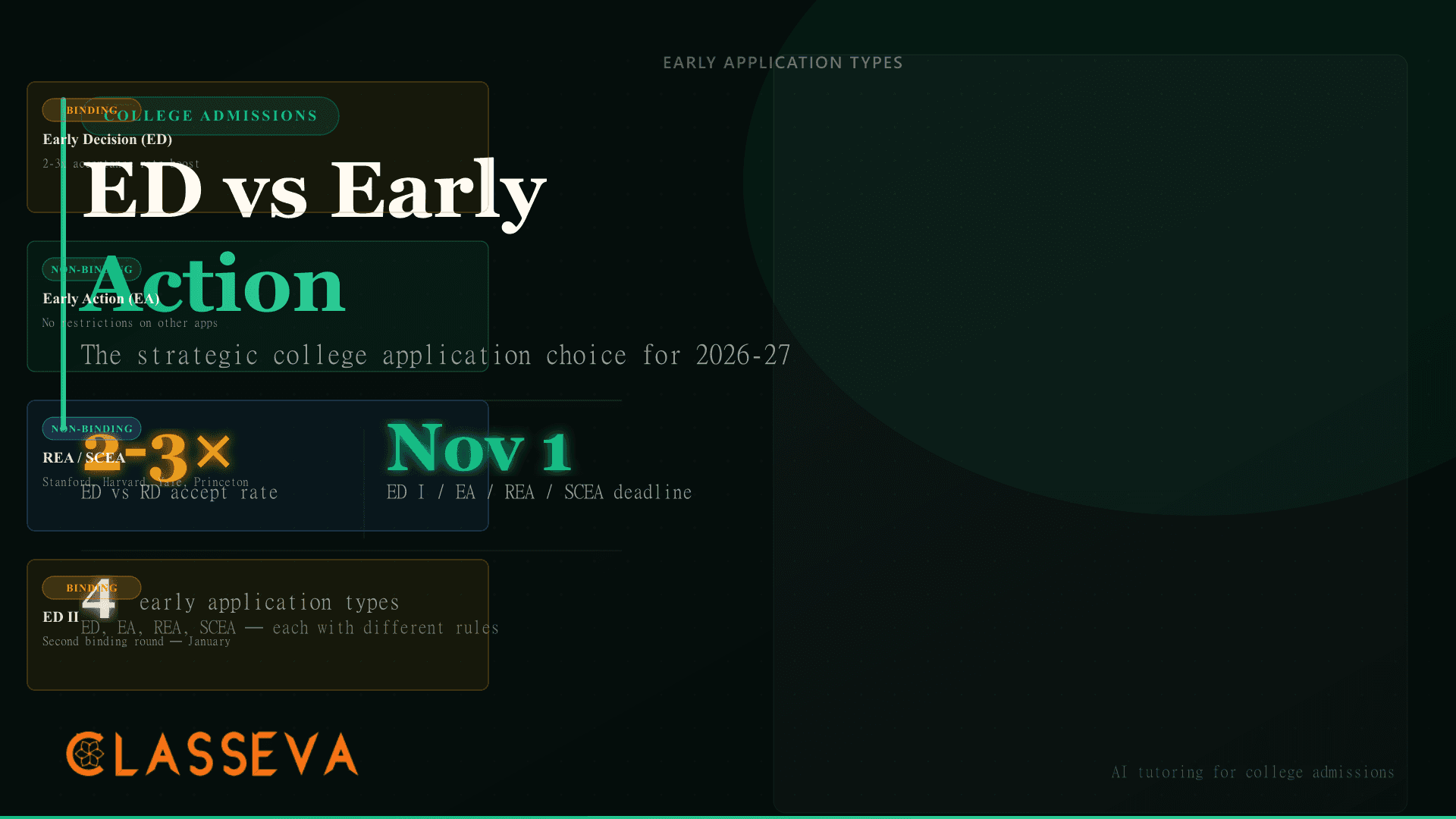
Apply Early Decision or Early Action
ED is the strongest possible interest signal. EA is non-binding but still signals early engagement. At schools where demonstrated interest is Important or Very Important, applying ED can tip borderline decisions.
Does Applying Early Decision Count as Demonstrated Interest?
Yes, and it is the strongest version. Applying Early Decision (binding) tells an admissions office that the school is your unambiguous first choice. Students admitted ED enroll by contract. That removes yield uncertainty entirely, which is why schools admit larger percentages of their class through ED than through Regular Decision.
The nuance: ED matters even at schools that officially mark demonstrated interest as "Not Considered." Yield pressure shapes enrollment management at every school, regardless of what Section C7 says. A borderline applicant who applies ED at a school that "doesn't track interest" may still benefit from the ED yield signal in ways that never appear in the official CDS. The difference is that at schools marking interest "Not Considered," this effect is smaller and less systematic.
At schools marking demonstrated interest as Important or Very Important, applying Early Decision creates a double signal: both the formal ED binding commitment and a separately tracked demonstrated interest history. Students with campus visits, virtual event attendance, and admissions emails on file who also apply ED present the most complete interest profile possible.
Demonstrated Interest as a Strategic Factor on Your College List
The strategic implication of CDS Section C7 data is straightforward: where you invest your demonstrated interest effort should depend on whether the school's C7 rating makes that effort count.
A student who spends six hours crafting the perfect email sequence for Harvard has wasted six hours. A student who spends those same six hours on a specific, well-researched Tufts supplemental essay, registers for Tufts' virtual panels, and schedules a campus visit before the November deadline has built a demonstrably stronger application at a school where the signals actually register.
Schools Where Interest Doesn't Count
- •All 8 Ivy League universities
- •MIT, Stanford, Caltech
- •Emory, Vanderbilt, Notre Dame
- •All UC campuses
- •UNC, UVA, Michigan, UT Austin
- •Invest effort in essays and academics only
Schools Where Interest Does Count
- •Tufts, NYU, Duke, Williams, Wash U
- •Lehigh, Tulane, U Rochester
- •American University, Dickinson
- •Spelman, Morehouse, Kenyon, Bates
- •Build a complete interest profile
- •Visit + email + specific essays + consider ED
Building a college list with this in mind also matters for the scholarship probability estimator. Schools where you demonstrate strong interest and sit at the top of their academic profile often offer merit aid specifically to improve yield with high-caliber students they worry about losing to higher-ranked competitors.
If your college list spans both camps (which most students' lists do), audit each school's CDS before you start planning campus visits or writing "Why Us?" essays. The Classeva college admissions resource hub covers the broader factors in holistic review alongside this interest data.
College Application Cost Calculator
Add up application fees, score-sending costs, test prep, and campus visit expenses across your full college list. Knowing the total cost helps you prioritize where demonstrated interest investments make sense.
One final point on strategy: colleges with demonstrated interest listed as "Very Important" in their CDS often admit a significant share of their class through Early Decision. That correlation is not coincidental. These are schools actively trying to close the gap between applicants who are serious about attending and those treating the school as a backup. Your Common App essays set the academic and personal foundation; demonstrated interest builds on top of that foundation at schools where it registers.
Key Takeaways
- Common Data Set Section C7 reports each school's official stance on demonstrated interest. Look for "Level of applicant's interest" in Section C7 of any school's annual CDS publication.
- All 8 Ivy League universities, MIT, Stanford, Caltech, and most major public flagships mark demonstrated interest "Not Considered." Do not invest time trying to signal interest to these schools.
- Many selective private universities, including Tufts, NYU, Northeastern, Duke, Williams, Wellesley, and Washington University in St. Louis, rate it "Considered." At these schools, a complete interest profile can matter in borderline decisions.
- Lehigh, Tulane, University of Rochester, Kenyon, and Bates rate it "Important." American University, Dickinson, Quinnipiac, Spelman, and Morehouse rate it "Very Important." At these schools, demonstrated interest carries genuine admissions weight.
- Campus visits (with admissions office sign-in) and Early Decision applications generate the most trackable signals. Virtual events, email outreach, and specific supplemental essays follow in roughly that order of reliability.
- Applying Early Decision sends an interest signal even at schools that officially mark interest as "Not Considered," because yield certainty matters to every enrollment management office.
- Check each school's C7 directly before building your interest strategy. The CDS is a primary source; consulting it takes 10 minutes per school and removes guesswork entirely.