Yale Admissions Decoded: What the Common Data Set Reveals
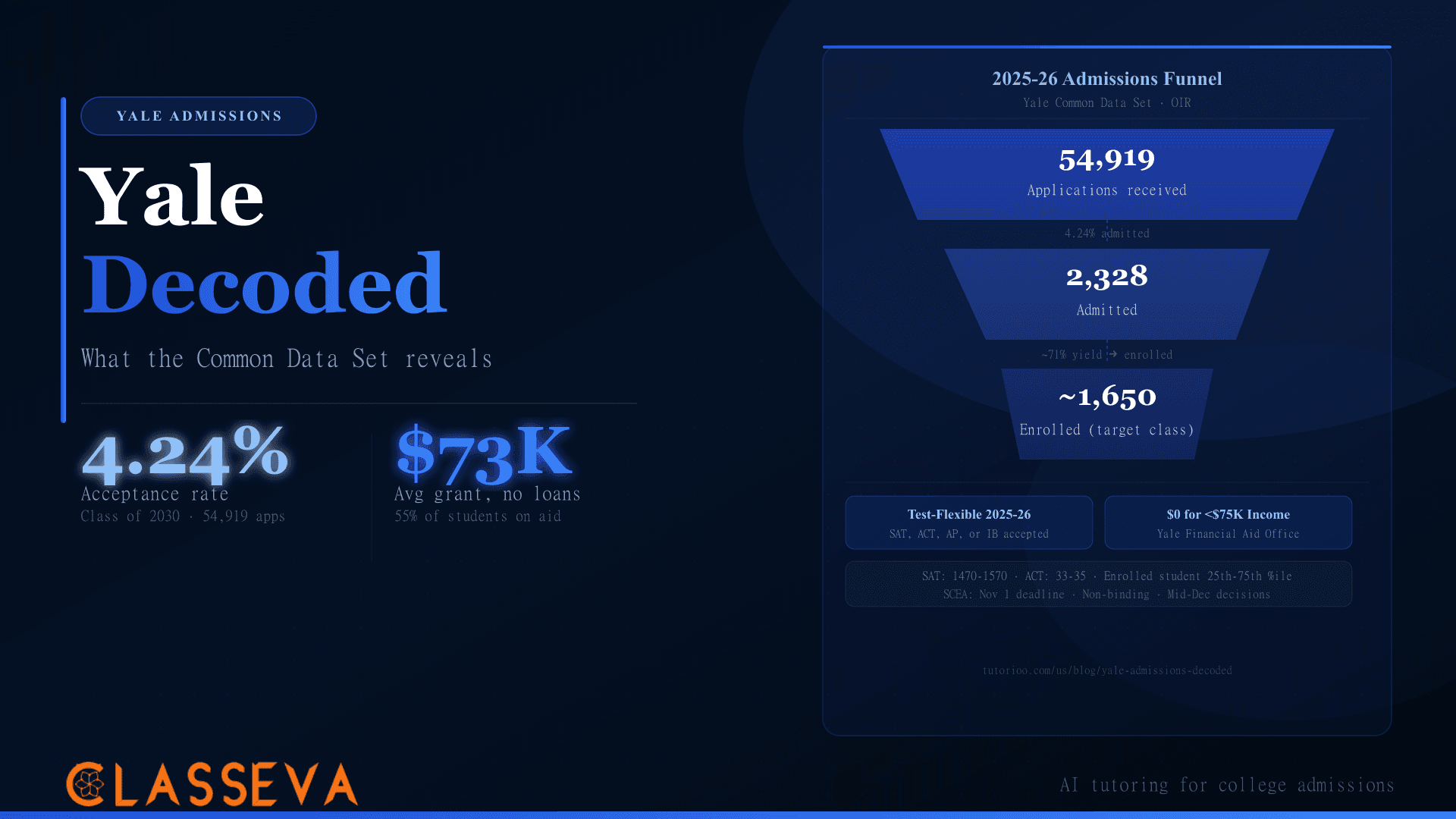
Yale admitted 2,328 students from 54,919 applicants for the Class of 2030, a 4.24% acceptance rate. The number alone doesn't explain what Yale actually values. What makes Yale worth studying specifically is its Single-Choice Early Action program, which differs from binding Early Decision and from a standard EA program in ways that reshape application strategy, and its test-flexible policy, which diverges from what Harvard and MIT reinstated in the same 2024 cycle. The Common Data Set from Yale's Office of Institutional Research reveals the full picture.
What Does It Actually Take to Get Into Yale?
Yale's holistic review weighs academic rigor, personal character, and extracurricular depth together. No single factor guarantees admission or rejection. The Common Data Set lists seven factors as Very Important: rigor of secondary school curriculum, academic GPA, application essays, letters of recommendation, character and personal qualities, extracurricular activities, and talent or ability. Standardized tests, despite strong score ranges among enrolled students, appear as Considered rather than Very Important under the test-flexible framework.
The Acceptance Rate in Context
A 4.2% acceptance rate sounds like a fixed ceiling. It isn't. The denominator matters: 54,919 applicants submitted materials to Yale for the Class of 2030, a 9.4% increase over the previous cycle and the second-largest pool in the university's history. Larger pools depress headline acceptance rates without necessarily changing what the admitted class looks like. Yale expanded its first-year class to approximately 1,650 students beginning with recent cohorts, which actually increased the number of admits even as the rate fell.
Demonstrated interest does not factor into Yale's decision. The CDS lists it as Not Considered. Emailing the admissions office or attending a Yale information session adds nothing to your application file, which matters for how you spend your senior fall.
The Class of 2030 in Numbers
Of the 2,328 admitted students, 779 received their offers in December through Single-Choice Early Action and 118 through the QuestBridge National College Match program. The remaining roughly 1,431 learned their decisions in late March during the Regular Decision round. Enrolled students represent all 50 states, two U.S. territories, and 75 countries, graduating from more than 1,650 secondary schools across 83 of Yale's undergraduate academic programs.
The Latest Yale Admissions Data
Yale participates in the Common Data Set initiative, publishing detailed admissions statistics through its Office of Institutional Research. The 2025-26 CDS, released in April 2026, covers the academic year ending spring 2026. Score ranges and admissions factor ratings below draw from that document and from Yale's published class profiles.
Test Score Ranges of Enrolled Students
The ranges below reflect enrolled first-year students, not admitted students. Enrolled medians run slightly below admitted medians because some top-scoring students chose other schools. The 25th-to-75th percentile band covers the middle half of the class; scoring at the 25th percentile doesn't disqualify an applicant, and scoring above the 75th doesn't guarantee admission.
| Test | 25th Percentile | 75th Percentile |
|---|---|---|
| SAT Evidence-Based Reading and Writing | 730 | 780 |
| SAT Math | 740 | 790 |
| SAT Composite (combined) | 1470 | 1570 |
| ACT Composite | 33 | 35 |
Source: Yale CDS 2024-25 and OIR SAT score data (W032). Enrolled first-year student ranges.
A combined SAT range of 1470-1570 places Yale's enrolled class squarely in the top 1-2% of all test-takers. The ACT range of 33-35 corresponds roughly to the 98th-99th percentile nationally. These figures reflect the self-selected applicant pool: most students who apply to Yale come with strong academic credentials, which is why factors beyond scores determine admission outcomes.
What Yale Weighs in Section C7
Section C7 of Yale's Common Data Set rates each admissions factor on a four-point scale. The ratings for the most recent CDS show where Yale concentrates its evaluation.
| Rating | Factors |
|---|---|
| Very Important | Rigor of secondary curriculum, Academic GPA, Application essays, Recommendations, Character/personal qualities, Extracurricular activities, Talent/ability |
| Important | First-generation student status |
| Considered | Standardized tests, Interview, Alumni/ae relation, Geographical residence, Racial/ethnic status, Volunteer work, Work experience |
| Not Considered | Demonstrated interest, Religious affiliation, State residency |
Source: Yale CDS Section C7, 2025-26. Standardized tests moved from Important to Considered following the 2024 test-flexible policy.
Yale explicitly does not consider demonstrated interest. Campus visits, information session attendance, and admissions office emails do not appear in your application file and have no bearing on the decision. Spend that energy on the essays instead.
Yale's Single-Choice Early Action Explained
Single-Choice Early Action is the aspect of Yale admissions that confuses applicants most often, partly because it shares characteristics with multiple early program types. It is non-binding, which students assume means unrestricted. It is not. The "single-choice" name signals the central constraint.
SCEA vs ED vs REA vs Regular EA
Four distinct early application frameworks exist in US college admissions, and Yale's sits at a specific point among them.
Early Decision (ED)
- •Binding: must attend if admitted
- •Must withdraw all other apps on admission
- •Used by most selective private schools
- •Restricts all simultaneous early apps
Yale SCEA / Harvard REA
- •Non-binding: may decline if admitted
- •Cannot apply EA or ED at private schools
- •Public school early programs allowed
- •Programs notifying after Jan 1 allowed
Harvard calls its version Restrictive Early Action (REA). Princeton also uses REA. Yale's SCEA follows functionally identical rules under a different name. All three are non-binding but restrict simultaneous applications to other private schools' early programs. A student cannot apply Yale SCEA and Harvard REA in the same cycle. They can apply Yale SCEA and then submit Regular Decision applications to Harvard, Princeton, or any other school in January.
Applying Yale SCEA does not prevent you from applying to public university early programs. University of Michigan Early Action, UC schools (which use a different timeline entirely), and comparable public institution early programs are all permitted alongside Yale SCEA.
Decision Timeline and Possible Outcomes
SCEA applicants submit by November 1 and receive one of three decisions in mid-December: admission, denial, or deferral. Denied SCEA applicants cannot reapply through Regular Decision in the same cycle. Deferred applicants enter the RD pool and receive final decisions in late March alongside all RD applicants. Yale states explicitly that it does not give an admissions advantage to SCEA applicants over RD applicants; the early round offers no statistical boost to odds of admission.
Yale's Test-Flexible Policy for 2026
Yale went test-optional during the pandemic years (2020-2024) and reinstated a standardized testing requirement in February 2024 for applicants starting with the 2025-26 cycle. But Yale's reinstatement differs from what Harvard and MIT did. Harvard and MIT returned to a standard SAT/ACT requirement. Yale introduced a broader test-flexible framework that accepts four different exam types as equivalent.
SAT, ACT, AP, and IB: What Yale Accepts
Any one of the following satisfies Yale's testing requirement: the SAT, the ACT, Advanced Placement exams, or International Baccalaureate exams. Yale does not prefer one type over the others. If you submit only AP or IB scores without any SAT or ACT, you must include all AP or IB exams you have completed prior to applying. Predicted IB scores do not count; only finalized results qualify.
| School | Testing Policy (2025-26 cycle) | Tests Accepted |
|---|---|---|
| Yale | Test-flexible | SAT, ACT, AP, or IB (all satisfy requirement) |
| Harvard | Test-required (reinstated) | SAT or ACT required |
| MIT | Test-required (reinstated) | SAT or ACT required |
| UC System | Test-blind | Scores never reviewed |
| Princeton | Test-required (reinstated) | SAT or ACT required |
Testing policies as of the 2025-26 application cycle. Yale's test-flexible approach is distinct from the standard test-required reinstatement at peer schools.
For most US applicants, submitting an SAT or ACT score remains the straightforward path. The AP and IB options primarily benefit international applicants whose secondary education is oriented around those exams rather than the SAT or ACT. For students who took many AP exams and scored well, submitting those scores alongside SAT scores is permitted but generally not necessary. See our full breakdown of test-optional vs test-required vs test-flexible policies at selective colleges for the broader landscape.
Yale's Supplemental Essays
Yale's supplemental writing load ranks among the heavier in the Ivy League. Beyond the Common Application personal statement, applicants complete eight discrete written components: three short answer questions, four short takes limited to 200 characters, and one main essay. The tight word limits force clarity and precision that longer prompts do not require.
Short Answers and Short Takes
The short answer section asks applicants to select up to three academic areas of interest from a menu, then respond to two follow-up prompts: a 200-word description of a topic or idea related to those interests, and a 125-word reflection on how their interests drew them to Yale. The four Short Takes appear only on the Common Application and Coalition Application versions of the Yale supplement, and each allows 200 characters (roughly 35 words).
The 125-Word Why Yale Essay
At 125 words, Yale's "why Yale" short answer is one of the tightest in Ivy admissions. CollegeVine has counted it among the most constraining supplemental prompts at any T20 school. The compression reveals something about the applicant: someone who has genuinely researched Yale writes 125 words about specific programs, named faculty, or particular aspects of the residential college system. Someone who has not researches the word count on "why Yale essay" templates instead.
The prompt asks how your interests, values, and experiences drew you to Yale specifically. Generic answers ("Yale's academic excellence and diverse campus community") waste all 125 words. Effective responses identify a specific Yale lab, seminar series, professor, or student organization and connect it directly to prior work the applicant has already done. That specificity signals genuine interest in a way that the admissions office can verify. For guidance on the broader Common App essay, see our breakdown of the 2026-27 Common App prompts.
Yale's Actual Cost: Financial Aid by Income
Yale's 2025-26 sticker price totals $90,550: tuition at $69,900 and housing plus meals at $20,650. Fifty-five percent of enrolled students pay less than that, often dramatically less. Yale meets 100% of demonstrated financial need for all admitted students, domestic and international, without including loans in the initial aid package.
What Families at Each Income Level Pay
Yale's financial aid scale is steeper than most families realize. The university draws on a $41 billion endowment to fund need-based grants averaging approximately $73,000 per student per year (2024-25 data). The aid is entirely grant-based; Yale does not include loans in initial aid offers, though families may opt into loan programs voluntarily.
Use the College Net Cost Estimator to run a personalized Yale cost estimate based on your family's financial profile. For families uncertain whether Yale is financially reachable, the Scholarship Probability Estimator provides additional context on merit and need-based aid likelihood across institutions.
Planning the application budget itself? The $80 application fee (fee waivers available for eligible students) fits into a broader strategy. See the FAFSA 2026-27 walkthrough for the financial aid application process that runs in parallel with college applications.
College Application Cost Calculator
Estimate the total cost of applying to Yale and your other target schools, including application fees, test sending costs, and optional extras.
How Yale Compares to Harvard
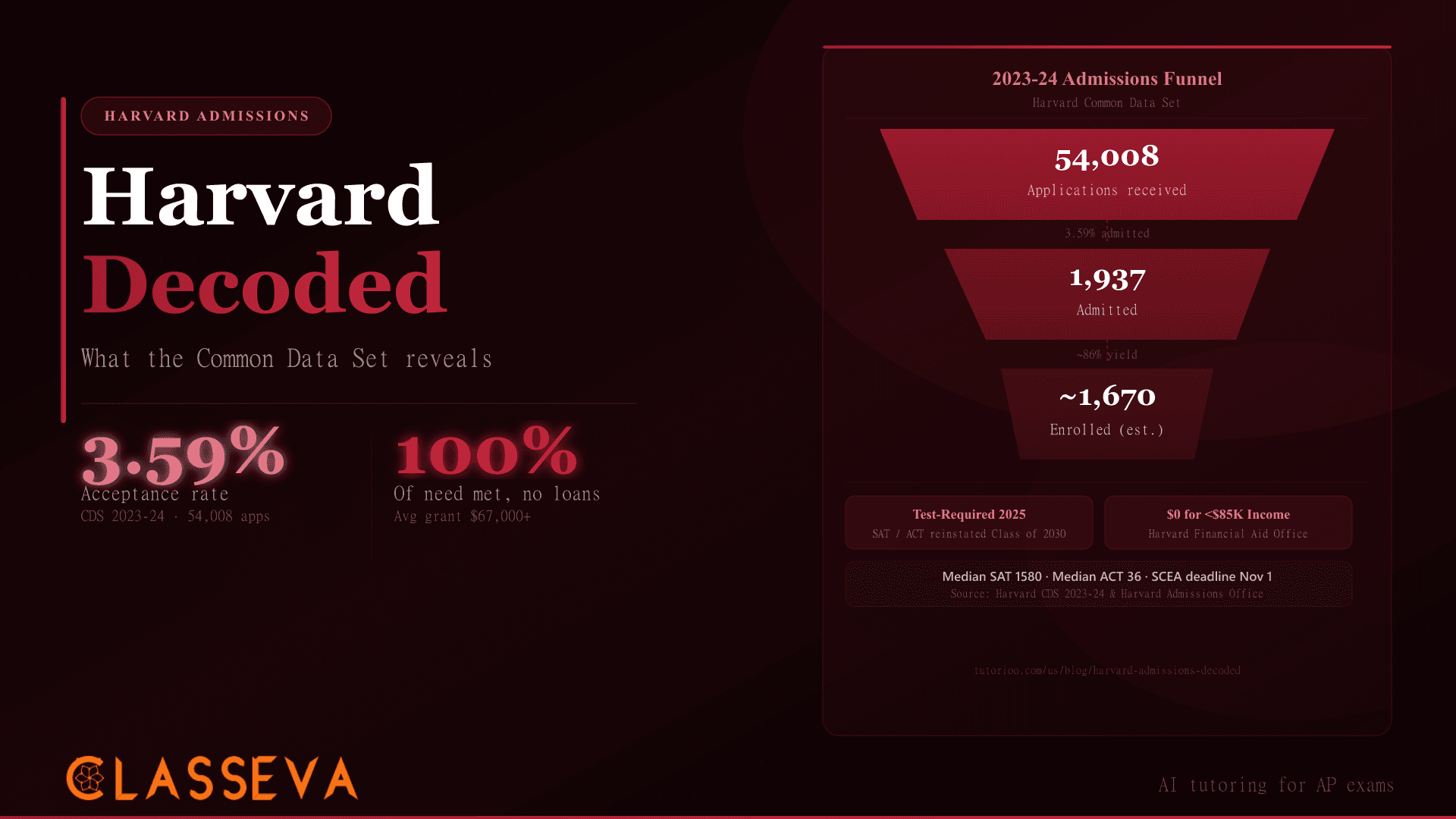
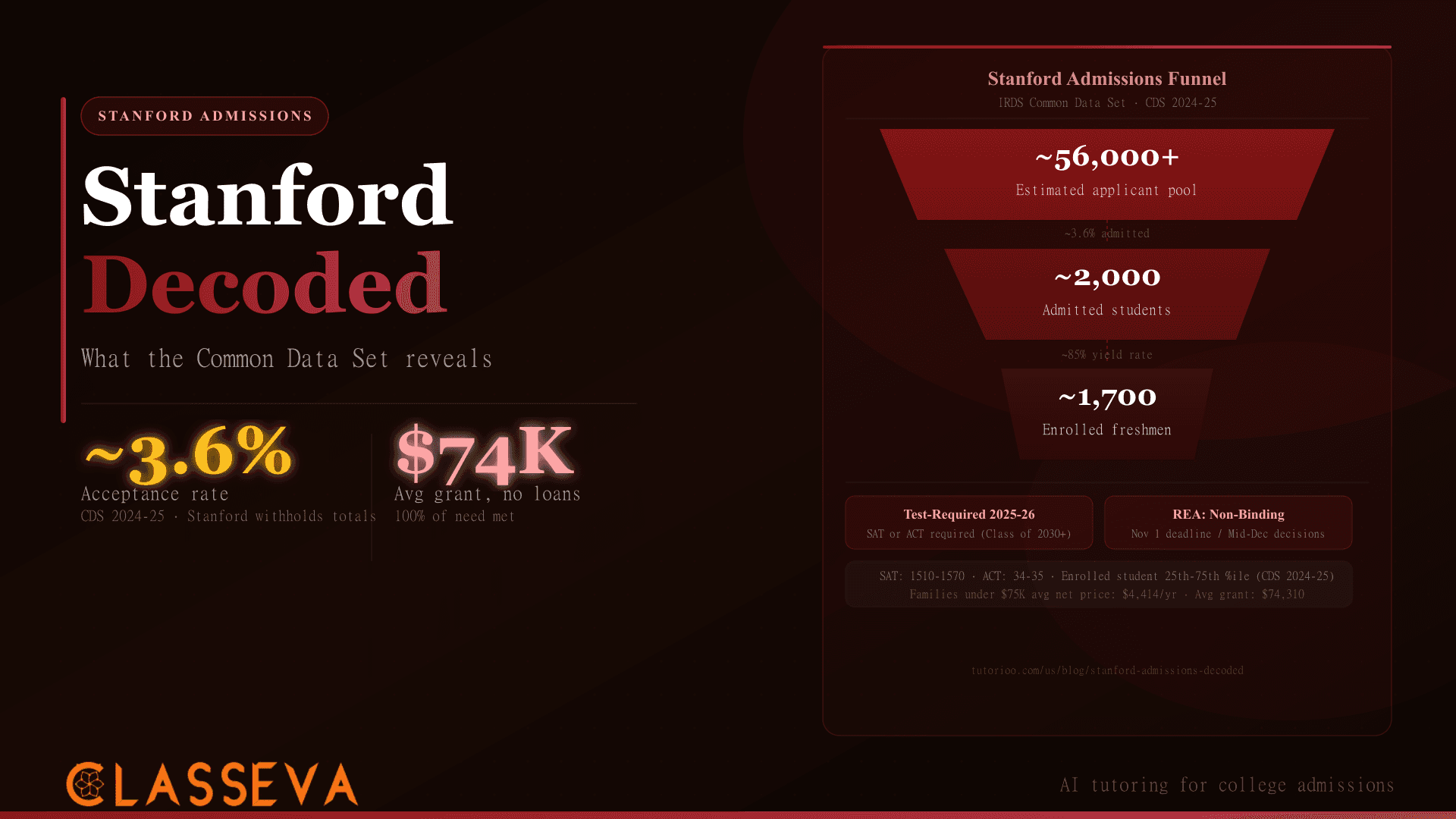
Yale and Harvard draw the most direct comparisons in Ivy admissions, and their early application structures are nearly identical. Both use non-binding restrictive early action programs. Both meet 100% of demonstrated financial need without loans. Both report acceptance rates in the 3.5-4.5% range and enroll roughly 1,600-1,750 students per class. The differences are real but narrower than applicants often assume.
| Factor | Yale | Harvard |
|---|---|---|
| Early program type | SCEA (Single-Choice Early Action) | REA (Restrictive Early Action) |
| Early program binding? | No | No |
| Acceptance rate (latest cycle) | 4.2% (Class of 2030) | ~3.6% (Class of 2029) |
| Test policy | Test-flexible (SAT, ACT, AP, IB) | Test-required (SAT or ACT) |
| Financial aid | 100% of need, no loans | 100% of need, no loans |
| Endowment (approx.) | ~$41 billion | ~$52 billion |
| Demonstrated interest | Not considered | Not considered |
Yale vs Harvard: key admissions and policy comparisons. Sources: Yale and Harvard Common Data Sets, university news releases.
The test policy difference is the most consequential for applicants who have strong AP or IB records but weaker SAT or ACT scores. Yale's test-flexible framework creates a path Harvard does not offer. Applicants who scored 5s across multiple AP exams but sat the SAT only once with a sub-1400 result have a distinct strategic reason to favor Yale's policy.
Yale's residential college system, which organizes all undergraduate life into 14 semi-autonomous colleges, also differs structurally from Harvard's house system. Both draw on similar endowments to fund comparable financial aid commitments. The choice between them belongs to the specifics of your academic interests, campus culture preferences, and which supplemental essay you can write more authentically. For broader context on selective admissions strategy, the College Admissions resources hub covers the full application process.
Key Takeaways
- Yale's acceptance rate for the Class of 2030 was 4.24%, drawn from 54,919 applicants, the second-largest pool in the university's history. The admitted class of 2,328 included 779 SCEA admits in December and 118 QuestBridge matches.
- Single-Choice Early Action is non-binding but restrictive. Applying Yale SCEA blocks simultaneous EA or ED applications at other private schools. Public university early programs, rolling admissions, and programs notifying after January 1 remain permitted. Yale states no statistical advantage for SCEA over RD applicants.
- Yale's test-flexible policy accepts SAT, ACT, AP, or IB exams. This diverges from Harvard and MIT, which reinstated standard SAT/ACT requirements in 2024. Applicants submitting only AP or IB scores must include all completed exams; predicted scores do not qualify.
- Seven admissions factors carry Very Important weight in Yale's CDS C7 rating. Demonstrated interest is Not Considered. Standardized tests appear as Considered, not Very Important, reflecting the test-flexible framework.
- Yale's supplemental writing load includes eight components beyond the Common App essay. The 125-word Why Yale answer and the four 200-character Short Takes demand precision that longer prompts allow applicants to avoid. Generic responses waste both word counts.
- Yale meets 100% of demonstrated financial need without loans. Families earning under $75,000 with typical assets pay nothing. The average grant for aid recipients in 2024-25 was approximately $73,000, covering most or all of the $90,550 sticker price for eligible families.
- Yale is need-blind for domestic applicants and need-aware for international applicants in admissions, but commits to meeting 100% of demonstrated need for all enrolled students regardless of citizenship or immigration status.
Frequently Asked Questions
What is Yale's acceptance rate for the most recent cycle?
Yale admitted 2,328 students from 54,919 applicants for the Class of 2030, an acceptance rate of approximately 4.2%. That pool was the second-largest in Yale's history, up 9.4% from the previous cycle. The overall acceptance rate has been between 4% and 5% for several consecutive years.
Does Yale require the SAT or ACT?
Yale uses a test-flexible policy, not a standard test-required policy. Applicants may submit SAT or ACT scores, but Advanced Placement or International Baccalaureate exam scores also satisfy the requirement. Applicants who submit only AP or IB scores must include all completed exams. Yale permits superscoring on both the SAT and ACT.
What is Single-Choice Early Action at Yale?
Single-Choice Early Action (SCEA) is Yale's early admissions program. It is non-binding, meaning an admitted student may still decline the offer. It is restrictive, meaning applicants cannot simultaneously apply Early Decision or Early Action at other private colleges. The deadline is November 1, with decisions released in mid-December.
Can I apply to other schools if I apply Yale SCEA?
Yes, with restrictions. You may not apply Early Decision or Early Action to other private schools. You may apply to public universities' early programs, rolling admissions programs, any program that notifies after January 1, and institutions outside the United States. Regular Decision applications to any school are also permitted.
How many supplemental essays does Yale require?
Yale's application includes three short answer questions (academic interests; a 200-word topic response; a 125-word why Yale essay), four short takes limited to 200 characters each, and one main essay chosen from three prompts at 400 words maximum. That is eight discrete written components beyond the Common App personal statement.
What GPA do you need for Yale?
Yale does not publish an average GPA for admitted students, and the CDS does not report a class-rank median. Nearly all enrolled students graduated from high school with grades near the top of their class. Yale's CDS rates academic GPA and rigor of curriculum as Very Important factors, placing them among the most weighted elements of the holistic review.
Is Yale need-blind for international students?
Yale is need-blind for U.S. citizens and eligible non-citizens, meaning financial need plays no role in the admissions decision for domestic applicants. For international applicants, Yale is need-aware in the admissions process, though Yale commits to meeting 100% of demonstrated financial need for all enrolled students regardless of citizenship or immigration status.
When does Yale release admissions decisions?
Single-Choice Early Action decisions arrive in mid-December. Regular Decision applicants receive decisions in late March, typically around the last week of the month. The reply deadline for all admitted students is May 1. Deferred SCEA applicants are reconsidered in the Regular Decision round alongside new RD applicants.
Admissions data sourced from Yale News (March 2026, Class of 2030) and the Yale Office of Institutional Research Common Data Set. Financial aid figures from Yale Undergraduate Financial Aid. SCEA policy from Yale Admissions SCEA page. Essay prompts from Yale Admissions essay topics page (2025-26 cycle). Test policy from Yale Admissions standardized testing page. Last verified: May 17, 2026.