Harvard Admissions Decoded: What the Common Data Set Reveals
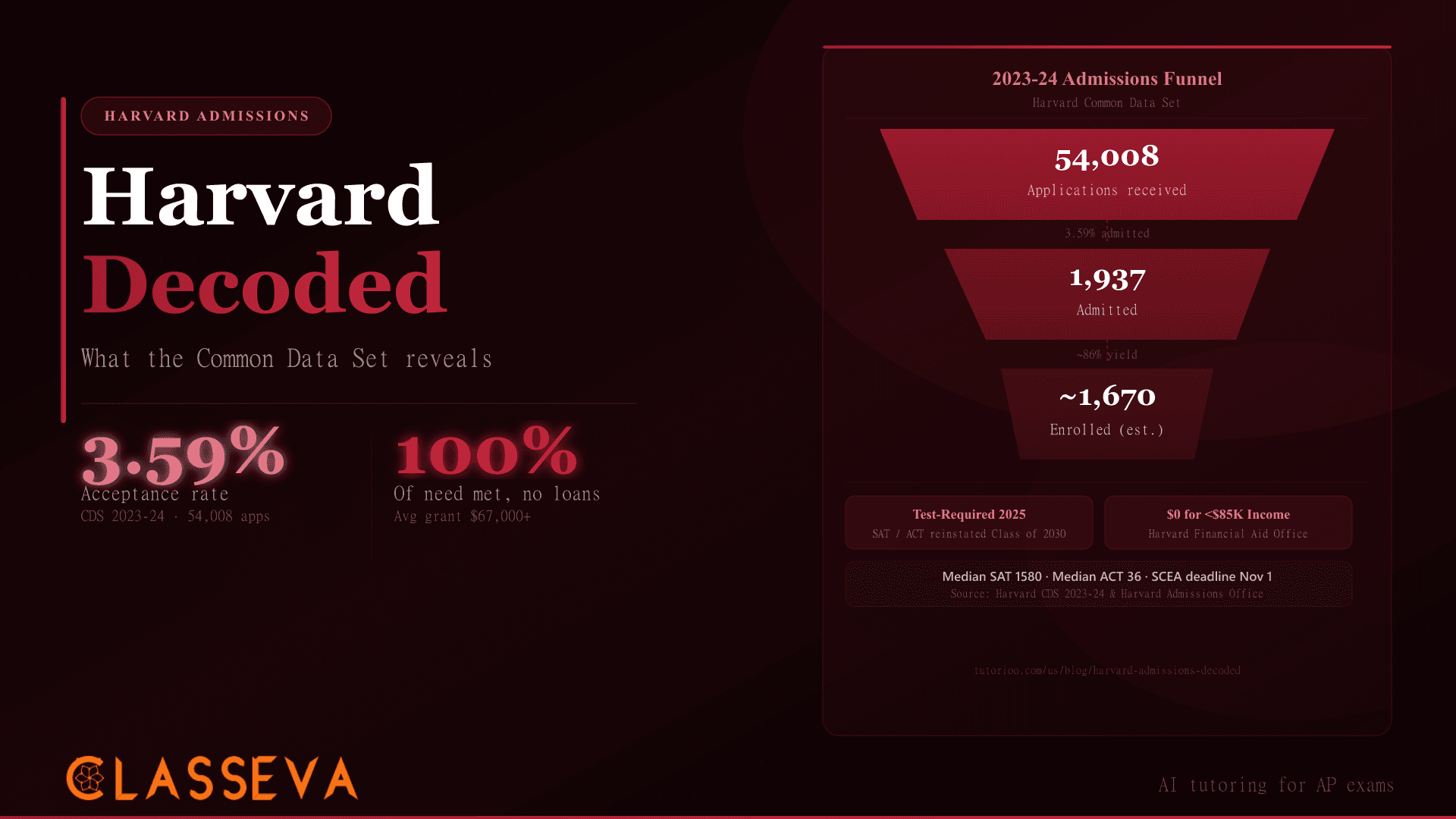
The number that stops most families: Harvard received 54,008 applications for the Class of 2028 and admitted 1,937 students. That 3.59% acceptance rate comes directly from Harvard's Common Data Set 2023-24. What fewer families notice, sitting one page deeper in the same document, is the financial aid guarantee: Harvard commits to meeting 100% of every admitted student's demonstrated financial need, with no loans required. The school families assume is unaffordable often costs less than a state flagship for middle-income households.
What Does It Take to Get Into Harvard?
Getting into Harvard requires academic performance in the top fraction of a percent nationally, a compelling personal narrative, and meaningful engagement outside the classroom. No single factor determines admission. The data from Harvard's own publications make the academic floor clear, even if they cannot define a ceiling.
The Academic Bar
The mid-50% SAT score range for enrolled Harvard students runs 1500-1600. The mid-50% ACT composite runs 34-36. Both figures come from Harvard's published admissions statistics. Most admitted students rank among the top 1-3% of their high school class academically, though Harvard regularly admits students from schools that do not calculate class rank at all.
| Test | 25th Percentile | 75th Percentile |
|---|---|---|
| SAT Composite | 1500 | 1600 |
| SAT Reading and Writing | 730 | 800 |
| SAT Math | 770 | 800 |
| ACT Composite | 34 | 36 |
Source: Harvard Common Data Set 2023-24, Section C9. Figures represent enrolled Class of 2028 students.
These ranges describe the middle half of enrolled students. The upper bound of the SAT range is 1600, the maximum possible score, meaning the top quarter of enrolled Harvard students achieved a perfect SAT composite. The lower bound is not a hard cutoff. Harvard regularly admits students below these ranges when the rest of the application is exceptional.
The Holistic Review Reality
Scoring a 1600 on the SAT does not meaningfully change a student's odds at Harvard. Among applicants with near-perfect test scores, the acceptance rate still sits in the single digits, roughly consistent with the overall pool. Admission for these students turns entirely on the non-academic dimensions of the application.
Harvard rejects roughly 96 out of every 100 applicants. Most rejected students are academically qualified. The differentiating review happens among qualified applicants, not between qualified and unqualified ones. Academic strength earns a read; what happens in that read determines the outcome.
That framing reshapes how to allocate effort. Students who believe the path to Harvard runs through test scores alone misread what the review process does with those scores. Harvard's own factor weighting, published in the CDS, lists seven factors as "Very Important" and only two as "Important." Test scores do not appear on the list by name; they feed into the "Academic GPA" and "Rigor of secondary school record" buckets alongside everything else Harvard collects.
The Latest Harvard Admissions Data
Acceptance Rate and Class Size
Harvard's acceptance rate has compressed steadily over the past two decades. In 2004, roughly 10% of applicants were admitted. By 2014, the rate had dropped below 6%. The Class of 2028 cycle closed at 3.59%. The declining rate reflects growing application volume rather than a shrinking class: Harvard enrolls roughly 1,650-1,700 students per year, a figure that has stayed nearly constant while the applicant pool has more than doubled.
Class Profile by the Numbers
The CDS provides a snapshot of the enrolled class. Academic performance concentrates at the very top of the national distribution. Geographic and demographic diversity is a stated institutional priority, with Harvard drawing enrolled students from all fifty states and over 80 countries annually.
| Metric | Class of 2028 |
|---|---|
| Total applicants | 54,008 |
| Students admitted | 1,937 |
| Acceptance rate | 3.59% |
| Mid-50% SAT composite | 1500-1600 |
| Mid-50% ACT composite | 34-36 |
| Students from top 10% of HS class | Approximately 95% |
| International students (enrolled) | Approximately 12-14% |
| States represented | All 50 |
Source: Harvard Common Data Set 2023-24. Enrolled figure and some percentages are approximate based on published Harvard data.
What Harvard Actually Looks For
Harvard's CDS Section C7 publishes how the school weights each admissions factor. The categories run: Very Important, Important, Considered, and Not Considered. Most published analyses of Harvard admissions skip the CDS and rely on inference. The document says something specific, and the "Not Considered" column is as informative as the "Very Important" one.
Academic Factors per the Common Data Set
The seven "Very Important" factors span both academic and personal dimensions. Rigor of course selection weighs separately from GPA, reflecting Harvard's preference for students who push the boundaries of what their school offers. A student with a 3.95 GPA in a full International Baccalaureate curriculum typically reads differently than one with the same GPA from a lighter schedule. Both the level of challenge and the performance within that challenge receive independent consideration.
Non-Academic Factors and What Is Missing
The "Not Considered" column in Harvard's CDS deserves direct attention. Harvard explicitly does not factor in demonstrated interest. Attending Harvard's information session, scheduling a campus tour, or emailing an admissions officer has zero documented weight in the decision. This contrasts with a significant number of selective schools where demonstrated interest moves the needle measurably.
Campus visits, virtual info sessions, and admissions officer contact do not improve a Harvard application. The CDS confirms demonstrated interest is not considered. Channel that time toward essays and recommender conversations instead.
Legacy status has a more complicated history at Harvard. The school has faced legal scrutiny over legacy preferences and, as of the 2023-24 cycle, was actively reviewing its legacy admissions policies. Harvard's official CDS documentation does not classify legacy connections as a formal admissions factor in any of the standard weighting categories.
Application Strategy for Harvard
Harvard presents two application rounds: Single Choice Early Action (SCEA) and Regular Decision. Both rounds receive a full application review. Neither is numerically easier to get into based on published data alone, though early-round acceptance rates at highly selective schools have historically run several percentage points higher than the overall rate.
SCEA vs Regular Decision
Single Choice Early Action
- •Non-binding: you may decline the offer of admission
- •November 1 deadline; decisions released in mid-December
- •Restricts simultaneous Early Decision applications to other schools
- •Allows non-binding Early Action applications to non-restrictive schools
- •Historically carries a slightly higher acceptance rate than RD
- •Best for students with Harvard as a clear first choice by October
Regular Decision
- •Non-binding
- •January 1 deadline; decisions released in late March
- •No restrictions on other applications in any round
- •Six additional weeks to strengthen senior-year academic record
- •Same application requirements as SCEA
- •Best when you need more time or want full application flexibility
Apply SCEA only if Harvard is genuinely your first choice and your application is as strong as it will be by November. If you are still developing your senior-year academic record or finishing application materials, RD gives you six more weeks with no cost to your Harvard chances. The application itself does not change between rounds.
Across a full list of 10-15 schools, application fees accumulate quickly. The College Application Cost Calculator helps budget across reach, match, and safety schools before you commit to a submission strategy.
College Application Cost Calculator
Harvard's $85 application fee is one line item on a longer list. Model your full application budget across your complete school list before submitting.
Harvard's Supplemental Essays for 2026
Harvard's supplement sits inside the Common Application and changes slightly year to year. For recent cycles, it has required short-answer responses covering intellectual experiences, the most meaningful extracurricular activity, and what the applicant would contribute to Harvard's community. Each question typically allows 200-400 words. The exact prompt list for each cycle is finalized and published on the Common App platform each August.
The essay strategy that separates strong applications from excellent ones applies at Harvard as clearly as anywhere: write about something specific rather than something impressive. Admissions officers read thousands of essays about varsity team leadership, community service trips, and academic competitions. They read far fewer about a specific insight from a chemistry lab, a community conversation that shifted the applicant's thinking, or a self-taught skill built for a particular and genuine reason.
Read all Harvard supplement prompts in August
The Common App platform releases updated supplements each August. Read the full prompt set before drafting anything. Knowing all prompts prevents writing toward one question when a later prompt would have been the stronger fit for your best material.
Write toward specificity, not impressiveness
Harvard readers are practiced at identifying essays that perform rather than reveal. A specific, honest essay about a modest interest outperforms a vague essay about a prestigious one. Ask yourself: could only you write this? If not, rewrite until the answer becomes yes.
Address your fit with Harvard specifically
At least one prompt addresses what you would contribute or what draws you to Harvard. Research specific programs, professors, student organizations, and academic resources. Generic answers that could apply to any selective school signal a lack of genuine engagement with Harvard itself.
Brief recommenders with specific examples
Harvard's review committee reads the complete file together. Strong letters address intellectual engagement and character that grades and test scores cannot capture. Prepare your recommenders with concrete examples they may not have written about otherwise.
For a detailed breakdown of the Common App personal statement (the 650-word essay that anchors every application), the Common App Essay Prompts 2026-27 guide covers all seven prompt options with specific examples of what resonates in competitive review.
Does Harvard Require the SAT or ACT?
Yes. Harvard reinstated standardized testing requirements for the 2025-26 application cycle, applying to students entering fall 2026 (the Class of 2030). Students who applied during Harvard's pandemic-era test-optional period were exempt; students applying for fall 2026 admission or later must submit official scores. The requirement is published on Harvard's application requirements page.
Both SAT and ACT are accepted without preference. Harvard superscores the SAT, using the highest section score from each sitting date across all attempts. If you took the SAT twice and scored 740 Reading/Writing in one sitting and 800 Math in another, Harvard considers 1540, not the scores from a single test date. The Digital SAT's adaptive structure means your section score is influenced by which module difficulty you received, a factor worth understanding before your final prep sprint.
Harvard is one of the schools that reversed course on test-optional admissions after reviewing internal data on the predictive validity of standardized tests. The test-optional policies breakdown tracks where each major selective institution currently stands and what the policy research actually shows.
Harvard Financial Aid: What It Actually Costs
Harvard's financial aid program is one of the most generous at any university in the country. The school pledges to meet 100% of every admitted student's demonstrated financial need, with no loans in any aid package. Every dollar of Harvard's financial aid award takes the form of a grant. That commitment is published in detail on Harvard's financial aid page and has been in effect for over fifteen years.
What Your Family Pays by Income Level
Harvard publishes income-based guidelines that describe typical family contributions at different earnings levels. These are estimates, not guarantees. Actual awards depend on specific family assets, other children in college, and circumstances disclosed on the CSS Profile.
Harvard's current policy guarantees that families earning $85,000 or less pay nothing toward tuition. Families earning between $85,000 and $150,000 pay roughly 0-10% of their income annually. A family earning $100,000 would typically pay $8,000-$14,000 per year at Harvard, compared to $30,000 or more at many state flagships after scholarship. The $82,000 sticker price (tuition, room, board, and fees) rarely reflects what a middle-income family actually pays.
How to Estimate Your Net Price
Harvard requires both the FAFSA and the CSS Profile to determine financial aid eligibility. The FAFSA establishes federal aid eligibility; the CSS Profile gives Harvard the detailed family finance picture it needs to calculate its institutional grant. Submit both as early as possible in October of senior year, regardless of which application round you plan to use.
For a step-by-step walkthrough of the FAFSA form itself, including the IRS Direct Data Exchange that shortens completion for most families, the FAFSA 2026-27 step-by-step guide covers the full sequence.
College Net Cost Estimator
Harvard's $82,000 sticker price says nothing about what your family actually pays. The net cost estimator factors in income and assets to project your realistic annual contribution.
The Scholarship Probability Estimatorcan help model whether merit aid at other institutions might match or beat Harvard's need-based offer, a comparison worth running if your family is full-pay and considering schools with strong merit programs.
What to Do If You're Below the Typical Range
A 1480 SAT with a 3.8 GPA and a compelling background is a genuinely strong application at most institutions in the country. It sits outside the middle range for Harvard admits. That framing should not discourage any applicant from applying to Harvard, but it should inform how you construct your full school list.
Harvard's selectivity means even academically exceptional students face long odds. Treat Harvard as a reach school on a balanced list that includes match schools (15-40% admit rates) and safety schools where admission is close to certain. The College Admissions resources hub maps the full landscape of selective schools across selectivity tiers, including schools with strong programs, generous financial aid, and genuine academic community.
Apply to Harvard if the school genuinely excites you and your application represents your strongest work. Build a list of 10-15 schools across selectivity ranges. At least two or three schools on your list should be ones where admission feels close to guaranteed, regardless of how strong your Harvard application is.
Students who fall below Harvard's median profile can also consider the transfer path. Harvard admits a small number of transfer students annually, primarily from two-year institutions and community colleges. Transfer admission is similarly selective, but the review process differs from first-year admission and opens a distinct path for students who build exceptional records after high school graduation.
Key Takeaways
- Harvard's acceptance rate for the Class of 2028 was 3.59%, with 1,937 admitted from 54,008 applicants. The rate has declined every decade for twenty years.
- Harvard is test-required starting with the 2025-26 application cycle. Both SAT and ACT are accepted. The SAT is superscored. Mid-50% range: 1500-1600 SAT composite, 34-36 ACT composite.
- Seven factors are listed as "Very Important" in the CDS, spanning academic rigor, essays, recommendations, extracurriculars, and character. Demonstrated interest is explicitly not considered.
- Harvard uses Single Choice Early Action, a non-binding early round that restricts simultaneous Early Decision applications to other schools. SCEA deadline: November 1. RD deadline: January 1.
- Harvard meets 100% of demonstrated financial need for every admitted student with no loans. Families earning under $85,000 typically pay nothing. The CSS Profile is required in addition to the FAFSA.
- Harvard is need-blind for both domestic and international students, one of very few schools with this commitment for both populations.