Common App Essay Prompts 2026-27 Decoded
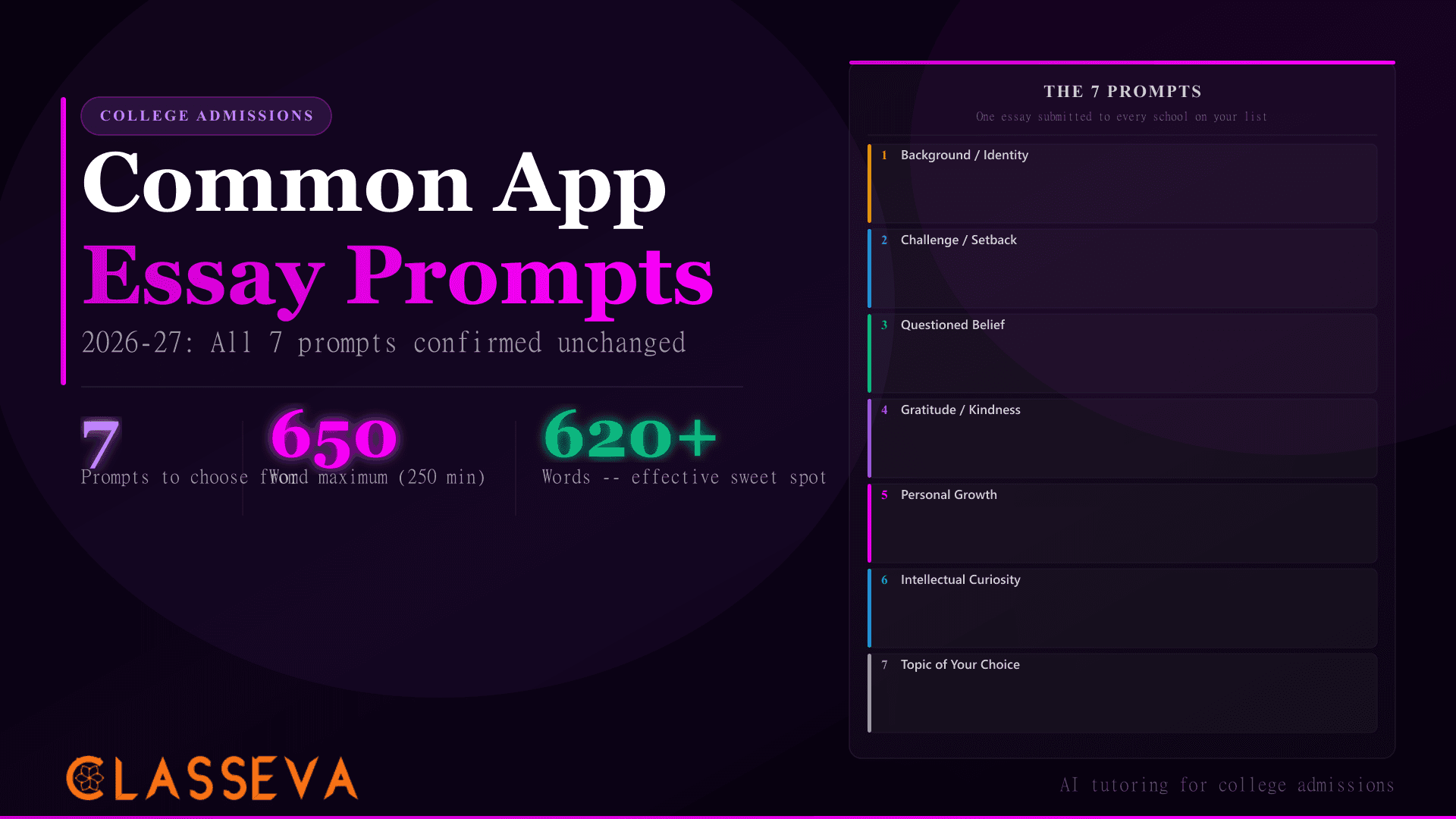
The 7 Common App essay prompts for 2026-27 are the same seven that have held since 2022. The Common Application confirmed no changes on February 27, 2026. That stability is worth noting because it runs against a common student instinct: many applicants wait to start writing until they see the new prompts, expecting something to shift. Nothing shifted. Start now.
What does make 2026-27 slightly different is the Additional Information section, which now carries a broader Challenges and Circumstances prompt with a tighter 300-word cap (down from 650). That is not the main essay. The main Common App personal essay still runs 250-650 words, and admissions officers still read every word of it.
What Are the Common App Essay Prompts for 2026-27?
The Common App personal essay offers seven prompt options. Students select one and write a single 250-650 word essay submitted to every school on their Common App list. Below are the exact prompts for the 2026-27 cycle.
The Official Seven Prompts
| # | Theme | Prompt Text |
|---|---|---|
| 1 | Background / Identity | Some students have a background, identity, interest, or talent that is so meaningful they believe their application would be incomplete without it. If this sounds like you, then please share your story. |
| 2 | Challenge / Setback | The lessons we take from obstacles we encounter can be fundamental to later success. Recount a time when you faced a challenge, setback, or failure. How did it affect you, and what did you learn from the experience? |
| 3 | Questioned Belief | Reflect on a time when you questioned or challenged a belief or idea. What prompted your thinking? What was the outcome? |
| 4 | Gratitude | Reflect on something that someone has done for you that has made you happy or thankful in a surprising way. How has this gratitude affected or motivated you? |
| 5 | Personal Growth | Discuss an accomplishment, event, or realization that sparked a period of personal growth and a new understanding of yourself or others. |
| 6 | Intellectual Curiosity | Describe a topic, idea, or concept you find so engaging that it makes you lose all track of time. Why does it captivate you? What or who do you turn to when you want to learn more? |
| 7 | Topic of Choice | Share an essay on any topic of your choice. It can be one you have already written, one that responds to a different prompt, or one of your own design. |
Source: commonapp.org, confirmed for 2026-27 cycle
What Changed for the 2026-27 Cycle
The seven main prompts are unchanged. The change sits in a separate section of the application: the Additional Information area now carries a distinct Challenges and Circumstances prompt and caps responses at 300 words (previously 650). Students who want to explain a significant obstacle, disruption, or circumstance that affected their academic record should use that space rather than writing about hardship in the main essay, which is better suited to stories about identity, growth, or curiosity.
The Common App personal essay requires a minimum of 250 words and a maximum of 650 words. The platform blocks submissions over 650 words. Essays under 600 words risk signaling to admissions officers that a student did not fully engage with the prompt. Aim for 620-650.
How Do You Pick the Right Common App Prompt?
The prompt you choose does not matter as much as most students think. Admissions officers at selective colleges read essays written on all seven prompts every cycle, and the ones they remember are the ones with a specific, vivid story, regardless of which prompt it technically answered. What the prompt selection does is give you a frame. Choose the frame that makes your best story the most natural fit.
A Simple Self-Selection Test
Before picking a prompt, list three to five specific moments or scenes from your life that feel meaningful enough to write 650 words about. Do not start with the prompts. Start with the story. Then read the seven prompts and ask: which prompt gives this story the clearest home?
If no prompt fits well, Prompt 7 (Topic of Your Choice) exists precisely for that situation. If three prompts fit equally well, pick the one whose wording most closely matches the emotional core of the story you want to tell. Prompt 2 is not only for overcoming tragedy; it works for any moment where something went wrong and you learned from it. Prompt 5 is not only for dramatic realizations; it works for quiet shifts in how you see yourself or others.
How to Approach Each Common App Prompt
Below is a breakdown of all seven prompts: what admissions officers expect to see, which student types the prompt suits best, and the most common mistake applicants make with each one.
Prompt 1: Background, Identity, Interest, or Talent
Some students have a background, identity, interest, or talent that is so meaningful they believe their application would be incomplete without it.
Prompt 1 is the most open-ended of the structured prompts. It covers four distinct categories (background, identity, interest, talent) and works best when the student has something specific, not abstract, to anchor the essay. A first-generation college student writing about navigating two cultures is using this prompt correctly. A student writing "I have always been passionate about helping others" is not.
The pitfall with Prompt 1 is identity inflation: students overgeneralize ("My immigrant family taught me resilience") instead of finding the specific scene that shows the identity in action. Admissions officers have read tens of thousands of resilience essays. The ones that land do not tell the reader the student is resilient. They show a single moment where that trait was tested.
If you are choosing Prompt 1, write down the single most specific moment that captures your background or identity. Not the theme. The moment. That specific scene should be your opening paragraph.
Prompt 2: Challenge, Setback, or Failure
The lessons we take from obstacles we encounter can be fundamental to later success.
Prompt 2 is the most popular prompt for students who overcame a significant hardship. It is also the most commonly misused. The prompt explicitly asks about what the student learned, not what the student suffered. Essays that spend 500 of their 650 words on the challenge itself and only 150 words on the lesson tend to read as trauma narratives, which is not what admissions officers are evaluating. They are evaluating character.
A Prompt 2 essay does not require a dramatic setback. A failed chemistry experiment that forced a sophomore to rethink how she studied can produce a stronger essay than a year of illness, if the reflection is genuine and specific. The challenge is the setup. The growth is the essay.
Prompt 3: Questioning a Belief or Idea
Reflect on a time when you questioned or challenged a belief or idea.
Prompt 3 attracts students with intellectual confidence and draws out some of the strongest analytical writing in the Common App pool. It also draws out the most politically risky essays when students mistake "challenging a belief" for "arguing a political position."
The prompt asks about the process of questioning, not the conclusion. A strong Prompt 3 essay shows a student who encountered a belief they held (or their community held), experienced a specific moment of doubt, and worked through that doubt to a more nuanced position. The belief challenged could be academic, personal, cultural, or intellectual. It does not have to be controversial to be compelling.
Prompt 4: Gratitude and Unexpected Kindness
Reflect on something that someone has done for you that has made you happy or thankful in a surprising way.
Prompt 4 is the least-chosen of the seven and produces some of the most memorable essays when executed well. The word surprising in the prompt is doing heavy lifting: the person or act of kindness should genuinely catch the reader off guard. An essay about a parent's sacrifice is sincere, but it is not surprising. An essay about a stranger's ten-second comment that redirected a student's entire senior year has the element of unexpectedness the prompt calls for.
The trap with Prompt 4 is that it can shift focus onto the person who showed kindness rather than onto the student. The prompt asks how this gratitude affected or motivated the writer. Center the response on your own transformation, not on the other person's character.
Prompt 5: Personal Growth and New Understanding
Discuss an accomplishment, event, or realization that sparked a period of personal growth and a new understanding of yourself or others.
Prompt 5 is essentially the narrative arc prompt. It works best for students with a clear before-and-after story: who they were before the event, what the event was, and who they became after it. "Period of personal growth" is important: the change should be ongoing, not a single resolved moment. An accomplishment that ends in a trophy and no further reflection does not fit this prompt. A realization that re-oriented a student's relationship with failure, creativity, or community does.
Prompt 6: Intellectual Curiosity
Describe a topic, idea, or concept you find so engaging that it makes you lose all track of time.
Prompt 6 is tailor-made for students who have pursued a subject, idea, or question with genuine depth outside of class. Students considering STEM majors who have spent nights reading mathematics papers, students who became fluent in a programming language to build something specific, students who traced their family history through archival records; these are Prompt 6 students. The prompt asks not just what captivates you but why and how you pursue it independently.
The pitfall is listing hobbies rather than showing obsession. "I love reading" is a topic. "I spent six months building a corpus of 19th-century medical texts to understand how terminology shifted with germ theory" is an intellectual engagement. The second version reveals a student with genuine scholarly instincts. If you gravitate toward Prompt 6 but your answer feels broad, it probably belongs in Prompt 5 or Prompt 1 instead.
For students who tie their intellectual curiosity to their AP coursework, the AP resources hub offers context on how AP courses signal academic depth to admissions offices.
Prompt 7: Topic of Your Choice
Share an essay on any topic of your choice.
Prompt 7 consistently ranks as the most-chosen prompt in recent cycles. That popularity reflects a generation of students who have already written college essays through prep courses, English classes, or summer programs. It also reflects the trap: many students choose Prompt 7 because they cannot decide among the other six, not because their story genuinely does not fit any of them. Prompt 7 is strongest when a student has a specific, unusual story that would feel forced under any other framing. If your story fits Prompt 2 or Prompt 5 reasonably well, use the structure of those prompts.
What Do Admissions Officers Actually Look For?
Admissions officers at selective colleges read between 1,500 and 2,500 essays per cycle. They read fast. The essays that slow them down (the ones they discuss in committee) share three traits: a specific opening moment, a voice that sounds like an actual teenager rather than a writing consultant, and a reflection that shows genuine self-awareness rather than a lesson-learned formula.
The Voice Test
Yale's admissions guidance is direct on this point: "If an essay doesn't sound like the person who writes it, it cannot serve very well as a personal statement." Stanford's guidance echoes the same theme, encouraging applicants to "allow your genuine voice to come through" because the essay is designed to help the admissions team "get to know you as a friend, future roommate, and classmate." Both offices are describing the same thing: the essay should read as if the student is speaking, not as if a writing coach has smoothed every rough edge.
The practical test: give your draft to a family member who knows you well, without telling them what the essay is about. Ask them if it sounds like you. If they hesitate, revise until it does. Admissions officers run a version of this test in their heads with every essay they read. They check it against the voice in the activity descriptions and against what teachers wrote in recommendation letters.
Why AI-Written Essays Fail
Building Classeva, I work with AI language models every day. The detection problem for AI-written essays is not a software problem. It is a specificity problem. AI-generated prose tends toward grammatical perfection, thematic generality, and a rhythm that never stumbles, never pauses, never sounds like a 17-year-old who just ran out of time in fourth period and is trying to explain something they actually care about.
What AI cannot replicate is the idiosyncratic detail: the specific brand of headphones you wore during that chemistry exam, the exact way your grandmother held the spatula when she taught you the dish, the phrase your coach used that stuck in your head for three years. Those details live only in your memory. They are also the details that make an admissions officer look up from the page.
Asking an AI to write a draft and then editing it does not solve the specificity problem. The structure and rhythm of AI prose are recognizable even after surface edits. Use AI to brainstorm topics or check grammar, not to generate the voice or the story.
Common Pitfalls That Weaken Any Common App Essay
Pitfall: Writing About a Theme
- •Leads with an abstract lesson rather than a specific scene
- •Opens with a definition, a quote, or a general statement
- •Could have been written by any student in any state
- •Admissions officer finishes reading and cannot picture the applicant
What Works Instead
- •Opens with a specific scene the reader can visualize
- •Names specific people, places, or objects
- •The reflection grows organically from the scene
- •Admissions officer closes the essay knowing one true thing about this person
Beyond the theme-versus-moment problem, three other pitfalls appear across nearly every admissions cycle.
The Formulaic Closing
Essays that end with "I look forward to bringing this experience to [college]" or "I know college will help me grow further" waste the final 50 words. The bridge should be specific: what you plan to study, build, join, or change, grounded in what the essay revealed about you.
The Obituary Draft
Listing achievements, positions held, and awards won in narrative form is a resume, not an essay. Admissions officers already have the Activities section. The essay should reveal who the student is behind the list, not repeat it.
Starting with a Quote
Opening with "As [famous person] once said..." signals that the student ran out of ideas before writing the first sentence. The most memorable essay openings start in a moment the applicant lived, not in someone else's words.
Estimating Your Application Costs
The essay is one part of an application that carries real financial weight. Common App member schools charge application fees ranging from $50 to $100 per school. Applying to 10-15 schools at an average of $75 per application runs $750 to $1,125 in fees alone, before test score sends, SAT Subject Tests, or other costs. Students from lower-income families can apply for Common App fee waivers, but most students pay full fees for at least some schools.
The community college pathway and the UC system both carry different cost structures worth understanding before finalizing a school list. For scholarships that offset application costs and first-year tuition, the Scholarship Probability Estimator generates a personalized estimate based on GPA, test scores, and intended major.
College Application Cost Calculator
Application fees add up quickly across 10-15 colleges. The College Application Cost Calculator estimates your total application costs based on your school list, including Common App fees, SAT score sends, and test registration.
Key Takeaways
- The 7 Common App essay prompts for 2026-27 are unchanged. The Common App confirmed no changes on February 27, 2026.
- The essay runs 250-650 words. Aim for 620-650. Essays under 600 words read as incomplete to admissions officers who deal in character-limited evidence every day.
- Pick the prompt that makes your best story the easiest to tell, not the prompt that sounds most impressive or most serious.
- Admissions officers evaluate voice, specificity, and genuine reflection. Yale, Stanford, and Princeton all anchor their guidance on the same quality: the essay must sound like the person who wrote it.
- AI-generated prose fails a specificity test: it lacks the idiosyncratic sensory details that only exist in the writer's actual memory. Use AI to brainstorm or check grammar, not to write the story.
- Plan for three to five drafts across May through October if applying Early Decision or Early Action. Students who wait until October to start the first draft submit essays that read like first drafts.
- Application fees for 10-15 schools average $750-$1,125. Factor that cost into your school list strategy and research Common App fee waivers early.