Community College to 4-Year Transfer: When It Works
Looking at Common Data Set Section D entries across dozens of universities, one pattern stands out immediately: the community college transfer path ranges from a near-guarantee to a near-impossibility, depending entirely on which schools you target. UCLA admits roughly 23% of transfer applicants while admitting only 9% of first-year applicants. Harvard admits less than 1% of transfer applicants. The choice of whether to start at community college is, in practice, inseparable from the choice of which four-year school you ultimately want to attend.
The headline savings number is real. Two years at a community college plus two years at an in-state public university costs roughly $15,000 less in tuition than four years at the same university. But that calculation assumes your credits transfer, your chosen major accepts transfers, and you finish in four total years. Each of those assumptions fails more often than most families expect.
Does Transferring From Community College Actually Save Money?
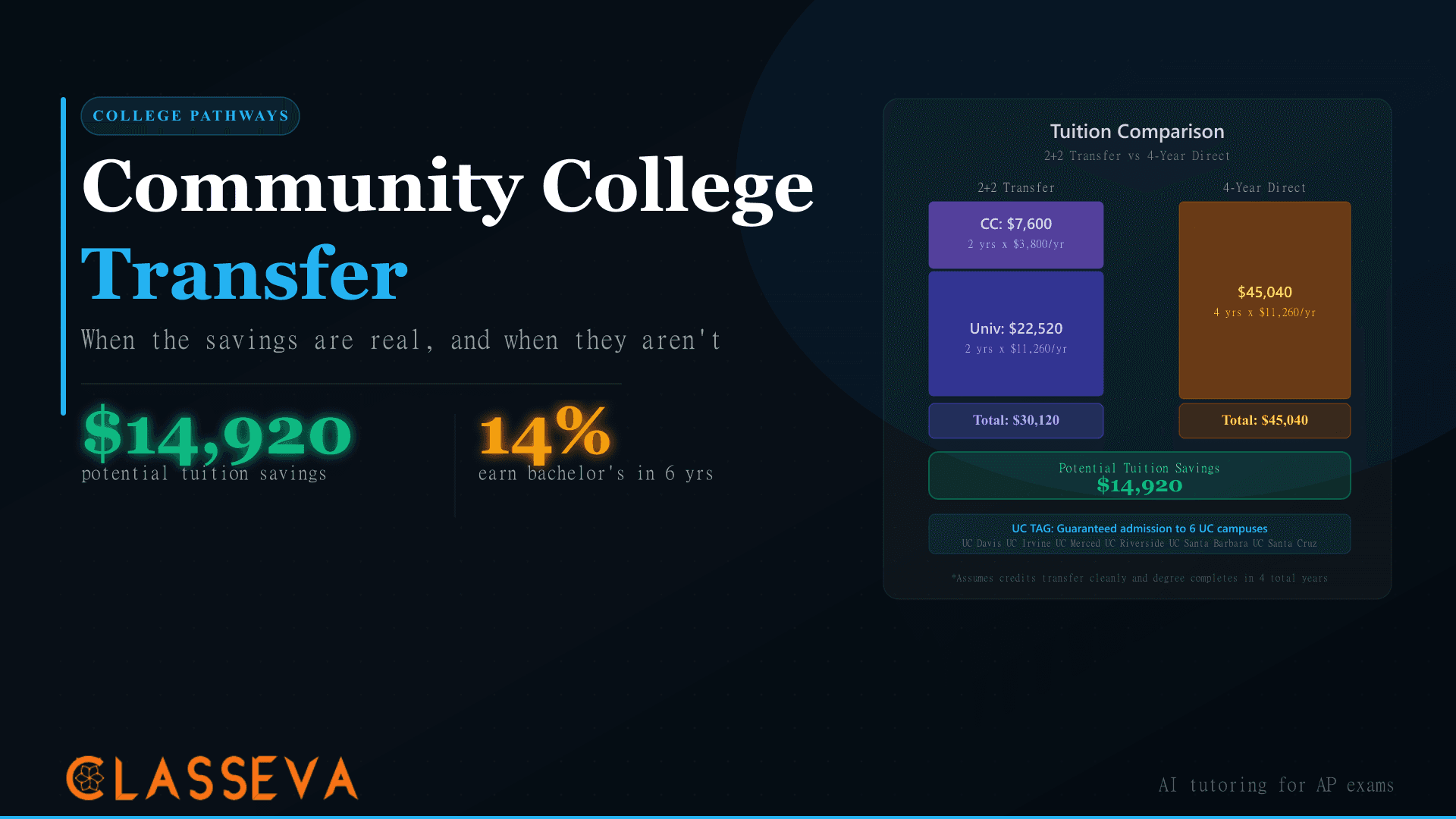
Two years at a public community college, at the national average tuition of $3,800 per year, followed by two years at an in-state public university at $11,260 per year (per NCES Digest of Education Statistics), produces a total tuition bill of about $30,120. Four straight years at that same university runs $45,040. The difference is $14,920.
Students who live at home during the community college years add another $10,000-$12,000 per year in room and board savings to that figure. For families where those savings are material, the path makes obvious financial sense.
The Real Cost Calculation
When the Savings Disappear
The $14,920 figure assumes exactly two years at the CC and exactly two years at the university. Research from the NCES Beginning Postsecondary Students surveycomplicates that assumption: only about 14% of students who start at a community college earn a bachelor's degree within six years. Students who start directly at a four-year institution complete at roughly 62% within six years.
Part of that gap comes from life circumstances. But a significant portion comes from the credit transfer problem. When 30-43% of your community college credits get denied at the receiving institution (a range documented in multiple studies), you need extra semesters to fill the gaps. At $11,260 per year, one extra semester costs roughly $5,600. Two extra semesters wipe out a third of the projected savings.
A student who saves $14,920 in tuition but needs five years instead of four to finish will pay roughly $11,260 in extra tuition for the fifth year, reducing the real savings to about $3,660. Factor in the opportunity cost of a delayed first year of full-time work, and the math often flips.
Before assuming transfer is cheaper, use the College Net Cost Estimator to see your actual net price at the four-year school you plan to transfer into. A school with strong need-based aid for first-year students may cost less as a direct enrollee than the sticker price suggests.
College Net Cost Estimator
Before assuming transfer saves money, check the actual net price at your target four-year school versus starting there as a first-year. A school with strong need-based aid may cost less than you expect.
What Are Transfer Admission Rates at Top Universities?
Transfer admission rates vary so dramatically across institution types that “transfer admissions” is almost two different processes depending on where you apply. University of California campuses operate formal transfer pipelines specifically designed to absorb California community college graduates. Selective private universities treat transfer admissions as rare exceptions to their normal class-building process.
UC System: Transfers Are Easier Than First-Year
UCLA's Common Data Set Section D shows a transfer acceptance rate around 23-24% compared to a first-year acceptance rate near 9%. UC Berkeley accepts approximately 19% of transfer applicants versus roughly 14% of first-year applicants. Across the UC system, community college transfers who complete IGETC and major prerequisites typically face substantially better odds than students applying as first-year students.
Selective Privates: The Opposite Story
Harvard's Common Data Set shows fewer than 15 transfer students admitted in a typical year, from an applicant pool of over 1,500. Yale admits roughly 20-25 transfers annually. Princeton effectively has no transfer program. These schools build their classes almost entirely from first-year students and treat transfer admission as rare and circumstantial.
Georgetown runs a more open transfer process, admitting around 10% of applicants, but that still trails its 14% first-year acceptance rate. Brown and Cornell are somewhat more transfer-friendly among Ivies, but both remain below 10% for transfer applicants.
If your target school's first-year acceptance rate is below 15%, check its Common Data Set Section D before assuming community college transfer is a realistic path. Transfer admission is almost always more competitive at those schools, not less.
How Do Guaranteed Transfer Agreements Work?
Three state systems offer some of the strongest formal transfer guarantees in the country: California (through both the UC and CSU systems), Florida, and North Carolina. Each works differently and carries different limitations.
UC Transfer Admission Guarantee (UC TAG)
UC TAG guarantees admission to a specific UC campus for California community college students who meet that campus's requirements. Six campuses participate: UC Davis, UC Irvine, UC Merced, UC Riverside, UC Santa Barbara, and UC Santa Cruz. UCLA and UC Berkeley do not participate. Students must generally achieve a GPA of 3.2 or higher (some campuses require 3.4 or above for competitive majors), complete IGETC, and finish major-specific prerequisite courses.
TAG applications open in September and must be submitted before the regular application opens in November. The guarantee is specific to the campus selected, so a student who tags UC Irvine cannot pivot to a different campus under that guarantee.
CSU Associate Degree for Transfer (ADT)
The CSU ADTguarantees admission to the California State University system (not necessarily a specific campus) and junior standing with 60 transferable units, provided a student earns an ADT in a qualifying major at a California community college. ADTs exist for over 30 majors, from Accounting and Business Administration to Psychology and Kinesiology. The guarantee comes with priority consideration for the student's top-choice CSU campus, though acceptance at a specific campus is not guaranteed when that campus is impacted (has more applicants than seats).
Florida, North Carolina, and Other State Agreements
Florida's statewide articulation agreement guarantees Florida College System AA degree graduates admission to a Florida state university with junior standing. This applies to the University of Florida, Florida State University, the University of Central Florida, and all other state university system schools. The guarantee requires maintaining a 2.0 GPA, though competitive programs at UF and FSU operate separate selective admissions processes.
North Carolina's Comprehensive Articulation Agreement (CAA) guarantees transfer admission to any UNC system school for NC community college students who earn an Associate in Arts or Associate in Science with a minimum 2.0 GPA. Individual campuses like UNC-Chapel Hill apply additional standards for competitive programs.
| Agreement | State | Guarantee Type | GPA Minimum | Excluded Schools |
|---|---|---|---|---|
| UC TAG | California | Specific UC campus | 3.2-3.4+ | UCLA, UC Berkeley |
| CSU ADT | California | CSU system admission | 2.0 (higher preferred) | Impacted campuses not guaranteed |
| Florida 2+2 | Florida | Any FL state university | 2.0 (programs vary) | Selective programs use separate admissions |
| NC CAA | North Carolina | Any UNC system school | 2.0 (programs vary) | Competitive programs add requirements |
State transfer guarantee programs. GPA minimums are baseline requirements; competitive majors typically require significantly higher GPAs.
Why Do Credits Sometimes Not Transfer?
A 2017 Government Accountability Office report (GAO-17-574) found that transfer students lost an average of 43% of their credits when moving from a two-year institution to a four-year institution. A parallel finding from the American Association of Community Colleges put the average credit loss at 30%. The gap depends heavily on whether formal articulation agreements exist between the two schools.
Which Credits Get Denied Most Often
Remedial and developmental courses never transfer because they represent below-college-level work, even at the CC where they were completed. Beyond that, the denials cluster in predictable places: major-specific courses where the receiving institution teaches the material differently, lab science courses taken without an accompanying lab component, and courses that were completed many years before transfer (some schools apply a 10-year limit).
The most painful denials happen in competitive majors. A student who took “Business Statistics” at a community college may arrive at a business school and find the course does not satisfy the school's specific statistics requirement for the major, even though the content is nearly identical. The solution is to check the articulation database before enrolling in CC courses, not after.
Articulation Agreements vs. Individual Review
California's ASSIST.org database shows precisely which community college courses map to which courses at each UC and CSU campus. A student who uses ASSIST before enrolling can build a community college course schedule that transfers with almost no loss. A student who ignores ASSIST and just takes whatever seems relevant risks significant denials.
Outside California, articulation databases are patchier. Many states have informal equivalency agreements that are not publicly searchable. The safest approach is to email the receiving institution's registrar with a proposed CC course list before enrolling, and get the pre-approval in writing.
Which Majors Transfer Best and Worst?
Major choice is probably the single biggest variable in whether community college transfer works. Business, social sciences, liberal arts, and communications all transfer cleanly because the curriculum is largely course-by-course interchangeable. Engineering, nursing, and architecture transfer poorly because their programs are built around strict sequences that begin in the first semester of year one.
Transfer-Friendly Majors
- •Business Administration (most states have ADT or equivalent)
- •Psychology, Sociology, Political Science
- •Communications and Media Studies
- •Liberal Arts and Humanities
- •Education (pre-teacher credential)
- •Computer Science (at non-impacted programs)
Transfer-Difficult Majors
- •Engineering (strict year-1 sequence that CC cannot replicate)
- •Nursing (clinical placement spots limited for transfers)
- •Architecture (design studio sequences are institution-specific)
- •Impacted CS programs at selective universities
- •Pre-med post-bac sequences (timing with MCAT matters)
- •Film/MFA programs (portfolio review from year 1)
The structural problem with engineering is worth explaining. UC Berkeley's College of Engineering expects transfer students to arrive having completed Calculus 1, Calculus 2, Physics with Calculus 1, and often specific lower-division engineering courses that are sequenced. A CC student who took Calculus 1 but not Calculus 2, or who took a general physics course instead of calculus-based physics, cannot slot into junior-year engineering coursework. The 4-year curriculum breaks.
When Does Community College Transfer Backfire?
Four failure modes recur consistently enough to be worth naming explicitly.
The Credit Denial Cascade
A student plans a 2+2 path, arrives at the transfer school, and discovers 15 credits were denied. Instead of entering as a junior with 60 transferable units, the student effectively enters as a sophomore with 45. Completing the degree now takes five semesters at the four-year school, not four. At $11,260/year, that extra semester costs about $5,600, eliminating roughly 38% of the projected tuition savings.
Transfer Shock
Research consistently documents a GPA drop of 0.3 to 0.5 points in a student's first semester after transfer, a phenomenon called "transfer shock." Students move from an environment where they had social networks and understood institutional rhythms to a new campus where they are strangers. Academic performance often recovers by the second semester, but students who start in a major with grade thresholds (nursing clinical cut-offs, for instance) may not recover in time.
Lower Aid at the Receiving School
Some universities that meet 100% of demonstrated financial need for first-year students do not apply the same guarantee to transfers. Before building a financial plan around CC transfer savings, verify the receiving school's financial aid policies for transfer students specifically. A school that would have offered a first-year student $25,000 in grants might offer a transfer student $18,000.
Choosing a School With No Transfer Path
A student who spends two years at a community college hoping to transfer into a school with a 2% transfer acceptance rate has not improved their odds versus applying as a first-year student. They have likely reduced them. Competitive four-year schools prefer applicants who have demonstrated performance in a four-year academic environment, not in a CC context.
Decision Framework: Should You Start at Community College?
The clearest way to think about this decision is to map it against two variables: your target school type and your intended major. Almost every other factor flows from those two.
One factor this framework does not cover is financial aid at the target school. A four-year university that meets 100% of demonstrated need for first-year students might make starting there directly cheaper than two years of CC plus reduced aid as a transfer. The College Net Cost Estimator handles that calculation. Use it before making the final call.
Students planning to use AP credits earned in high school should also check whether those credits apply to both the CC path and the direct four-year path. An AP Calculus BC credit earned as a high school student transfers to the four-year university regardless of CC attendance, but taking redundant courses at the CC wastes money and credits.
For a full picture of college application costs across both paths, the College Application Cost Calculator accounts for application fees at both CC and four-year institutions, which add up faster than most families expect across multiple school applications.
Key Takeaways
- Community college followed by a 4-year transfer saves roughly $14,920 in tuition compared to four straight years at an in-state public university, but only if all credits transfer cleanly and the student finishes in four total years.
- UC TAG guarantees admission to 6 UC campuses (not UCLA or Berkeley) for California CC students who meet GPA and coursework requirements, with TAG applications due each September.
- Florida's 2+2 agreement and North Carolina's Comprehensive Articulation Agreement are among the strongest state transfer guarantees outside California, both offering guaranteed admission with junior standing.
- The GAO found students lose an average of 43% of their credits when transferring without articulation agreements; ASSIST.org (California) and similar state databases reduce that loss substantially by pre-mapping course equivalencies.
- Transfer acceptance rates at UCs run 19-25%, higher than first-year admission rates; at Harvard, Yale, and Princeton, transfer acceptance falls below 3%.
- Engineering, Nursing, and Architecture transfer poorly because their curricula depend on strict year-one sequences that community college course offerings rarely replicate exactly.
- The financial case for CC transfer holds only if the student completes the bachelor's in four total years. A fifth year of tuition eliminates most of the savings.
If you are a California resident targeting a UC campus, visit UC's TAG page and ASSIST.org before you enroll at a community college. Knowing which courses count takes 30 minutes and can protect you from losing thousands of dollars in credits two years later.