Dual Enrollment vs AP: Credit, GPA, and Admissions
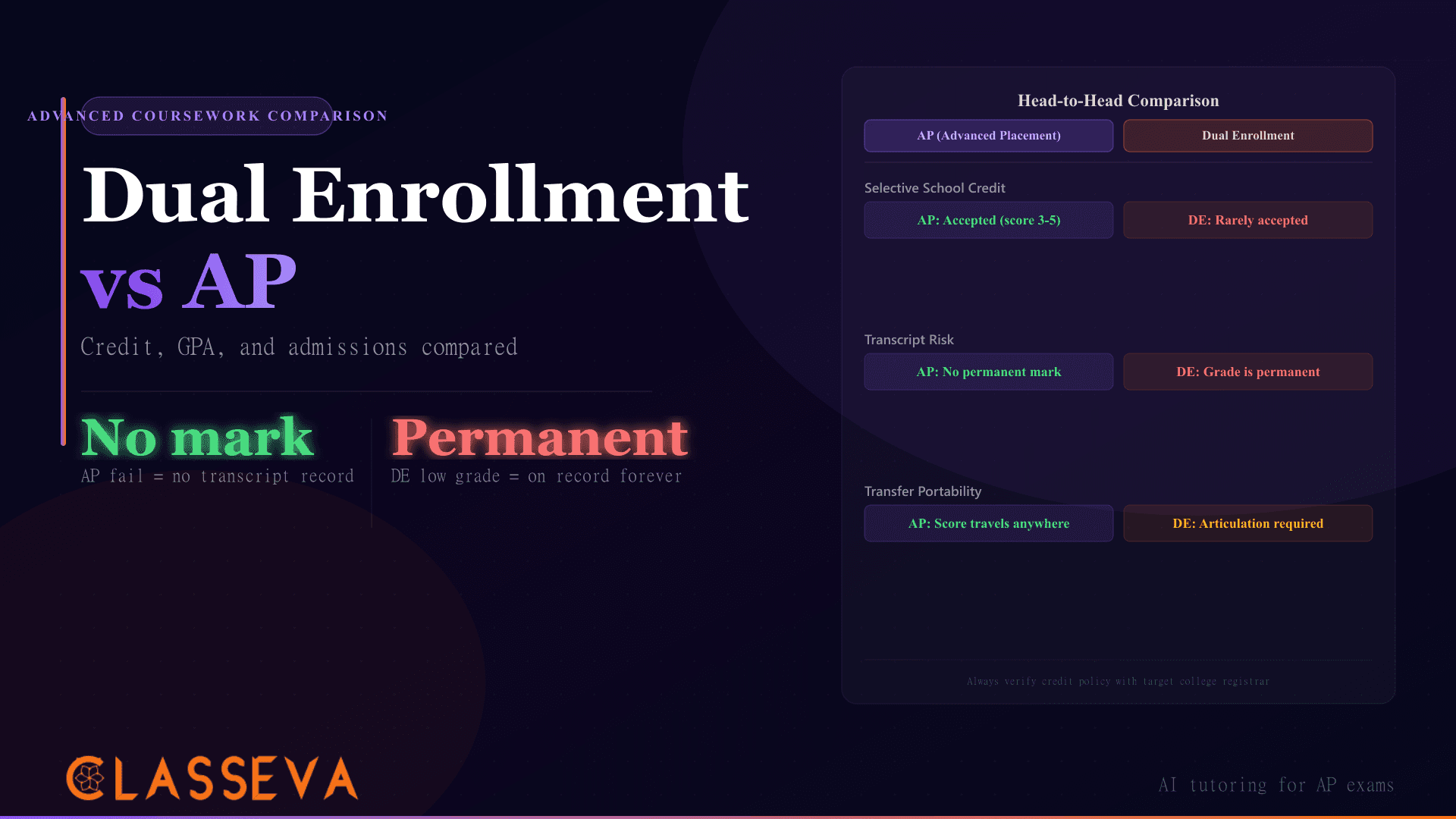
AP and dual enrollment both deliver college-level credit during high school, but they carry different failure modes. A bad AP score leaves no permanent mark on any transcript. A bad dual enrollment grade goes on a college transcript that follows you for the rest of your academic career, including graduate and professional school applications filed a decade later.
Reviewing college pathway policies to build Classeva’s planning resources, I kept returning to one data point that most comparison articles skip entirely: selective universities almost universally accept qualifying AP scores for credit but reject dual enrollment transcripts from community colleges. That divergence is not random. It reflects a structural difference between standardized national testing and institution-specific grading. This post maps that difference across credit reliability, admissions signaling, GPA risk, and cost, then gives you a decision framework to apply to your specific situation.
What Is Dual Enrollment?
Dual enrollment is a program that lets high school students enroll in actual college courses, typically at a community college or state university, earning credit that appears on both a high school transcript and a college transcript. According to the National Center for Education Statistics, over 1.5 million high school students participate in dual enrollment programs each year, making it one of the fastest-growing advanced coursework options in the US.
The word “actual” matters. Unlike AP, dual enrollment students sit in college classrooms, get graded by college faculty, and earn credit that registers at the awarding institution. A student completing ENG 101 at a local community college receives credit from that college, not from a national body like College Board. That distinction drives every downstream difference in how the credit travels.
How Dual Enrollment Credit Works
When you complete a dual enrollment course with a passing grade, the community college or state school adds those credit-hours to your college transcript. If your eventual four-year university holds an articulation agreement with the awarding institution, those credits transfer directly and satisfy specific course requirements. Without an articulation agreement, each course goes through individual review by the receiving school’s registrar, and denial is common.
The credits appear on two documents: your high school transcript, noted as a college course, and an official transcript from the awarding college. That second transcript follows you permanently. Graduate programs, medical schools, and law schools can all request it years after you finish your undergraduate degree.
Which States Subsidize Dual Enrollment?
Dual enrollment costs vary enormously by state. Florida’s Dual Enrollment program and Washington State’s Running Start program allow eligible students to take courses at no direct cost, with the state paying tuition. Other states charge prorated tuition ranging from $25 to $400 per course.
According to the Education Commission of the States, 48 states and the District of Columbia have formal dual enrollment policies, but state-level subsidies differ widely. If your state fully subsidizes dual enrollment, the cost calculation shifts dramatically compared to states where students pay per course. Ask your high school counselor for the specific rules and eligibility requirements in your area before assuming cost.
How Does AP Credit Work?
AP credit depends on a single, nationally standardized exam. The College Board administers the same test to every AP student in the country on the same days each May, then scores responses on a 1-5 scale. Credit at your eventual college depends entirely on your score and that school’s published AP credit policy, which most universities post publicly and update annually.
That standardization is AP’s structural advantage. A score of 5 on AP Calculus BC at a high school in rural Montana carries the same weight as a 5 from a suburban New York school. The College Board maintains a publicly searchable database of credit policies at apstudents.collegeboard.org, so you can verify how many credit-hours your target colleges award before taking the exam.
The risk in AP sits entirely in the exam. A score of 2 earns no credit, costs you the $98 exam fee, and leaves no mark on any college transcript. You can retake the exam the following year. Your high school transcript may note that you took the AP course, but no college sees a failing record. For the full dollar-value breakdown of AP credits by school type, the AP Credit Savings post walks through the tuition math in detail.
Which Gives More Reliable College Credit?
AP credit transfers more reliably than dual enrollment credit at most four-year institutions, particularly at selective schools. A qualifying AP score earns credit at any institution that participates in the College Board’s credit policy, covering the vast majority of US colleges. Dual enrollment credit transfers only where articulation agreements exist or where the receiving school individually approves each course.
The Transfer Problem with Dual Enrollment
The transfer gap hits hardest at selective private universities. Harvard’s Advanced Standing program restricts early credit to AP, IB, and A-Level exams meeting specific score thresholds; it does not recognize dual enrollment credit from concurrent high school programs. Yale’s credit policy centers on placement rather than transferable units. Princeton requires strict equivalency reviews and rarely approves community college dual enrollment courses as equivalent to Princeton coursework.
Even at mid-selective privates, individual course review produces inconsistent outcomes. A student’s ENG 101 from Community College X might satisfy the English composition requirement at University Y but fail to qualify at University Z, even when both universities use the same textbook and cover the same topics. University departments control credit acceptance decisions, not admissions offices, which means a college that seems “transfer-friendly” in its admissions materials may still reject specific dual enrollment credits at the department level.
State flagship universities handle this better, especially within their own state systems. California’s ASSIST.org articulation database maps which community college courses transfer to UC and CSU campuses, with course-by-course equivalencies verified before enrollment. Florida, Texas, and North Carolina have similar statewide frameworks. If your target is a state flagship in the same state as your community college, dual enrollment transfer rates run substantially higher than at private institutions. Students planning the full community-college-to-4-year-transfer pathway can read more about how those articulation agreements work in the community college transfer guide.
Why AP Credit Travels Better
AP credit’s portability comes from centralization. When you earn a qualifying score, you request an official score report from College Board sent directly to your college. The college applies its published policy. There is no case-by-case review, no department committee, no individual instructor decision. A 4 on AP Chemistry is a 4 on AP Chemistry everywhere that accepts it.
The College Board updates its credit policy database each year. Colleges that previously did not award AP credit sometimes begin accepting it; policies on specific subjects and minimum scores also shift. Check the database annually during junior and senior year, not just once when you first research schools.
How Do Admissions Officers Weight AP vs Dual Enrollment?
Admissions officers at selective universities weight AP and dual enrollment differently, and the distinction matters more than most students expect.
AP signals a standardized national benchmark. An admissions officer reviewing thousands of applications can compare a 5 on AP US History from any state, any school district, any demographic background, against the same national scoring standard. The score carries consistent meaning regardless of who taught the course or where the student lives.
Dual enrollment signals initiative without the same standardization. A grade of A in ENG 101 at a community college does not tell a selective admissions officer what a 5 on AP English Language tells them. The question admissions officers cannot always answer for a dual enrollment course: how rigorous was this specific instructor at this specific institution? That uncertainty is why selective schools weight AP more heavily in the context of credit-bearing coursework.
The picture differs at regional universities and state flagships. Those admissions offices see dual enrollment transcripts constantly, know the local community colleges, and weight strong performance accordingly. A student who earned a 4.0 in six dual enrollment courses at a well-regarded regional community college sends a clear signal of college readiness to a state flagship admissions officer. For students applying primarily to in-state public universities, dual enrollment GPA and course rigor carry real weight.
Does Dual Enrollment Hurt or Help Your GPA?
Dual enrollment courses can affect two separate GPAs at the same time, which creates both opportunity and significant risk. Understanding which GPA each grade touches changes how you should weigh enrollment decisions.
Dual Enrollment Grades Are Permanent
A dual enrollment grade becomes part of a permanent college transcript at the awarding institution. A C earned in Calculus I as a high school junior stays on your college transcript for the rest of your academic life.
By contrast, a low AP score simply does not appear on any college transcript. You paid the exam fee, the score did not qualify for credit, and nothing enters any college record. You can retake the exam the following year or choose not to submit that score at all.
This asymmetry matters most for students targeting competitive graduate or professional programs. Medical school applications, law school applications, and competitive master’s programs can request all undergraduate transcripts from all institutions attended, including those from dual enrollment programs completed in high school. A student who earned a B in chemistry dual enrollment at 17 has that grade in their permanent academic record at 27.
How DE Affects Your High School GPA
Dual enrollment grades also typically count toward your weighted high school GPA, depending on your school district’s grading policy. Most districts weight dual enrollment courses equivalently to AP courses on a 5.0 scale, so an A in a dual enrollment course boosts your high school GPA more than an A in a standard course.
But that weighting cuts both ways. A B in a dual enrollment course adds less than an A, and a C can drag a GPA down from where a student expected it to land. Students who enroll in dual enrollment without adequate preparation face the highest compound risk: a lower high school GPA for college applications and a permanent low grade on a college transcript.
Ask your high school counselor exactly how your district weights dual enrollment grades before enrolling. Policies vary enough across districts that no general rule applies.
When Dual Enrollment Beats AP
Dual enrollment is the stronger choice in specific situations. Choose it when:
No AP Equivalent Exists
- •Nursing prerequisites, technical programs, culinary arts, and many vocational subjects have dual enrollment courses but no AP equivalent
- •Dual enrollment opens access to college-level coursework in areas AP simply does not cover
- •For career-focused pathways, dual enrollment credit may directly satisfy program prerequisites
Your State Subsidizes Dual Enrollment
- •Florida, Washington State, and others offer fully subsidized programs where tuition costs nothing
- •Free dual enrollment credits represent a dramatically better deal than $98 per AP exam
- •Verify your state subsidy extends to your chosen course and institution
Your Target Schools Have Strong Articulation
- •California (ASSIST.org), Florida, Texas, and North Carolina have statewide articulation frameworks
- •Within these systems, dual enrollment credits transfer to state flagships reliably
- •Students targeting in-state public universities can build substantial transferable credit
Students planning the community college transfer route can also use dual enrollment as a preview of college coursework. Earning strong grades in dual enrollment builds a record that transfer admission committees at state flagships value. For more on that pathway, see the community college transfer guide, which covers articulation agreement specifics and GPA requirements in detail.
When AP Beats Dual Enrollment
AP is the stronger choice when:
- Your target schools include highly selective privates, Ivies, or top-25 universities that do not accept dual enrollment credit from community colleges.
- You want to avoid any permanent college transcript record until you enroll on your own terms.
- Your state does not subsidize dual enrollment and the per-course cost approaches or exceeds what AP exam prep costs.
- Your subject aligns with a high-credit AP exam. AP Calculus BC, for example, typically awards 6 to 8 credit-hours at most universities, replacing both Calculus I and Calculus II in a single exam.
- You want a second chance. AP retakes are available annually with no penalty. Dual enrollment grades cannot be retaken or removed.
Before committing to AP in a subject where you are uncertain of your likelihood of a qualifying score, check the AP Score Predictor to gauge your realistic expected score. If the prediction consistently falls below 3, dual enrollment in an equivalent course may deliver more certain credit, but only if your target college accepts it.
AP vs Dual Enrollment Cost Comparison
Costs break down differently depending on your state program and target institution. No single answer fits all students.
| Cost Factor | AP | Dual Enrollment |
|---|---|---|
| Per exam or per course | $98 per exam (2025) | $0 to $400+ per course (state-dependent) |
| Study materials | $20-$60 per prep book | Textbook often included |
| Total for 5 courses | ~$490-$790 with prep | $0 (subsidized) to $2,000+ (full-cost) |
| Credit guarantee | Depends on exam score | Depends on articulation agreement |
| Retake cost if unsuccessful | $98 plus prep materials | Repeat enrollment fees (grade stays) |
Estimates based on 2025 College Board exam fees and state dual enrollment program data. Dual enrollment costs vary significantly by state and institution.
For families in states with fully subsidized dual enrollment, the cost math strongly favors DE, assuming the credits transfer. A student in Florida completing five dual enrollment courses earns 15 credit-hours of college credit at no cost, compared to $490 to $790 in AP exam fees plus prep materials for equivalent coverage.
For families in states where dual enrollment runs $300 to $400 per course, three courses cost $900 to $1,200, substantially more than three AP exams. The AP path delivers fewer guaranteed credit-hours in that scenario, but at lower total cost and without transcript risk.
AP Credit Savings Calculator
Estimate how much you save across different AP subjects and school types. Compare per-credit-hour tuition savings at your target college to the cost of your AP exam plan.
For families planning total college costs across both pathways, the College Application Cost Calculator factors in AP exam fees alongside application, test prep, and submission costs to give a complete picture of the financial investment in your admissions strategy. A broader breakdown of all college cost components is available at Classeva’s college pathways resource hub.
Decision Framework: Which Should You Choose?
The dual enrollment vs AP decision depends on four variables: college targets, credit portability, GPA risk, and state subsidy. Apply them in sequence:
Identify your target colleges and check their dual enrollment credit policy
If your primary targets are highly selective privates or Ivy League schools, dual enrollment credit from a community college will not save tuition at those schools. Prioritize AP in that case. If your primary targets are in-state state flagships, check each school's articulation database to confirm whether your specific dual enrollment courses transfer.
Confirm your state subsidy status
If your state fully subsidizes dual enrollment tuition, the cost calculus shifts in its favor. If your state charges $200 to $400 per course, AP often costs less per guaranteed credit-hour, particularly in subjects with high-value exams like AP Calculus BC.
Assess the GPA risk honestly
Ask yourself whether you can realistically earn an A or B in a college-level course in this subject. If the answer is uncertain, the AP exam path carries less downside: a low score costs $98 and nothing else. A low dual enrollment grade costs that course's tuition and leaves a permanent record.
Check whether an AP exam covers your subject
For nursing, culinary arts, technical programs, and career-focused fields, no AP equivalent exists. Dual enrollment is the only path to college-level coursework in those areas during high school.
Consider taking both
Many students use AP for nationally standardized academic subjects and dual enrollment for career-focused or specialized courses. There is no requirement to choose one exclusively. Students in subsidized states with articulation-strong in-state targets can accumulate significant credit through both pathways simultaneously.
Key Takeaways
- AP credit travels on a standardized score; dual enrollment credit travels only through articulation agreements. Selective universities accept the former; most reject the latter.
- A low AP score leaves no college transcript record and can be retried the following year. A low dual enrollment grade stays on a college transcript permanently, including for future graduate program applications.
- Ivy League and top-25 private universities do not award degree credit for most dual enrollment courses taken at community colleges.
- Dual enrollment grades count toward both your high school GPA and a permanent college GPA simultaneously. A C in a dual enrollment course is higher-stakes than a 2 on an AP exam.
- In states with fully subsidized dual enrollment programs, the cost case for DE is strong, but only where credits transfer to your eventual four-year school.
- AP and dual enrollment are not mutually exclusive. Using AP for core standardized subjects while using dual enrollment for career-focused or specialized courses without AP equivalents is the strongest combined approach.
- Always verify credit acceptance with your target college’s registrar directly, not just the admissions office, before making enrollment decisions.