Gap Year After High School: When It Helps and When It Hurts
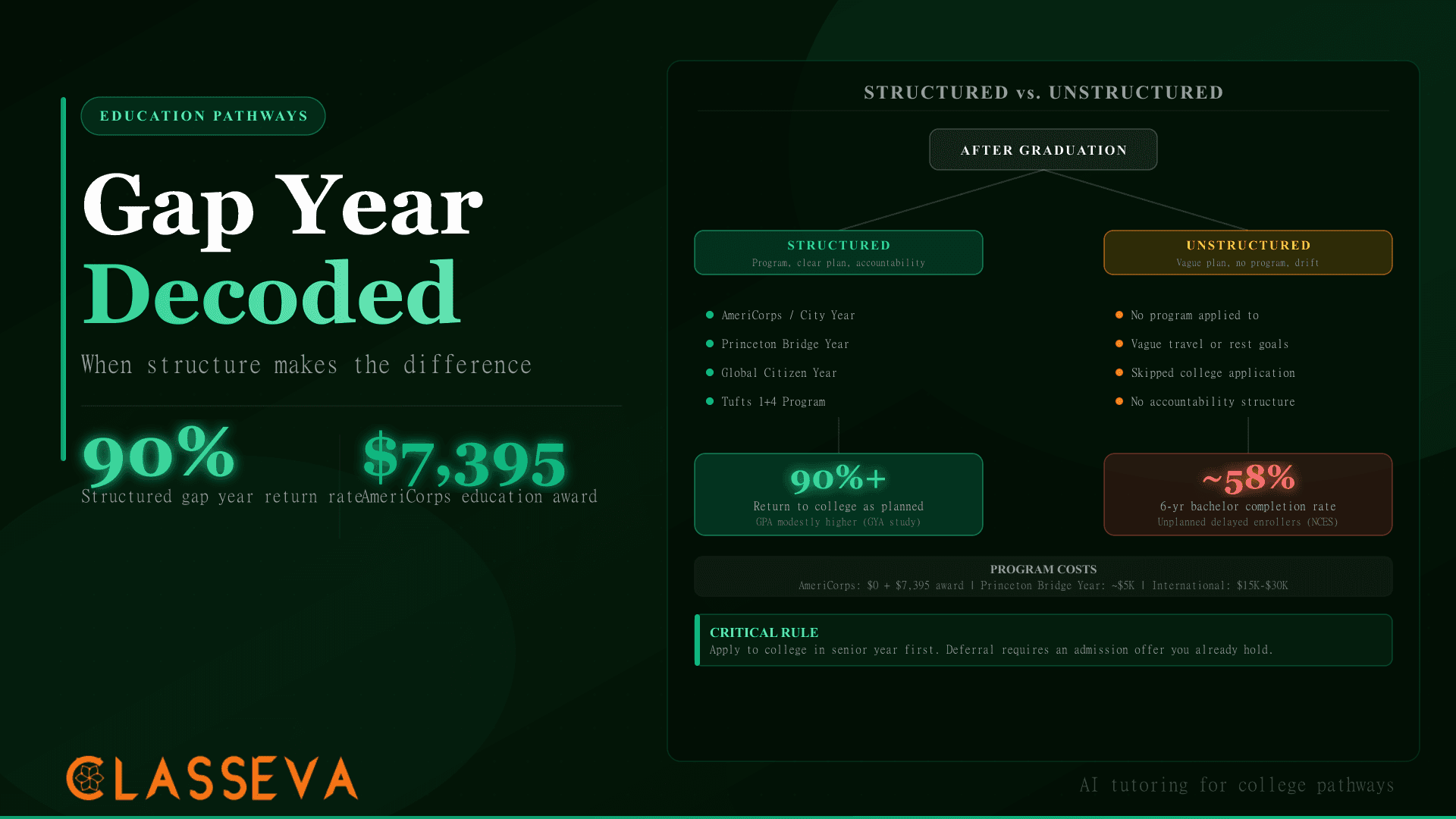
The gap year pitch sounds obvious: take a year, find yourself, come back refreshed. The data on who actually benefits tells a more specific story. Students who enter a structured program with clear outcomes, real accountability, and resume-building work return to college at rates above 90% and average GPAs modestly higher than peers who enrolled immediately. Students who take an unstructured year without a program, drifting between jobs or travel or family obligations without a concrete goal, return at substantially lower rates. The structure is what makes the gap year work, not the year itself.
Researching this question while building Classeva's college pathways content, the pattern I kept finding was that most gap year coverage pitches the concept without distinguishing between types. This post tries to fix that: the data on structured programs is genuinely encouraging, and the data on unstructured gaps is genuinely concerning. Both matter.
What Is a Gap Year After High School?
A gap year is a deliberate pause between high school graduation and college enrollment, typically lasting 9 to 12 months. The term covers a wide range of activities: structured service programs, international experiences, paid work, independent study, or some combination. What separates a gap year from simply not going to college is intent: the student plans to enroll in higher education after the gap year ends.
Who Takes Gap Years in the US?
Gap years remain far less common in the US than in countries like the UK or Australia, where structured programs are embedded in the admissions culture. The Gap Year Association estimates that roughly 40,000-50,000 US students take a deliberate gap year each year, a fraction of the roughly 3.5 million students who enroll in college annually. That number spiked during 2020-2022 as COVID deferrals surged, and the post-pandemic cohort outcomes are still being studied.
The typical gap year student in the US is disproportionately from higher-income families. Structured programs with competitive applications, international travel costs, and unpaid service components are easier to access when finances allow flexibility. AmeriCorps is a significant exception: its stipend-plus-education-award model makes structured service accessible to students from most income brackets.
When a Gap Year After High School Actually Helps
A gap year helps when it adds something concrete. The research from the Gap Year Association on structured program participants is consistent: students return to college with slightly higher GPAs, stronger clarity about their major choice, and, in many cases, a specific experience they can write about in graduate school applications or job interviews years later.
Structured Programs and College Outcomes
The Gap Year Association's longitudinal study of structured gap year program alumni found participants averaged GPAs between 0.1 and 0.4 points higher than matched non-gap year peers across multiple years. Return-to-college rates for structured program participants ran above 90%. These are self-selected students, so some caution is warranted; students who apply to competitive gap year programs likely have strong baseline motivation. But the direction of the data is clear: structured gap years do not hurt college performance. [VERIFY exact GPA figures with current GYA longitudinal study publication]
Recovery From Academic Burnout
High school juniors who took four AP courses, varsity sports, extracurricular leadership, and a summer program simultaneously, and who genuinely burned out by spring of senior year, often benefit from a gap year for reasons that have little to do with GPA. Enrolling exhausted and unmotivated in September produces a difficult first semester. Taking a structured gap year that is physically active, socially engaged, and academically light can reset motivation in ways that a summer between senior year and college cannot. The key word remains structured: rest at home for 12 months rarely produces the same reset.
If burnout is the reason for a gap year, choose a program that is physically engaged and socially active but not academically intensive. AmeriCorps and City Year programs fit this description well. Programs that require significant academic work during the gap year can extend rather than relieve the burnout cycle.
When a Gap Year After High School Backfires
The gap year mythology runs in one direction: take a year, gain perspective, come back stronger. The cases where it fails rarely get the same coverage. They fail in predictable patterns.
The “Find Yourself” Gap Year Problem
The most common gap year failure mode is a student who plans to “figure out what they want” during the year without committing to any program, job, or structured activity. The year starts with good intentions: travel, reading, reflection. By month four, social peers are settled into their freshman year, the student is still at home, and the combination of isolation and drift kills motivation. By month nine, the idea of starting college feels heavier, not lighter. The student who did not apply to college in senior year — because “I wasn't ready” — now faces a second application cycle from a weaker position.
Do not skip the college application in senior year with a plan to apply later. Apply during senior year, receive an offer, then request deferral. Students who skip the application and attempt to reapply the following year often find the gap year experience does not add enough to their application to compensate for the year of lost momentum and the risk that application conditions change.
Academic Momentum and Delayed Enrollment Data
NCES data on “delayed enrollers” (students who do not enroll in college within six months of high school graduation) shows lower six-year bachelor's degree completion rates than students who enrolled immediately. NCES Digest of Education Statisticsdata shows the completion gap runs roughly 15 percentage points: approximately 74% of immediate enrollers complete a bachelor's degree within six years, compared to around 58-60% of delayed enrollers. [VERIFY current figures from NCES]
The key nuance: NCES delayed enrollers are a broader and less motivated population than deliberate gap year takers. Most are students who simply did not enroll, not students who completed AmeriCorps or Princeton Bridge Year. The comparison is imperfect. But it makes the point that a year without structure and a clear return plan carries real completion risk that optimistic gap year coverage tends to understate.
Major Structured Gap Year Programs
The gap year program landscape spans a wide range of cost, selectivity, and focus. The common thread for programs worth considering is that they have a clear structure, defined outcomes, and peer accountability.
Princeton Bridge Year Program
Princeton Bridge Year is available exclusively to admitted Princeton freshmen who choose to defer enrollment for service work abroad. Princeton covers approximately 90% of program costs, making it one of the most financially accessible structured international gap year options in the country. Recent host sites have included India, Bolivia, Senegal, and China. The cohort is small (typically 20-30 students per year) and the program is competitive within Princeton's admitted class. Students apply for Bridge Year during the college application process. [VERIFY current program cost share and cohort size at bridge-year.princeton.edu]
Bridge Year participants are Princeton students from day one. They arrive on campus the following September having already lived abroad for 10 months, typically with an intermediate-level command of a new language and a service experience that shapes their Princeton academic focus.
AmeriCorps and City Year
AmeriCorps programs offer the most financially accessible route into structured gap year service. Full-time AmeriCorps members receive a modest living stipend (typically $400-$600 per month) and, upon completing a full year of service, a Segal Education Award of approximately $7,395 (as of 2024) [VERIFY current award amount at americorps.gov]. The award applies to tuition, fees, or existing student loans at eligible schools.
City Year is an AmeriCorps program focused on K-12 education support in high-need schools. Corps members spend the year in a school, working alongside teachers, tutoring students, and building school culture. The experience is demanding, socially rich, and professionally formative. City Year has placed corps members in more than 29 cities. For a high school graduate uncertain about a major but drawn to education or social impact, City Year provides a year of genuine professional experience with the added benefit of the AmeriCorps education award.
International and Other Structured Options
Global Citizen Year places students in rural communities in Africa, Asia, and Latin America for 7-8 months of service and immersion. Costs run $15,000-$30,000, though financial aid is available for some participants. The program accepts applications and is not exclusively tied to any specific college. Tufts University's 1+4 Program is another university-affiliated option: admitted Tufts students can defer and spend a year in service at partner sites in the US or internationally before starting at Tufts.
| Program | Duration | Net Student Cost | Compensation | Selectivity |
|---|---|---|---|---|
| Princeton Bridge Year | 10 months | ~$5,000 (Princeton-subsidized) | None | Competitive (Princeton admits only) |
| AmeriCorps / City Year | 10-12 months | $0 | ~$500/mo stipend + $7,395 award | Moderately selective |
| Tufts 1+4 | 10 months | Low (Tufts-supported) | None | Tufts admits only |
| Global Citizen Year | 7-8 months | $15,000-$30,000 | None | Application-based, any school |
| Work/internship gap year | 12 months | $0-variable | Salary or hourly wage | N/A |
Costs and compensation are approximate and subject to change. Verify current figures directly with each program before making decisions.
How to Defer College Admission for a Gap Year
Deferral is simpler than most students assume. The process runs in parallel with college applications, not before or instead of them. The critical rule: apply to college on schedule in senior year, even if you plan a gap year. You cannot defer an admission you do not have.
Apply to college during senior year
Apply to your target schools on the regular timeline. Do not wait until after the gap year to apply. Treat your college and gap year program applications as two parallel tracks.
Receive your admission offer (spring)
Wait for admission decisions in March or April. Once you have a firm offer from your first-choice school, you can decide whether to enroll or request deferral.
Submit a deferral request letter
Write to the admissions office explaining your gap year plan and program. Be specific: name the program, the duration, and what you expect to gain. Most selective schools grant deferral for structured programs. Submit before the enrollment deposit deadline (typically May 1).
Pay the enrollment deposit
Most schools require a non-refundable deposit ($500-$1,000) to hold your deferred seat. This is the cost of having the option.
Confirm conditions in writing
Colleges granting deferral typically require you not to enroll in college-level courses during the gap year. Get the conditions confirmed in writing, including your re-enrollment deadline and any reporting requirements.
Execute your gap year program
Complete the program you committed to. Some schools ask for a brief gap year report before your deferred start date. Document your experience in a journal or portfolio for that purpose.
While most selective colleges support gap years, not every school grants deferral automatically or at all. Some schools grant deferral only case-by-case. A small number do not grant deferral under any circumstances. Check the specific policy of every school on your list before building a gap year plan that depends on deferring from a specific school.
The Financial Reality of a Gap Year
Most gap year coverage focuses on cost. The more useful frame is net cost after any compensation or award. The numbers look very different depending on program type.
Cost by Program Type
AmeriCorps is the clearest financial case for a structured gap year. A student who completes a full year of City Year or another AmeriCorps program finishes with a $7,395 education award, plus whatever living stipend they saved during the year (modest, but real). That award applies directly to college tuition. A family whose college of choice costs $60,000 per year in sticker price effectively reduces year one's net cost by $7,395 on top of whatever institutional aid is already in the package.
Princeton Bridge Year sits at the opposite extreme for institutional subsidization. Princeton covers the vast majority of program costs for participating students. A family paying standard Princeton tuition would spend roughly $5,000 on the Bridge Year itself (program fee), then proceed to Princeton on the same financial aid package they would have had as an immediate enrollee.
International programs without institutional backing cost substantially more. Global Citizen Year's $15,000-$30,000 price tag is real money. For families already financing college, adding another $20,000 for a gap year program requires careful planning. The College Net Cost Estimator can help model what college will actually cost, which is worth running before committing to a costly gap year program.
For families navigating the financial side of this decision, the College Application Cost Calculator can model the full cost of the college application process, which matters when a gap year means running a second application cycle. The broader financial aid picture also shifts if you defer: confirm with your college whether financial aid packages will be re-calculated for your deferred start year.
One additional consideration: the FAFSA. If you defer enrollment by a year, the income and asset data used for financial aid calculations shifts. Families whose circumstances change significantly during the gap year (income decrease, parent job loss, or a sibling starting college) should understand how that affects the aid calculation. The FAFSA walkthrough covers the underlying mechanics in detail.
How Colleges View Gap Year Applicants
Most selective colleges view gap years favorably, provided the student has a concrete plan. Admissions officers at Harvard, Yale, and similar schools read thousands of application essays per cycle. A student who spent a year doing something substantive has something real to write about in future applications (graduate school, fellowships, jobs) that their peers who went straight through do not.
The concern admissions offices have is not the gap year itself. It is the student who defers with a vague plan, spends the year unproductively, and arrives on campus having lost academic habits and focus. The Harvard admissions processexplicitly supports gap years, and Harvard's admissions website notes that students who take purposeful gap years often contribute meaningfully to Harvard's community. Yale takes a similar position. The substantive difference between a gap year that helps and one that hurts is the same for admissions offices as it is for outcomes data: structure.
What Colleges Want to See
- •Named program with defined scope and duration
- •Clear learning or service goal
- •Concrete takeaway you can articulate
- •College application filed on schedule in senior year
- •Deferral request with specific plan, not vague language
What Raises Concerns
- •No program or structure identified
- •"I want to travel and figure things out"
- •Skipping the senior year application cycle
- •Enrolling in college courses during deferral
- •No clear return date or re-enrollment plan
Decision Framework: Should You Take a Gap Year?
Gap years work for a specific type of student in a specific situation. The following framework cuts through the noise.
Signs a Gap Year Is the Right Call
A gap year makes sense when you have a specific structured program identified, the financial situation allows for it (or you can access AmeriCorps), you are admitted to college and will request deferral, and you have a concrete answer to “what will you do during the gap year?” that goes beyond vague exploration. Students who burned out during a demanding senior year, who want to build professional skills before college, or who have a genuine service commitment they want to pursue are strong candidates.
The college pathways resource hub covers multiple alternative timing strategies, including community college transfer, which can be another route for students who need more time before committing to a four-year school. If community college transfer is on the table, the community college to 4-year transfer analysis covers the credit transfer mechanics and admissions data in detail.
Signs to Skip the Gap Year
Skip the gap year if you have no specific program in mind and no concrete plan for the year. Skip it if your family's financial situation makes a year without income difficult. Skip it if you are already motivated and ready for college; there is no benefit to a gap year for a student who wants to start. Skip it if the gap year would require you to skip the college application in senior year, since that creates unnecessary risk. And skip it if the primary appeal is avoiding something (college, responsibility, adulthood) rather than pursuing something concrete.
Before committing to a gap year, answer this question in two sentences: What specific program or structured activity will I do, and what concrete skill or experience will I have when it ends? If you cannot answer in two specific sentences, the gap year is not ready yet.
Key Takeaways
- A gap year after high school helps students who enter a structured program with clear goals, peer accountability, and a concrete plan. It hurts students who drift without structure.
- Apply to college during senior year regardless of gap year plans. Deferral requires an admission offer. Students who skip the application cycle create unnecessary risk.
- AmeriCorps and City Year are the most financially accessible structured programs: zero cost, a living stipend, and a $7,395 Segal Education Award upon completion.
- Princeton Bridge Year covers approximately 90% of costs for admitted Princeton students, making it one of the best-subsidized international structured gap year options available.
- Most selective colleges actively support gap years and grant deferral for students with specific plans. Confirm the policy with each school on your list before building a plan around deferral.
- The FAFSA financial aid calculation shifts when enrollment is deferred by a year. Review the impact on your aid package with the financial aid office before finalizing the plan.