FAFSA 2026-27 Step-by-Step: A Practical Walkthrough
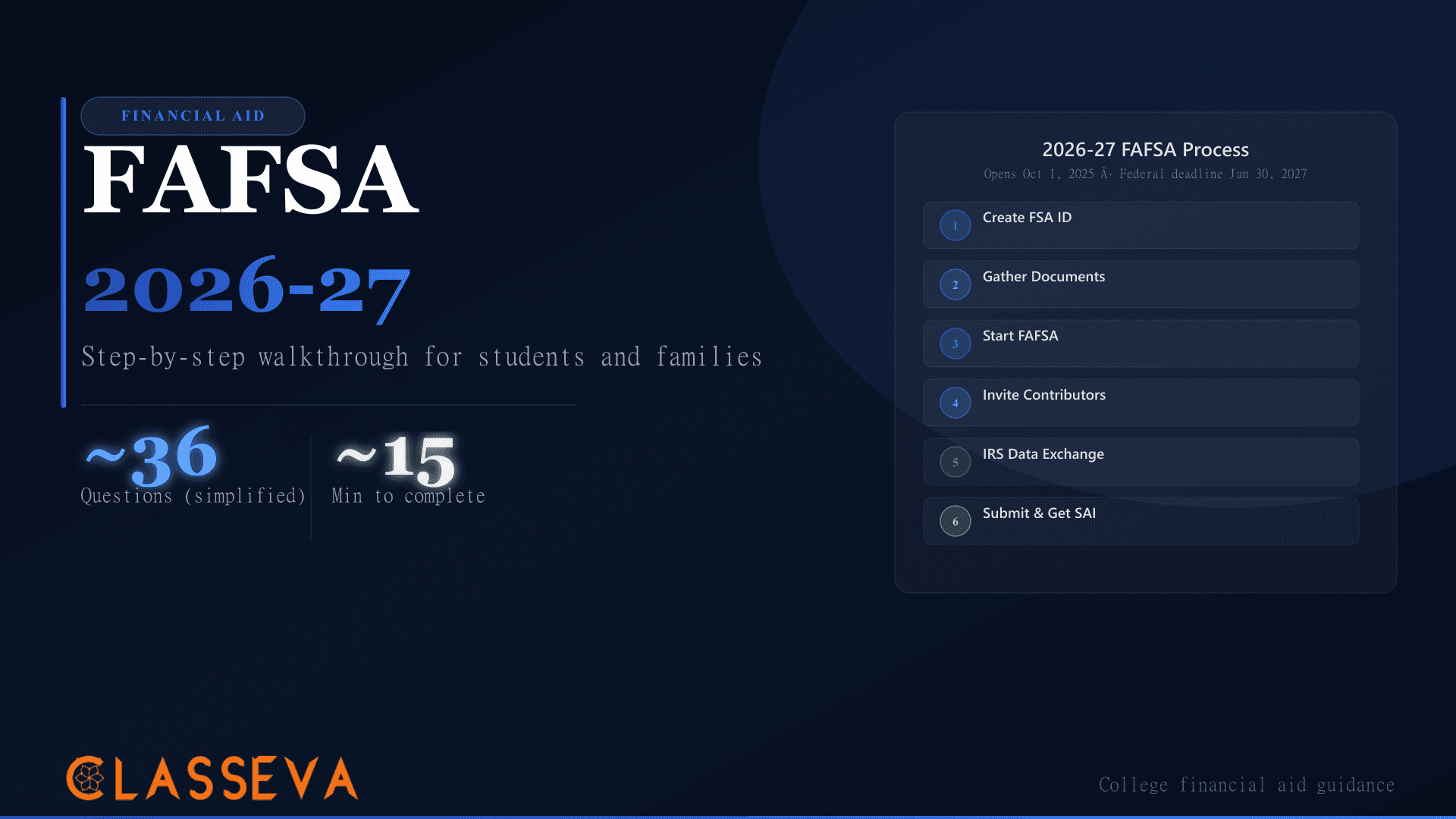
Studying how Federal Student Aidpublishes annual completion statistics while building Classeva's financial aid tools, one finding kept resurfacing: billions of dollars in Pell Grant aid go unclaimed each year not because students fail to qualify, but because families assume their income puts them out of range and never file. The 2026-27 FAFSA covers roughly 36 questions, takes about 15 minutes when your 2024 taxes are filed, and the IRS Direct Data Exchange does the heaviest lifting automatically.
This walkthrough covers every step, from creating your FSA ID to reading your financial aid award letter. It also covers the post-simplification changes that still catch families off-guard: the contributor invitation system, the new SAI calculation, and what to do when your finances changed after your 2024 tax return was filed.
What Does the 2026-27 FAFSA Actually Ask?
The 2026-27 FAFSA covers roughly 36 questions for most families, collecting student and contributor identity information, school choices (up to 20 colleges), dependency status, and current asset figures. Tax and income data transfer automatically from the IRS, which means most families no longer type a single number from their tax returns into the form.
How Many Questions Is the FAFSA Now?
The FAFSA Simplification Act, which took effect for the 2024-25 cycle, cut the question count from as many as 108 to roughly 36 for a typical family. The Department of Education achieved this by eliminating redundant questions, consolidating income and asset sections, and outsourcing tax data entirely to the IRS Direct Data Exchange. Families with more complex situations (self-employment, divorced parents, students with their own income) may encounter a few additional questions, but the form is shorter for virtually everyone.
| Aspect | Pre-2024 FAFSA | 2024-25 and Beyond |
|---|---|---|
| Typical question count | Up to 108 | ~36 for most families |
| Tax data entry | Manual input required | IRS Direct Data Exchange |
| Completion time | 30-45 minutes | ~15 minutes |
| Aid index name | EFC (Expected Family Contribution) | SAI (Student Aid Index) |
| Minimum aid index | $0 (EFC floor) | -$1,500 (SAI floor) |
| Parent section | Shared form | Separate contributor invitation |
Key changes introduced by the FAFSA Simplification Act, effective 2024-25
What Documents Do You Need Before You Start?
Gathering everything before you log in prevents mid-session pauses. Tax data transfers automatically, but several items require manual entry or pre-setup.
- Your FSA ID (and each contributor's FSA ID), created at least 3-7 days early for identity verification
- Social Security Numbers for the student and all contributors
- Your 2024 federal tax return, already filed (the IRS DDX cannot pull data from unfiled returns)
- Records of untaxed income from 2024 (child support received, veterans' benefits, workers' compensation)
- Current bank account balances as of the filing date
- Investment values (excluding retirement accounts for most families)
- List of colleges you want to receive your FAFSA data (you can add up to 20)
The Social Security Administration verification for new FSA accounts can take 1-3 business days or longer. Create all FSA IDs at least one week before you plan to start the FAFSA. A parent who has not created an FSA ID cannot complete their contributor section until verification clears.
When Does the 2026-27 FAFSA Open and When Is It Due?
The 2026-27 FAFSA opened October 1, 2025 and remains open through June 30, 2027. That federal endpoint is the last resort, not the target. Most state aid programs carry deadlines between November 2025 and April 2026, and many colleges require FAFSA submission by February or March to receive the full institutional aid package.
Federal vs. State vs. College Deadlines
Three separate deadline systems govern FAFSA, and each operates independently. The federal deadline (June 30, 2027) covers Pell Grants and federal loans. State deadlines, which vary by state, govern state grant programs. College deadlines govern institutional grants and scholarships funded by the school itself.
Many state programs, including California's Cal Grant and New York's TAP, award aid on a first-come, first-served basis until funds run out. Filing on October 1 puts you first in line. Filing in February may mean the fund is exhausted even if you technically beat the state deadline. Check your state's financial aid agency website for the exact date.
The federal June 30, 2027 deadline is the absolute last resort for Pell Grant and loan eligibility. State and college aid runs out months earlier. Filing in October when the FAFSA opens gives you access to every aid program simultaneously; filing in spring risks missing state grants you otherwise qualify for.
How Does the FAFSA Contributor Invitation System Work?
Under the post-simplification system, the student starts the FAFSA online at studentaid.gov, then the form automatically sends an invitation email to each required contributor (parent, stepparent, or both). Each contributor logs in with their own FSA ID to complete their financial section independently. There is no shared single form.
This replaces the old model where parents entered their data alongside the student on one joint application. The new system means a parent who has not created an FSA ID blocks the entire process. Both the student and each required contributor must have active, verified FSA IDs before anyone starts filling out the form.
Which Parent Files After Divorce?
For students whose parents are divorced, separated, or never married, the FAFSA uses the financial information of the parent who provided more financial support during the 12 months before you file. Not the parent listed in custody arrangements. Not necessarily the parent you live with.
If both parents contributed equally, use the parent with the higher income. That parent's current spouse (your stepparent) must also complete a contributor section, even if they have no legal obligation to pay for college and even if you have no relationship with them. Both the FAFSA parent and their spouse receive separate invitation emails to complete their respective sections.
For divorced families, the FAFSA parent and that parent's current spouse (if any) each need their own FSA IDs. If your other biological or adoptive parent is not required to contribute, they do not need an FSA ID for your FAFSA, but will need one if required as a contributor for a sibling's FAFSA.
How Does the IRS Direct Data Exchange Auto-Fill Your Taxes?
After starting the 2026-27 FAFSA and completing the identity section, the form presents a prompt to transfer tax information from the IRS. Approving this link connects your FSA ID to your IRS records and pulls your 2024 federal tax return data directly into the FAFSA fields: adjusted gross income, taxes paid, filing status, and W-2 income figures. You do not type these manually.
The IRS DDX uses the prior-prior year rule: the 2026-27 FAFSA pulls from 2024 taxes, which most families filed by April 2025. If your 2024 return was not yet filed when you start the FAFSA, you can complete the form with estimated figures, but you must log back in and correct them after your taxes are filed.
Several income categories fall outside IRS records and require manual entry even when DDX is active: child support received, workers' compensation, certain veterans' benefits, and employer contributions to tax-exempt retirement plans. The form flags these sections for you.
How to Complete the FAFSA 2026-27: Step by Step
Completing the 2026-27 FAFSA takes roughly 15 minutes for a family with standard finances and taxes already filed. Each contributor completes their section independently after receiving a system invitation. The full process runs eight steps from FSA ID creation to electronic signature.
Create your FSA ID
Go to studentaid.gov and create an FSA ID using your Social Security Number, legal name, date of birth, and email address. Each contributor needs a separate FSA ID tied to their own SSN and email. New accounts may take 1-3 business days for Social Security Administration identity verification; create IDs at least one week before you plan to file.
Gather your documents
Collect Social Security Numbers for the student and all required contributors, current bank account balances, investment values (excluding most retirement accounts), and records of any 2024 untaxed income. Your tax data transfers automatically if you authorize IRS DDX, but you need the manual items ready for the asset section.
Start the 2026-27 FAFSA at studentaid.gov
Log in with your student FSA ID, select "Start a New FAFSA," and choose the 2026-27 award year. The form saves progress automatically, so you can pause and return. Complete the student section first before the contributor invitations go out.
Complete the student section
Answer identity questions, enter your Social Security Number, and select up to 20 colleges you want to receive your FAFSA data. Answer the dependency status questions carefully. If you answer them incorrectly and appear independent when you are not, the college will flag it during verification.
Invite contributors and wait for completion
The system automatically emails each required contributor with an invitation link. Contributors log in with their own FSA ID and complete their financial section independently. You can track contributor status from your FAFSA dashboard. The form cannot be submitted until all contributors finish.
Authorize IRS Direct Data Exchange for each contributor
Each person completing a section of the FAFSA (student and each contributor) approves the IRS DDX separately. This transfers 2024 federal tax data directly into the form. Review the pre-populated figures before proceeding. If any figure looks incorrect, you can correct it manually before advancing.
Enter assets and untaxed income
Provide current bank account balances and investment values as of the filing date. Report any untaxed income from 2024 that the IRS DDX did not capture: child support received, workers' compensation, certain veterans' benefits, and tax-free employer retirement contributions.
Review, sign electronically, and submit
Review all sections for accuracy. Sign the form electronically using your FSA ID; this constitutes your legal signature certifying the information is correct. Submit and save the confirmation number. Your Student Aid Report arrives by email within 1-3 business days showing your SAI and any action items.
What Is SAI and How Is It Calculated?
The SAI (Student Aid Index) ranges from -$1,500 to $999,999 and represents the federal formula's estimate of how much a family can contribute toward college costs for one academic year. It replaced the Expected Family Contribution (EFC) starting with the 2024-25 FAFSA cycle. A lower SAI means greater need-based aid eligibility. An SAI of zero or below signals maximum Pell Grant eligibility.
EFC / SAI Estimator
Before you submit the FAFSA, this tool previews your Student Aid Index based on income and family details, so you know what to expect in your financial aid award letter.
Can Your SAI Be Negative?
Yes. A negative SAI (as low as -$1,500) is possible and intentional. Before the 2024-25 cycle, the EFC bottomed out at $0 even for families with extremely low incomes, which obscured the difference between a family with $0 EFC and one with a more severe financial situation. The negative floor lets the formula explicitly flag the highest-need families for both Pell Grants and institutional aid.
A negative SAI does not mean a college owes you money. It signals that your calculated need exceeds the Cost of Attendance, and colleges with need-blind admissions or strong grant programs use that signal to prioritize aid dollars. The actual aid package still depends on the individual college's resources.
How SAI Translates to Your Financial Aid Package
Colleges use a simple subtraction to calculate your financial need: Cost of Attendance (COA) minus your SAI equals need. A student at a school with a $70,000 annual COA and an SAI of $8,000 has a calculated need of $62,000. Whether the school meets that full need with grants, loans, and work-study varies by institution.
Use the College Net Cost Estimator to see how different COA levels interact with your SAI, and how much the actual out-of-pocket cost varies between schools. Sticker prices rarely match what families pay. The net price after grants and scholarships often differs by $20,000 or more between schools with similar ranking.
What Happens After You Submit?
After submitting, the Department of Education calculates your SAI and sends a Student Aid Report (SAR) by email within 1-3 business days. Colleges you listed receive your FAFSA data automatically. Financial aid award letters from individual schools typically arrive between December and April, depending on the school and when you filed.
Review your SAR carefully. It shows your calculated SAI, flags any inconsistencies in your application, and notes if you were selected for verification. Verification means the college needs additional documentation before finalizing your aid package, commonly a tax transcript, proof of household size, or documentation of untaxed income.
How to Handle a Financial Circumstances Change
The FAFSA uses 2024 tax data, which cannot reflect income changes that happened in 2025 or 2026. Job loss, a major medical event, divorce, or retirement between your tax filing and your aid application does not appear automatically in your SAI. In these cases, contact each college's financial aid office directly and ask about a special circumstances review or professional judgment appeal.
Financial aid administrators have legal discretion to adjust the data elements used in your SAI calculation based on documented circumstances. Bring specific documentation: a termination letter, medical bills, a separation agreement. The review is college-specific; one school may approve an adjustment while another declines. Start with your first-choice school and work down the list.
Compare financial aid packages by net price (sticker price minus grants and scholarships), not by award size. A $30,000 aid package at a $75,000-per-year school may leave you with more debt than a $15,000 package at a $35,000-per-year school. The Student Loan Payment Calculator converts any loan amount into a monthly payment estimate before you commit. For additional funding sources, the Scholarship Probability Estimator identifies grants and scholarships that may supplement your aid package.
Detailed guidance on how institutional aid policies differ between public and private universities, and how to negotiate aid packages, lives in the Financial Aid resources hub.
Key Takeaways
- The 2026-27 FAFSA opened October 1, 2025, runs roughly 36 questions for most families, and takes about 15 minutes when your 2024 taxes are filed.
- SAI replaced EFC in 2024-25 and can reach as low as -$1,500, reflecting the highest-need families more precisely than EFC ever did.
- IRS Direct Data Exchange transfers 2024 federal tax data automatically, with no manual income entry required for most families.
- Each contributor (parent, stepparent) needs a separate FSA ID and completes their own section after receiving a system invitation from the student.
- For divorced families, the FAFSA parent is the one who provided more financial support in the past 12 months, regardless of custody arrangement.
- State and college deadlines typically fall months before the federal June 30, 2027 cutoff; filing in October gives access to every aid program simultaneously.
- Income changes after your 2024 tax return require a direct conversation with each college's financial aid office, not a FAFSA correction alone.