AP Credit Savings: Real College Tuition Math
Five AP exams, each passing with a score of 3 or above, can eliminate 15 credit-hours of intro coursework at most state universities. Multiply 15 by $700, the approximate per-credit-hour rate for in-state students at a state flagship like UNC-Chapel Hill or UVA, and you get $10,500 in tuition you never pay. Run the same math at NYU, where the per-credit-hour rate runs approximately $2,000, and those same 15 credits represent a $30,000 savings. The qualifier is significant: that calculation only works if your target school actually awards AP credit, and not every college does.
Pulling together per-credit-hour tuition data from university registrar pages to calibrate Classeva’s AP credit calculator, the range I found was wider than I had anticipated. The same five AP scores translate to radically different dollar outcomes depending entirely on where you enroll. That gap is what this post maps out, school type by school type, with real tuition figures and honest caveats about which schools actually award the credit.
How Much Does AP Credit Actually Save?
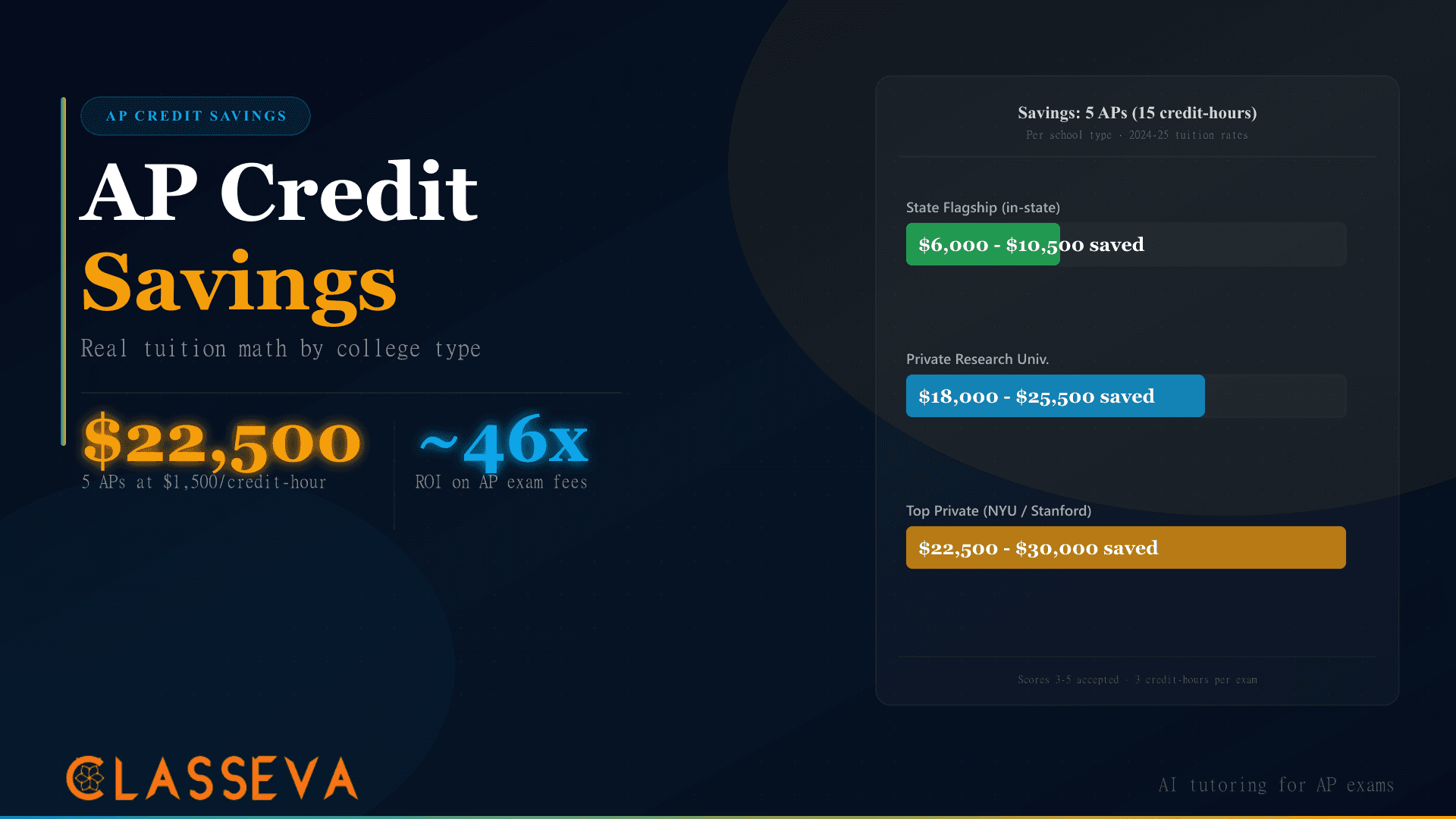
AP credit savings range from roughly $1,200 to $6,000 per qualifying exam, depending on your target school’s per-credit-hour tuition rate and how many credit-hours each AP exam awards at that institution. Five qualifying exams at a state flagship typically save $6,000 to $10,500 for in-state students. At a private research university, the same five exams can save $15,000 to $30,000.
Savings by School Type: State vs. Private
The clearest way to see the difference is to hold the AP side constant and change only the school. Assume you take five AP exams and earn a qualifying score on each. Most AP exams award 3 credit-hours when accepted, so five qualifying exams give you 15 incoming credit-hours. Here is what that translates to in tuition savings across school types:
| School Type | Per-Credit-Hour Rate | 15 Credits Saved | Min Score |
|---|---|---|---|
| State flagship (in-state) | ~$400 to $700 | $6,000 to $10,500 | 3 on most APs |
| State flagship (out-of-state) | ~$1,200 to $1,600 | $18,000 to $24,000 | 3 on most APs |
| Private research university | ~$1,200 to $1,700 | $18,000 to $25,500 | 4 or 5 on most APs |
| Top private (NYU, Stanford, BU) | ~$1,700 to $2,000 | $25,500 to $30,000 | 4 or 5; select subjects |
| Highly selective (Yale-tier) | N/A | Placement only, typically | Varies by school |
Estimates based on published 2024-25 tuition data. Actual savings depend on each school's specific AP credit policy, subject restrictions, and score thresholds.
The ROI Math: $130 Investment vs. Thousands in Savings
Each AP exam costs $98 in 2025, per College Board’s published exam fee schedule. Fee reduction waivers are available for qualifying students who demonstrate financial need. Add an optional prep book at $20 to $30 and your total investment per exam runs roughly $120 to $130. Five exams total approximately $600 to $650.
Against a $10,500 savings at an in-state state school, that investment returns roughly 16x. Against a $30,000 savings at a top private, the same investment returns 46x. Even a student who earns credit for only two of the five exams at a selective school still sees a 6x to 12x return on exam fees. This is one of the few genuinely high-ROI decisions available in high school, and it is also time-limited: you only take these courses once.
How Per-Credit-Hour Rates Shape Your Savings
Per-credit-hour tuition is the single largest variable in the AP credit equation. Two students can earn the same five AP scores and walk away with a $20,000 difference in savings depending purely on enrollment choice. The chart below compares approximate per-credit-hour rates at representative schools using their published 2024-25 tuition schedules. Green bars indicate state school in-state rates; teal bars indicate mid-range out-of-state and private rates; gold indicates the top-private tier.
Top Private University Rates: NYU, Stanford, BU
NYU charges approximately $2,000 per credit-hour for undergraduate students at its main campus, based on its published 2024-25 tuition schedule. UCLA’s registrar page shows that California residents pay roughly $700 per credit-hour while out-of-state students pay approximately $1,500. Stanford operates on a quarter system; its per-unit rate converts to approximately $1,900 per credit-hour equivalent. Boston University runs approximately $1,700 per credit-hour.
These figures are full tuition rates before financial aid. A student receiving substantial grant aid may find the dollar savings from AP credit smaller in practice: credit-hours eliminated reduce billable tuition that was already partially covered by grants. If your expected aid package covers a large portion of tuition, calculate your net cost of attendance before and after AP credit to determine your actual savings, not just the headline number.
State Flagship Rates: UCLA, UNC, UVA
State flagships operate at a very different scale for in-state students. UCLA charges approximately $700 per credit-hour for California residents. UNC-Chapel Hill and UVA fall in the $500 to $600 per credit-hour range for in-state students based on their 2024-25 published tuition rates. The University of Florida, Ohio State, and Purdue fall in similar in-state ranges.
Out-of-state rates at these same schools climb sharply. UCLA charges approximately $1,500 per credit-hour for non-California students. UVA charges approximately $1,600 per credit-hour for out-of-state enrollment. If you are applying as an out-of-state student to a flagship, the AP credit math looks similar to attending a mid-tier private university, not the in-state bargain most students picture.
AP Credit Savings Calculator
Enter your AP exams, expected scores, and target school type to see your projected tuition savings. The calculator applies each school type's per-credit-hour rate and credit policies to show your estimated savings side by side.
Which Universities Award AP Credit?
Most public universities award AP credit for scores of 3, 4, and 5 across a broad range of subjects. Many selective private universities restrict credit to scores of 4 or 5 on approved subjects. A small group of highly selective schools offers placement into advanced courses rather than equivalent credit units, which means limited or no direct tuition savings.
Yale, Brown, and MIT: What the Policy Means
Yale’s AP credit policy has historically centered on course placement rather than awarding credit units equivalent to Yale courses. Strong AP scores may let a student skip certain prerequisite courses or satisfy distributional requirements, but Yale does not generally replace Yale credit-hours with AP performance in the way a state school does. If your college cost plan depends on specific AP credit savings, verify Yale’s current policy directly, as Yale periodically updates its placement guidelines.
Brown’s open curriculum means AP scores can influence course placement and satisfy some requirements, but the savings mechanics are less predictable than at schools with structured general education requirements. MIT awards course credit for a select group of AP subjects with a score of 5: AP Calculus BC can award credit for MIT’s 18.01 (single-variable calculus), and AP Chemistry and AP Biology have specific qualifying conditions. MIT’s list is narrower than what most state universities offer and is published on MIT’s registrar site.
The most reliable way to verify current policy at any school is College Board’s AP credit policy search tool, which pulls directly from each institution’s reported data. Check it for every school on your list before assuming a specific savings figure.
Schools That Award Broad AP Credit
State flagships and most regional public universities award credit generously. The University of Florida, Ohio State, Penn State, Purdue, Michigan, UNC, and UVA all accept a wide range of AP subjects with scores of 3, 4, and 5. Many private universities in the $50,000 to $70,000 per year tuition range, including Northeastern, Syracuse, and Boston University, award credit on similar terms.
At these schools, the savings are predictable. Five qualifying APs commonly eliminate a full semester’s worth of credit-hours, roughly 15 credit-hours, which translates directly to tuition savings at the published per-credit-hour rate. Use the financial aid resources sectionto cross-check any school’s aid policies alongside its AP credit policies, since both affect your actual out-of-pocket cost.
How to Calculate Your AP Credit Savings
Calculating your actual savings takes seven steps. The first four gather the inputs; the last three do the math. The AP Credit Savings Calculator automates all seven once you enter your exams and target schools.
Find your target college's AP credit policy
Use College Board's AP credit policy search tool. Enter each school on your list to find which AP subjects it accepts, the minimum qualifying score, and how many credit-hours each exam awards.
List your qualifying AP exams and expected scores
Write down every AP exam you plan to take or have already taken. Only include exams where you meet or exceed the school's minimum score threshold for credit. Conservative estimates produce more reliable savings projections.
Calculate total incoming credit-hours
Most AP exams award 3 credit-hours. AP Calculus BC may award 6 to 8 credit-hours at schools that count it as two courses. Add up all qualifying credit-hours to get your total entering credit-hour count.
Find the per-credit-hour tuition rate
Navigate to each college's registrar or bursar page. Look for the tuition rate listed per credit-hour or per unit. If only a per-semester or per-year rate is published, divide by the standard full-time credit load (typically 15 to 18 credits per semester).
Multiply credit-hours by the per-credit-hour rate
This calculation gives your estimated tuition savings. At $700 per credit-hour, 15 qualifying credits save $10,500. At $1,500 per credit-hour, the same 15 credits save $22,500. Run this for each school on your list.
Subtract your AP exam investment for net ROI
Each AP exam costs $98 in 2025 plus roughly $20 to $40 in prep materials. Five exams run $590 to $690 in total investment. Subtract this from your savings estimate to get your net return.
Confirm which credits apply toward required courses
Contact the academic advising office or department directly to confirm that AP credit satisfies required courses in your intended major, not only general electives. This step determines whether AP credit shortens your degree or just adds flexibility.
State Flagship (In-State)
- •$400 to $700 per credit-hour
- •Credit for scores of 3, 4, or 5 on most AP exams
- •15 qualifying credits save $6,000 to $10,500
- •Broad subject coverage; check registrar for exclusions
Private Research University
- •$1,200 to $1,700 per credit-hour
- •Credit typically restricted to scores of 4 or 5
- •15 qualifying credits save $18,000 to $25,500
- •Subject restrictions vary; AP Chemistry and Calculus most accepted
Highly Selective (Yale, MIT)
- •Per-credit-hour rate: $1,900 to $2,100
- •Placement rather than credit units in many cases
- •MIT awards credit for select subjects with a score of 5
- •Verify current policy at College Board search tool
Which AP Subjects Give the Most Credit Value?
Not all AP exams are equally valuable from a credit perspective. The number of credit-hours an AP exam replaces varies by subject and by school policy, creating significant differences in savings even within the same tuition tier.
AP Calculus BC stands out as the highest-value single AP exam. Most universities award 6 to 8 credit-hours for a passing score, because BC covers both Calculus I and Calculus II content in one course. At a school charging $1,500 per credit-hour, AP Calculus BC alone eliminates $9,000 to $12,000 in tuition. At a $2,000 per credit-hour school, that figure reaches $12,000 to $16,000 from a single exam.
AP Physics Cis offered as two separate exams: Mechanics and Electricity and Magnetism. Engineering programs at most universities require two semesters of calculus-based physics. Passing both AP Physics C exams can eliminate both requirements. That’s 6 credit-hours of required engineering coursework at a school that accepts both exams. Combined with AP Calculus BC, a student entering an engineering program with these three AP scores can eliminate the equivalent of a full semester of required first-year courses.
AP Chemistry and AP Biology each award 3 credit-hours at most schools that accept them. Both are particularly valuable for pre-med students, who typically need both introductory chemistry and biology sequences. Passing both can eliminate an entire semester of required pre-med prerequisites. For computer science students, AP Computer Science A often replaces the required intro programming course.
Can AP Credit Help You Graduate Early?
Graduating a full semester early is realistic at most state universities if you enter with 15 or more AP credit-hours and maintain a focused course schedule. A semester saved at an in-state school with a $25,000 per year cost of attendance represents roughly $12,500 in total savings beyond the credit-hour savings already counted. At a $75,000 per year private, avoiding one semester saves more than $37,000 in cost of attendance.
The Early Graduation Math
Entering college with 15 AP credit-hours means you start with 12.5% of a 120-credit-hour degree already completed. At most universities, that is enough to shorten your enrollment by one semester if the credits apply toward required courses rather than stacking into elective hours. This requires deliberate planning: scheduling AP credits toward general education requirements that appear in your first two years, and confirming with your academic advisor that the credits satisfy those requirements specifically.
The caveat: programs with rigid course sequences, particularly engineering, nursing, and architecture, sometimes see AP credits reduce elective flexibility rather than shorten time to degree. Some programs require their own section of foundational courses regardless of AP performance. The conversation with your program advisor is not optional before building a graduation plan around AP credit.
AP Credit vs. Dual Enrollment Credit
Dual enrollment courses, where a high school student takes an actual college course for credit through a community college or university, tend to transfer more universally than AP credit. Because dual enrollment generates a real college transcript with a letter grade, it bypasses the score-threshold restrictions that AP policies impose.
A score of 3 on the AP exam may not earn credit at a selective private university; a B in the equivalent dual enrollment course typically transfers as a graded B toward degree requirements under a formal articulation agreement. This makes dual enrollment a more predictable tool at schools that restrict AP credit to scores of 4 or 5 on approved subjects.
The tradeoffs: AP exams are standardized across all students, taken in May, and assessed against a national rubric. Dual enrollment requires successfully completing a college-level course with a grade your target school will accept, and verifying that the specific course title appears in an articulation agreement between the community college and your target university. For students targeting schools that restrict AP credit, dual enrollment through an accredited institution may guarantee the credit-hour savings more reliably. For students targeting schools with broad AP credit policies, the AP exam at $98 is often the simpler and cheaper path to the same credit.
If AP scores and college selection are both still in progress, the AP Score Predictor can help you estimate your realistic score range before committing to an AP-specific credit savings strategy. A student unlikely to score above a 3 at a school requiring a 4 for credit may be better served by dual enrollment for that particular subject.
When AP Credit Can Work Against You
There are three edge cases where AP credit can create problems rather than savings, and they are worth knowing before building a plan around AP-heavy course selection.
First, skipping foundational context. At schools where AP credit satisfies major prerequisites, a strong AP score in a foundational subject can place you past introductory material that provides essential grounding. A student who places out of introductory chemistry via AP and then struggles in organic chemistry may have been better served by retaking the intro course even without the credit savings. This is particularly common in biology and chemistry sequences, where understanding mechanism from first principles matters for every subsequent course.
Second, financial aid recalculations. Some scholarship programs and financial aid packages tie eligibility to enrolled credit-hours. Students who enter with substantial AP credit may find themselves classified as part-time or below the credit threshold for certain awards in later semesters if they reduce their course load after satisfying requirements early. Confirm the credit-hour requirements for any scholarship you hold before relying on AP credit to reduce your course load.
Third, honors and specialized program requirements. Some honors programs, pre-professional cohorts, and dual-degree programs require students to complete specific foundational courses within the program regardless of AP performance. Check program admission and continuation requirements directly rather than assuming AP credit satisfies specialized program prerequisites.
For a fuller picture of how AP credits interact with cost of attendance and financial aid packaging, the College Net Cost Estimator lets you model different credit and aid scenarios together. You can also read about how to interpret college financial aid packages in our net price vs sticker price guide.
AP Credit Savings Calculator
Model your AP credit savings across different school types. Enter your expected scores and target college to see projected tuition savings, early graduation potential, and net ROI on your AP exam investment.
Key Takeaways
- AP credit savings range from $1,200 to $6,000 per qualifying exam depending on the school’s per-credit-hour rate. Five qualifying exams save $6,000 to $10,500 at a state flagship and $22,500 to $30,000 at a top private university.
- Most state universities award credit for AP scores of 3, 4, and 5. Most selective private universities restrict credit to scores of 4 or 5 on approved subjects. Verify each school’s current policy at the College Board AP credit search tool before committing to a savings plan.
- Yale’s AP policy centers on placement rather than direct credit units. MIT awards credit for a narrow list of subjects with a score of 5. Never assume a school awards credit without confirming its specific policy.
- AP Calculus BC delivers the highest credit value of any single AP exam, typically replacing both Calculus I and Calculus II for 6 to 8 credit-hours, worth $9,000 to $16,000 in tuition at private university rates.
- The ROI on AP exams is significant: roughly $130 in total investment per exam, against potential savings of $4,500 to $6,000 per exam at a typical private university charging $1,500 per credit-hour.
- Graduating one semester early with AP credits saves an additional $12,500 to $37,500 in cost of attendance on top of the credit-hour savings, depending on the school’s annual cost of attendance.
- Always confirm with your academic advisor or department that AP credits apply toward required major courses and not only open elective slots, since the placement matters as much as the credit count.