Merit-Based Scholarships: Which Colleges Actually Offer Them
Harvard, Yale, Princeton, MIT, and Stanford have one thing in common that surprises many families researching financial aid: none of them offer merit-based scholarships. Their aid programs run exclusively on demonstrated financial need. A student with a 1600 SAT, a 4.0 GPA, and a full list of AP credits receives no additional institutional grant beyond what their family’s income and assets qualify them for.
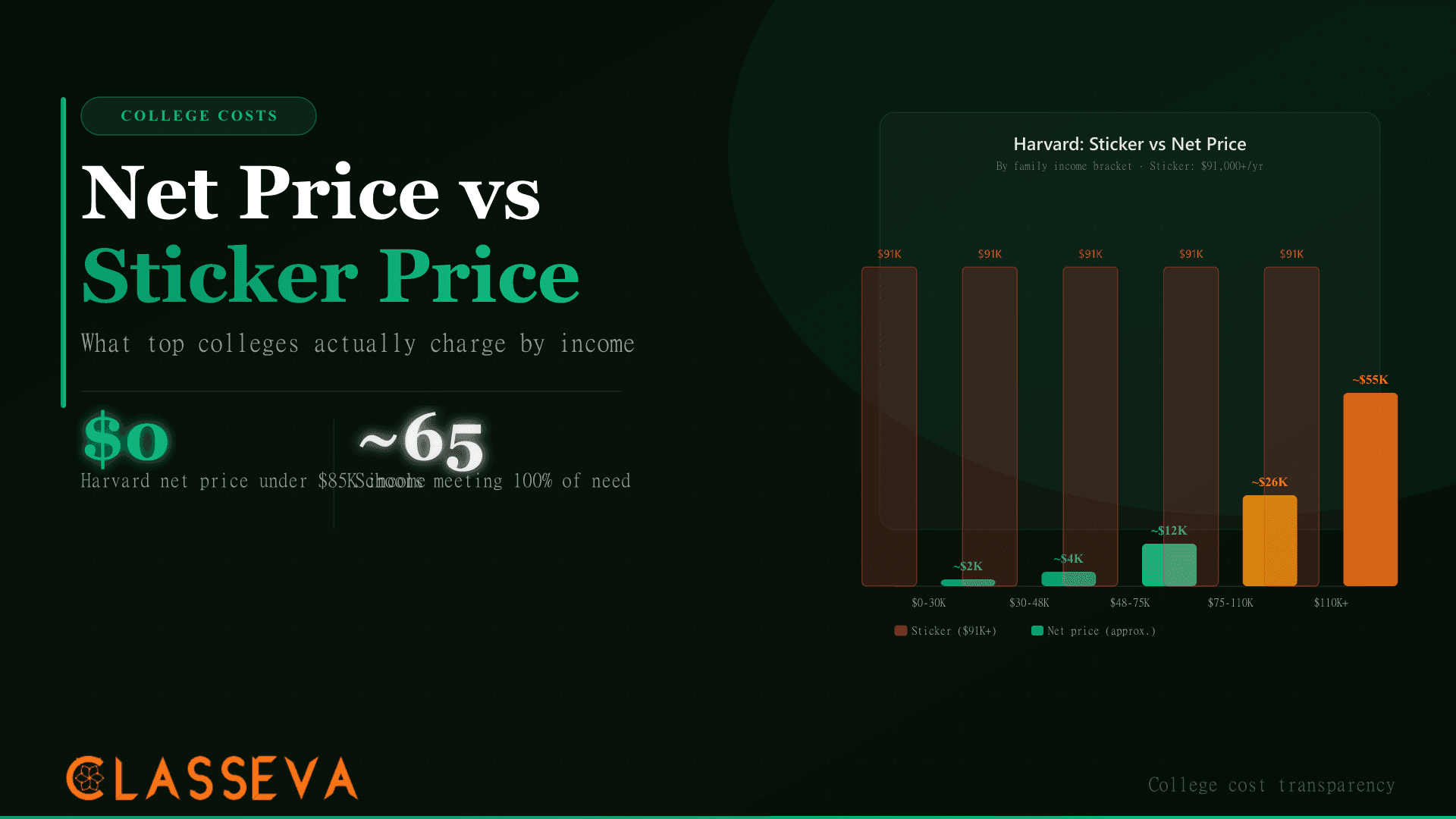
For families earning less than $85,000, that policy produces a net price of $0 at Harvard. For families earning $200,000 or more, it produces a bill approaching $91,000 per year with no institutional relief in sight. Students in that second category who want their college costs reduced need a different college list entirely.
What Is Merit Aid and How Is It Different From Need-Based Aid?
Merit-based aid is institutional financial assistance awarded based on a student’s academic performance, test scores, talent, or leadership qualities, independent of family income. A student from a family earning $500,000 per year can qualify for merit scholarships. Need-based aid, by contrast, flows from the FAFSA-derived Student Aid Index (SAI); the family’s financial situation, not their academic record, determines the award.
The distinction appears directly in the Common Data Set (CDS) that every Title IV-eligible institution publishes annually. Section H, line H1, documents exactly how many first-year students received non-need-based institutional grants and what the average amount was. For Harvard, Yale, Princeton, MIT, Stanford, and all eight Ivy League schools, that line reads: zero students, zero dollars.
Why This Distinction Changes Your College List Entirely
Building a college list without understanding this distinction is one of the most expensive mistakes families make. A family earning $160,000 who applies exclusively to Ivy League schools and MIT will receive little to no institutional grant aid at any of them. The same student, applying to Vanderbilt with a strong academic profile, may receive a Cornelius Vanderbilt Scholarship covering full tuition. That single application decision represents a potential four-year difference of $140,000 to $220,000. [VERIFY: current Vanderbilt tuition figures.]
Most college ranking lists rank schools by prestige, not by generosity to high-income families. A school ranked 25th nationally may offer dramatically more financial relief than schools ranked 5th through 15th, because the top schools have shifted entirely to need-based aid models.
Why Ivies, MIT, and Stanford Don’t Offer Merit Scholarships
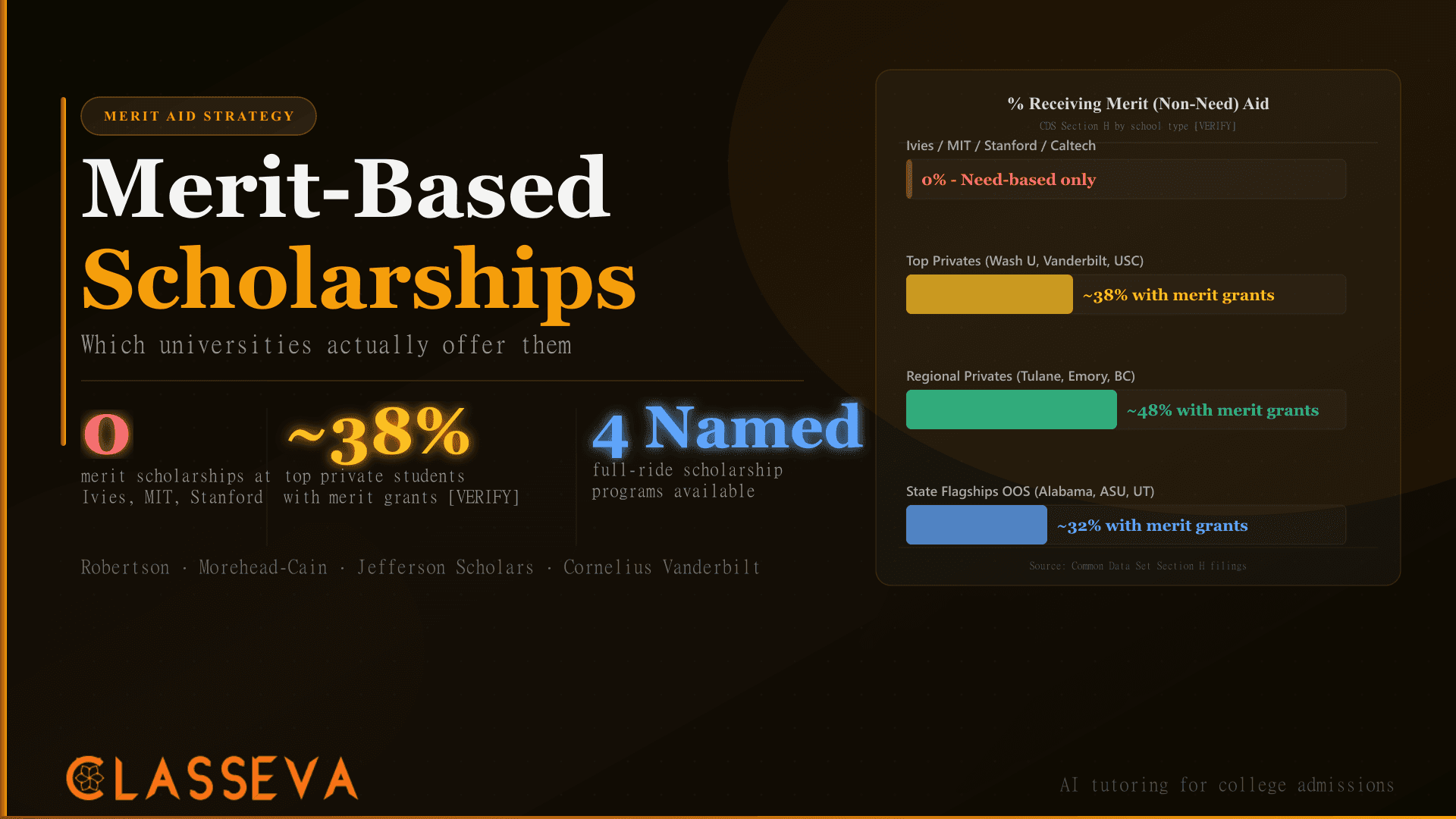
The Ivy League, MIT, Stanford, and Caltech operate on need-based-only aid models. No institutional merit scholarships exist at these schools. If you see a student with a 1600 SAT attending Harvard on a full scholarship, that scholarship reflects the family’s financial need, not the SAT score.
What Harvard, Yale, and Princeton Actually Offer
These schools offer some of the most generous need-based aid programs in the country. Harvard commits that families earning under $85,000 pay $0 in tuition, room, board, and fees. Families from $85,000 to $150,000 pay no more than 10% of annual income. Princeton operates a similar program, and Yale’s need-based aid scales comparably. For families in those income ranges, these schools frequently cost less out-of-pocket than state universities.
The schools covered by need-only policies include all eight Ivies (Harvard, Yale, Princeton, Columbia, Brown, Dartmouth, UPenn, Cornell), MIT, Stanford, and Caltech. Some of them, like Harvard and Yale, have explicitly confirmed that they will not introduce merit scholarships, a policy they view as preserving their aid budget for students who need it most.
The Endowment Logic Behind Need-Only Aid
Harvard’s endowment exceeded $50 billion in 2024. At that scale, distributing merit awards to wealthy students who don’t need financial help reduces the institutional aid pool available to families that do. The logic is straightforward: every dollar of merit aid sent to a family earning $300,000 is a dollar not available to a family earning $30,000. Schools with massive endowments choose to maximize access, not to compete for high-achieving wealthy students through financial incentives.
Which Top Private Universities Have Strong Merit Aid Programs?
Outside the Ivy League cluster, a distinct group of selective private universities competes for top students using substantial merit scholarships. These schools sit in the top 30 to 50 nationally and distribute non-need-based institutional grants to 30-50% of their entering classes.
Wash U, Vanderbilt, and USC
Washington University in St. Louis distributes merit scholarships at one of the highest rates among top-30 institutions. Roughly 40-45% of entering students receive non-need-based institutional awards. [VERIFY] The John B. Ervin Scholars Program, the Myron Glassberg Scholars Program, and several other named awards span a range of amounts from partial to near-full tuition.
Vanderbilt’s Cornelius Vanderbilt Scholarship covers full tuition for approximately 40 students per year, selected from the most exceptional applicants in the entering class. [VERIFY: number of recipients.] Below that tier, Chancellor’s Scholarships, Dean’s Scholarships, and Ingram Scholarships extend merit aid to a broader share of admitted students. For high-income families, Vanderbilt often produces a lower net cost than any Ivy League school.
USC runs one of the most publicly visible merit programs at a major research university. The Trustee Scholarship covers full tuition for admitted students in the top academic tier. Presidential Scholarships cover approximately half of tuition. Both are automatically considered at application. No separate application or notification of interest in merit aid is required.
Notre Dame, Boston College, Tulane, and Emory
Tulane’s Paul Tulane Award covers full tuition for students with a 3.75 GPA and a 34+ ACT score or equivalent SAT. [VERIFY: current thresholds.] That threshold is lower than the average profile of students enrolled at schools like Wash U or Vanderbilt, making Tulane one of the most accessible full-tuition merit scholarships at a recognized research university.
Emory’s Robert W. Woodruff Scholarship and Emory Scholars Program distribute awards ranging from partial scholarships to full-tuition recognition. Notre Dame’s Hesburgh-Yusko Scholars Program blends merit and mission-fit criteria in its selection. Boston College’s Presidential Scholars program covers tuition for a small cohort of top academic performers.
| School | Top Merit Award | Approx. Value | % Receiving Merit Aid |
|---|---|---|---|
| Washington University in St. Louis | Multiple named tiers | $20,000 - full tuition | ~40-45% [VERIFY] |
| Vanderbilt | Cornelius Vanderbilt Scholarship | Full tuition (~$60,000/yr) | ~40% [VERIFY] |
| USC | Trustee Scholarship | Full tuition (~$66,000/yr) | ~45% [VERIFY] |
| Tulane | Paul Tulane Award | Full tuition (~$65,000/yr) | ~55% [VERIFY] |
| Emory | Emory Scholars / Woodruff | $15,000 - full tuition | ~38% [VERIFY] |
| Boston College | Presidential Scholars | Full tuition (~$65,000/yr) | ~30% [VERIFY] |
| Notre Dame | Hesburgh-Yusko Scholars | $10,000 - full tuition | ~22% [VERIFY] |
Approximate merit aid data for selective private universities. [VERIFY: all figures against each school's most recent CDS Section H and official scholarship pages.]
Which State Flagships Offer Merit Aid to Out-of-State Students?
State universities traditionally served their home-state residents. Over the past two decades, many flagships have developed aggressive out-of-state merit scholarship programs designed to recruit top national talent. The incentive is straightforward: out-of-state students pay higher tuition, and attracting high-achieving students improves rankings and national visibility. A full-tuition out-of-state scholarship can still generate positive net revenue for the university while representing massive savings for the student.
Alabama, Arizona State, and Tennessee: Named Programs
The University of Alabama runs one of the most well-documented merit programs in this category. Out-of-state students with a 3.5 GPA and a 30 ACT score (or equivalent SAT) can receive a Presidential Scholarship covering full out-of-state tuition. [VERIFY: current thresholds and award amounts; Alabama’s scholarship tiers adjust annually.] Higher test score ranges qualify for the University Fellows and Computer-Based Honors scholarships, which add stipends and housing allowances.
Arizona State University offers the New American University Scholarship and Provost Scholarship to high-achieving out-of-state applicants. The University of Tennessee awards Chancellor’s Honors Scholarships to out-of-state students at the top of their incoming class. The University of South Carolina’s McKissick Scholars and Capstone Scholars programs operate on similar competitive merit frameworks for out-of-state recruits.
| State Flagship | Merit Scholarship Name | Approx. Threshold | Award |
|---|---|---|---|
| University of Alabama | Presidential Scholarship | 3.5 GPA + 30 ACT [VERIFY] | Full OOS tuition |
| University of Alabama | University Fellows | 3.5 GPA + 33 ACT [VERIFY] | Full tuition + stipend |
| Arizona State University | New American U. Scholarship | Top-tier academic profile | Varies up to full tuition |
| University of Tennessee | Chancellor's Honors | 3.5 GPA + 29 ACT [VERIFY] | $12,000-$20,000/yr |
| University of South Carolina | McKissick / Capstone Scholars | 3.8 GPA + 32 ACT [VERIFY] | $20,000+/yr |
[VERIFY all thresholds and award amounts against each university's official scholarship office website before application.] Thresholds change annually.
State flagship merit awards are often distributed on a first-come, first-served basis among qualified applicants. At the University of Alabama, priority scholarship deadlines fall as early as November 1. Students who apply Regular Decision may find the top scholarship tiers already fully committed even if their academics qualify.
The Most Prestigious Named Merit Scholarship Programs
Named scholarship programs sit above standard merit packages. They select students not only on academic strength but on leadership potential, character, and fit with a specific mission. Most require separate applications and campus interview visits. The awards cover full attendance costs and include distinctive programming.
Robertson Scholars Leadership Program (Duke and UNC)
Approximately 36 scholars per year, split between Duke University and the University of North Carolina at Chapel Hill. The award covers full tuition, housing, fees, and a living stipend, plus four structured summers and the option to spend a semester at the partner campus. Selection involves a multi-day campus visit and interviews. Academic strength is a threshold, not the deciding criterion.
Morehead-Cain Scholarship (University of North Carolina at Chapel Hill)
Founded in 1945, the Morehead-Cain is one of the oldest merit scholarships in the United States. Approximately 30-35 scholars enter UNC each year. [VERIFY] The award covers full tuition, room and board, books, and a laptop, plus four summer enrichment programs spanning leadership development, entrepreneurship, outdoor challenge, and international exploration. Schools nominate candidates; direct applications are not accepted.
Jefferson Scholars Foundation (University of Virginia)
The Jefferson Scholarship covers full tuition, room and board, and an allowance for books and expenses at UVA. Selection proceeds through a competitive campus interview process. The Foundation also runs a graduate fellowship. Academic distinction combined with evidence of leadership and service drives the selection process.
Cornelius Vanderbilt Scholarship (Vanderbilt University)
Vanderbilt awards the Cornelius Vanderbilt Scholarship to approximately 40 students per year from the top of its entering class. [VERIFY: current number of awards.] The scholarship covers full tuition and includes a $500 annual enrichment stipend. Unlike the Robertson and Morehead-Cain, it does not require a separate application; Vanderbilt identifies candidates from the regular applicant pool.
How CDS Section H Reveals Any School’s Merit Aid Practices
The Common Data Set is a standardized reporting document that every Title IV-eligible college completes annually. Section H covers student financial aid and is the most direct source for comparing merit aid across institutions. Unlike promotional materials on financial aid websites, the CDS contains hard numbers that apply to the actual enrolled freshman class.
Line H1 of Section H asks each institution to report the number and percentage of full-time, first-time, first-year students who received institutional non-need-based scholarship or grant aid. It also asks for the average dollar amount of those awards. These two numbers tell you immediately whether a school has an active merit aid program and what scale those awards reach.
Finding CDS data: search “[school name] Common Data Set [year]” in any search engine. Most schools host PDFs on their institutional research or budget office pages. The NCES College Navigatorlinks to each school’s Net Price Calculator but also provides direct institutional data points worth cross-referencing.
From CDS Section H, pull two figures: (1) the percentage of freshmen receiving non-need-based institutional grants, and (2) the average amount. A school where 40% receive an average $24,000 in non-need-based grants looks sharply different from a school where 8% receive an average $5,000. The first is merit-active. The second is essentially need-only with minimal exceptions.
Merit Aid vs Need-Based Aid: The Break-Even Math
For families earning under $75,000, need-based schools often produce lower net prices than merit schools. Harvard’s $0 net price for those families is hard to beat. For families earning $150,000 to $250,000, the calculus reverses. This is the income band where merit aid matters most, because need-based programs at most selective schools produce diminishing returns.
| Household Income | Harvard (Need-Based Only) | Vanderbilt (Merit + Need) | State Flagship (Merit OOS) |
|---|---|---|---|
| Under $75,000 | ~$0 net price | ~$10,000-$25,000 | ~$5,000-$18,000 |
| $75,000-$125,000 | ~$15,000-$40,000 | ~$15,000-$35,000 | ~$15,000-$28,000 |
| $125,000-$175,000 | ~$40,000-$65,000 | ~$20,000-$40,000 | ~$15,000-$28,000 |
| $175,000-$250,000 | ~$65,000-$85,000 | ~$25,000-$50,000 | ~$15,000-$28,000 |
| Over $250,000 | ~$87,000-$91,000 | ~$30,000-$60,000 | ~$15,000-$28,000 |
Estimated annual net price by income bracket and school type. [VERIFY: against current FAFSA aid estimator outputs and each school's Net Price Calculator. State flagship figures assume full out-of-state merit scholarship award.] Figures are illustrative. Actual awards depend on family assets, household size, and specific school formulas.
One thing I notice consistently when reading through CDS Section H data: the break-even point between need-only schools and merit-active schools for most families sits around $125,000 to $150,000 household income. Below that, Harvard’s need-based generosity dominates. Above it, a Cornelius Vanderbilt Scholarship or a Paul Tulane Award can cut four-year costs by $150,000 to $240,000 compared to paying near-sticker at an Ivy.
This does not mean families at those income levels should skip Ivy applications. It means they should not skip merit-active schools either. Both categories belong on the same college list, and understanding the net price vs sticker price gap at each institution is how you build a list that controls the real cost.
How to Build a College List That Captures Merit Aid
A college list optimized for merit aid looks different from a list built around prestige rankings alone. It includes schools where your academic profile puts you in the top 10-20% of admitted students, because that relative position drives the size of the merit award. Applying only to schools where you are at the median of their admitted class produces median merit offers; applying to schools where you are well above median produces their best offers.
The Four-Step Merit Aid Strategy
Calculate your SAI using the Federal Student Aid estimator
Visit studentaid.gov and use the FAFSA Aid Estimator before finalizing your college list. Your SAI tells you what need-based aid programs will produce. Families with an SAI above $50,000 should treat merit aid research as a high priority because need-based institutional grants at most selective schools become minimal at and above that threshold.
Pull CDS Section H data for every school you are considering
Check line H1 in the most recent CDS for each school on your list. Note the percentage of freshmen receiving non-need-based grants and the average award. Schools where that percentage exceeds 30% and the average exceeds $15,000 are worth targeting as merit opportunities. Track these numbers in a simple spreadsheet.
Include at least two merit-friendly schools as financial safeties
A financial safety school is one where your academic profile sits clearly above the median of their admitted class, producing a predictably strong merit offer. State flagships with documented merit programs, plus regional privates like Tulane or Emory, serve this function well. Use the Scholarship Probability Estimator at Classeva to assess your position relative to each school's profile.
Submit named scholarship applications on separate timelines
Named programs like Robertson, Morehead-Cain, and Jefferson Scholars have deadlines that often precede standard application deadlines by several weeks. Vanderbilt's Cornelius Vanderbilt Scholarship requires no separate application, but programs at Duke, UNC, and UVA do. Add named scholarship deadlines to your calendar immediately after identifying which programs you plan to pursue.
Estimate Your Scholarship Probability
Enter your GPA, test scores, and target schools to see where your academic profile lands relative to each school's merit scholarship thresholds.
For context on how these decisions connect to long-term cost savings, the AP credit savings analysis shows how AP exam scores can reduce tuition further once you are enrolled, cutting overall cost regardless of which tier your college falls into. And the College Net Cost Estimator lets you run the actual comparison across specific schools on your list.
One more path worth including in your research: the FAFSA step-by-step walkthrough explains how to maximize your need-based aid eligibility before FAFSA filing, which stacks with merit aid at schools that offer both. Even at merit-active schools, need-based aid supplements merit packages for qualifying families.
Key Takeaways
- Harvard, Yale, Princeton, MIT, Stanford, and all eight Ivy League schools offer zero merit-based scholarships; aid at these institutions is purely need-based.
- Washington University in St. Louis, Vanderbilt, USC, Tulane, and Emory distribute substantial merit aid, often making them significantly cheaper than Ivies for families earning over $150,000.
- State flagships including the University of Alabama, Arizona State, and the University of Tennessee offer full out-of-state tuition scholarships to top academic performers through documented merit programs.
- Named programs (Robertson, Morehead-Cain, Jefferson Scholars, Cornelius Vanderbilt) represent the most prestigious merit opportunities but require separate competitive applications and campus interview visits.
- CDS Section H, line H1, documents what percentage of freshmen receive non-need-based grants and at what average amount, giving you a direct comparison tool across any institution.
- The break-even point between need-only Ivies and merit-active schools sits around $125,000 to $150,000 household income for most families; above that range, merit aid often produces lower net costs.
- A well-structured college list includes schools from multiple tiers: need-based powerhouses for lower-income families, merit-generous top privates, state flagship merit targets, and named scholarship programs for the most competitive applicants.