University of California Admissions Decoded: 2026 Guide
Here is the fact that surprises most families researching UC admissions for the first time: test scores don't matter at all. Not slightly less. Not as a tiebreaker. Not even read. The University of California system is fully test-blind, which means that a student with a 1600 SAT and a student with no SAT score whatsoever are evaluated on identical factors.
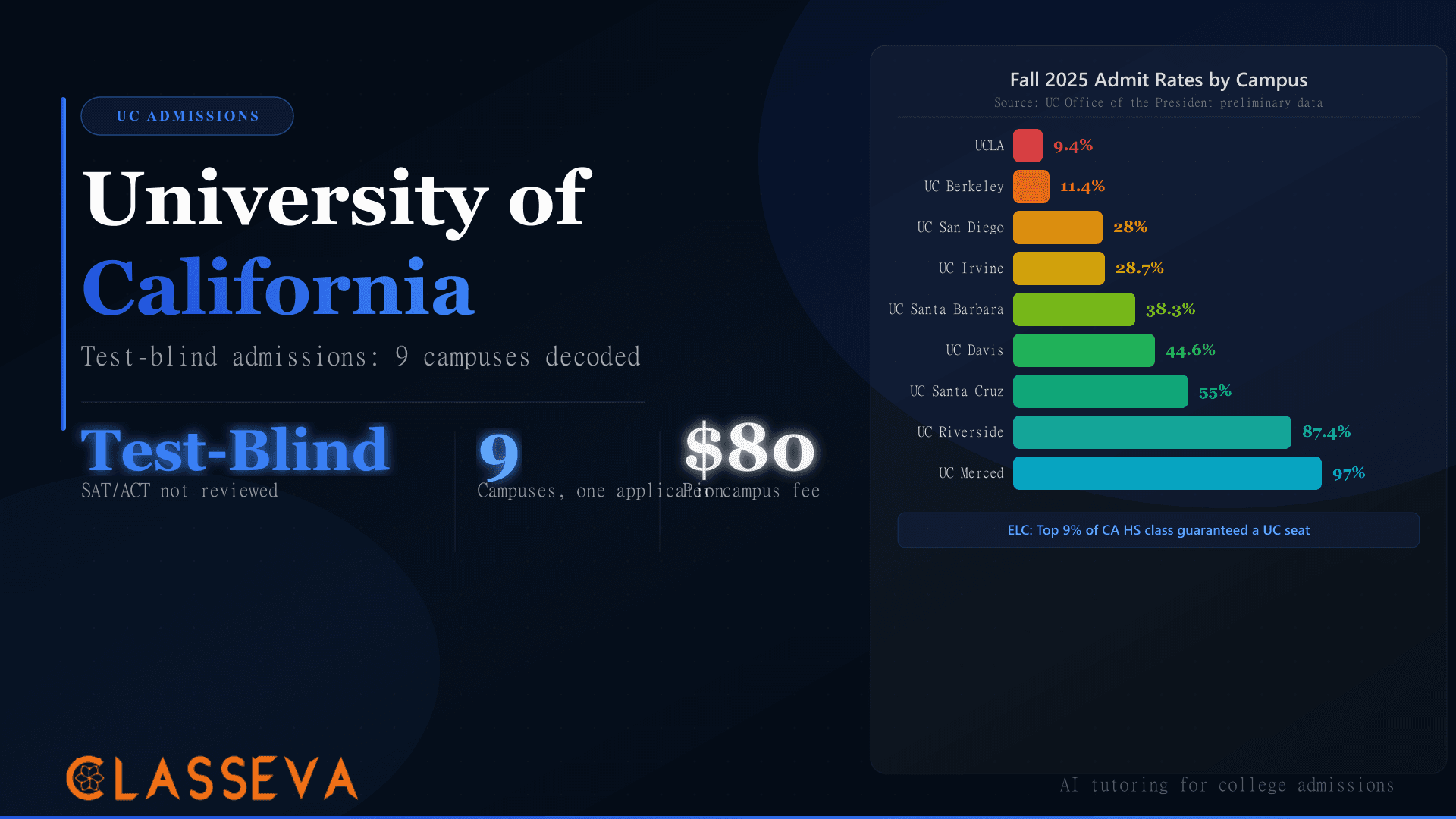
That shift changes the entire calculus of preparing for UC admissions. What fills the space that test scores left behind is a combination of GPA in a specific set of coursework, the Personal Insight Questions, and a set of factors that vary by campus. The spread in selectivity across the 9 campuses is enormous: UCLA admitted 9.4% of applicants in 2025 while UC Merced admitted roughly 97%. One application, one portal, and that range of outcomes.
What Does It Take to Get Into a UC Campus?
Getting into a UC campus requires meeting California's A-G course requirements, earning a qualifying GPA, and submitting the UC application with four Personal Insight Question responses by November 30. What “qualifying” means depends heavily on which campus you target.
GPA and Course Requirements
The minimum GPA to apply is 3.0 for California residents and 3.4 for out-of-state and international applicants, calculated in UC-approved “A-G” coursework only. The A-G requirements specify 15 college-preparatory courses across history, English, math, science, foreign language, visual/performing arts, and an elective. At least 11 of those 15 courses must be completed before senior year.
Meeting the minimum gets you eligible to apply. Getting admitted to a selective campus requires substantially more: admitted students at UCLA and Berkeley typically show UC-calculated GPAs above 4.15. The GPA range at Davis and Santa Barbara runs closer to 4.0 to 4.25. Riverside and Merced admit students across a much broader GPA spectrum.
What Replaces Test Scores in Review
UC's holistic review process evaluates 13 criteria published by the Office of the President. These include GPA and course rigor (with particular attention to honors, AP, and IB courses), the Personal Insight Questions, special talents or awards, family educational attainment, geographic context, and whether the applicant overcame significant challenges. No single criterion determines admission, though GPA in A-G coursework and the PIQ responses carry the most weight in the application file.
Each campus weights the 13 review criteria differently. Berkeley and UCLA place heavier emphasis on academic achievement and research context. Davis and Santa Cruz weight first-generation college student status more prominently. Check each campus's published holistic review criteria at admission.universityofcalifornia.edu.
How Do the 9 UC Campuses Compare in Selectivity?
The 9 UC undergraduate campuses span a wider selectivity range than most applicants expect. UCLA, at 9.4% for Fall 2025, sits alongside Ivy-caliber admit rates. UC Merced, at the other end, accepts virtually everyone who meets eligibility requirements.
| Campus | Fall 2025 Admit Rate | Selectivity Tier |
|---|---|---|
| UCLA | 9.4% | Highly Selective |
| UC Berkeley | 11.4% | Highly Selective |
| UC San Diego | ~28% | Selective |
| UC Irvine | 28.7% | Selective |
| UC Santa Barbara | 38.3% | Moderately Selective |
| UC Davis | 44.6% | Moderately Selective |
| UC Santa Cruz | ~50-60% | Accessible |
| UC Riverside | 87.4% | Open Access |
| UC Merced | ~97% | Open Access |
Sources: UC Office of the President preliminary admit data, Fall 2025. UC Santa Cruz rate is approximate.
Reading the Admit Rate Spread
The spread from 9.4% to 97% makes UC campus selection genuinely strategic. A student with a 3.8 GPA is statistically unlikely to get into UCLA but nearly certain to be admitted to Merced and Riverside. A student applying only to UCLA and Berkeley without including Davis or Irvine as realistic options takes a large risk for no additional cost.
Applying to multiple campuses costs more in fees but dramatically improves the odds of receiving at least one offer. A student targeting only UCLA and Berkeley spends $160 for two long-shot applications. Adding Davis, Irvine, and Santa Cruz for $240 more produces a portfolio with several realistic admits included.
What Does “Test-Blind” Actually Mean for UC Applicants?
Test-blind means UC admissions officers never see your SAT or ACT score. The score is not reviewed, not used as a tiebreaker, not factored into scholarship calculations for admission-linked merit awards. It is completely absent from the decision.
What UC Does and Does Not Do With Scores
You can still submit SAT or ACT scores as part of your UC application, and UC campuses may use them for placement into math or writing courses after you enroll. They may also count toward satisfying certain eligibility requirements if your GPA is borderline. But in the admissions decision itself, test scores carry zero weight.
Test-optional schools (like many private universities) still read submitted scores and factor them into the holistic review. Test-blind schools do not. UC is test-blind, not test-optional. Submitting a strong score does not help your UC application; a weak score cannot hurt it. Prep time invested in the SAT or ACT for UC admissions is prep time not spent on the Personal Insight Questions, which do matter.
The test-blind policy has remained in place through the 2026 application cycle. Discussions within the UC Academic Senate about potentially reinstating standardized testing have not produced a policy change. Students applying for fall 2027 admission should plan under the assumption that test-blind remains in effect, but monitor admission.universityofcalifornia.edu for any official updates.
How Do the Personal Insight Questions Work?
The UC application includes 8 Personal Insight Questions. Students choose exactly 4 to answer, with a hard cap of 350 words per response. These four essays are the primary writing sample UC admissions officers read, and they replace the Common App personal statement entirely.
The 8 questions are:
- Describe an example of your leadership experience in which you have positively influenced others, helped resolve disputes, or contributed to group efforts over time.
- Every person has a creative side, and it can be expressed in many ways: problem solving, original and innovative thinking, and artistically, to name a few. Describe how you express your creative side.
- What would you say is your greatest talent or skill? How have you developed and demonstrated that talent over time?
- Describe how you have taken advantage of a significant educational opportunity or worked to overcome an educational barrier you have faced.
- Describe the most significant challenge you have faced and the steps you have taken to overcome this challenge. How has this challenge affected your academic achievement?
- Think about an academic subject that inspires you. Describe how you have furthered this interest inside and/or outside of the classroom.
- What have you done to make your school or your community a better place?
- Beyond what has already been shared in your application, what do you believe makes you a strong candidate for admissions to the University of California?
Which Four Should You Choose?
Choose the four questions where your answers reveal something concrete, specific, and uniquely yours. Admissions readers at Berkeley and UCLA review thousands of PIQs per cycle. Generic answers to question 5 (“I overcame a challenge by working hard”) blend into the stack. Specific answers tied to a particular experience, outcome, or skill stand out.
Question 8 (“Beyond what has already been shared”) is the most open-ended and the easiest to write poorly. It works best when a student has something genuinely important that did not fit elsewhere in the application: a significant achievement, an unusual talent, or context that changes how the rest of the file should be read.
The 350-Word Constraint
350 words is tight. A typical double-spaced page runs 250 to 300 words. Students who try to cram a 650-word Common App essay into a PIQ response produce cluttered, rushed writing that loses points on clarity. The better approach: write the 350-word version from the start with one specific story and one clear takeaway. Breadth is the enemy of a strong PIQ.
Since UC's application is separate from the Common App essay prompts, students applying to both UC campuses and private universities need to prepare two distinct sets of essays: four 350-word PIQ responses for UC and the 650-word Common App personal statement for private schools.
What GPA Do You Need for UC?
The UC minimum GPA is 3.0 for California residents and 3.4 for nonresidents, calculated only in A-G courses from grades 10 and 11. Meeting that minimum makes you eligible to apply. Admitted students at selective campuses show GPAs substantially above the floor.
California vs Out-of-State GPA Standards
The 3.0 vs 3.4 split reflects California's obligation to prioritize in-state students. California residents who meet the 3.0 threshold can apply to any UC campus. Out-of-state applicants must also show a stronger academic profile, and they compete in a separate admission pool capped at 18% of new freshman enrollment systemwide.
Understanding the UC Capped Weighted GPA
UC calculates its own GPA, different from what you see on your high school transcript. The UC GPA uses only 10th and 11th grade A-G coursework (9th grade grades are excluded). It gives extra weight to approved honors, AP, and IB courses taken in grades 10 and 11, but caps that bonus at a maximum of 8 semesters of honor-weighted courses. The cap means taking 10 AP classes instead of 8 does not increase your calculated UC GPA.
The practical effect: a 4.0 unweighted GPA with 8 honors/AP courses in 10th and 11th grade produces a UC GPA above 4.2. That range puts a student in the competitive tier at Davis and Santa Barbara, but still below the median for UCLA and Berkeley admitted students.
How Does the Eligibility in the Local Context (ELC) Program Work?
ELC is UC's equity mechanism for California students. If you rank in the top 9% of your California high school's graduating class based on GPA in UC-approved courses completed in grades 10 and 11, you receive ELC designation automatically when you apply. That designation does two things: it adds weight to your application in holistic review, and it guarantees you a UC seat somewhere in the system if you are not admitted to any of your chosen campuses.
The ELC guarantee does not guarantee admission to your first-choice campus. A student who applies only to UCLA and Berkeley and receives ELC designation is not guaranteed admission to either school. The guarantee means UC finds a campus with space, which in practice usually means Riverside or Merced.
When you submit your UC application, the system calculates your ELC status based on GPA reported by your high school. You do not need to apply separately or indicate it on your application. Check your UC Application portal after submission to see whether ELC designation appears on your record.
How Is the UC Application Different From the Common App?
The UC application is entirely separate from the Common Application, the Coalition Application, and every other college application platform. UC runs its own application portal at apply.universityofcalifornia.edu, and it is the only way to apply to any of the 9 UC campuses.
Common App
- •One application, 900+ colleges
- •650-word personal statement
- •School report from counselor required
- •Works for most private universities
- •Early Decision (binding) options available
UC Application
- •Covers all 9 UC campuses only
- •Four 350-word PIQ responses
- •No counselor recommendation required
- •No Common App personal statement
- •No Early Decision or Early Action option
One structural difference matters especially: UC does not accept or require teacher or counselor recommendation letters for freshman applicants. Many students applying to UC and private universities spend time securing recommendation letters that UC simply will not read. That time could go toward stronger PIQ responses.
Application Fees, Waivers, and Timing
The UC application opens August 1 and accepts submissions from October 1 through November 30 for fall entry the following year. The $80 per campus fee means that applying to all 9 campuses costs $720. UC fee waivers automatically cover up to 4 campuses for students who demonstrate financial need; campuses beyond 4 cost $80 each even with a waiver.
College Application Cost Calculator
Calculate your total UC application fees based on how many campuses you plan to apply to, plus estimate costs for private universities on Common App. Includes fee waiver scenarios.
What About Transfer Admissions to UC?
UC transfers are a genuinely viable pathway that many students underuse. California community college students who complete UC's Intersegmental General Education Transfer Curriculum (IGETC) or meet campus-specific transfer requirements can apply to UC as junior transfers, typically with strong admit rates at Davis, Riverside, Merced, and Santa Cruz.
Transfer admit rates to Berkeley and UCLA are lower than the freshman rates but still meaningfully above zero: Berkeley transfers around 22-24% of applicants, UCLA closer to 18-20%. The transfer application is also separate from freshman admission and uses its own timeline, with the filing window in November. For students whose high school GPA fell below the threshold for direct freshman admission, the community college pathway remains open.
Find more detail on transfer requirements at universityofcalifornia.edu/admissions/transfer. And if you are thinking through the full financial picture before deciding how many campuses to apply to, the College Net Cost Estimator and the Scholarship Probability Estimator can ground those calculations in numbers.
For help with financial aid applications alongside your UC application, the FAFSA 2026-27 step-by-step guide covers the full process. UC participates in FAFSA, and California residents may also be eligible for the Cal Grant, which the state awards based on income and GPA independent of your specific UC campus.
Building Classeva, I kept running into the same pattern: students and parents who spent months researching private universities with Common App had often not spent 30 minutes reading UC's actual admissions pages. The UC application portal contains more plain-language guidance than most private university sites. Reading it directly is still underrated. Start at admission.universityofcalifornia.edu and the college admissions resource hub for the full picture.
Key Takeaways
- UC is test-blind in 2026. SAT and ACT scores are not reviewed in admissions decisions at any of the 9 campuses. Prep time spent on test scores for UC specifically is better redirected to the Personal Insight Questions.
- Admit rates span 9.4% to 97%. UCLA and Berkeley admit roughly 1 in 10 applicants. UC Merced and Riverside admit nearly everyone who qualifies. Campus selection is a genuine strategic decision.
- UC uses 8 PIQs, students answer 4. The brief sometimes circulates as “13 questions” but the official count is 8, with a firm 350-word cap per response. These essays replace the Common App personal statement for UC purposes.
- The UC application is entirely separate from the Common App. No recommendations required, no Early Decision option, and the portal is at apply.universityofcalifornia.edu. Students applying to both UC and private schools manage two distinct application systems.
- The ELC guarantee protects the top 9% of California high school graduates. If an ELC-designated student is not admitted to any chosen campus, UC guarantees a seat at a campus with available space. This guarantee does not cover out-of-state applicants.
- The A-G course requirement is non-negotiable. 15 college-preparatory courses across seven subject areas, with a minimum GPA of 3.0 (California) or 3.4 (out-of-state) in those courses. GPA from 9th grade is excluded from the UC calculation.
- Each campus costs $80 to apply. Applying to all 9 costs $720. Fee waivers cover up to 4 campuses for qualifying students. The College Application Cost Calculator helps model total application budgets across UC and private schools.
Frequently Asked Questions
Does UC still require the SAT or ACT in 2026?
No. The University of California system is test-blind, meaning SAT and ACT scores are not considered in admission decisions at any of the 9 undergraduate campuses. Scores may be submitted and used for placement purposes after enrollment, but they play no role in whether you are admitted.
How many UC campuses can you apply to with one application?
One UC application covers all 9 undergraduate campuses: Berkeley, Davis, Irvine, Los Angeles, Merced, Riverside, San Diego, Santa Barbara, and Santa Cruz. You select which campuses to apply to within the same application. Each campus charges a separate $80 fee, so applying to all 9 costs $720.
What is the UC application fee for 2026?
The UC application fee is $80 per campus for domestic applicants and $95 per campus for international applicants. UC offers fee waivers for up to 4 campuses for qualifying students with financial need. If you apply to more than 4 campuses and receive a waiver, you pay $80 for each campus beyond the waiver limit.
What GPA does Berkeley or UCLA require for admission?
UC does not publish minimum GPAs for specific campuses. Based on Common Data Set data, admitted Berkeley freshmen typically show UC-calculated GPAs in the 4.15 to 4.30 range (weighted, capped). UCLA admitted students show similar ranges. Both campuses admit around 10% of applicants, so GPA is one factor among many in a holistic review process.
Can out-of-state students get into UC?
Yes, but out-of-state students face a higher minimum GPA requirement (3.4 versus 3.0 for California residents) and are not eligible for the ELC guarantee. UC caps nonresident enrollment at 18% of new undergraduates systemwide under California law, which makes out-of-state competition separate from in-state competition.
What is the difference between UC and the California State University system?
The University of California (UC) is the research-focused tier, with 9 undergraduate campuses and a mission anchored in graduate education and research. The California State University (CSU) system has 23 campuses and focuses on teaching-oriented undergraduate and master's programs. UC campuses are generally more selective, and only UC campuses grant doctoral degrees.
When does the UC application open and close for 2026-27 applicants?
For students entering fall 2027, the UC application opens August 1, 2026. The submission window runs from October 1 through November 30, 2026. UC Santa Cruz extended its deadline to December 1 for the 2026-27 cycle. Decisions for regular first-year applicants are typically released in March.
Are there UC merit scholarships for high-achieving students?
UC does not offer system-wide merit scholarships. Individual campuses and departments offer merit-based awards, and UC Regents Scholarships (campus-specific) are among the most prestigious. High-achieving students should also consider the Regents and Chancellor's Scholarship programs at each campus they apply to. The Classeva Scholarship Probability Estimator can help model your odds for merit-based aid.
Admit rate data sourced from the UC Office of the President preliminary Fall 2025 admit data. Personal Insight Questions from the UC Admissions PIQ page. ELC program details from UC Admissions ELC documentation. UC Santa Cruz admit rate is approximate based on available 2025 data. Verify current figures at admission.universityofcalifornia.edu.