Stanford Admissions Decoded: What the Common Data Set Reveals
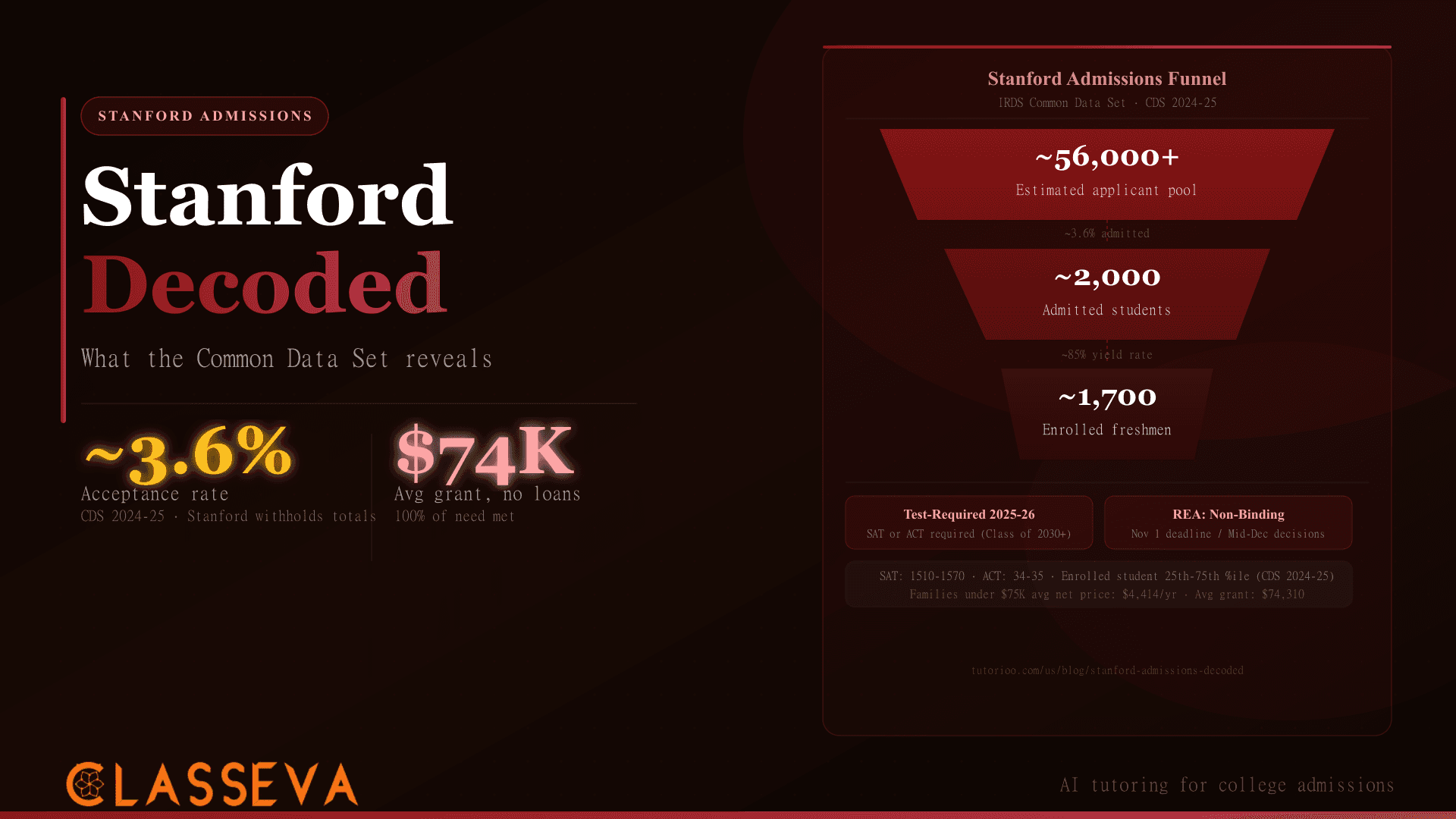
Stanford admits roughly 3.6% of applicants, a rate that ranks it among the most selective universities in the country. That figure tells you how competitive the pool is; it does not tell you what separates a deny from an admit. Stanford reads every application holistically, weighing academic rigor, intellectual curiosity, and personal context against each other in ways no formula captures. This post walks through the actual Common Data Set data, the Restrictive Early Action rules, the reinstated test requirement, and the eight-component essay structure so you can build a strategy based on what Stanford actually evaluates.
What Does It Actually Take to Get Into Stanford?
Stanford admits students through a holistic process that has no published formula and no minimum GPA or score cutoff. What the Common Data Set does reveal is which factors the admissions office considers "Very Important," "Important," or merely "Considered" when reviewing each file.
By the Numbers: Acceptance Rate and Class Size
Stanford does not publish total application or admit figures in its CDS, a practice it adopted in 2018 to reduce the cultural fixation on acceptance rates. Third-party tracking of Stanford's CDS data puts the acceptance rate at approximately 3.6% for recent cycles, placing the enrolled class around 1,700-1,800 students.
That rate has declined steadily over the past decade from roughly 5% in 2016. The applicant pool has grown as Stanford's brand has expanded globally, while the freshman class size has stayed largely flat. Fewer spots, more applicants: the selectivity math is not complicated, but it does mean that qualified students get denied every year because Stanford can only admit so many.
What Stanford's CDS Section C7 Actually Says
Section C7 of the Common Data Set asks each college to rate admission factors from "Very Important" down to "Not Considered." Stanford's ratings reveal priorities that differ from peer institutions in at least one meaningful way: demonstrated interest is explicitly not considered.
| Rating | Factors |
|---|---|
| Very Important | Rigor of secondary school record, Academic GPA, Standardized test scores (reinstated 2025-26), Application essays, Recommendations, Character and personal qualities |
| Important | Extracurricular activities, Talent and ability, First-generation college student status |
| Considered | Alumni/ae relation, Geographical residence, State residency, Volunteer work, Work experience |
| Not Considered | Demonstrated interest, Class rank, Religious affiliation |
Source: Stanford IRDS Common Data Set 2024-25, Section C7
The "Not Considered" status for demonstrated interest matters practically: visiting campus, emailing admissions officers, or opening Stanford's portal will not help your file. Spend that energy on the essays instead.
The Latest Stanford Admissions Data
Stanford's most recent published CDS covers the 2024-25 academic year, reporting on the enrolled Class of 2028. That cohort applied under the old test-optional policy, so the score data below reflects students who submitted scores voluntarily. Starting with the Class of 2030, all enrolled students will submit scores.
Test Score Ranges for Enrolled Students
Under the prior test-optional policy, roughly half of enrolled students submitted SAT scores. Among those who did, the middle 50% range ran 1510-1570 on the SAT and 34-35 on the ACT. For the Class of 2030, all students submitted scores, so published ranges will shift; early projections suggest the ranges will hold or tighten slightly upward.
| Test | 25th Percentile | 75th Percentile | Context |
|---|---|---|---|
| SAT (Evidence-Based) | 1510 | 1570 | CDS 2024-25 enrolled students |
| ACT Composite | 34 | 35 | CDS 2024-25 enrolled students |
| SAT Reading and Writing | 760 | 790 | Sectional range (enrolled) |
| SAT Math | 780 | 800 | Sectional range (enrolled) |
Source: Stanford IRDS Common Data Set 2024-25
GPA, Course Rigor, and Academic Profile
The median unweighted GPA among admitted Stanford students lands around 3.96. But the CDS rates rigor of secondary school record as "Very Important" alongside GPA, which means a 4.0 in average coursework will not carry a 3.7 in the most demanding courses your school offers. Stanford wants to see you push the ceiling of what your curriculum provides.
Course selection signals how you think about intellectual challenge, not just whether you can earn high grades. Students who pass on harder courses to protect their GPA often find that the trade-off works against them at schools like Stanford, where admissions readers expect you to have sought out difficulty.
Stanford's Restrictive Early Action Explained
Stanford's Restrictive Early Action (REA) program accepts applications by November 1 and releases decisions in mid-December. It is non-binding: an admit letter does not obligate you to enroll. But the "restrictive" part carries real constraints that students often misunderstand.
REA vs Early Decision vs SCEA: Key Differences
Stanford REA, Yale's Single-Choice Early Action, and Harvard's Restrictive Early Action share the same basic framework. Early Decision at schools like Columbia or Northwestern is fundamentally different: a binding commitment. Here is how the three application types compare side by side.
Early Decision (ED)
- •Binding: you must enroll if admitted
- •Can only apply ED to one school
- •Does not restrict other EA apps
- •About 34% of top schools use ED
- •Financial aid revealed before commit
Stanford REA
- •Non-binding: no enrollment commitment
- •Restricts other private-school EA/ED apps
- •Public universities still allowed
- •Nov 1 deadline / mid-Dec decisions
- •REA admit yield: historically ~85%
Yale SCEA / Harvard REA
- •Same non-binding, restrictive structure
- •Also bars applying REA to Stanford
- •Princeton SCEA follows same rules
- •Effectively forces a single flagship choice
- •Public early apps still permitted
Schools You Can Still Apply to Early Under REA
The restriction targets private U.S. colleges. Under Stanford REA, you can still apply early to any public university with a non-binding early deadline, any school with rolling admissions, any non-U.S. institution, and any private school where applying early is required to be considered for a merit scholarship. The USC exception illustrates this last category: USC's Early Action is non-binding and required for merit scholarship consideration, so it qualifies as permissible under Stanford's REA rules.
If Stanford is your top choice, REA forces a clean choice: Stanford or another private school early round. You cannot apply Harvard REA, Yale SCEA, Princeton SCEA, MIT EA, or Columbia ED while also applying Stanford REA. Choose the school whose REA or SCEA best fits your strategy, then apply the other top privates Regular Decision.
Learn more about how early action and early decision policies work across selective colleges in our guide to test-optional policies at top schools for 2026.
Stanford's Test-Required Policy for 2026
Stanford reinstated standardized test requirements for the 2025-26 application cycle, covering students applying for the Class of 2030 and all classes beyond. The change reversed the temporary test-optional policy Stanford adopted in 2020 during the COVID-19 admissions disruptions.
Stanford accepts the SAT or ACT. It does not specify a minimum score, but the middle 50% of enrolled students (CDS 2024-25, test-optional cohort) ran 1510-1570 on the SAT and 34-35 on the ACT. With all students now required to submit, the published range for Class of 2030 will be more representative. Plan to hit at least 1500 SAT or 34 ACT to land within the competitive zone.
Stanford accepts superscoring for the SAT, meaning it considers your highest section scores across multiple test dates. For the ACT, Stanford considers your highest composite. Submit all test dates if superscoring helps your profile; withhold dates only if scores materially hurt your case.
For context on how other selective universities handle testing, our test-optional policies guide covers 20 top schools in one place.
Stanford's Supplemental Essays: What They Actually Ask
Stanford requires eight essay components beyond the Common App personal statement. Five short answer questions at 50 words each, plus three longer essays ranging from 100 to 250 words. The structure is distinctive and demanding: 50 words forces precision, and three longer essays at up to 250 words each require you to say something specific about who you are and why Stanford.
The Five Short Answer Questions (50 Words Each)
The five short answers change infrequently. For 2025-26, they are:
- What is the most significant challenge that society faces today?
- How did you spend your last two summers?
- What historical moment or event do you wish you could have witnessed?
- Briefly elaborate on one of your extracurricular activities, a job you hold, or responsibilities you have for your family.
- List five things that are important to you.
Fifty words rewards writers who choose a specific lens over a broad sweep. The challenge question (prompt 1) is not asking you to solve climate change in two sentences; it is asking you to reveal how you think. The summers question (prompt 2) is one of the most revealing because students cannot fake depth of experience in 50 words.
The Three Longer Essays (100-250 Words Each)
The three longer essay prompts for 2025-26 are:
- Write a note to your future roommate that reveals something about you or helps your roommate (and us) get to know you better.
- The Stanford community is deeply curious and driven to learn in and out of the classroom. Reflect on an idea or experience that makes you genuinely excited about learning.
- Please describe what aspects of your life experiences, interests, and character would help you make a distinctive contribution as an undergraduate to Stanford University.
The roommate letter is the one that most consistently separates generic applications from memorable ones. Students who treat it as another opportunity to list achievements miss the point. Admissions readers want the detail that does not appear anywhere else in the file. Your Common App personal statement can handle your biggest narrative; the roommate letter should hand the reader something unexpected.
Stanford's Actual Cost: Financial Aid by Income
Stanford's total cost of attendance runs approximately $85,000 per year in 2024-25. What families actually pay after grants depends on income and assets. The average need-based grant for the Class of 2028 reached $74,310 from Stanford directly. Stanford meets 100% of every enrolled student's demonstrated financial need, and no loans appear in Stanford financial aid packages.
Stanford is need-blind for U.S. citizens, permanent residents, and eligible non-citizens: financial need plays no role in admission decisions for domestic applicants. For international students, Stanford is need-aware, meaning financial need may factor into admission. Once enrolled, all students regardless of citizenship receive 100% of demonstrated need met.
Net Price by Family Income
Use Classeva's College Net Cost Estimator to see how Stanford's aid compares to other selective schools for your family income level. You can also check your scholarship probability across your full list.
Submit the FAFSA and the CSS Profile by Stanford's priority deadline, typically February 15 for Regular Decision applicants. Early Action applicants should check Stanford's financial aid calendar for their specific deadline. The CSS Profile collects more detailed household financial data than the FAFSA and drives most of Stanford's institutional aid decisions. Our FAFSA step-by-step guide covers the 2026-27 form in full.
College Application Cost Calculator
Stanford's $90 application fee plus SAT/ACT prep costs add up fast across a full list. Calculate your total application budget before you submit.
How Stanford Compares to Harvard and Yale
Stanford, Harvard, and Yale compete for the same pool of high-achieving applicants. Their early application programs share a non-binding, restrictive structure, but the policies diverge in meaningful ways around financial aid, test requirements, and essay volume.
| Factor | Stanford | Harvard | Yale |
|---|---|---|---|
| Early Program | REA (non-binding) | REA (non-binding) | SCEA (non-binding) |
| Early Deadline | November 1 | November 1 | November 1 |
| RD Deadline | January 2 | January 1 | January 2 |
| Test Policy (2025-26) | Required | Required | Flexible (SAT/ACT/AP/IB) |
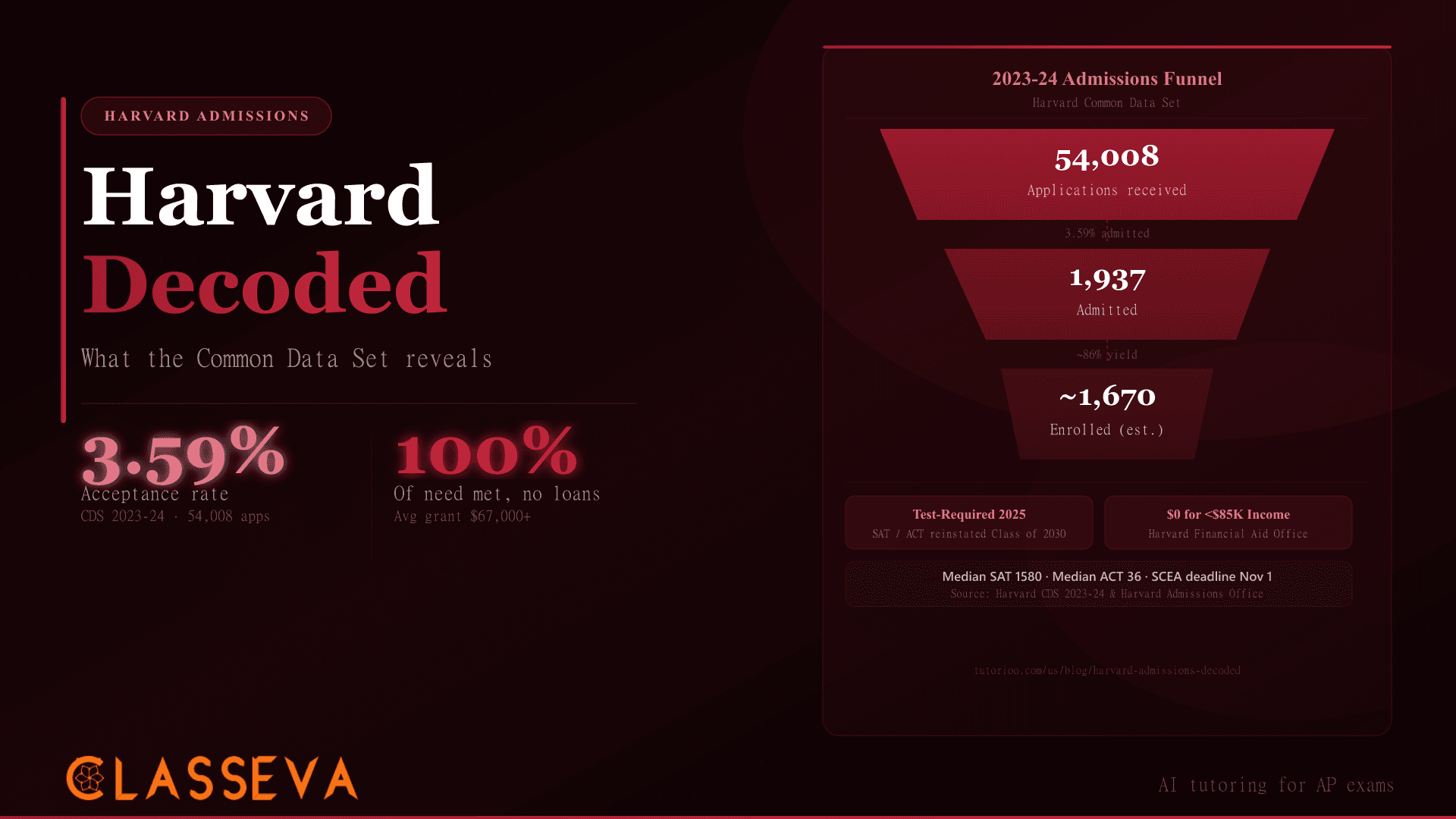
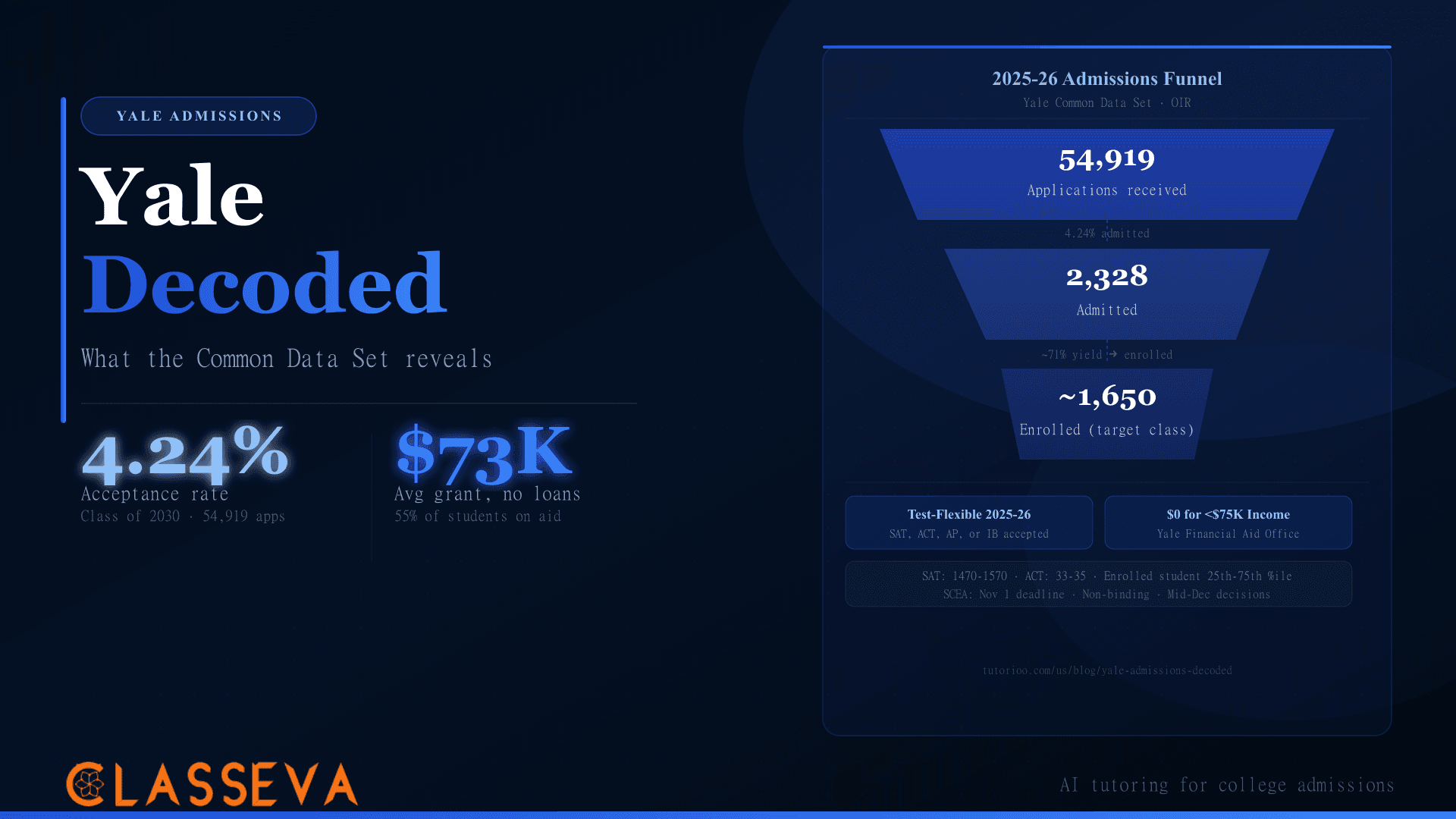
| Acceptance Rate | ~3.6% | ~3.4% | ~4.2% |
| Avg Need-Based Grant | $74,310 | $67,000+ | $73,000+ |
| Demonstrated Interest | Not Considered | Not Considered | Not Considered |
| Supplemental Essays | 8 components | 5 components | 5-6 components |
Sources: Stanford IRDS CDS 2024-25, Harvard CDS 2024-25, Yale OIR CDS 2025-26
The most practical difference for applicants choosing between REA programs: Stanford and Harvard both reinstated test requirements; Yale remains test-flexible, accepting SAT, ACT, AP scores, or IB scores. If testing is not your strongest credential, Yale's flexibility matters. Read our full breakdown of Harvard admissions and Yale admissions to compare strategies side by side.
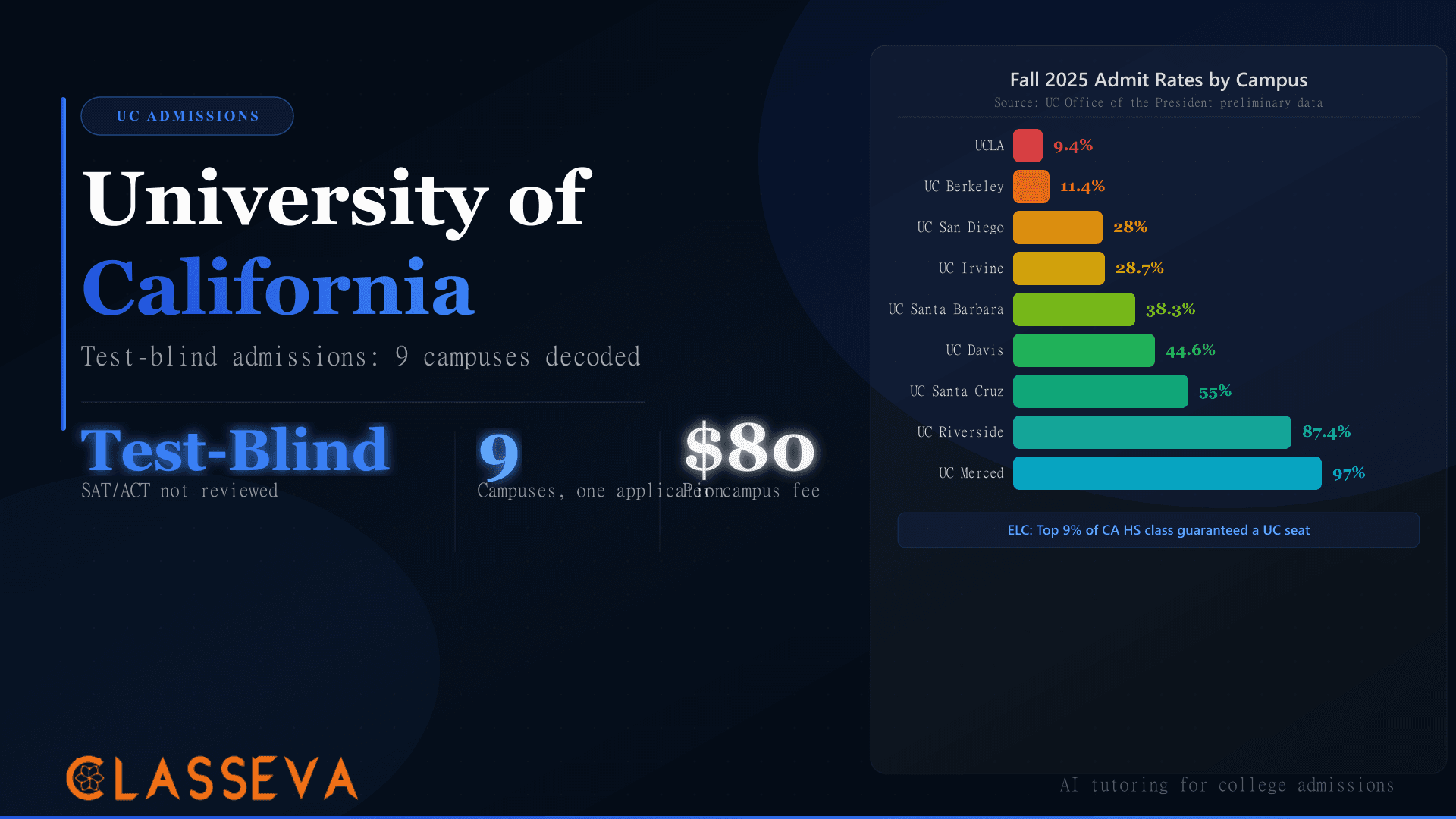
If you are considering West Coast public universities alongside Stanford, our UC admissions guide covers the University of California system, where REA restrictions do not apply and demonstrated interest also plays no role in admission decisions.
For a broader view of financial aid mechanics across schools, our guide on net price vs sticker price explains why the $85,000 published cost at Stanford often lands far below what families actually pay.
Key Takeaways
- Stanford admits approximately 3.6% of applicants. Stanford withholds total applicant figures, but the rate has held near this level across recent cycles.
- Test scores are now required. Stanford reinstated the SAT/ACT requirement for the Class of 2030 and beyond. Target 1510+ SAT or 34+ ACT to sit within the competitive range.
- REA is non-binding but forces a choice. Applying Stanford REA bars you from applying early to Harvard, MIT, Yale, Princeton, or any other private U.S. college. Public universities remain fair game.
- Eight essay components is not a typo. Five 50-word short answers plus three 100-250 word essays require more writing than most schools. Start early and treat the short answers with the same precision as the longer ones.
- Demonstrated interest is officially not considered. Visits, emails, and portal opens do not move your file. Direct that energy toward essays and recommendations.
- Families under $75,000 pay under $5,000 per year. The average net price for the lowest income bracket is $4,414. Stanford meets 100% of demonstrated need with no loans.
- Course rigor matters as much as GPA. The CDS rates both "Very Important." A student with a 3.7 in the most challenging curriculum available often outcompetes a student with a 4.0 in standard coursework.
Frequently Asked Questions
What is Stanford's acceptance rate?
Stanford's acceptance rate sits at approximately 3.6% based on its most recent Common Data Set. Stanford does not publish total application figures, but the rate has held in the 3.5%-4% range across recent cycles, making it among the most selective universities in the United States.
Does Stanford require the SAT or ACT for 2026?
Yes. Stanford reinstated standardized test requirements starting with the 2025-26 application cycle, meaning students applying for the Class of 2030 and beyond must submit SAT or ACT scores. The middle 50% SAT range for recently enrolled students was 1510-1570; the ACT range was 34-35.
What is Stanford's Restrictive Early Action?
Stanford's Restrictive Early Action (REA) is a non-binding early application program with a November 1 deadline and mid-December decisions. It is not the same as Early Decision: you are not committed to attend if admitted. But REA restricts you from applying early to any other private U.S. college under Early Action, Early Decision, or Early Notification plans.
Can I apply REA to Stanford and Early Action to MIT?
No. If you apply Stanford REA, you cannot simultaneously apply to MIT Early Action, Harvard Restrictive Early Action, Yale Single-Choice Early Action, or any other private U.S. college under a binding or non-binding early plan. You can still apply to public universities with non-binding early deadlines.
How many supplemental essays does Stanford require?
Stanford requires eight essay components in total: five short answer questions at 50 words each and three longer essays ranging from 100 to 250 words. The short answers are concise but competitive readers notice them closely. The three longer essays drive most of the holistic narrative.
Is Stanford need-blind?
Stanford is need-blind for U.S. citizens, permanent residents, and eligible non-citizens: financial need plays no role in admission decisions for domestic applicants. Stanford is need-aware for international students, meaning financial need may factor into admission for non-U.S. applicants. For all enrolled students, Stanford meets 100% of demonstrated need.
What GPA do you need for Stanford?
There is no minimum GPA cutoff. The median unweighted GPA among admitted students is approximately 3.96, and course rigor is rated 'Very Important' in the Common Data Set alongside GPA. A 4.0 in unrigorous coursework will not carry a 3.7 in the most challenging courses available at your school.
When does Stanford release admissions decisions?
Stanford releases Restrictive Early Action decisions in mid-December. Regular Decision applicants (deadline January 2) receive decisions in late March, typically around April 1. Waitlist notifications go out separately in April or May after enrollment deposits are confirmed.
Data sourced from the Stanford IRDS Common Data Set 2024-25, Stanford Undergraduate Admission, Stanford Financial Aid, and Stanford supplemental essay prompts for 2025-26. Last verified May 2026.
For a complete picture of how selective admissions works across the country, explore our college admissions resource hub.