How the Digital SAT Adaptive Module Structure Actually Works
The thing I find most under-discussed about the Digital SAT is not that it is shorter or digital. It is that Module 1 performance sets a ceiling on what you can score before you ever see Module 2. The College Board's published structuredescribes this as adaptive routing: based on Module 1 performance, “the second module of questions will either be more difficult or less difficult.” What that sentence quietly implies is that students routed to the easier Module 2 cannot reach the same score ceiling as students routed to the harder one. That asymmetry shapes every preparation decision worth making.
What Is the Digital SAT Adaptive Structure?
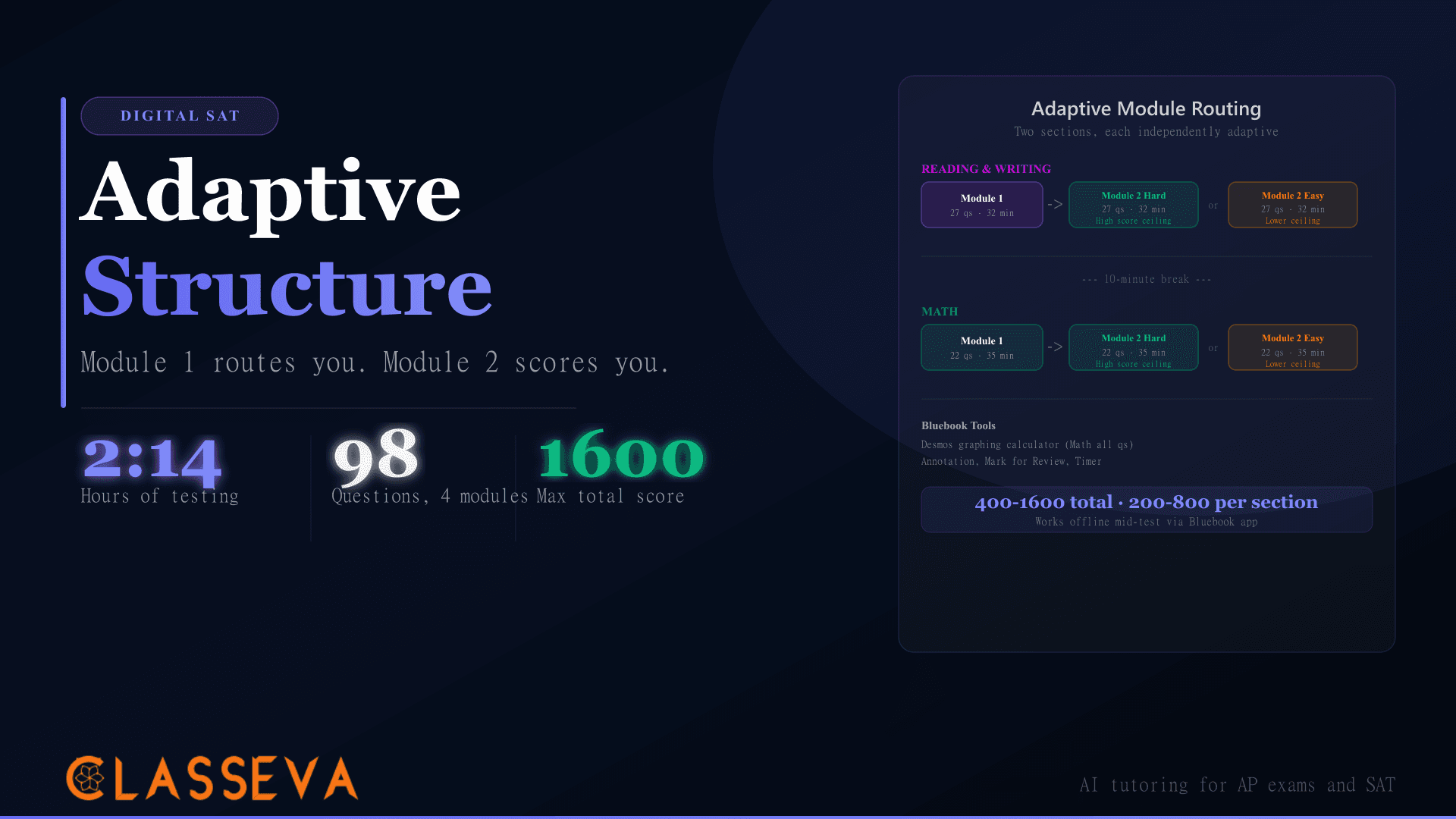
The Digital SAT is a multistage adaptive test. Each of its two sections splits into two sequential modules, and performance on the first module determines the difficulty of the second. The result is a test where every student faces the same Module 1 but two different possible Module 2s, producing a personalized difficulty path calibrated to ability on the fly.
Two Sections, Four Modules
The SAT contains two sections: Reading and Writing (R&W) and Math. Each section runs independently through the adaptive process.
| Module | Questions | Time | Adaptive? |
|---|---|---|---|
| R&W Module 1 | 27 | 32 min | No: same for all students |
| R&W Module 2 | 27 | 32 min | Yes: hard or easy based on Module 1 |
| Math Module 1 | 22 | 35 min | No: same for all students |
| Math Module 2 | 22 | 35 min | Yes: hard or easy based on Module 1 |
Source: College Board SAT structure documentation. A 10-minute break separates the R&W section from Math.
Total test time: 2 hours 14 minutes of testing, plus the break. The entire Digital SAT finishes in under three hours from first question to last, compared to over three hours on the pre-2023 paper version.
Why Adaptive Matters More Than You Think
On a non-adaptive test, every student faces the same questions in the same order. Missing five questions costs the same five raw points regardless of which questions you missed. The Digital SAT does not work that way. The test dynamically constructs your Module 2 based on Module 1 evidence of ability. A student who nails Module 1 faces harder Module 2 questions, but correct answers on that harder set earn more toward the scaled score. A student who struggles on Module 1 faces easier questions in Module 2, but those correct answers contribute less.
Module 1 is the same for every student. Module 2 is personalized. The path you take through Module 2 determines your score ceiling, not just your score.
How Does Module 1 Determine Module 2 Difficulty?
College Board published the routing logic directly: “The first module of each section contains a broad mix of easy, medium, and hard questions. Based on how you perform on the first module, the second module of questions will either be more difficult or less difficult.” The routing runs independently for R&W and Math. You could land on the hard R&W Module 2 but the easy Math Module 2, or vice versa.
The Routing Decision: What College Board Actually Says
College Board has not published the exact score threshold that triggers each routing outcome. What the documentation confirms is that Module 1 draws from a broad difficulty distribution, and the routing algorithm reads your Module 1 performance as an ability estimate. The scoring system running underneath this is called Item Response Theory (IRT). IRT treats each question as a calibrated data point with a known difficulty parameter and uses your pattern of correct and incorrect answers to estimate your ability level, not just count raw rights and wrongs.
That means your ability estimate from Module 1 reflects not just how many questions you got right, but which ones. Getting the harder Module 1 questions right while missing easier ones sends a different signal than the reverse. The routing algorithm reads this signal and assigns Module 2 accordingly.
Score Ceiling: The Hidden Consequence of Module 1
The phrase “score ceiling” describes the maximum scaled score achievable given a student's Module 2 routing. A student on the hard Module 2 path can score anywhere from the low end to 800 on that section. A student on the easy Module 2 path faces a compressed range. The ceiling on the easy path is lower, and no amount of perfect performance on easy questions compensates for that compression.
Students targeting the 93rd percentile and above need the hard Module 2 on both sections. That means Module 1 accuracy is not just one factor among many. It is the gate.
What's in the Reading and Writing Section?
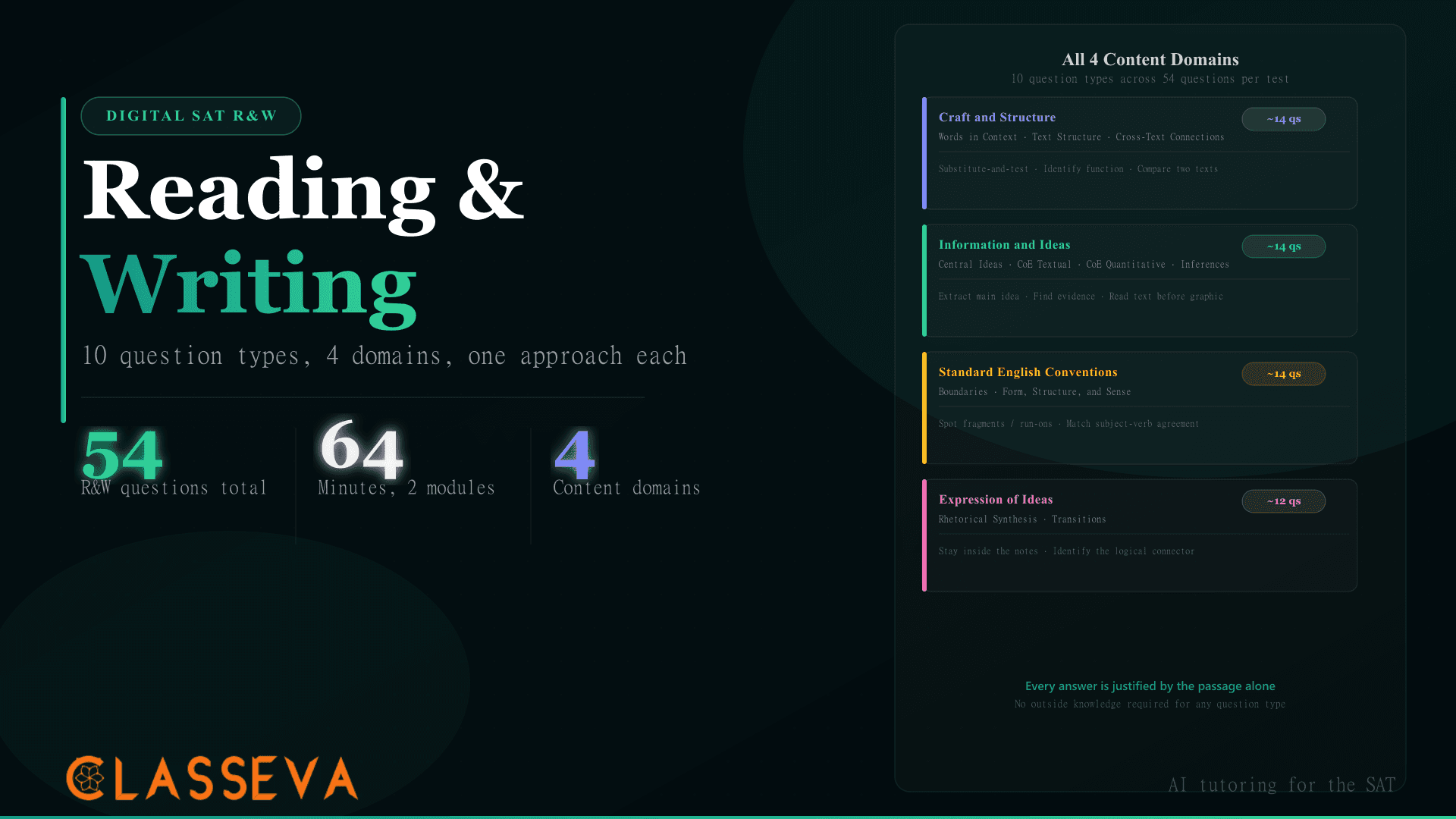
The Reading and Writing section totals 54 questions across two 32-minute modules. All R&W questions are multiple choice with four answer options. The section covers four question domains, each anchored to a short passage or paired passages.
R&W Module Timing and Question Counts
Each R&W module runs 27 questions in 32 minutes, giving roughly 71 seconds per question before accounting for passage reading time. Students see passages of 25 to 150 words, then one question per passage. This one-question-per-passage format is a structural departure from the old SAT, which grouped multiple questions around each longer reading passage.
Question Domains in R&W
The R&W section covers four domains: Information and Ideas (reading comprehension, inferences, central ideas), Craft and Structure (text structure, word choice, cross-text connections), Expression of Ideas (rhetoric, transitions, synthesis), and Standard English Conventions (grammar, punctuation, sentence structure). Questions appear in roughly ascending difficulty order within each module, with easier questions early and harder ones later.
What's in the Math Section?
The Math section totals 44 questions across two 35-minute modules. Unlike R&W, Math includes both multiple-choice questions and student-produced responses (fill-in-the-blank answers that students type directly into Bluebook). No answer choices appear for student-produced response questions.
Math Module Timing and Question Counts
Each Math module runs 22 questions in 35 minutes. The pacing works out to approximately 95 seconds per question on average, but that figure is misleading. Strong Math students often finish modules with 5 to 10 minutes remaining. The time pressure in Math comes from harder Module 2 questions, not the overall clock.
Math Domains and Student-Produced Responses
The four Math domains are Algebra, Advanced Math, Problem-Solving and Data Analysis, and Geometry and Trigonometry. Algebra and Advanced Math together represent the majority of Math questions, consistent with what College Board designates as the primary focus of SAT Math. About 75% of questions are multiple choice; the remaining 25% require student-produced responses where students enter a decimal or fraction.
R&W Section
- •2 modules × 27 questions = 54 total
- •32 minutes per module
- •All multiple choice (4 options)
- •One question per short passage
- •Domains: Information, Craft, Expression, Conventions
Math Section
- •2 modules × 22 questions = 44 total
- •35 minutes per module
- •~75% multiple choice, ~25% fill-in
- •Desmos calculator available on all questions
- •Domains: Algebra, Advanced Math, Data, Geometry
What Tools Does Bluebook Provide During the Test?
Bluebook, the College Board's testing app installed on student devices before test day, includes four built-in tools that operate on every question throughout the test. Each tool changes how students should approach the test relative to the paper version.
Desmos: The Built-In Graphing Calculator
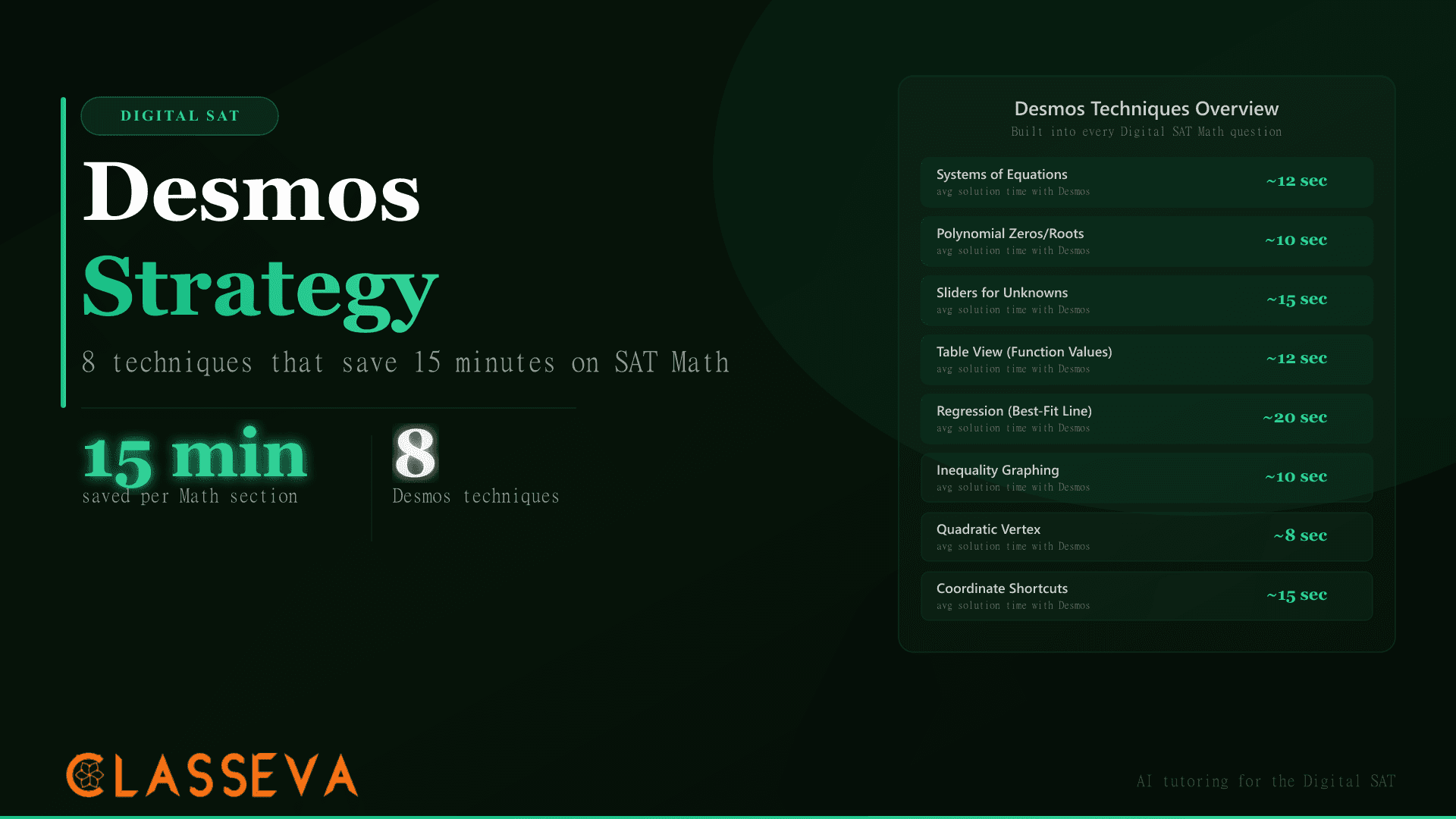
Every Math question in Bluebook includes access to the Desmos graphing calculator. Students launch it with one click, graph functions, evaluate expressions, and use it for table-of-values analysis. The key difference from a hand-held calculator is that Desmos can graph an equation and find intersection points visually, cutting through algebraically complex problems in seconds. Students who have not practiced with Desmos before test day leave points on the table.
Practice Desmos before test day specifically. Graph systems of equations to find intersection points, use the table feature to check values, and practice entering quadratic equations. These three skills cover the majority of Math questions where Desmos provides the biggest advantage.
Annotation, Mark for Review, and Timer
The annotation tool lets students highlight text within passages and add brief notes, replacing the physical underlining that paper-test takers do with pencil. Mark for Review flags any question for return before submitting that module, replacing the paper convention of circling question numbers. The timer displays time remaining in the current module and can be hidden if the on-screen clock creates distraction.
How Is the Digital SAT Scored?
Each section scores on a 200 to 800 scale. Total scores range from 400 to 1600. The scale matches the old paper SAT exactly, so concordance between test years is straightforward.
Score Bands by Module 2 Difficulty
The adaptive scoring mechanism means a student's scaled score reflects both raw correct answers and the difficulty of questions answered. Two students who each answer 40 of 54 R&W questions correctly will receive different scaled scores if one received the hard Module 2 and the other received the easy Module 2. The student on the hard path scores higher because their correct answers carry greater statistical weight.
Reading the College Board's Digital SAT overview, what stands out is how deliberately the adaptive mechanism is framed as a benefit to students. The argument is that adaptive testing provides more accurate ability measurement across a wider range of ability levels than a single fixed-difficulty test can. For students targeting high scores, the practical implication runs the other direction: you must earn the harder path, not wait for it to appear.
How Do You Prepare for an Adaptive Test?
Preparing for an adaptive test requires a different mental model than preparing for a fixed-format test. On a fixed test, every practice question is equivalent. On the Digital SAT, Module 1 accuracy triggers different downstream experiences, so weak Module 1 performance during practice produces misleading results. Students need to simulate the full four-module structure regularly, not just drill individual question types in isolation.
Module 1 Strategy: Accuracy Over Speed
The highest-leverage Module 1 strategy is accuracy on harder questions, not raw completion speed. Students who rush through Module 1 trying to maximize attempts often miss the harder questions that carry the most routing signal. A slower, more deliberate pace on Module 1 that nails the medium and hard questions will earn the harder Module 2 routing far more reliably than a fast pace with scattered errors across all difficulty levels.
This runs counter to the instinct many students bring from timed standardized tests. Speed is a lever in Module 2, where harder questions reward students who can work efficiently. Speed in Module 1 is a risk. Getting routed to the easy Module 2 because of avoidable Module 1 mistakes caps your score before Module 2 begins.
Once you understand how Module 1 determines your score ceiling, the Test Score Goal Setter below helps you map your target score back to the practice performance you need to achieve it. Enter your goal score and current practice performance to see the gap.
Test Score Goal Setter
Once you understand how Module 1 determines your possible score range, the Test Score Goal Setter helps you map your target score back to the practice performance needed.
The SAT resources hub covers practice test strategy, timing, and full Bluebook test walk-throughs. The SAT-ACT Converter translates target SAT scores into ACT equivalents for students evaluating both tests. The Optimal Test Date Selector helps match your prep timeline to the right test date. For students taking AP exams alongside the SAT, the Score Report Send Optimizer coordinates which scores to send and when.
Key Takeaways
- The Digital SAT runs two independent adaptive sections: R&W (54 questions, 64 minutes) and Math (44 questions, 70 minutes), totaling 2 hours 14 minutes.
- Module 1 of each section is identical for all students. Module 2 difficulty is personalized based on Module 1 performance, and the harder Module 2 path carries a higher score ceiling.
- College Board uses Item Response Theory (IRT) for routing and scoring, so both how many questions you answered correctly and which questions you answered correctly influence Module 2 routing.
- Bluebook's built-in Desmos graphing calculator is available on every Math question. Students who practice Desmos before test day convert hard algebra problems into quick graph intersections.
- Accuracy on Module 1 is the single highest-leverage factor on test day for students targeting scores above 1200. Speed in Module 1 increases routing error risk.
- The total score scale (400-1600) and section scale (200-800) match the old paper SAT. Scores from 2023 onward are directly comparable to scores from previous years via College Board's concordance tables.
- Bluebook operates offline once the test begins. An internet outage mid-test does not interrupt the session.