Early Decision vs Early Action: Which Should You Choose?
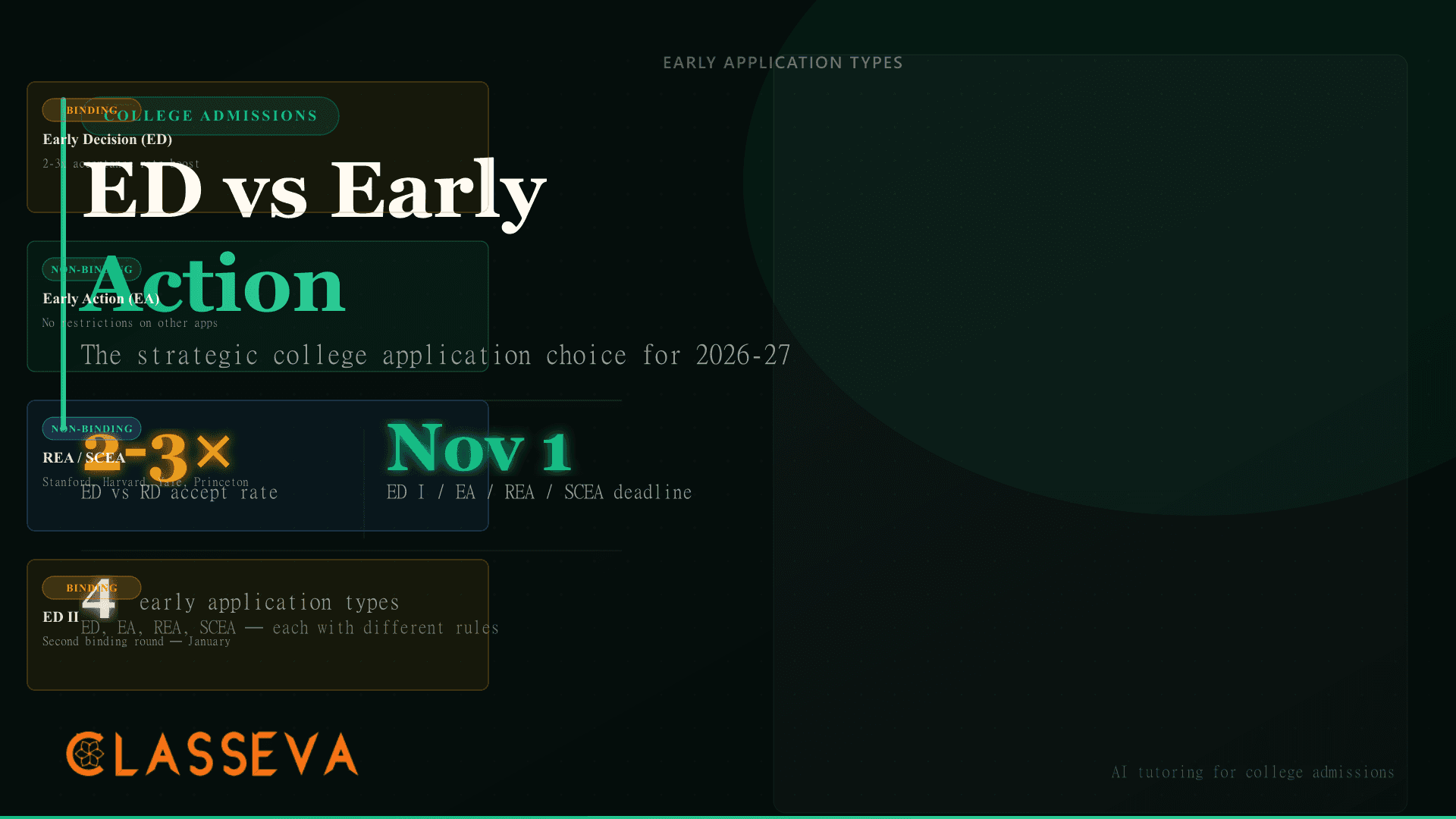
Early Decision acceptance rates at selective schools run 2 to 3 times above the Regular Decision rate for the same cycle. Penn, Duke, and Vanderbilt have shown this gap consistently across multiple application years. When I built the admissions section of Classeva and read through Common Data Sets for dozens of schools, the rate differential appeared at nearly every institution offering Early Decision. But those higher rates come attached to a binding commitment that removes your ability to compare financial aid packages, negotiate with competing schools, or decline an offer you find unaffordable. Whether that exchange makes sense depends entirely on your financial position, application strength, and how certain your first-choice preference actually is.
The Four Early Application Categories
Students applying to selective colleges in 2026-27 can choose from four distinct early application models. They differ on two axes: whether the commitment is binding, and whether applying to one school restricts your options elsewhere. Understanding where each model sits on those two axes is the foundation of the entire early application decision.
Early Decision: Binding and Powerful
Early Decision commits you to attending the school that admits you. The commitment is binding, meaning you withdraw every other college application and enroll in that school regardless of the financial aid package offered. Two circumstances release you from the obligation: if the school defers or denies you (in which case you apply elsewhere in Regular Decision), or if the financial aid award falls demonstrably short of what your family can afford. Outside those scenarios, backing out of ED carries real consequences.
The binding nature of ED makes your application a stronger signal of interest, and most selective schools with ED programs admit a higher share of their ED pool than their RD pool. That advantage is the reason well-prepared applicants with a clear first choice consider it.
Early Action: No Commitment Required
Early Action lets you apply early, hear back early, and carry zero enrollment obligation. Accept an EA offer and you still have until May 1 (National Reply Date) to decide whether to attend. Decline it and your other applications remain unaffected. Most EA programs have no restrictions on applying to other schools at the same time, making EA the simplest early option: earlier feedback and earlier peace of mind with no strategic downside.
MIT, Caltech, Georgetown, Notre Dame, UVA, and UChicago all offer non-restrictive EA. You can apply to all of them in the same November cycle, hear back in December, and still wait until spring to make your final choice.
REA and SCEA: Non-Binding With Restrictions
Both REA and SCEA describe the same policy: non-binding early application where you agree not to apply early to other private schools simultaneously. Stanford calls its program Restrictive Early Action. Harvard, Yale, and Princeton call theirs Single-Choice Early Action. The practical effect is identical: you apply early to one of these four schools and hold off on filing ED or EA applications at other private colleges. Public universities (in-state and out-of-state) and most international institutions remain available.
If Stanford defers you in December, you are free to apply anywhere in Regular Decision. The non-binding aspect means you can receive an offer, take until May 1 to decide, and still choose a different school. REA and SCEA exist because Harvard, Yale, Princeton, and Stanford want the same early commitment signal that ED provides, without forcing students into a binding financial commitment before they see their aid package.
Early Decision II: A Second Binding Window
ED II gives students a second binding round, with deadlines typically in early January and decisions in mid-February. The commitment is identical to ED I: accept and you enroll, withdraw all other applications. Schools offering ED II include Vanderbilt, Emory, NYU, Tufts, Wash U in St. Louis, and Bowdoin. Students deferred from ED I at a school sometimes receive an invitation to reapply through ED II, though policies vary by school.
ED II also suits students who identified a clear first choice after the November 1 deadline had already passed, or who needed more time to strengthen their application.
Which Schools Offer Each Option?
The single biggest source of early application confusion is not understanding the categories themselves but not knowing which schools sit in which category. A student who assumes Harvard offers ED (it does not) or that Northwestern offers EA (it does not) will build the wrong strategy. The college admissions resource hub covers school-specific strategy in more depth, but here are the categories by school for the 2026-27 cycle.
Early Decision Schools
Binding Early Decision is the dominant early application format at most highly selective universities outside the Ivies that offer SCEA. The following offer ED I and (where noted) ED II:
| School | ED I | ED II | Notes |
|---|---|---|---|
| Penn | Yes | No | Nov 1 deadline; decisions mid-Dec |
| Duke | Yes | No | Nov 1 deadline; decisions mid-Dec |
| Columbia | Yes | No | Nov 1 deadline; decisions mid-Dec |
| Northwestern | Yes | No | Nov 1 deadline; decisions mid-Dec |
| Brown | Yes | No | Nov 1 deadline; decisions mid-Dec |
| Cornell | Yes | No | Nov 1 deadline; decisions mid-Dec |
| Dartmouth | Yes | No | Nov 1 deadline; decisions mid-Dec |
| Vanderbilt | Yes | Yes | ED II deadline Jan 1; decisions mid-Feb |
| Rice | Yes | No | Nov 1 deadline; decisions mid-Dec |
| Emory | Yes | Yes | ED II deadline Jan 15; decisions mid-Feb |
| Tufts | Yes | Yes | ED II deadline Jan 1; decisions mid-Feb |
| Wash U in St. Louis | Yes | Yes | ED II deadline Jan 1; decisions mid-Feb |
| NYU | Yes | Yes | ED II deadline Jan 1; decisions mid-Feb |
| Bowdoin | Yes | Yes | ED II deadline Jan 1; decisions mid-Feb |
[VERIFY: Confirm exact ED II deadlines and decision dates for the 2026-27 cycle at each school's admissions page]
Early Action and REA/SCEA Schools
The most selective non-ED schools use REA or SCEA. Schools offering straightforward non-binding EA include MIT, Caltech, Georgetown, Notre Dame, UVA, and UChicago. Harvard and Yale both use SCEA, with November 1 deadlines and mid-December decisions. Princeton uses SCEA under its own framing. Stanford uses REA.
UC campuses (UCLA, UC Berkeley, UC San Diego, UC Davis, and others) offer their own November 30 EA deadline, which has no binding component and no restrictions on simultaneously applying to private schools early. Students applying to the UC system can file UC EA alongside any private school EA, SCEA, or REA without violating any restriction.
Does ED Actually Improve Your Odds?
Early Decision acceptance rates at selective schools run 2 to 3 times above the Regular Decision rate in the same cycle. That gap appears consistently year over year in publicly available Common Application data and individual school Common Data Sets. But understanding what drives the gap matters as much as knowing the gap exists.
The Acceptance Rate Numbers
Below are approximate ED vs RD acceptance rates from recent cycles at several schools that offer binding Early Decision. All figures should be verified against the most recent Common Data Sets before drawing specific conclusions [VERIFY: current CDS figures for each school].
The Self-Selection Factor
The ED acceptance rate gap does not exist purely because the school rewards early applicants. It exists partly because the ED pool skews stronger. Students who apply ED tend to have clearer first choices, more developed applications, and greater confidence in their file. Less prepared students more often defer to Regular Decision to allow more time for test retakes, essay polishing, and senior year grade improvement.
Research from NACAC has shown that the ED advantage, even after controlling for applicant quality, remains meaningful at many schools. But the self-selection effect is real and accounts for some portion of the gap. The practical implication: applying ED with a weaker application does not close the gap, and applying RD with a strong application is not a strategic disaster.
Financial Aid and the Binding Commitment
The acceptance rate differential makes ED attractive. The financial structure makes it risky for families who need to compare aid offers before committing. Understanding both sides of this equation is the most consequential part of the ED decision.
When an ED Package Falls Short
A school that accepts you through ED must offer an aid package, but the binding commitment means you accept that package as the price of admission. If the package covers your demonstrated need fully, this poses no problem. But schools vary widely in how generously they meet need and how broadly they award merit aid.
Schools that commit to meeting 100% of demonstrated financial need (with no loans in the package) include Harvard, Yale, Princeton, MIT, Stanford, and a small set of other highly endowed institutions. At these schools, the financial risk of binding ED is lower because the package structure is predictable and relatively generous. At schools that do not guarantee full need-meeting, or where merit aid awards vary by negotiation, the package you receive through ED may be substantially lower than what a competing offer from another school could have provided. Federal aid eligibility is determined separately through studentaid.gov and remains the same regardless of which school you attend.
Use the College Net Cost Estimator to model what your expected out-of-pocket cost might look like at different schools before deciding whether to commit early.
The Financial Aid Out Clause
Every ED agreement includes a provision for students who receive an insufficient financial aid package. If the offered package genuinely cannot be met by your family, you may request release from the binding commitment and re-enter the Regular Decision pool. The threshold for what qualifies as "insufficient" is not standardized across schools.
In practice, a family that received a net price estimate of $20,000 per year and receives a package of $22,000 will have a harder time invoking the out clause than a family that estimated $25,000 and received $45,000. Document your family's financial position carefully with the financial planning tools before filing ED, so you have a clear baseline if you need to invoke the clause.
Applying ED to a school without first running your expected family contribution through a net price calculator. Every school with ED has a net price calculator on its admissions website. Use it before filing. If the estimated out-of-pocket cost comes close to or exceeds what your family can actually pay, ED at that school creates real financial exposure.
How to Choose the Right Early Option
The right early application strategy depends on four factors: how certain your first choice is, whether your family can absorb any financial aid package, whether your application is ready by November 1, and which early option the school actually offers. Here is how each scenario maps to a strategy.
When ED Makes Sense
Apply Early Decision if your first-choice school is clear and settled, not just a preference. "Clear" means you would genuinely enroll there over every other school, regardless of which other schools also accepted you. It also means your family can afford the aid package that school is likely to offer, ideally confirmed through a net price calculator run before filing.
The other condition for ED is application readiness. A student applying ED to Penn or Duke with a strong transcript, finalized test scores, and polished essays before November 1 gains the full acceptance rate advantage. A student rushing to file incomplete materials before November to "get the ED boost" does not.
When EA or REA/SCEA Makes More Sense
Apply Early Action if your first choice is not fully settled or if financial aid comparison matters to your enrollment decision. Applying EA to MIT, Notre Dame, UVA, and UChicago in the same cycle gives you early decisions from multiple schools by mid-December with no commitment pressure and full freedom to compare packages through April. This scenario costs you the ED acceptance advantage at each school, but it preserves the financial information you need to make a rational enrollment decision.
Apply SCEA or REA if your first choice is Harvard, Yale, Princeton, or Stanford but you are not ready to commit to binding enrollment before seeing your aid package. These programs give you an early decision from the most selective schools without forcing the binding commitment that ED requires. Read more about test requirements and application strategy to ensure your application is competitive before filing.
Apply ED When...
- •Your first choice is settled, not just preferred
- •Family finances can absorb any package from that school
- •Application is strong and ready by November 1
- •School offers ED (not REA or SCEA)
- •ED II available if you miss the November 1 window
Apply EA When...
- •First choice is not fully settled between two schools
- •Need to compare financial aid packages before committing
- •School offers non-restrictive EA (MIT, Caltech, UVA, others)
- •Want early decisions from multiple schools simultaneously
- •Application benefits from more time to develop
Apply REA/SCEA When...
- •First choice is Harvard, Yale, Princeton, or Stanford
- •Not ready for binding commitment before seeing aid
- •Application is strong enough to compete in these pools
- •Willing to forgo early apps at other private schools
- •State school EA applications still remain available
Run a net price calculator before filing
Every school with an early application option publishes a net price calculator. Run yours before November 1. If the estimate is close to or above what your family can actually pay, reconsider binding ED for that school.
Finalize test scores before the deadline
Most ED and EA schools require official scores by the November 1 application deadline, not just the decision deadline. Check each school's score submission policy in September. Missing a score cutoff invalidates the early application.
Align your essays for the early school first
If applying ED or SCEA, the "Why this school?" essay and primary supplement carry more weight than in RD because they signal intentionality. Review the Common App essay prompts for 2026-27 and complete the school-specific supplement before turning to other schools. The Common App prompts guide (linked below) covers how to approach each prompt.
Have your counselor sign the ED agreement early
The ED agreement requires your counselor's signature. Most counselors are processing dozens of signatures in late October. Do not wait until October 30 to ask. Give your counselor at least two weeks of notice before the filing deadline.
Decide what you will do if deferred
A deferral from ED moves you to Regular Decision at that school. Decide in advance whether you will submit additional materials (a mid-year report, a letter of continued interest) or whether you will focus your energy on RD applications elsewhere. Having this plan before December prevents decision paralysis.
College Application Cost Calculator
Calculate the total cost of your college application list: Common App fees, supplemental fees, testing fees, and CSS Profile charges across each school on your list.
Application Timeline and Key Deadlines
Every early application type shares roughly the same calendar. ED I, EA, REA, and SCEA deadlines cluster around November 1 at most schools (Georgetown and Notre Dame use November 1; a few EA programs extend to November 15). Decisions arrive in mid-December. ED II deadlines fall in early January, with decisions in mid-February. Regular Decision deadlines span January 1 through January 15 at most schools, with decisions in late March.
One planning note: test-optional and test-required policies affect the early application strategy. Harvard requires test scores for the 2026-27 cycle. Confirm each school's current policy before finalizing your strategy in September.
Key Takeaways
- Early Decision is binding. Accept and you enroll, withdraw all other applications, and commit to the offered aid package. The financial out clause exists but requires genuine financial hardship to invoke.
- ED acceptance rates run 2-3 times above RD at most selective schools offering binding Early Decision, but the ED pool skews toward stronger applicants who partially explain the gap.
- REA and SCEA are non-binding. Stanford, Harvard, Yale, and Princeton use these programs to give early decisions without binding commitment, but they restrict simultaneous early applications at other private schools.
- Non-restrictive EA at MIT, Caltech, Notre Dame, UVA, Georgetown, and UChicago carries zero restrictions. Apply to all of them in the same cycle if your application is ready.
- ED II provides a second binding window in January for students who identified a clear first choice late or were deferred from ED I at a school that offers it.
- Financial aid readiness determines ED eligibility. Run a net price calculator on your target school before filing ED. If the estimated cost exceeds what your family can pay, EA or RD preserves the ability to compare competing offers.
- Application readiness matters as much as strategy. A strong application filed in Regular Decision beats a weak application filed in Early Decision at every selective school.