Columbia Admissions Decoded: What the Common Data Set Reveals
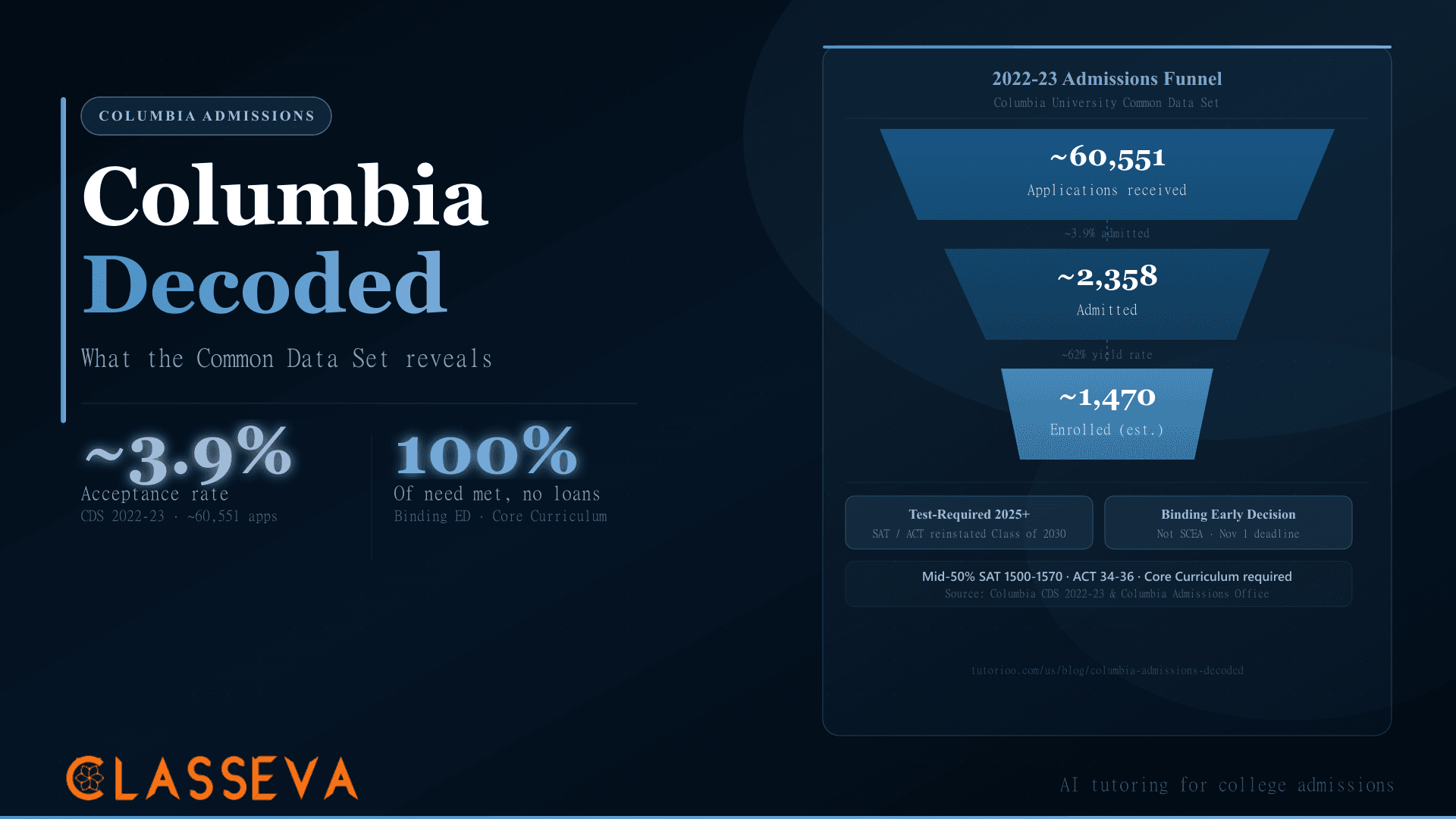
Columbia received approximately 60,551 applications for its Class of 2027 and admitted roughly 2,358 students, a 3.9% acceptance rate drawn from Columbia's published Common Data Set. Two details separate Columbia from most of its Ivy peers: Early Decision at Columbia is binding, not the non-binding Single Choice Early Action structure used at Harvard, Yale, and Princeton; and every Columbia undergraduate, regardless of major, completes a shared Core Curriculum that accounts for nearly one-third of all credits earned. Those two institutional commitments shape both the application strategy and the college experience that follow.
What Does It Take to Get Into Columbia?
Getting into Columbia requires academic performance in the top fraction of the national distribution, a compelling intellectual identity, and authentic engagement with the values Columbia signals through its Core Curriculum. No single factor determines admission. The Common Data Set makes the academic floor visible, even if no document can define a ceiling.
The Academic Bar
The mid-50% SAT range for admitted Columbia students runs approximately 1500-1570. The mid-50% ACT composite runs 34-36. Both figures are drawn from Columbia's CDS data. Most admitted students rank among the top 1-5% of their graduating class academically, and Columbia draws from high schools across all fifty states and more than 80 countries annually.
| Test | 25th Percentile | 75th Percentile |
|---|---|---|
| SAT Composite | 1500 | 1570 |
| SAT Reading and Writing | 730 | 790 |
| SAT Math | 770 | 800 |
| ACT Composite | 34 | 36 |
Source: Columbia University Common Data Set 2022-23, Section C9. Figures represent mid-50% ranges for enrolled students. [VERIFY against most recent CDS release]
These ranges describe the middle half of enrolled students. A student below these ranges still competes in the pool, but the application file must demonstrate exceptional strength on every dimension that does not carry a single standardized metric. The lower bound is not a cutoff; it is a signal about where the density of the admitted class sits.
Beyond Grades and Scores
Columbia's CDS Section C7 identifies seven factors as “Very Important” in the admissions review. Rigor of secondary school record, academic GPA, application essays, recommendations, extracurricular activities, character and personal qualities, and talent and ability all carry that designation. Test scores feed into the academic GPA and rigor assessment rather than standing alone.
Columbia rejects roughly 96 out of every 100 applicants. Most rejected students are academically qualified. The differentiating review happens among academically qualified applicants. Academic strength earns a read; what happens in that read determines the outcome.
Cataloging Ivy League admissions policies to build Classeva's admissions guidance content, the distinction I find most under-discussed is Columbia's supplement structure. Every other selective school asks primarily what students have achieved. Columbia's Lists ask what students have consumed: books read, music heard, art experienced. That inversion from product to process reveals intellectual character differently than any traditional accomplishment essay.
The Latest Columbia Admissions Data
Acceptance Rate and Application Volume
Columbia's acceptance rate has declined from roughly 10% in 2004 to under 4% today. The compression reflects growing application volume rather than a shrinking class: Columbia enrolls roughly 1,450-1,500 first-year students per year, a figure that has remained nearly stable while the applicant pool has grown dramatically. Columbia's New York City location drives sustained global application interest, and the university's engineering programs (SEAS) attract a separate, competitive applicant stream alongside the Columbia College pool.
Class Profile by the Numbers
Columbia's enrolled class concentrates at the top of the national academic distribution. Geographic and socioeconomic diversity is a stated institutional priority. Columbia's New York City campus draws enrolled students internationally at higher rates than many peer institutions, and the dual SEAS/Columbia College structure means the class profile spans engineering, humanities, and social science students who share the same Core curriculum.
| Metric | Class of 2027 (approx.) |
|---|---|
| Total applicants | ~60,551 |
| Students admitted | ~2,358 |
| Acceptance rate | ~3.9% |
| Mid-50% SAT composite | 1500-1570 |
| Mid-50% ACT composite | 34-36 |
| Students in top 10% of HS class | Approximately 93-96% |
| International students (enrolled) | Approximately 15-17% |
| States represented | All 50 |
Source: Columbia University Common Data Set 2022-23. Figures are approximate. Verify against the most recent CDS release at opir.columbia.edu.
Columbia's Binding Early Decision Policy
Columbia uses binding Early Decision. An admitted ED applicant commits to enrolling at Columbia and must withdraw all other college applications within a short window after the decision. This is materially different from the non-binding SCEA policies at Harvard, Yale, and Princeton, where students who apply early can still hold simultaneous offers from other schools through the spring.
ED vs SCEA: Why the Distinction Matters
Columbia's Binding ED
- •Binding: you must enroll if admitted and offered financial aid you consider adequate
- •November 1 deadline; decisions released in mid-December
- •Requires withdrawing all other applications upon admission
- •Applicants may apply EA to non-restrictive schools simultaneously
- •Historically carries a slightly higher admit rate than Regular Decision
- •Best for students who have visited Columbia and confirmed first-choice commitment
Harvard/Yale/Princeton's SCEA
- •Non-binding: you may decline the offer of admission
- •November 1 deadline; decisions in mid-December
- •Restricts simultaneous Early Decision applications to other schools
- •Allows non-binding EA applications to non-restrictive schools
- •Same application requirements as Regular Decision
- •Best for students with this school as a genuine first choice by October
The practical implication: applying ED to Columbia is a stronger signal of first-choice intent than applying SCEA to Harvard or Yale. Before applying ED, make sure Columbia's financial aid package meets your family's needs. Columbia's ED release allows admitted students to request a short extension to evaluate the aid offer before the withdrawal obligation takes full effect, but that window is narrow.
For a detailed comparison of Early Decision and Early Action policies across selective schools, the Early Decision vs Early Action guide walks through the strategic framework, the data on early-round yield advantages, and how to build a school list around ED commitments.
Does Columbia Require the SAT or ACT?
Yes. Columbia reinstated standardized testing requirements for the 2025-26 application cycle, applying to students entering fall 2026. Students who applied during Columbia's pandemic-era test-optional period were exempt; students applying for fall 2026 admission or later must submit official scores. Columbia accepts both the SAT (via College Board's Score Choice) and ACT. The requirement is confirmed on Columbia's application requirements page.
Columbia reviews all test scores submitted and superscores the SAT across multiple sittings (combining the highest section scores from different test dates). Sending multiple scores generally helps rather than hurts. If your highest composite comes from a single sitting, submit that date first.
The mid-50% SAT range of 1500-1570 sits slightly below Harvard's (1500-1600), reflecting Columbia's different class composition across Columbia College and SEAS. A 1500 SAT score places a student at the 25th percentile of enrolled Columbia students. That is not a disqualifying score; it means the rest of the application carries more weight in the review. A 1570 or above puts a student comfortably inside the middle range.
The Columbia Supplemental Essays (and the Famous Lists)
Columbia's supplement requires several short-answer essays plus the distinctive Columbia Lists. Together, these elements give the admissions office a richer picture of intellectual life than most supplements capture. The essay prompts change slightly year to year; the Lists are a Columbia constant.
What Are the Columbia Lists?
The Columbia Lists ask applicants to share books they have read for pleasure, musicians and composers they listen to, artwork they have experienced, films they have viewed, and similar cultural consumption. Each List is typically brief (five to ten items). No elaboration is required unless the supplement specifically asks for it.
The Lists reveal something essays often cannot: the texture of a student's intellectual life between achievements. An applicant who lists Toni Morrison, Hilma af Klint, and John Coltrane alongside a physics textbook signals a kind of breadth that a GPA cannot. An applicant who lists five popular airport thrillers signals something else. The admissions office reads Lists for genuine intellectual curiosity, not cultural prestige. Listing a challenging book you did not understand sends a worse signal than listing a genre novel you genuinely loved.
Essay Strategy for Columbia
Columbia's short-answer essays in recent cycles asked students to explain why Columbia specifically, describe an intellectual passion or area of study, and reflect on a community they belong to. The “Why Columbia” essay is where most applicants underperform. Generic answers that mention the city and the Core Curriculum without specificity land flatly with readers who process thousands of identical responses.
Name specific Columbia programs, professors, or courses
The 'Why Columbia' essay distinguishes strong applications from generic ones. Name the specific lab, professor, first-year seminar, or student organization that connects to your academic interest. Citing Professor X's research on Y signals real engagement; citing 'Columbia's strong biology department' signals a template.
Treat the Core Curriculum as an opportunity, not an obligation
Many applicants mention the Core Curriculum in their essay without showing genuine enthusiasm for it. Columbia admits students who want to read Homer and debate political philosophy alongside their STEM coursework. If that sounds appealing rather than burdensome, say so specifically and explain why.
Curate your Lists with honest taste, not cultural performance
The Columbia Lists work best when they are genuinely yours. Listing books you read because they appeared on a 'best-of' list without having read them is visible to experienced readers. List what you actually consumed and loved, at whatever level of sophistication that reflects.
Reserve your strongest material for the Common App personal statement
The 650-word personal statement carries more weight than any individual Columbia short answer. Do not use the short answers to tell the same story the personal statement tells. Each essay should reveal a different dimension of who you are.
For guidance on the 650-word Common App personal statement that anchors every application, the Common App Essay Prompts 2026-27 guide covers all seven prompt options with specific examples of what resonates in competitive review.
What Is Columbia's Core Curriculum?
Columbia's Core Curriculum is a required sequence of shared foundational courses that every Columbia College undergraduate completes regardless of major. Established in 1919, the Core is one of the oldest general education requirements in the United States and a defining feature of the Columbia experience. Engineering students in SEAS follow a modified version with Core requirements proportional to their technical course load.
What the Core Covers
The Core spans approximately nine to eleven courses depending on the student's program. Two year-long sequences anchor it: Literature Humanities (a close reading of foundational texts from Homer through Virginia Woolf) and Contemporary Civilization (a survey of political and moral philosophy from Plato through the twentieth century). These two sequences alone require four semesters of mandatory coursework in the humanities and social thought.
The Core is the feature that most distinguishes Columbia from every other Ivy. At Harvard, Yale, or Princeton, a computer science major can satisfy humanities requirements through distributional electives chosen from a broad menu. At Columbia, a computer science major reads Plato, Homer, Montaigne, and Dostoevsky alongside everyone else in the class. The design is deliberate. The Columbia Core Curriculum Officedescribes it as building a shared intellectual community across the university's student population.
Columbia Engineering and Applied Science (SEAS) students complete a modified version of the Core with requirements scaled to their technical course load. SEAS students take Literature Humanities, Contemporary Civilization, and University Writing, plus three humanities or social science electives. The full Core sequence described above applies specifically to Columbia College students.
Financial Aid and Columbia's Actual Cost
Columbia meets 100% of demonstrated financial need for all admitted domestic students. Aid packages contain no loans. The sticker price at Columbia runs approximately $82,000-$85,000 per year (tuition, room, board, and fees combined), but families at most income levels pay substantially less. Comparing sticker price across selective universities is largely meaningless; net price after aid is what matters.
What Your Family Pays by Income Level
Columbia's financial aid program scales by family income. Families with incomes under approximately $60,000 per year typically receive aid covering full tuition and much of room and board, resulting in minimal or zero expected family contribution. Families in the $60,000-$100,000 range typically pay a significantly reduced net cost relative to sticker price, with Columbia grant aid covering the gap. Families above $150,000 per year still qualify for merit-informed aid if financial need exists based on their full financial picture, including assets and other obligations. [VERIFY against current Columbia Financial Aid published brackets at studentaffairs.columbia.edu/finaid]
The College Net Cost Estimatorlets you model Columbia's net price against other schools on your list using your family's income and asset profile before committing to an application strategy.
College Application Cost Calculator
Columbia's application fee is one line item on a full list of reach, match, and safety schools. Model your total application budget before submitting.
Columbia requires the CSS Profile in addition to the FAFSA to determine need-based aid eligibility. Submit the CSS Profile as early as October 1 of senior year, which is the first date it becomes available. Late CSS Profile submission is one of the most common reasons for aid delays at Columbia and similar need-blind schools. The scholarship probability estimator can help identify external scholarship sources worth applying for alongside need-based aid.
For a detailed breakdown of how selective university net prices compare to sticker prices across income levels, the net price vs sticker price guide shows what Columbia and peer schools actually cost at different family income levels.
How Columbia Compares to Other Ivies
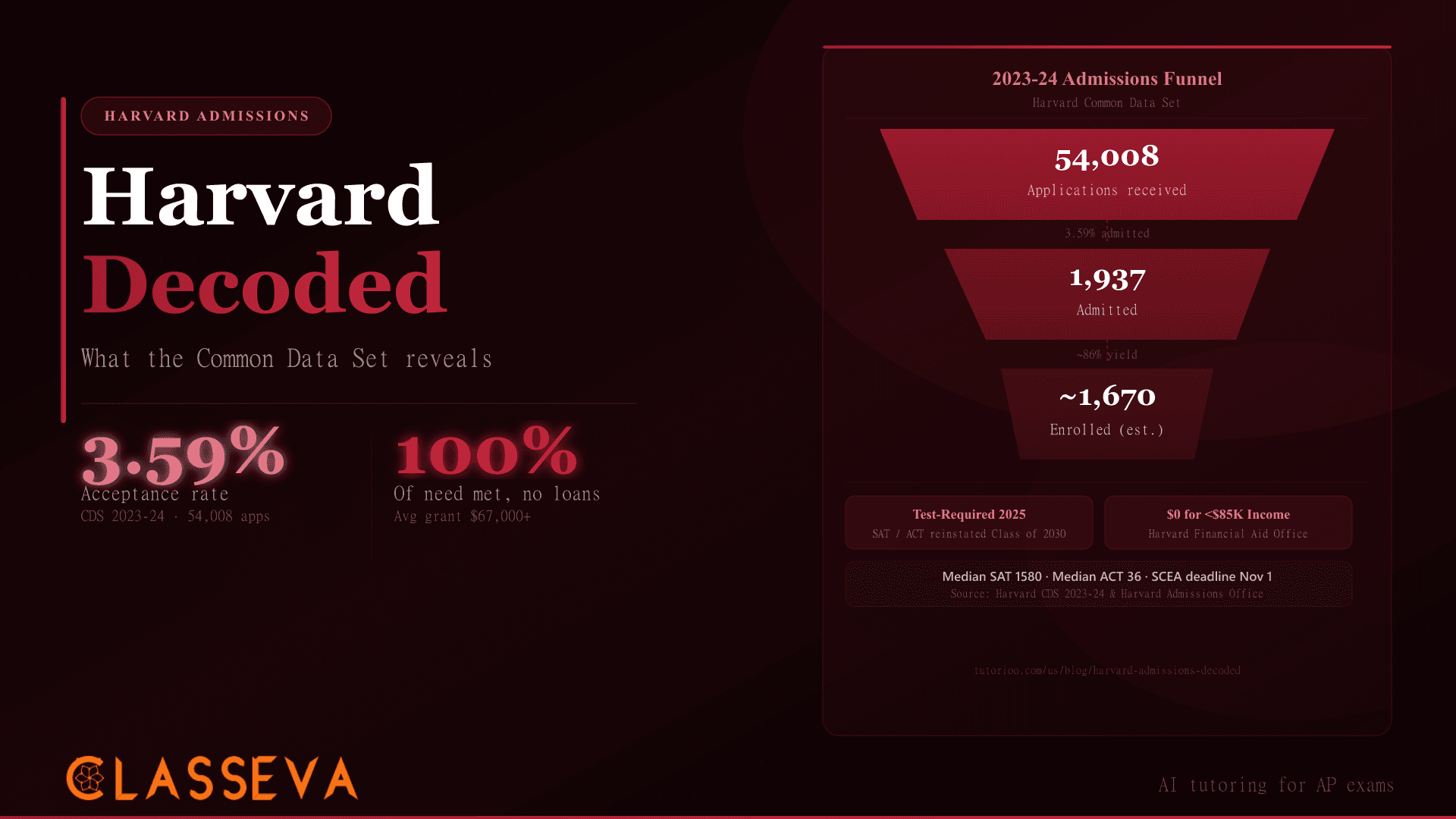
Columbia occupies a specific position among the Ivies. Its acceptance rate sits in the bottom tier of Ivy selectivity (alongside Harvard, Yale, and Princeton), its location in New York City gives it distinctive character relative to suburban campuses, and its Core Curriculum sets it apart from the distributional requirement systems used at every other Ivy. The table below captures the structural differences relevant to application strategy.
| School | Early Round Type | Test Policy (2025+) | Acceptance Rate (approx.) |
|---|---|---|---|
| Columbia | Binding ED | Test-required | ~3.9% |
| Harvard | SCEA (non-binding) | Test-required | ~3.6% |
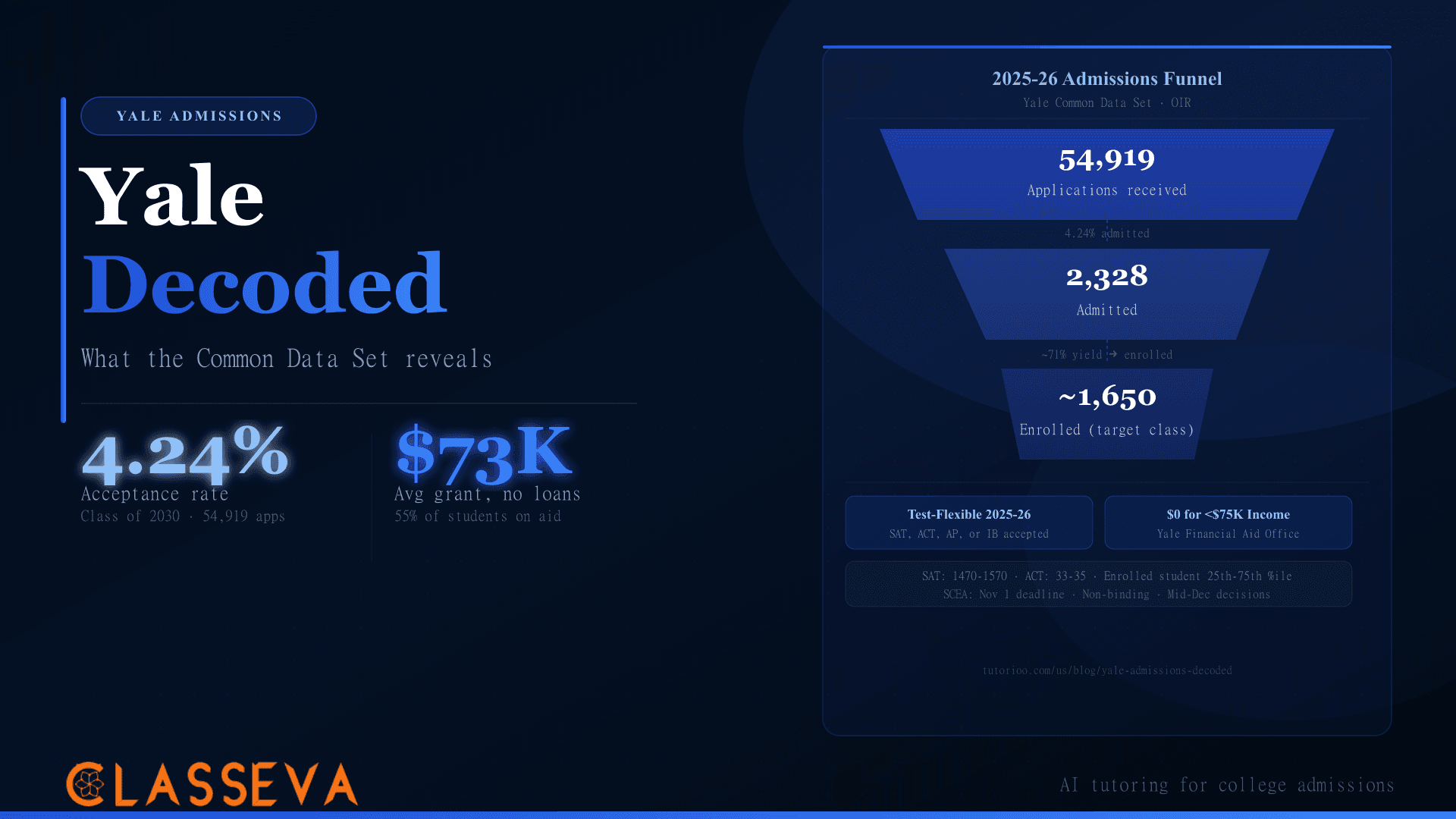
| Yale | SCEA (non-binding) | Test-required | ~3.7% |
| Princeton | REA (non-binding) | Test-required | ~3.7% |
| Penn | Binding ED | Test-required | ~5.7% |
| Brown | Binding ED | Test-required | ~5.1% |
| Dartmouth | Binding ED | Test-required | ~5.3% |
| Cornell | Binding ED | Test-required | ~7.4% |
Acceptance rates are approximate based on most recent publicly available CDS data. Verify against each school's current CDS. [VERIFY all figures]
Columbia joins Penn, Brown, Dartmouth, and Cornell in using binding Early Decision rather than SCEA. This is counterintuitive to many students who assume all of the most selective Ivies use the same early-round structure. For students who have Columbia as a genuine first choice, binding ED represents a stronger strategic signal to the admissions office than non-binding SCEA does at comparable schools. For students who want application flexibility, Regular Decision preserves that flexibility at the cost of a lower early-round advantage. For detailed breakdowns of Harvard and Yale specifically, the Harvard Admissions Decoded and Yale Admissions Decoded guides follow the same CDS-grounded framework used in this post.
For a comprehensive overview of the college admissions process, including how to build a balanced school list with reach, match, and safety schools, visit the Classeva college admissions resources hub.
Key Takeaways
- Columbia's acceptance rate sits near 3.9% based on CDS data, making it among the most selective universities in the world. Application volume has grown substantially while class size has remained near 1,470 students.
- Columbia's Early Decision is binding. Unlike Harvard's and Yale's SCEA, admitted ED applicants must enroll. Apply ED only after visiting Columbia and confirming it as a genuine first choice.
- Columbia reinstated test requirements for the 2025-26 application cycle. Both SAT and ACT are accepted; submit your strongest scores through College Board Score Choice or ACT.
- The Columbia Lists (books, music, art, film) are a distinctive supplement feature. Curate them with genuine taste. Admissions readers distinguish authentic intellectual interests from performative cultural signaling.
- Every Columbia College undergraduate completes the Core Curriculum regardless of major. Approximately 9-11 required courses, including two-semester sequences in Literature Humanities and Contemporary Civilization, define the shared intellectual experience.
- Columbia meets 100% of demonstrated financial need for domestic admits with no loans. Submit the CSS Profile by October 1 of senior year to avoid aid delays.
- The net cost of Columbia is often significantly lower than its sticker price for families at most income levels. Compare net prices, not sticker prices, when building your school list.