Princeton Admissions Decoded: What the Common Data Set Reveals
Princeton is the only Ivy League university that does not require standardized test scores for the 2025-26 application cycle. Harvard, Yale, Columbia, Penn, Brown, Dartmouth, and Cornell have all reinstated SAT or ACT requirements. Princeton has not. That single policy difference carries real strategic weight for applicants whose academic record is stronger than their test scores. This post walks through the actual Common Data Set data, the Single-Choice Early Action rules, the Bridge Year program, and the no-loan financial aid policy so you can build a strategy grounded in what Princeton actually evaluates, not what everyone assumes it evaluates.
What Does It Take to Get Into Princeton?
Princeton admits students through holistic review with no published formula and no minimum score or GPA cutoff. The Common Data Set does reveal which factors the admissions office considers Very Important, Important, or merely Considered when reading each application file.
By the Numbers: Acceptance Rate
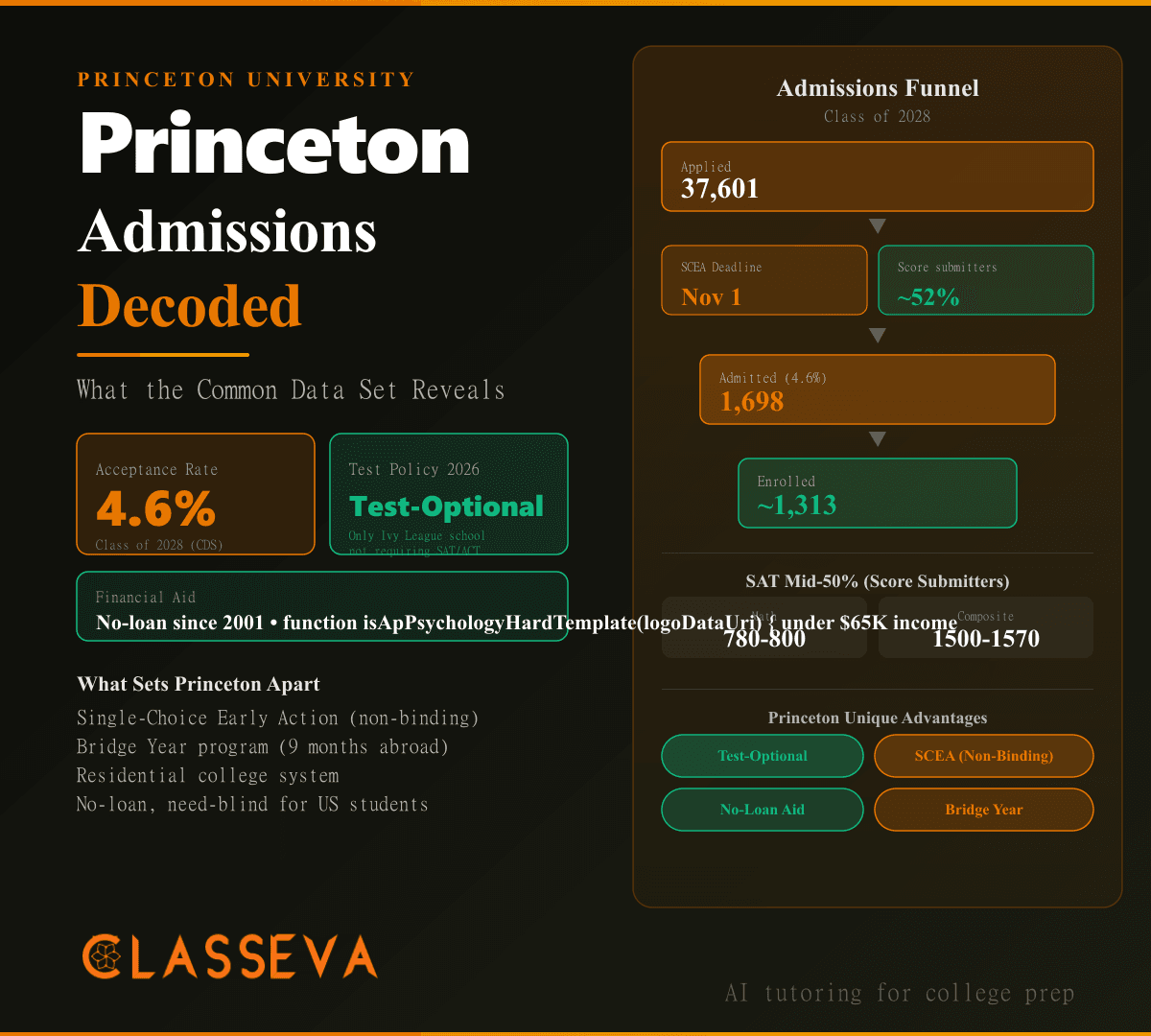
Princeton received approximately 37,601 applications for the Class of 2028 and admitted roughly 1,698 students, producing a 4.6% acceptance rate. Approximately 1,313 students enrolled. Those numbers have shifted only slightly over recent cycles; Princeton's class size stays tightly controlled, so the acceptance rate tracks closely with total application volume rather than any change in how Princeton evaluates candidates.
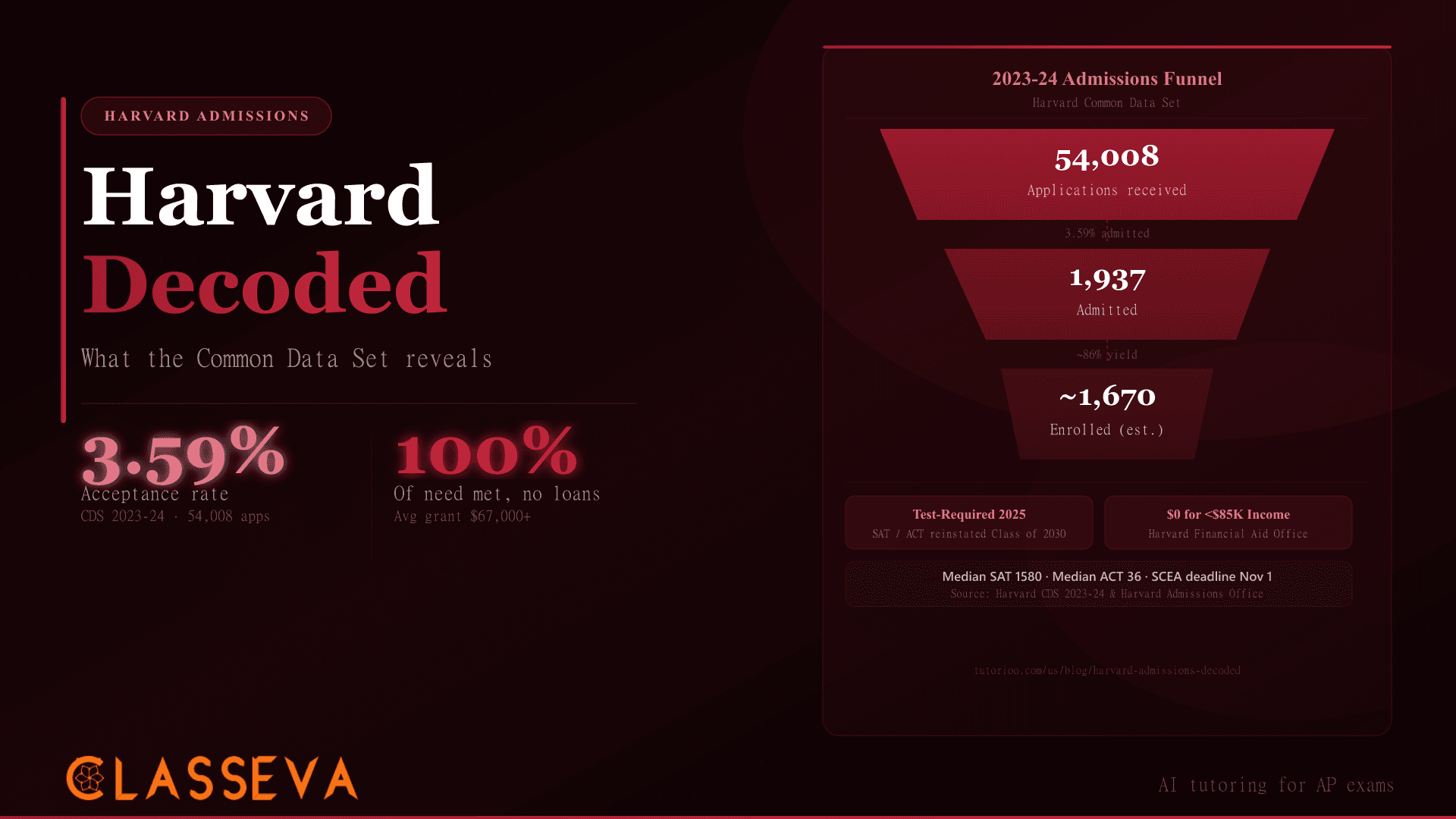
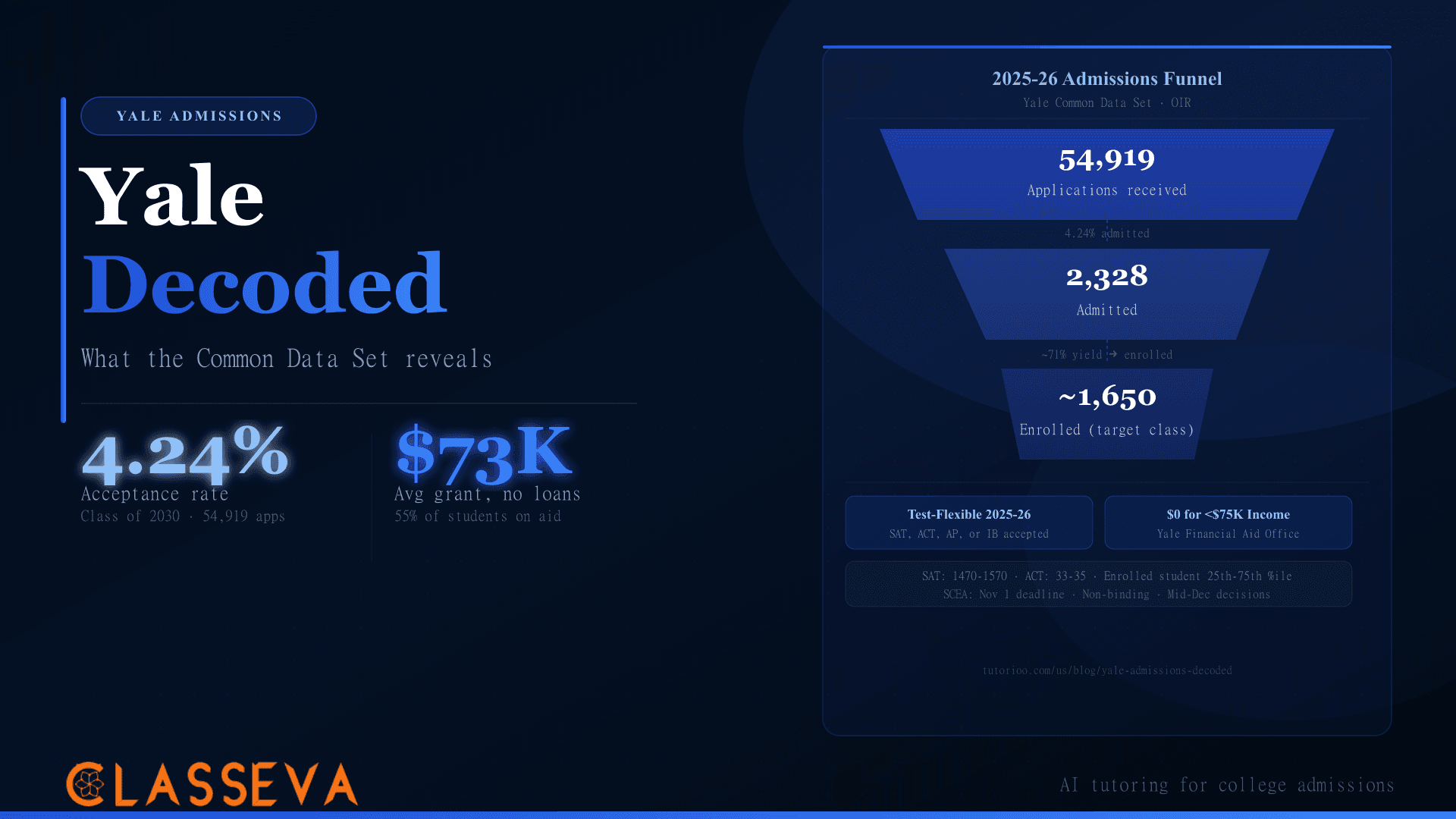
The 4.6% rate is roughly comparable to Harvard (3.6%) and Yale (3.7%) and slightly higher than Stanford (3.6%). But Princeton's test-optional policy means the shape of its applicant pool differs: more students with strong academic records but lower or no test scores apply to Princeton as their reach school in ways they would not at the other Ivies.
What CDS Section C7 Shows
CDS Section C7 lists each factor the admissions office rates Very Important, Important, Considered, or Not Considered. Princeton rates academic rigor and GPA as Very Important. Application essays, recommendations, character, and extracurricular commitment land as Important. Standardized test scores are Considered, not Important, reflecting the test-optional stance.
The practical implication of that Considered rating: a 1580 SAT probably does not move the needle as much as a 1580 would at Harvard. Conversely, a missing score also does not automatically sink an application the way it would at a test-required school.
Princeton's Test Policy: The Only Test-Optional Ivy
Princeton is the only Ivy League school still test-optional for the 2025-26 application cycle. Every other Ivy reinstated requirements: Harvard, Yale, Columbia, Penn, Brown, Dartmouth, and Cornell all require SAT or ACT scores from applicants entering Fall 2026. Princeton has held its test-optional position and stated publicly that it will continue assessing the policy annually.
What Test-Optional Actually Means at Princeton
Test-optional does not mean test-blind. Princeton does consider scores when submitted; it simply does not penalize applicants who choose not to submit them. The admissions office has said it evaluates non-submitting applicants using the full strength of the rest of their application file. Grades, essays, recommendations, and extracurriculars carry the weight that scores would have carried at a test-required school.
Princeton has stated that submitting scores is optional and that choosing not to submit will not disadvantage an applicant. The admissions office reads every application holistically within its full context. The Princeton testing policy page has the current official statement for each application cycle.
Should You Submit Scores?
The decision hinges on where your scores land relative to Princeton's published ranges for enrolled students who did submit scores. If your SAT sits at 1500 or above, submitting almost certainly helps. If your score falls below 1400, withholding and leaning on your academic record is likely the stronger move. The 1400-1499 range is genuinely uncertain; consider the strength of the rest of your application before deciding.
If your score falls in the top 10% nationally (SAT 1400+, ACT 32+) but below Princeton's mid-50% range for score submitters, you face a real trade-off. Talk to your school counselor. The decision is not as obvious as it might seem from the outside.
The Latest Princeton Admissions Data
Princeton's Common Data Set gives the most reliable picture of the admitted class. The CDS is published annually and covers both academic profile and demographic composition of each entering class.
Class of 2028 Profile
| Metric | Class of 2028 |
|---|---|
| Total applications | 37,601 |
| Students admitted | 1,698 |
| Acceptance rate | 4.6% |
| Students enrolled | ~1,313 |
| First-generation college students | Approximately 18% |
| Pell Grant recipients | Approximately 20% |
| States represented | 50 states + DC |
| Countries represented | Over 100 |
Source: Princeton University Common Data Set 2024-25
Princeton's enrolled class stays tightly controlled near 1,300 students per year. That class size has not expanded meaningfully in decades, which is why the acceptance rate has declined steadily as the applicant pool has grown without a corresponding increase in seats.
SAT and ACT Ranges for Score Submitters
| Test | Section | 25th Percentile | 75th Percentile |
|---|---|---|---|
| SAT | Total | 1500 | 1570 |
| SAT | Math | 780 | 800 |
| SAT | Reading & Writing | 730 | 770 |
| ACT | Composite | 34 | 36 |
Score ranges for enrolled students who chose to submit scores (CDS 2024-25)
These ranges apply only to the subset of enrolled students who submitted scores. Roughly half of Princeton's enrolled class chose not to submit test scores. That means the ranges above reflect the higher-scoring portion of the class, not the full class. A student enrolling without test scores may have academic achievements that Princeton found equally compelling through other indicators.
Princeton's Single-Choice Early Action
Princeton's Single-Choice Early Action (SCEA) is non-binding, with a November 1 application deadline and mid-December notification. You are not required to attend if admitted. But SCEA comes with significant application restrictions that most students misunderstand.
What SCEA Restricts (and What It Doesn't)
Applying SCEA to Princeton bars you from applying early to any other private U.S. college under Early Decision, Early Action, or Early Notification in the same application cycle. You can still apply early to public universities that offer non-binding early action and to military academies. Rolling admissions schools are also permitted.
Allowed with Princeton SCEA
- •Public university Early Action (UMich, UNC, UVA, etc.)
- •Military academy applications
- •Rolling admissions programs
- •Regular Decision at any school
- •Financial aid applications anywhere
Restricted by Princeton SCEA
- •Early Decision at any private college
- •Early Action at any other private college
- •Early Notification at any private college
- •Harvard REA, Yale SCEA, Stanford REA, MIT EA: all off the table
SCEA vs Harvard REA vs Stanford REA vs MIT EA
Princeton SCEA and Harvard REA and Yale SCEA all share the same structure: non-binding, but restricting early applications at other private schools. MIT EA is the outlier. MIT's Early Action is fully non-restrictive, meaning you can apply MIT EA and Princeton SCEA simultaneously. That combination is one of the most strategically efficient early application pairings available.
If you are genuinely interested in both Princeton and MIT, applying SCEA to Princeton and EA to MIT simultaneously is fully permitted. Both schools notify in mid-December, giving you two top-choice decisions before the Regular Decision deadline season begins. This is the paired early strategy that our Early Decision vs Early Action breakdown covers in depth.
Princeton Supplemental Essays
Princeton requires the Common App personal statement plus a set of Princeton-specific supplements. The supplements change each cycle; the prompts below reflect the general structure Princeton has used in recent years. Verify the current prompts on Princeton's application checklist before the cycle opens.
The Main Supplement Essays
Princeton typically requires two or three short essays of 250 words each covering distinct themes. Common themes across recent cycles include: intellectual interests and how Princeton's curriculum serves them, public service and civic engagement (Princeton's motto is “Princeton in the Nation's Service and the Service of Humanity”), and what you plan to contribute to Princeton's community. These essays assess fit with Princeton's particular culture, not just your application narrative.
Princeton places genuine institutional weight on public service. That does not mean you need to have volunteered abroad or started a nonprofit. It means you should have thought carefully about your responsibilities to communities beyond yourself. The strongest essays ground Princeton's service ethos in something specific and personal, not generic commitments to “making a difference.”
Short Answer Questions
Princeton also requires several short-answer responses in the 50-150 word range. These typically cover favorite books or works that have influenced you, activities you plan to continue at Princeton, and similar profile-building questions. The short answers reward precision and authentic voice. Admissions readers notice when a 50-word answer sounds rehearsed or generic. They also notice when it sounds distinctly like you.
Draft separately, then compress
Write a full 200-word version of each short answer, then cut to the word limit. Compression reveals which ideas you actually believe versus which words you are padding with.
Avoid the activities list restatement
Princeton can read your activities section. The short answers should not repeat what is already listed. Use them to reveal something the Common App form cannot capture.
Verify current prompts before the August deadline
Princeton typically publishes its supplement prompts in early August. Check the application checklist directly at Princeton's admissions site. Do not rely on last year's prompts.
The Princeton Bridge Year Program
Princeton offers a deferred enrollment option unlike anything else in Ivy admissions: the Bridge Year program. Roughly 25 admitted students defer their first year of enrollment to spend nine months in a structured service and language immersion experience abroad.
Program sites vary by year but have included Bolivia, Ecuador, India, Senegal, and other countries with a strong language-learning and community service focus. Princeton's Bridge Year site publishes current country placements and the application timeline.
Bridge Year participants apply at the same time they accept Princeton admission (May 1 deadline). Princeton covers all program costs including travel, housing, food, and insurance. Your Princeton financial aid package applies, which means Bridge Year often costs less than taking a self-directed gap year. Students arrive at Princeton in September following the program, one year behind their original cohort.
For students interested in a structured gap year, Bridge Year is worth considering before committing to a self-organized plan. Our gap year guide covers the broader landscape of gap year options, including when a self-directed year makes more sense than a program like Bridge Year.
Financial Aid and the No-Loan Policy
Princeton eliminated loans from all financial aid packages in 2001 and has maintained that policy ever since. No Princeton student with demonstrated financial need ever has to borrow to fund their education. Every dollar of Princeton aid comes as a grant or work-study arrangement.
This is not a marketing claim. It is Princeton's published, operational policy. Compare it to the federal loan situation at most public universities, where even students receiving substantial aid often graduate with $20,000-$30,000 in debt. Our net price versus sticker price breakdown explains why Princeton's no-loan policy changes the math so significantly.
Net Price by Family Income
Families earning under $65,000 per year typically see a $0 expected contribution from Princeton. The university covers everything including tuition, room, board, and fees through grants. As income rises, the expected contribution rises, but it never comes with a loan requirement. The work-study component (typically $3,000-$4,000 per year) represents an on-campus job rather than debt.
College Application Cost Calculator
Princeton's $75 application fee plus test prep, campus visit, and application support costs add up across a full list. Calculate your total application budget before the fall deadline rush.
For a detailed estimate of what Princeton would actually cost your family, use the College Net Cost Estimator. It factors in Princeton's specific aid policy to give a more accurate picture than the sticker price alone. For students also considering merit aid at other schools, the Scholarship Probability Estimator is worth running in parallel.
How Princeton Compares to Other Top Schools
Princeton sits alongside Harvard, Yale, Stanford, and MIT in terms of selectivity, academic reputation, and endowment. The distinctions that matter for applicants are practical: which early program, which test policy, which financial aid structure, and which academic culture.
| Factor | Princeton | Harvard | Yale | Stanford | MIT |
|---|---|---|---|---|---|
| Accept rate | ~4.6% | ~3.6% | ~3.7% | ~3.6% | ~4.5% |
| Test policy (2026) | Optional | Required | Required | Required | Required |
| Early program | SCEA | REA | SCEA | REA | EA (non-restrictive) |
| Early binding? | No | No | No | No | No |
| Restricts other private early? | Yes | Yes | Yes | Yes | No |
| No-loan aid? | Yes (since 2001) | Yes | Yes | Yes | Yes |
| Application portal | Common App | Common App | Common App | Common App | Own portal |
Comparison based on publicly available admissions data, 2025-26 cycle
The standout differences: Princeton's test-optional status makes it uniquely accessible to applicants whose academic record far outpaces their test scores. MIT's non-restrictive EA makes it the one elite school you can apply to early even if you are also pursuing Princeton SCEA. And MIT's own application portal (not Common App) means it requires separate essays regardless.
For the full breakdown of how MIT's application process differs from the Common App schools, our MIT Admissions Decoded post covers the portal, non-restrictive EA, and the maker/builder admissions philosophy in detail. For Harvard and Yale, see our Harvard Admissions Decoded and Yale Admissions Decoded posts.
Princeton's test-optional policy benefits applicants in specific situations: strong academic records with lower scores, documented circumstances that affected testing access, and applicants whose profile reads stronger without a distracting score. For students with scores above 1500 SAT, submitting almost certainly helps. Test-optional does not mean tests do not matter; it means you control whether they factor in.
Our test-optional policy breakdown for 2026 covers how admissions offices at multiple schools have discussed the policy shift publicly and what data suggests about how score submission affects outcomes. And if you are weighing Princeton SCEA against another early strategy, our ED vs EA guide covers the mechanics and strategy of every early application option in depth.
Key Takeaways
- Princeton is the only Ivy League school still test-optional for the 2025-26 cycle. Every other Ivy requires SAT or ACT scores.
- The acceptance rate sits at approximately 4.6% based on the most recent CDS, with roughly 37,601 applications and 1,698 admitted for the Class of 2028.
- Single-Choice Early Action (November 1) is non-binding but restricts early applications at other private colleges. Public university EA is still permitted.
- Applying Princeton SCEA and MIT EA simultaneously is permitted, since MIT EA is non-restrictive. This is one of the strongest paired early application strategies available.
- The Bridge Year program places approximately 25 admitted students in nine months of structured service abroad at no additional cost; Princeton financial aid applies.
- Princeton has offered no-loan financial aid since 2001. Families earning under $65,000 per year typically face $0 expected contribution.
- CDS Section C7 rates standardized tests as Considered, not Important, consistent with the test-optional stance. Academic rigor and GPA remain Very Important.