MIT Admissions Decoded: What the Common Data Set Reveals
The fact most families on the Common App route never notice: MIT is not on it. More than 1,000 colleges accept the Common Application. MIT has never participated, and it shows no sign of changing course. Students who apply to MIT manage a separate system at apply.mitadmissions.org, complete five distinct short-answer prompts that share no overlap with the 650-word personal statement, and work against different deadlines. Beyond the separate portal, MIT's Early Action round is non-restrictive, meaning you can apply EA to MIT while also submitting an Early Decision application to Harvard, Yale, or any other school in the same window. That combination, a separate portal with a genuinely open early round, makes MIT's application strategy unlike every other school in the top tier. This post walks through what the MIT Common Data Set 2024-25 actually says, and what it means for your application plan.
What Does It Take to Get Into MIT?
Getting into MIT requires exceptional math and science performance, a demonstrated record of making or building things, and the ability to articulate a genuine intellectual passion in five short answers. MIT's CDS lists standardized test scores among the "Very Important" admissions factors, the same tier as GPA and rigor of course selection, which separates MIT from many schools that list scores merely as "Important."
The Academic Bar
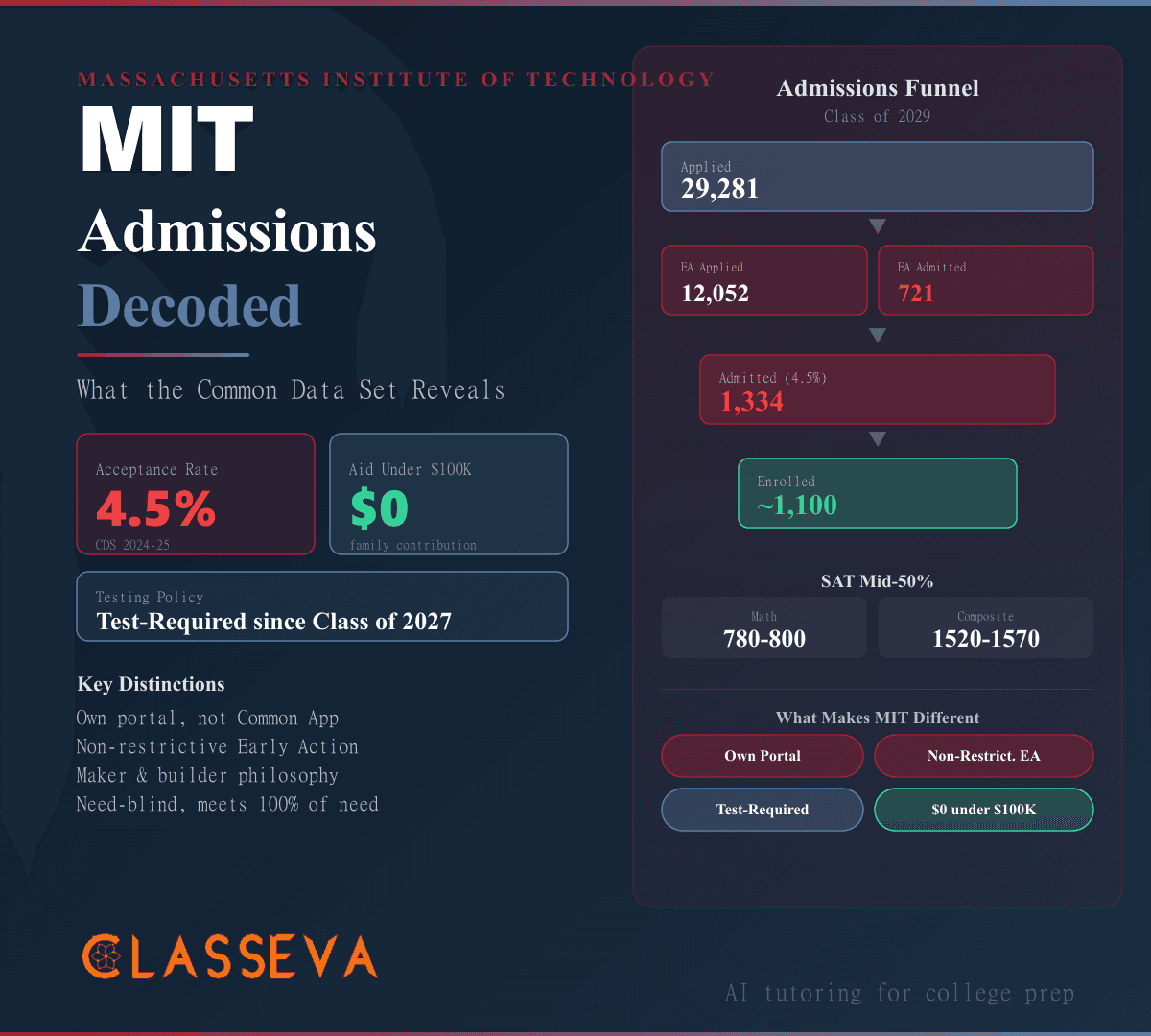
The mid-50% SAT composite for enrolled Fall 2024 MIT students runs 1520 to 1570. The mid-50% ACT composite is 34 to 36. Both figures come from MIT's CDS. The Math section tells a particular story: the 25th-percentile SAT Math score is 780 out of 800, meaning three-quarters of enrolled MIT students scored 780 or above on SAT Math alone. A 780 on the SAT Math section places a student near the 99th percentile nationally.
| Test | 25th Percentile | 50th Percentile | 75th Percentile |
|---|---|---|---|
| SAT Composite | 1520 | 1550 | 1570 |
| SAT Reading and Writing | 740 | 760 | 780 |
| SAT Math | 780 | 800 | 800 |
| ACT Composite | 34 | 35 | 36 |
Source: MIT Common Data Set 2024-25, Section C9. Figures represent enrolled Fall 2024 students.
These ranges describe the middle half of enrolled MIT students. The upper bound on SAT Math shows 800 at both the 50th and 75th percentiles, which means at least half of all enrolled MIT students scored a perfect 800 on the Math section. This concentration reflects MIT's curriculum directly: every student, regardless of major, must complete the General Institute Requirements, which include two semesters of calculus, two of physics, one of chemistry, and one of biology. A student who struggles with calculus faces those requirements in the first semester of every major at MIT.
The Maker and Builder Mindset
MIT's dean of admissions, Stu Schmill, has described MIT's approach publicly as favoring students who "want to use science to change the world." What that language means practically: the admissions office looks for evidence of doing, not just studying. A student who placed in the USA Math Olympiad and also built a spectrometer from salvaged parts occupies a different position in MIT's review than a student with identical test scores who only completed the AP Physics sequence.
MIT accepts optional creative portfolios through SlideRoom for students with work in research, making, building, art, or performance. A GitHub repository with active commit history, a robotics design document, or a research paper preprint belongs here. The portfolio gives MIT's readers context for hands-on work that never appears in a transcript.
This emphasis on making is not marketing language. MIT's five essay prompts ask what you do for pleasure, what unconventional paths you have taken in your education, and how you have collaborated with others. These prompts collectively map the contours of an applicant's intellectual life outside the classroom. A student who cannot answer all five with genuine specificity faces a harder review at MIT than at schools where one strong personal statement carries more of the weight.
The Latest MIT Admissions Data
Acceptance Rate and How It Breaks Down
MIT admitted 1,334 students from 29,281 applicants for the Class of 2029, a 4.6% acceptance rate. The Early Action round drew 12,052 applicants and admitted 721, a rate of approximately 6%. Regular Action applicants numbered 17,229; MIT admitted 603 directly plus 175 who had been deferred from EA, giving a combined Regular Action rate near 4.5%. The waitlist extended 561 offers and admitted 10 students from that pool.
Class of 2029 Profile
The Class of 2029 spans 49 US states and 56 countries. Twenty percent of enrolled students are first-generation college students, and 27% qualify for Pell Grants. Sixty-eight percent of enrolled students come from public high schools. MIT has emphasized these figures in its public communications as evidence that the financial aid program reaches beyond the independent school pipeline that populates many comparable institutions.
| Metric | Class of 2029 |
|---|---|
| Total applicants | 29,281 |
| Students admitted | 1,334 |
| Overall acceptance rate | 4.6% |
| EA acceptance rate (estimated) | ~6.0% |
| Regular Action acceptance rate (est.) | ~3.5% |
| Mid-50% SAT composite | 1520-1570 |
| Mid-50% ACT composite | 34-36 |
| First-generation college students | 20% |
| Pell Grant eligible | 27% |
| From public high schools | 68% |
| US states represented | 49 |
| Countries represented | 56 |
Source: MIT Admissions Statistics (Class of 2029) and MIT Common Data Set 2024-25.
What MIT Actually Looks For
MIT's CDS Section C7 maps every admissions factor to a weighting tier. The document is specific enough to settle most debates about what moves the needle in MIT's holistic review. Reading it alongside the admissions statistics reveals where MIT diverges from peer schools.
Academic Factors per the Common Data Set
What the Not Considered Column Reveals
MIT's CDS lists demonstrated interest as a factor the school does not consider. Campus visits, emailing admissions officers, and attending virtual info sessions carry no weight in the decision. The document also marks alumni relation and state residency as not considered, which means having a parent who attended MIT confers no admissions advantage in the CDS-reported weighting. These are not assumptions. They appear in the school's own published document.
MIT does not count demonstrated interest. The application essay category sits in the "Very Important" tier. Redirect any time you would spend on campus tours or admissions officer outreach toward the five short-answer essays instead. The tradeoff is that direct.
MIT's Unique Application: No Common App Here
MIT operates its own application portal at mitadmissions.org/apply/firstyear. No Common App, no Coalition App, no shared platform. A student building a list of twelve schools with MIT on it writes eleven Common App applications and then opens a completely separate system for MIT. The logistics matter when planning timelines. MIT's five short-answer prompts require different preparation than the Common App essay prompts, and MIT's two-teacher recommendation requirement specifies one STEM teacher and one humanities or social science teacher, which differs from many schools' open-ended recommendation policies.
The Five Short-Answer Essays
MIT asks five questions capped at 100 to 200 words each. They do not function like the Common App personal statement. Each prompt probes for specificity about the applicant's actual intellectual and personal life, not a polished narrative built around a single formative moment.
Field of study interest
100-200 words. Which field appeals to you most right now, and why does that field at MIT specifically appeal to you? MIT expects specificity about its curriculum and research offerings, not a generic enthusiasm for engineering or computer science.
Something done purely for pleasure
100-200 words. Not an extracurricular activity, not a leadership role with a title attached. Something you do because you genuinely enjoy it. This is where the maker and builder identity surfaces most clearly for STEM applicants.
An unconventional path in education
100-200 words. A way in which you have done something different from what was expected in your educational journey. Self-taught skills, independent projects, or detours from the standard academic sequence all belong here.
Collaboration experience
100-200 words. How you have collaborated with others to learn from them, with them, or contribute to your community together. MIT's culture of collaborative problem-solving makes this prompt particularly revealing about how an applicant actually works with other people.
Managing an unexpected challenge
100-200 words. How you managed a situation or challenge you did not expect, and what you learned from it. MIT's admissions readers have noted publicly that this prompt surfaces how applicants respond to failure and uncertainty, not just success.
A student with a strong Common App personal statement still writes five separate essays for MIT. The reverse holds as well: five strong MIT essays do not substitute for the Common App personal statement at other schools. Build separate preparation time for MIT if it sits on your list.
Early Action vs Regular Action
MIT's Early Action deadline falls on November 1, with decisions in mid-December. Regular Action closes January 5, with decisions in mid-March. What makes MIT's EA distinctive is its non-restrictive structure.
One concrete consequence: a student who applies EA to MIT and ED to Vanderbilt faces no conflict. If Vanderbilt admits them under ED, the binding commitment stands and they withdraw from MIT's process. If Vanderbilt defers or denies, MIT's mid-December decision gives them an option in hand before most Regular Decision deadlines hit in January. This optionality is unique to MIT among schools of comparable selectivity.
Does MIT Require the SAT or ACT?
Yes. MIT reinstated standardized testing requirements in March 2022 for applicants to the Class of 2027 onward. In the public announcement, Stu Schmill wrote that MIT's research showed scores "help us better assess the academic preparedness of all applicants, and also help us identify socioeconomically disadvantaged students who lack access to advanced coursework." MIT became one of the first major US universities to reverse its pandemic-era test-optional stance, and the requirement continues for the 2026-27 cycle.
MIT superscores both tests, taking the highest section score from each sitting across all test dates. Applicants self-report all official sittings, and MIT calculates the best combination during the review. The ACT writing section and SAT essay are not required. Review the MIT tests and scores pagefor the current cycle's submission deadlines: EA applicants must have scores in by the November testing date; Regular Action applicants have until the December date, with January test dates also accepted.
MIT's rationale differs from most schools that reverted to test requirements. Schmill argued publicly that a test-required policy is more equitable than a test-optional one because it prevents advantaged students from strategically withholding low scores while disadvantaged students with good scores submit them. MIT's research showed scores improve prediction of academic success, particularly for first-generation and low-income applicants whose transcripts may lack advanced course signals.
What MIT Actually Costs
MIT's published sticker price runs approximately $82,000 to $83,000 per year when tuition, room, board, and fees combine. For most admitted families, the net price sits well below that figure. MIT Student Financial Services publishes the guarantee directly: families earning under $100,000 per year with typical assets contribute nothing toward attendance costs.
Income Brackets and Family Contribution
MIT's financial aid program extends further up the income scale than most families realize. The free-tuition threshold sits at $200,000 in family income, meaning households at that level pay only room and board, roughly $18,000 to $20,000 per year. The average MIT scholarship for undergraduate students with demonstrated financial need was $68,358 in the 2024-25 academic year. Eighty-eight percent of MIT's most recent graduating class completed their degrees without any student debt.
How to Estimate Your Net Price
MIT's net price calculator on the Student Financial Services website accepts family income, asset, and family size inputs and returns a personalized estimate. Before building a full college list budget, use the calculator below to understand what MIT and comparable schools might cost across your application set. Application fees, score report sends, and test prep expenses add up quickly when applying to multiple selective schools.
College Application Cost Calculator
Budget for application fees, test score sends, and prep costs across your full college list, including MIT and comparable schools.
For a personalized MIT net price figure, the College Net Cost Estimatorlets you compare MIT's projected cost against other schools side by side. MIT's financial aid program frequently makes it cheaper than in-state tuition at major public universities for families in the $100,000 to $150,000 income range.
MIT vs. Other Highly Selective Schools
Comparing MIT to Harvard and Yaleon the admissions factors that differ most shows where MIT sits distinctly in the top-tier landscape. The comparison also clarifies the strategic implications of MIT's non-restrictive EA.
MIT
- •Non-restrictive EA (Nov 1 deadline)
- •Own portal: apply.mitadmissions.org
- •Test-required since Class of 2027
- •No demonstrated interest considered
- •5 short-answer essays (100-200 words each)
- •SAT mid-50%: 1520-1570
- •$0 for families earning under $100K
Harvard
- •SCEA: restrictive early (Nov 1 deadline)
- •Common App + Harvard supplement
- •Test-required since 2025-26 cycle
- •No demonstrated interest considered
- •Multiple supplemental short answers
- •SAT mid-50%: 1500-1600
- •$0 for families earning under $85K
The clearest practical difference is the EA structure. MIT's non-restrictive EA lets a student apply EA to MIT and ED to Harvard, Yale, or any other school in the same November window. Harvard's SCEA closes that option: applying SCEA to Harvard blocks simultaneous ED applications anywhere else. A student who wants MIT and Harvard as separate targets representing different institutional types can apply to both early. The same student cannot do the equivalent with Harvard and Yale, since SCEA and REA conflict with each other.
Review our 2026 test-optional policies overview for which schools have returned to test requirements and which remain test-optional. For California public university comparisons, the UC admissions decoded postcovers the UC system's test-free policy alongside its own comprehensive review process.
What to Do If You're Below the Typical Range
The mid-50% SAT Math range starts at 780. A student scoring 730 on SAT Math sits below that window. What the range does not capture: MIT admits students below it every year, and the CDS range describes the middle 50%, not the minimum. But a score meaningfully below the range reduces the probability of admission in an applicant pool where three-quarters of enrolled students scored 780 or above on Math alone.
The most productive response to a below-range score is not to apply and hope the rest compensates. It is to retake the test with focused preparation on the domains that cost the most points. For a student at 720 on SAT Math, the gap to 780 closes in eight to twelve weeks of deliberate practice targeting the specific question types responsible for missed points. MIT superscores, so every retake carries a chance of raising the composite without risking a lower score on sections already in range.
Applying to MIT without submitting test scores is not possible under the current policy. The SAT/ACT requirement is not optional or waivable for 2026-27 applicants. Applications missing valid standardized test scores are incomplete. Check MIT's testing requirements page for any policy updates before your submission deadline.
For applicants with strong maker or builder profiles but below-range test scores, the optional SlideRoom portfolio provides a channel for evidence that does not appear in scores or transcripts. A student who built a functional neural network from scratch, designed a working PCB layout, or contributed to an open-source research codebase can submit that work directly. MIT's admissions readers have direct context for evaluating technical work in a way that general admissions offices often do not. The Scholarship Probability Estimator can also help frame a financial fallback strategy if the competitive odds at MIT and similar schools suggest building a broader list.
Key Takeaways
- MIT's acceptance rate for the Class of 2029 was 4.6% overall. Early Action applicants saw roughly 6%, and Regular Action applicants saw roughly 3.5%.
- MIT does not use the Common Application. The portal is at apply.mitadmissions.org. Applying to MIT means managing two separate application systems if you also apply to Common App schools.
- MIT's Early Action (November 1 deadline) is non-restrictive: you can simultaneously apply Early Decision to any other school, a strategic option unavailable with Harvard's SCEA or Yale's REA.
- MIT reinstated SAT/ACT requirements in March 2022 for the Class of 2027 onward. The requirement continues for the 2026-27 cycle. MIT superscores both tests. The SAT Math 25th percentile for enrolled students is 780.
- MIT's CDS Section C7 lists standardized test scores as "Very Important," the same tier as GPA and rigor of course selection. Demonstrated interest is explicitly listed as "Not Considered."
- Families earning under $100,000 per year pay nothing. Families earning up to $200,000 receive free tuition. The average MIT scholarship for students with demonstrated need was $68,358 in 2024-25. Eighty-eight percent of the most recent graduating class finished debt-free.
- MIT values a maker and builder identity alongside academic credentials. The optional SlideRoom portfolio, the five short-answer essays, and MIT's CDS factor weighting all reflect a school that admits people who build things alongside people who study things.