UPenn Admissions Decoded: What the Common Data Set Reveals
Building Classeva's college admissions resources, the question that kept surfacing about Penn was structural rather than statistical: which of the four schools should I apply to? No other Ivy generates that question. At Harvard, Yale, and Princeton, you apply to the institution. At Penn, you apply to Wharton, or the College of Arts and Sciences, or SEAS, or Nursing, and the application process, the essay requirements, and in practice the admission rates differ between those choices.
The five coordinated dual-degree programs add a further layer. M&T, Huntsman, LSM, NETS, and VIPER each admit their own small cohorts from separate application processes, and their acceptance rates sit well below Penn's overall 5.7%. Penn's published Common Data Set gives you the numbers. Understanding the structural complexity is what this post covers.
What Does It Take to Get Into Penn?
Penn's overall acceptance rate sits near 5.7%, but that single number covers four schools with different academic priorities. The floor for academic preparation is consistent across all four: near-perfect grades in a rigorous course load, strong standardized test scores, and an application that demonstrates clear alignment with the specific school you are applying to.
The Academic Floor
The mid-50% SAT range for enrolled Penn students is approximately 1500-1560, with a mid-50% ACT composite of 34-36. Both figures come from Penn's Common Data Set 2023-24. Almost all enrolled students graduated near the top of their high school class nationally. Penn's CDS Section C9 shows over 95% of enrolled students placed in the top 10% of their graduating class.
| Measure | 25th Percentile | 75th Percentile |
|---|---|---|
| SAT Reading and Writing | 740 | 780 |
| SAT Math | 760 | 800 |
| SAT Total | 1500 | 1560 |
| ACT Composite | 34 | 36 |
Source: Penn Common Data Set 2023-24, Section C9. Figures represent enrolled Class of 2028 students.
These ranges describe the middle half of enrolled students. The top quarter of enrolled Penn students achieved SAT scores above 1560. Scoring at or above the 75th percentile does not guarantee admission; it earns a thorough read. What happens in that read determines the outcome.
Admissions Factors from the Common Data Set
Penn's CDS Section C7 discloses how much weight each factor carries in admissions review. Grades in college preparatory courses and the rigor of the curriculum both sit at the “Very Important” level. Application essays and class rank also fall in the Very Important tier. Recommendations, character, and extracurricular activities sit at “Important.”
| Factor | Penn CDS Weight |
|---|---|
| Grades in college preparatory courses | Very Important |
| Rigor of secondary school record | Very Important |
| Application essays | Very Important |
| Class rank | Very Important |
| Recommendations | Important |
| Character / personal qualities | Important |
| Extracurricular activities | Important |
| Standardized test scores | Considered |
| First generation status | Considered |
| Demonstrated interest | Not Considered |
Source: Penn Common Data Set 2023-24, Section C7.
Penn does not track demonstrated interest. Campus visits, emails to admissions officers, and attendance at information sessions carry no weight in Penn's review. Demonstrated interest distinguishes Penn from many smaller liberal arts colleges but aligns it with most other Ivies.
The Latest Penn Admissions Data
Acceptance Rate and Class Size
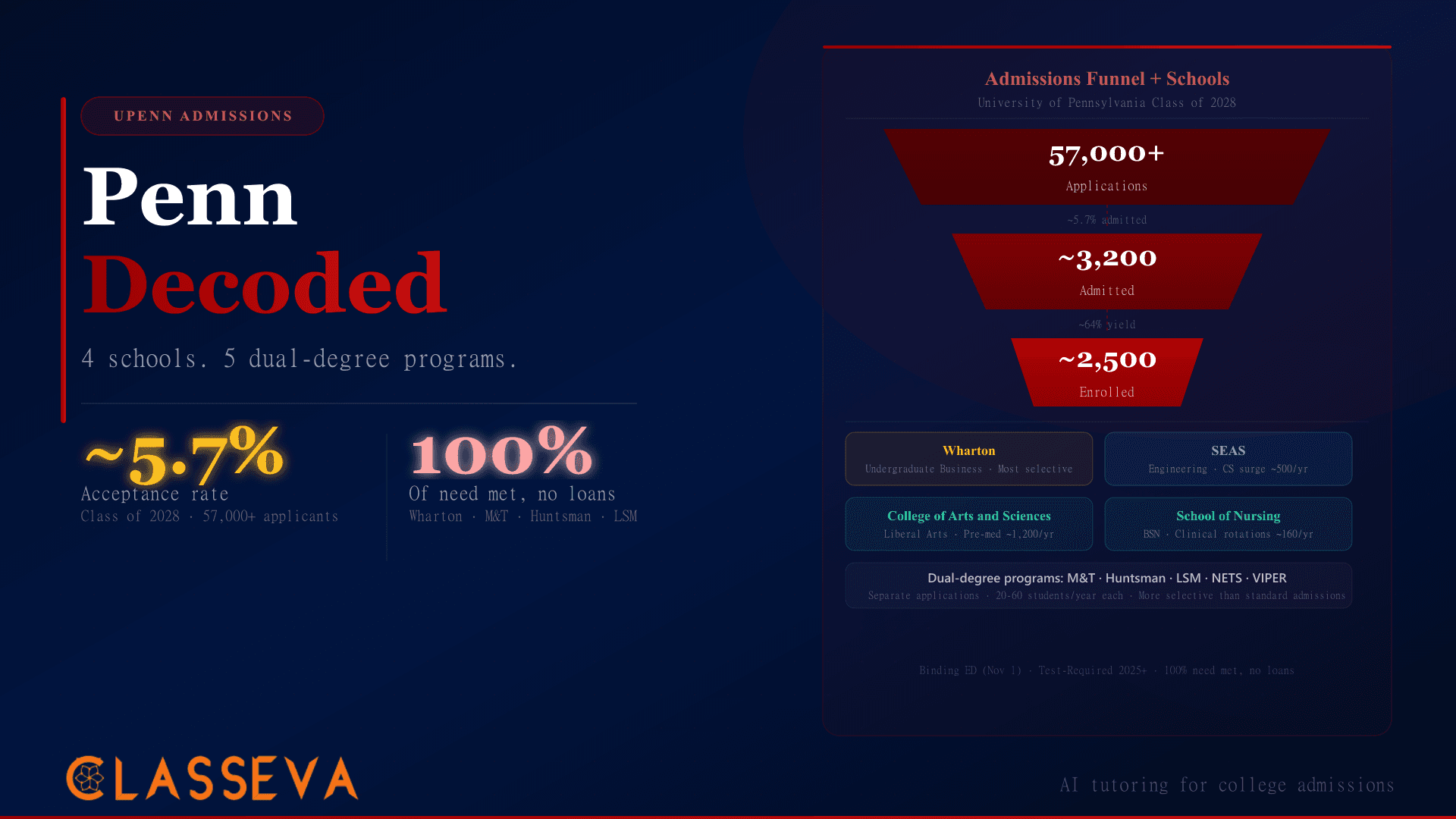
Penn's Class of 2028 drew over 57,000 applications across all four undergraduate schools. Penn admitted approximately 3,200 students, producing an overall acceptance rate of roughly 5.7%. The entering class enrolled near 2,500 students, consistent with Penn's class size over the past decade.
Class Profile by the Numbers
Approximately 40-45% of Penn's entering class typically comes from the Early Decision round. The remainder enters through Regular Decision in late March. Penn does not publish yield rates by school, but overall yield runs near 63-65%, among the higher yields at Ivies.
Penn's Four Undergraduate Schools
The choice of school is the single most consequential decision in any Penn application. You cannot apply to multiple Penn schools simultaneously, and switching schools after enrollment requires an internal transfer process with no guaranteed outcome. Apply to the school that matches your academic goals now, not the school you think might be slightly less competitive.
Wharton: Undergraduate Business
Wharton's undergraduate program is one of three or four programs in the country that functions as a true stand-alone undergraduate business school. Penn does not publish school-specific admit rates, but college counselors and admitted student data consistently show Wharton running 1-2 percentage points below Penn's overall rate, placing it among the most selective undergraduate programs in the country by acceptance rate.
Wharton students choose a concentration (Finance, Accounting, Management, Marketing, Statistics, Real Estate, and others) and complete the Wharton curriculum, which includes heavy quantitative coursework from the first semester. The Wharton supplement asks students to explain why Wharton specifically, and why now. Vague answers about “combining business and my other interests” read as underprepared. Strong answers reference specific Wharton concentrations, faculty, or programs by name.
Wharton
- •Undergraduate business, one of the few stand-alone programs of its kind
- •Concentrations: Finance, Accounting, Marketing, Statistics, Real Estate, and more
- •Highest selectivity among Penn's four schools
- •Supplement requires specific curriculum knowledge to write convincingly
- •~600 students per entering class
- •Gateway to finance, consulting, and entrepreneurship recruiting pipelines
College of Arts and Sciences
- •Liberal arts and sciences with pre-med and pre-law pathways
- •Most course selection flexibility of the four schools
- •Highest admit rate among Penn's four schools
- •Gateway to Huntsman and LSM dual-degree programs
- •~1,200 students per entering class
- •Strong sciences, social sciences, humanities, and quantitative majors
College, SEAS, and Nursing
The School of Engineering and Applied Science (SEAS) has seen its application volume surge over the past decade, driven by computer science demand. SEAS admit rates have tightened accordingly. CS, bioengineering, and systems engineering programs within SEAS attract competitive applicants who typically present with strong math and science records and evidence of independent technical projects.
The College of Arts and Sciences carries the highest overall admit rate among the four schools, but that does not mean it is less rigorous in its review. The College evaluates academic breadth, intellectual curiosity, and fit with its curriculum of arts and sciences coursework rather than a declared discipline-specific track.
The School of Nursing admits the smallest class of the four (approximately 160 students per year) and looks specifically for applicants with demonstrated interest in healthcare, clinical settings, or nursing science research. The Nursing curriculum is structured and pre-professional from the first semester, with clinical rotations beginning in the second year.
Penn requires you to choose one undergraduate school when applying. You cannot simultaneously submit applications to Wharton and the College, for example. Internal transfers between schools after enrollment are possible in some circumstances but are not guaranteed and are uncommon. Apply to the school that fits your academic goals now.
The Five Selective Dual-Degree Programs
Penn's coordinated dual-degree programs operate outside the standard school-based admissions process. Applicants apply directly to each program from high school during the same application cycle. If admitted, students pursue two full degrees simultaneously from two different Penn schools over four years. These are not double majors; they are separate degrees with separate degree requirements.
M&T: Management and Technology
The Jerome Fisher Program in Management and Technology is Penn's most recognized coordinated dual-degree program. M&T students earn degrees from both Wharton and SEAS, completing the full curriculum requirements of each school across four years. Penn admits approximately 45-50 students per year into M&T. The program runs its own application process with separate essays and, for recent cycles, an interview component.
M&T draws applicants who want to combine quantitative engineering training with Wharton's business curriculum, often targeting careers in technology entrepreneurship, venture capital, or technical product management. The application requires a separate M&T-specific essay on top of the standard Penn supplement for the school you would enter absent M&T.
Huntsman, LSM, NETS, and VIPER
The Huntsman Program in International Studies and Business places students in both the College of Arts and Sciences and Wharton. Huntsman admits approximately 50-60 students per year. Students must develop proficiency in a language other than English, and the program includes a year of study abroad. The focus is international business and policy at the intersection of economics and area studies.
LSM (Life Sciences and Management) bridges the College of Arts and Sciences and Wharton for students pursuing pre-health or life sciences research alongside management training. Roughly 35-40 students enroll in LSM each year. The program targets students whose career goals span healthcare, biotech, or pharmaceutical industries where scientific expertise and business literacy both matter.
NETS (Network and Social Systems Engineering) is a highly selective engineering honors program within SEAS combining network science, data systems, and computational social science. VIPER (the Vagelos Integrated Program in Energy Research) bridges SEAS and the College of Arts and Sciences for students focused on energy science and technology. Both programs admit cohorts of roughly 20-35 students per year through their own competitive application processes.
| Program | Schools | Cohort Size | Primary Focus |
|---|---|---|---|
| M&T | SEAS + Wharton | ~45-50/year | Technology and business leadership |
| Huntsman | College + Wharton | ~50-60/year | International business and policy |
| LSM | College + Wharton | ~35-40/year | Life sciences and management |
| NETS | SEAS (honors) | ~30-35/year | Network science and data systems |
| VIPER | SEAS + College | ~20-30/year | Energy research and technology |
Source: Penn program offices. Cohort sizes are approximate and vary by year.
Penn's Binding Early Decision
What ED Means for Admit Rates
Penn's Early Decision deadline is November 1, with decisions released in mid-December. Early Decision is binding. If admitted, you must withdraw all other applications and commit to enrolling. Penn's ED admit rate is meaningfully higher than the Regular Decision rate, consistent with the pattern at other schools offering binding ED. Roughly 40-45% of Penn's entering class each year comes from the ED round.
If Penn admits you Early Decision, you must enroll and withdraw all other college applications. The only legitimate reasons to withdraw from an ED commitment are if Penn's financial aid package is insufficient for your family. Review Early Decision vs Early Action carefully before applying.
How to Decide on ED at Penn
Applying ED to Penn makes the most sense when Penn is a clear first choice, your school selection is fully decided, and your financial situation is predictable enough that a binding commitment carries no meaningful risk. Request Penn's net price estimate (using the college net cost estimator) before applying, not after.
For students who are genuinely undecided between Penn and another school, or whose financial aid picture is uncertain, RD preserves optionality. Penn's RD deadline is January 5, with decisions in late March. RD applicants are evaluated by the same admissions officers with the same criteria; the process is more selective because fewer spots remain, but it is not a second-tier review.
Confirm your school choice within Penn
Identify which of the four undergraduate schools (or which dual-degree program) matches your academic goals. The school-specific supplement requires genuine knowledge of the curriculum. Apply to your actual first-choice school, not the one you assume has a slightly higher admit rate.
Get a financial estimate before committing
Use Penn's net price calculator at srfs.upenn.edu to estimate your expected family contribution. For a binding ED commitment to hold up financially, this number needs to be workable before you apply, not after you receive the award letter.
Submit the Common App with Penn supplement by November 1
The ED I deadline is November 1, 11:59 PM ET. The Penn supplement includes a school-specific essay on why that school specifically. Start this essay early in the fall semester. Rushed school-specific essays are one of the more identifiable weaknesses in Penn applications.
File CSS Profile by the priority financial aid deadline
Submit the CSS Profile as early as October 1 of senior year to meet Penn's priority financial aid deadline. The FAFSA also opens October 1. Both are required for Penn to calculate need-based aid. Missing the priority deadline does not disqualify you from aid, but it can delay your award letter.
Prepare to withdraw other applications if admitted
If Penn admits you ED, you must withdraw all other applications within 72 hours. The Common App allows you to withdraw school choices directly. Notify your school counselor and ask them to withdraw any applications submitted through school-based portals (Naviance, Scoir, etc.).
Does Penn Require the SAT or ACT?
Yes. Penn reinstated standardized testing requirements for the 2025-26 application cycle, applying to all students entering fall 2026 and beyond. Penn accepts both the SAT and ACT with no preference between them. Penn superscores the SAT (takes the highest section scores from multiple sittings). The mid-50% SAT range for enrolled Penn students is approximately 1500-1560; the mid-50% ACT composite is 34-36. Penn's test policy aligns with Harvard, Yale, Columbia, and most Ivies that reinstated testing for this cycle.
Penn's 75th percentile SAT score is 1560. Submitting scores below the 25th percentile (approximately 1500) puts you in the bottom quarter of enrolled students. Aim to sit the test at least twice by fall of senior year to benefit from superscoring.
Penn's No-Loan Financial Aid Policy
What the Aid Package Actually Covers
Penn meets 100% of demonstrated financial need for all admitted students. No loans appear in any Penn financial aid package. Penn's sticker price runs approximately $87,000 per year (tuition, room, board, and fees combined for 2024-25), but most families do not pay close to that figure. Penn's Student Registration and Financial Services office publishes the income-based grant ranges annually.
Families with total income under roughly $40,000 per year typically receive grants covering full cost of attendance, paying approximately nothing toward Penn. Families earning between $40,000 and $75,000 typically receive substantial grants with no loans and a manageable family contribution. Above $75,000, aid decreases progressively based on both income and assets. Penn also requires the CSS Profile (in addition to the FAFSA) to assess full family financial circumstances.
Penn joins Harvard, Yale, Columbia, and MIT in meeting 100% of demonstrated need with no loans. Brown and Dartmouth also meet full need. Princeton is an outlier that meets 100% of need with no loans and no student work requirements. For families comparing Ivy financial aid packages, the number that matters is not the sticker price but the net price after grants at each specific school.
How to Estimate Your Net Price
Penn's net price calculator, accessible through the admissions website, gives a personalized estimate based on family income, assets, and household size. Run this before filing the CSS Profile to calibrate expectations. The calculator estimates are typically within $2,000-$5,000 of the actual award letter for families without unusual financial circumstances.
College Net Cost Estimator
Enter your family income and household details to see a personalized net cost estimate for Penn and compare it across peer schools. Runs in seconds before you file the CSS Profile.
How Penn Compares to Other Ivies
Penn's most direct structural peers are Columbia (two undergraduate schools, binding ED), Cornell (seven undergraduate colleges, binding ED), and Dartmouth (single college, binding ED). Among Ivies offering binding ED, Penn is distinctive for housing the only Ivy undergraduate business school and for the depth of its dual-degree program portfolio.
| School | Accept Rate | Early Policy | Test Policy 2025-26 | Undergraduate Schools |
|---|---|---|---|---|
| Penn | ~5.7% | Binding ED | Required | 4 schools + 5 dual-degree |
| Harvard | ~3.6% | SCEA (non-binding) | Required | 1 college |
| Yale | ~3.7% | SCEA (non-binding) | Required | 1 college |
| Princeton | ~3.9% | Non-binding EA | Test-optional | 1 college |
| Columbia | ~4.0% | Binding ED | Required | 2 schools (CC + SEAS) |
Sources: Published Common Data Sets 2023-24. Accept rates approximate. SCEA = Single Choice Early Action.
Penn's acceptance rate of roughly 5.7% runs higher than Harvard (3.6%), Yale (3.7%), and Columbia (4.0%). The gap reflects Penn's higher application volume partly driven by Wharton's prestige drawing applicants who would not otherwise apply to other Ivies, and partly driven by Penn's binding ED structure, which the data consistently shows boosts raw application counts.
For students comparing Penn with Columbia or Princeton, the binding ED consideration is the first sorting question. If you apply ED to Penn and are admitted, that decision is made. Factor in financial aid estimates from both schools before committing to an ED application anywhere.
Among the schools with binding ED, Penn also stands out for financial aid strength. Penn, Harvard, Yale, Columbia, Brown, and most other Ivies all meet 100% of demonstrated need with no loans. Princeton goes further and removes student work requirements as well. The Harvard and scholarship probability estimator pages give more detail on how to compare aid packages across highly selective schools.
College Application Cost Calculator
Applying to Penn plus a mix of other schools adds up quickly. Calculate total application costs across your full list, including Common App fees, CSS Profile, SAT score sends, and application deposits.
Key Takeaways
- Penn admits to one of four schools, not to a single college. Choose your school before you write a word of the application. The school-specific supplement is evaluated by admissions officers who read that school's applications exclusively.
- Wharton's undergraduate program runs below Penn's overall 5.7% acceptance rate. The five dual-degree programs (M&T, Huntsman, LSM, NETS, VIPER) are more selective still, each admitting separate cohorts of 20-60 students per year.
- Penn is test-required for 2025-26 and beyond. The mid-50% SAT range for enrolled students is approximately 1500-1560; ACT 34-36. Penn superscores the SAT.
- Binding Early Decision accounts for roughly 40-45% of Penn's entering class. The ED admit rate runs meaningfully above the overall rate. But binding means binding: run a financial aid estimate before applying ED.
- Penn meets 100% of demonstrated need with no loans for all admitted students. Families earning under $40,000 typically pay nothing. The CSS Profile is required alongside the FAFSA.
- Penn does not track demonstrated interest. Campus visits, emails, and admissions events carry no weight in Penn's review, consistent with CDS Section C7.
- The school-specific supplement essay is the most differentiating piece of the Penn application. Generic “I want to combine my passions” essays read as under-researched. Name specific programs, concentrations, faculty, or clubs that exist only at the Penn school you are applying to.