Cornell Admissions Decoded: What the Common Data Set Reveals
What Does It Take to Get Into Cornell?
Cornell University is the most accessible of the Ivy League by acceptance rate, but "most accessible" at 8.41% still means nine of ten applicants are turned away. What separates Cornell from other Ivies is its unusual structure: eight undergraduate colleges, each with its own culture, curriculum, and admissions office. Applying to Cornell is not a single decision. It is a sequence of decisions, starting with which college to target.
The Common Data Set published by Cornell's Institutional Research and Planning office is the most reliable public source for admissions statistics. The figures below come from the CDS 2024-25, which covers the Class of 2028 entering in fall 2024. Cornell also reinstated standardized test requirements beginning with fall 2026 applicants, ending the test-optional policy that was introduced during the pandemic.
By the Numbers: Acceptance Rate and Class Profile
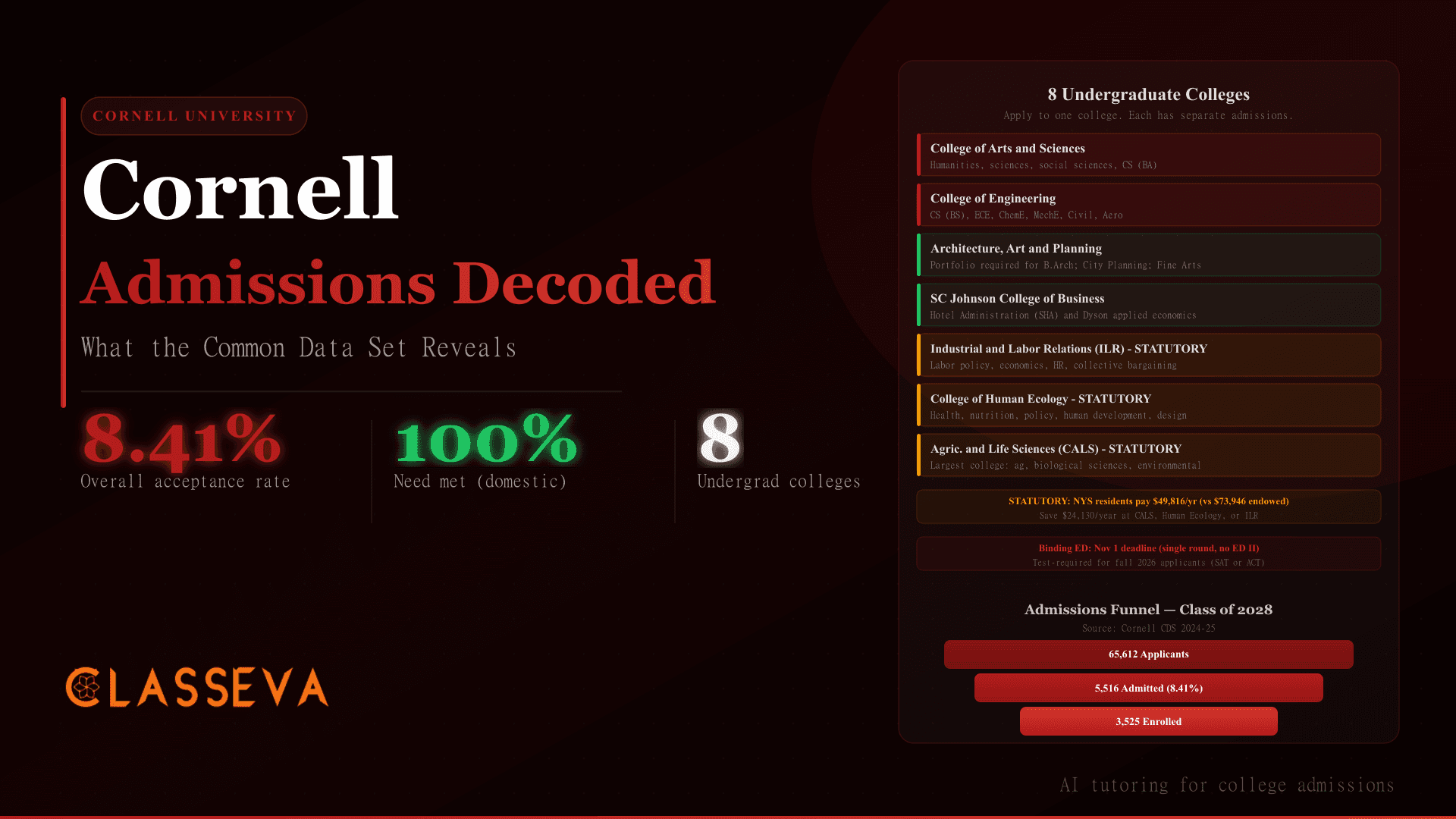
Cornell received 65,612 applications for the Class of 2028, admitted 5,516 (8.41%), and enrolled 3,525. The Early Decision round received 9,973 applications and admitted 1,161 students, meaning roughly one-third of the enrolled class was filled through binding ED. These funnel numbers reflect significant growth in application volume over the past several years, which has pushed the acceptance rate down from around 11% for the Class of 2024.
What the CDS Factor Ratings Show
The Common Data Set asks institutions to rate how important each admissions factor is on a four-point scale: Very Important, Important, Considered, or Not Considered. Cornell's self-reported ratings from the CDS 2024-25 are:
| Factor | Cornell Rating |
|---|---|
| Rigor of secondary school record | Very Important |
| Class rank | Considered |
| Academic GPA | Very Important |
| Standardized test scores | Important |
| Application essay | Very Important |
| Recommendation(s) | Very Important |
| Interview | Considered |
| Extracurricular activities | Important |
| Talent/ability | Important |
| Character/personal qualities | Very Important |
| First generation | Considered |
| Alumni/ae relation | Considered |
| Geographical residence | Considered |
| State residency | Considered |
| Volunteer work | Considered |
Source: Cornell University Common Data Set 2024-25, Section C7.
Cornell rates academic GPA, rigor of curriculum, application essay, recommendations, and character/personal qualities as Very Important. Standardized test scores are rated Important (a step below Very Important), which reflects the nuanced role of scores even under the reinstated requirement. The essay rating is notable: Cornell's supplemental essays are college-specific and evaluated by readers who specialize in individual colleges, so a generic response is easily identified.
The Latest Cornell Admissions Data
Cornell's academic profile for the Class of 2028 reflects the broader trend of rising credentials at selective universities. The middle 50% figures below are for enrolled students (not all admitted students), which is the most useful comparison point for applicants.
Test Score Ranges for Enrolled Students
| Test | Middle 50% (25th-75th Percentile) | Source |
|---|---|---|
| SAT Total | 1510 - 1560 | Cornell CDS 2024-25 |
| SAT Evidence-Based Reading and Writing | 740 - 780 | Cornell CDS 2024-25 |
| SAT Math | 790 - 800 | Cornell CDS 2024-25 |
| ACT Composite | 33 - 35 | Cornell CDS 2024-25 |
Middle 50% ranges for enrolled students. Cornell superscores both the SAT and ACT.
The SAT Math range topping out at 800 reflects Cornell Engineering's weight in the overall class. Cornell superscores both the SAT and ACT, taking the highest section scores across multiple test dates. If you sit the SAT more than once, each section score is evaluated independently.
GPA, Class Rank, and Academic Profile
Cornell does not publish a median GPA figure in its CDS, but Academic GPA is rated Very Important. Based on published enrolled student data, the overwhelming majority of admitted students have unweighted GPAs above 3.7 and weighted GPAs above 4.0. Most successful applicants ranked in the top 10% of their high school class.
Cornell reports that 85% of enrolled students were in the top 10% of their high school graduating class (CDS 2024-25, Section C). Class rank is only Considered in Cornell's factor ratings, but this statistic suggests that top-decile standing is the norm, not an edge.
Cornell's 8 Undergraduate Colleges
Cornell's college structure is unlike any other Ivy. When you apply to Cornell, you are applying to a specific college within the university, and each college has its own dean, curriculum, and admissions reader pool. You do not apply to "Cornell" in the abstract. This has real consequences for application strategy.
Endowed vs Statutory Colleges: What the Distinction Means
Cornell's eight colleges fall into two legal and financial categories. Endowed colleges are fully private, funded by Cornell's own endowment and tuition. Statutory colleges are New York State contract colleges, funded in part by the NYS legislature through an annual appropriation. This distinction determines tuition pricing.
The five endowed colleges are: College of Arts and Sciences, College of Engineering, College of Architecture Art and Planning, SC Johnson College of Business (Hotel Administration and Dyson Applied Economics and Management), and Cornell Bowers College of Computing and Information Science. The three statutory colleges are: College of Agriculture and Life Sciences (CALS), College of Human Ecology, and School of Industrial and Labor Relations (ILR).
Students at statutory colleges who are NYS residents pay the in-state rate. Out-of-state and international students at statutory colleges pay the full rate, which is comparable to endowed college tuition. This is a structural pricing mechanism, not a financial aid program.
How College Choice Shapes Your Application
Your college choice affects multiple aspects of your application. First, it determines which admissions office reads your file. Each college's office specializes in its domain. An application to Engineering will be read by readers who understand engineering curricula; an application to AAP's architecture program involves portfolio review. Second, your supplemental essays must speak specifically to that college's programs. Cornell explicitly asks applicants to explain their fit with the chosen college.
Switching colleges after admission is uncommon and typically requires meeting the receiving college's requirements for internal transfer. Applying strategically to a less competitive college to gain admission and then switching is generally unsuccessful. Cornell's admissions offices are aware of this tactic, and your essay will be evaluated for genuine fit.
Research the actual curriculum of your target college before writing. CALS offers a remarkably broad set of majors including atmospheric science, plant science, and nutritional sciences alongside more traditional fields. If your interests genuinely fit CALS, that is where you should apply, not as a backdoor to Cornell.
Statutory Colleges and the NYS Tuition Advantage
The statutory college tuition differential is one of the most concrete and underappreciated financial facts about Cornell. For NYS residents, the choice of college within Cornell is also a financial decision with annual implications of over $24,000.
What NYS Residents Actually Pay
For the 2025-26 academic year, Cornell tuition at endowed colleges is $73,946. Tuition at statutory colleges for NYS residents is $49,816. The $24,130 per year difference compounds to over $96,000 across a four-year degree before accounting for room, board, and fees.
The statutory tuition rate applies only to NYS residents. If you are an out-of-state or international student, applying to CALS or Human Ecology does not give you a tuition discount. Out-of-state students at statutory colleges pay rates comparable to endowed college tuition. Verify current rates at finaid.cornell.edu before building a budget.
For NYS residents who are considering Cornell, the statutory vs. endowed distinction should be part of the college-selection conversation from the beginning. If your academic interests genuinely fit one of the three statutory colleges, the financial advantage is substantial and real. If your interests lie in Engineering or Arts and Sciences, there is no workaround.
Financial aid calculations further interact with this distinction. Because statutory tuition is lower, the Cost of Attendance figure used in Cornell's financial aid formula is lower at statutory colleges, which can affect the size of grants awarded. The net price may end up comparable for need-based aid recipients, but for families not receiving significant grants, the statutory rate is a direct price reduction.
Cornell's Binding Early Decision
Cornell offers one Early Decision round. There is no Early Decision II. This is a meaningful structural difference from schools like Brown, Columbia, and UPenn, which offer both ED I and ED II. If you miss Cornell's ED deadline or are deferred, you move to Regular Decision. There is no second binding ED opportunity.
ED Deadline and the Binding Commitment
The Cornell ED deadline is November 1. Decisions are released in mid-December. The binding commitment means that if you are admitted, you must withdraw applications to all other schools and submit an enrollment deposit to Cornell. You may not use Cornell as a safety net while waiting for other results.
For the Class of 2028, Cornell received 9,973 ED applications and admitted 1,161 students through the ED process. Given that 3,525 students enrolled in that class, ED admits represented roughly 33% of the enrolled class. Cornell fills a meaningful share of each entering class through binding ED.
Early Decision vs Regular Decision Tradeoffs
Early Decision
- •Deadline: November 1
- •9,973 ED applications received (Class of 2028)
- •1,161 ED admits (~33% of enrolled class)
- •Binding commitment to enroll if admitted
- •No ED II round if deferred or denied
- •Strongest signal of demonstrated interest
- •Financial aid package must be acceptable before committing
Regular Decision
- •Deadline: January 2
- •Larger applicant pool, same academic bar
- •Decision released in late March
- •Compare financial aid offers from multiple schools
- •More time to strengthen application
- •No binding commitment
- •Lower effective acceptance rate than ED cohort
The financial implication of binding ED is real: you commit before seeing your financial aid package. Cornell's financial aid offer typically arrives alongside the admission decision, but families should estimate their expected contribution using the net price calculator before applying ED. If the financial aid package is insufficient, Cornell's policies allow for ED release in cases of demonstrated financial hardship, but this is not a routine opt-out mechanism.
For a broader discussion of ED versus EA strategy across schools, see our guide to Early Decision vs Early Action.
Does Cornell Require the SAT or ACT for 2026?
Yes. Cornell announced the reinstatement of standardized testing requirements for applicants entering fall 2026 and later. Applications submitted without SAT or ACT scores will not be considered complete. This reverses the test-optional policy Cornell adopted during the COVID-19 pandemic.
Confirm your scores are submitted through official channels
Submit SAT scores through the College Board and ACT scores directly to Cornell (SAT school code 2098, ACT code 2726). Self-reported scores are accepted for application review; official scores must be on file before enrollment.
Submit scores from all test dates to benefit from superscoring
Cornell superscores both the SAT and ACT, taking the highest section scores across all attempts. Sending scores from multiple test dates can only help. There is no advantage to withholding earlier sittings.
Target the middle 50% range as a benchmark
The middle 50% of enrolled students scored 1510-1560 on the SAT and 33-35 on the ACT. There is no published minimum, but scores below this range are at the lower end of the competitive pool, particularly in the engineering and computing colleges.
Check the testing deadline for late-cycle applicants
If you have not yet tested and are applying for fall 2026, verify Cornell's current testing deadline on the admissions website. Late-cycle ACT or SAT dates may not produce score reports in time to meet application review timelines.
Verify test requirements at admissions.cornell.edu
Cornell's official testing policy and any updates are published at admissions.cornell.edu. Policies can change between application cycles. Always verify requirements directly from the admissions office rather than from third-party sources.
The test requirement applies across all eight undergraduate colleges. There is no college-specific exemption. For a comparison of how other selective schools have handled the return to test requirements, see our post on test-optional policies in 2026.
Cornell's testing policy and official information are published at admissions.cornell.edu.
Cornell's Actual Cost: Financial Aid by Income
Cornell's sticker price is $73,946 in tuition (endowed) plus roughly $24,000 in room, board, and fees, bringing the total Cost of Attendance to approximately $98,000 per year before aid. For the majority of families who receive need-based aid, the actual out-of-pocket cost is substantially lower.
Net Price and Loan Policy by Family Income
Cornell meets 100% of demonstrated financial need for all admitted domestic students. Beginning with the 2025-26 academic year, Cornell eliminated student loans for families with incomes under $75,000. For these families, the financial aid package consists entirely of grants and work-study, with no borrowing required.
For families earning between $75,000 and approximately $120,000, Cornell provides substantial grant aid that significantly reduces the net price, though some loan component may be included. Families earning above $175,000 typically receive little or no need-based grant aid. Cornell does not offer merit scholarships separate from need-based aid.
Cornell is need-blind in admissions for US citizens and permanent residents. International students are evaluated need-aware, meaning their financial need is a factor in the admissions decision. Cornell does offer need-based aid to admitted international students, but the pool of aid for international applicants is more limited. For more on how to evaluate net price across schools, see our guide to net price versus sticker price.
For families trying to understand what Cornell would actually cost before applying, the net price calculator at finaid.cornell.edu provides a personalized estimate. You can also use our estimator:
College Application Cost Calculator
Estimate the full cost of your application cycle.
How Cornell Compares to Other Ivies
Cornell is frequently described as the "most accessible" Ivy League school. By acceptance rate, that is accurate. By academic profile, the difference between Cornell and the other Ivies is narrower than the acceptance rate gap suggests. The applicant pools are not identical: different self-selection patterns mean Cornell's applicant pool includes a different mix of students than Harvard's or Princeton's.
Cornell's 8.41% acceptance rate is roughly double Harvard's 3.6% and more than double MIT's 4.0%. For applicants on the margin between tiers, Cornell is a viable reach while Harvard and MIT may be longer reaches. The academic bar at Cornell is nonetheless high: middle 50% SAT scores of 1510-1560 and ACT of 33-35 overlap substantially with what you need for any Ivy.
For applicants interested in comparable schools, the following school-specific breakdowns follow the same data-driven approach:
- Harvard Admissions Decoded
- Yale Admissions Decoded
- Princeton Admissions Decoded
- Columbia Admissions Decoded
- Brown Admissions Decoded
- MIT Admissions Decoded
- Stanford Admissions Decoded
Key Takeaways
Acceptance rate: 8.41% for the Class of 2028
Cornell admitted 5,516 students from 65,612 applicants. Early Decision accounted for 1,161 admits from 9,973 ED applications, filling roughly 33% of the 3,525-student enrolled class.
8 undergraduate colleges with separate admissions
You apply to one college. Each college has its own admissions office, curriculum, and supplemental essay requirements. College choice affects both your application strategy and your tuition if you are an NYS resident.
NYS residents save $24,130/year at statutory colleges
CALS, Human Ecology, and ILR charge $49,816 in tuition for NYS residents versus $73,946 at endowed colleges. Out-of-state students at statutory colleges pay rates comparable to endowed tuition.
Binding ED only; no ED II
November 1 deadline with mid-December decisions. No second binding ED round. Deferred ED applicants move to Regular Decision with no additional early option.
SAT and ACT required for fall 2026 applicants
Cornell reinstated test requirements after the pandemic test-optional period. Middle 50%: 1510-1560 SAT, 33-35 ACT. Superscoring applies to both tests.
Need-blind for domestic students; need-aware for international
Cornell meets 100% of demonstrated need and eliminated loans for families under $75,000. International applicants are evaluated with financial need as a factor in the admissions decision.