Brown Admissions Decoded: What the Common Data Set Reveals
The number families quote first is 5.65%, the acceptance rate for the Class of 2029. The number fewer families engage with is what Brown actually asks you to do with your application: explain, specifically, how you plan to design your own education under a curriculum with no required courses. Brown is the only Ivy League school that runs binding Early Decision alongside a fully open curriculum. Those two facts together reshape what a competitive application looks like compared to Harvard, Yale, or Stanford.
What Does It Take to Get Into Brown?
Getting into Brown requires academic performance near the top of your class, a coherent intellectual identity, and genuine engagement with the Open Curriculum. The CDS does not publish a formula, but it does publish factor ratings that reveal which dimensions of an application Brown considers most when reviewing each file.
By the Numbers: Acceptance Rate and Class Profile
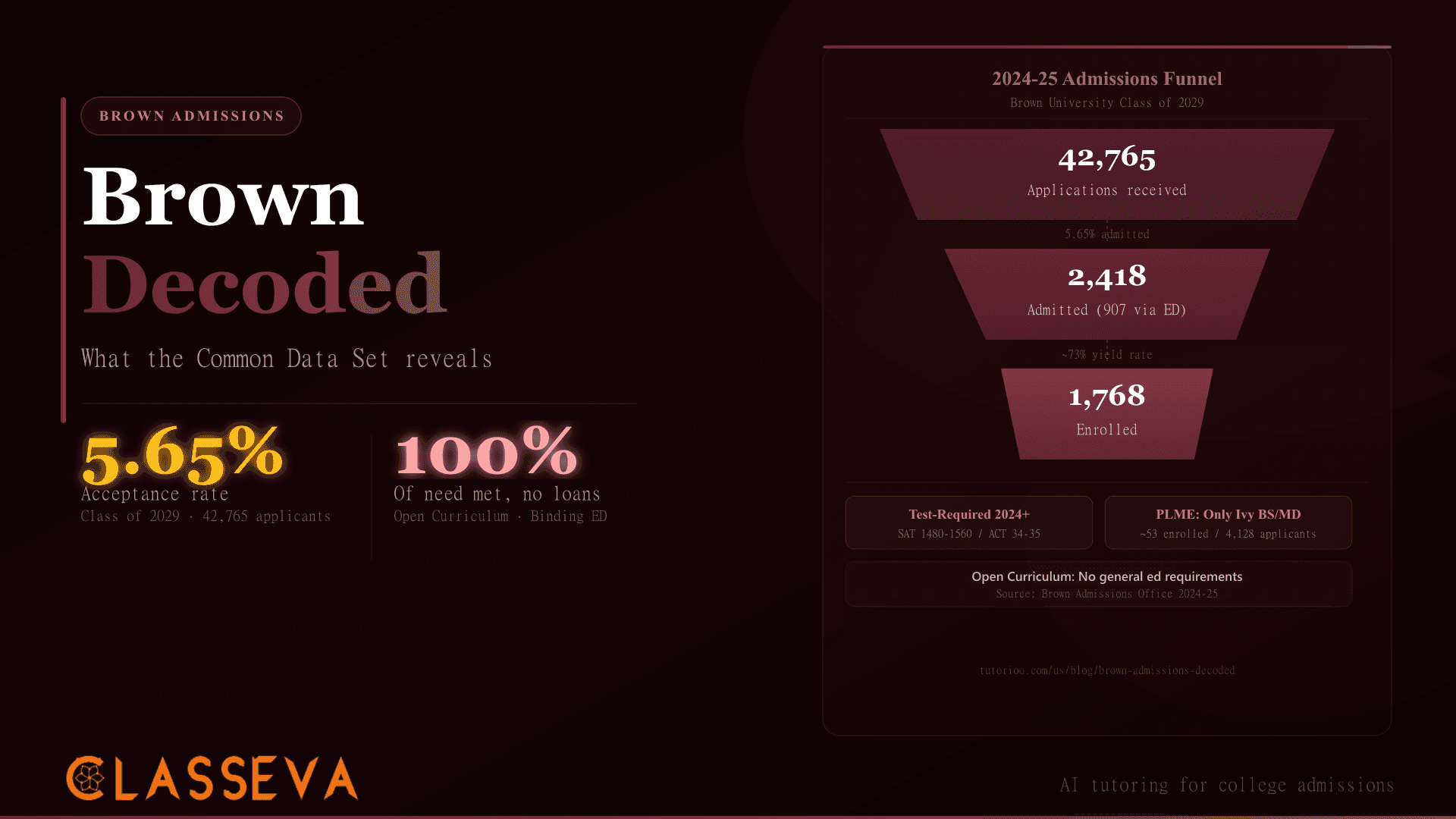
Brown admitted 2,418 students from 42,765 applicants for the Class of 2029, producing a 5.65% acceptance rate according to Brown's published admissions data. Early Decision admitted 907 students, which means roughly half the enrolled class of 1,768 committed before seeing peer schools' decisions. The top-10% of high school class figure sits at 95% of enrolled students.
What the CDS Factor Ratings Show
Brown's Common Data Set rates rigor of secondary school record and academic GPA as the two most heavily weighted factors. Essays, recommendations, and character or personal qualities also carry significant weight. Demonstrated interest is explicitly rated "Not Considered," matching Harvard, Yale, Stanford, and MIT. Campus visits and emails to admissions staff carry no weight in the review.
| Admissions Factor | CDS Rating |
|---|---|
| Rigor of secondary school record | Very Important |
| Academic GPA | Very Important |
| Application essays | Very Important |
| Recommendations | Very Important |
| Character / personal qualities | Very Important |
| Extracurricular activities | Important |
| Talent / ability | Important |
| Standardized test scores | Important |
| First generation status | Considered |
| Alumni / legacy relation | Considered |
| Demonstrated interest | Not Considered |
Source: Brown University Common Data Set 2023-24, Section C7.
The legacy entry deserves attention. Brown's own data shows approximately 8% of each enrolled class comprises legacy students, and the university publicly deferred a final decision on legacy preferences in 2024, opting to study the issue further rather than eliminate them immediately. Legacy is rated "Considered" in the CDS, the same rating used for first-generation status.
The Latest Brown Admissions Data
Brown's admissions data for the Class of 2029 reflects a first fully test-required cycle since 2020. Score ranges from this cohort offer a cleaner baseline than the test-optional years, when only students who believed scores would strengthen their files chose to submit them.
Test Score Ranges for Enrolled Students
| Test | 25th Percentile | 75th Percentile |
|---|---|---|
| SAT Composite | 1480 | 1560 |
| ACT Composite | 34 | 35 |
Source: Brown University Admissions Office, Class of 2029 data. Mid-50% ranges for enrolled students.
GPA, Class Rank, and Academic Profile
Brown reports that 95% of enrolled Class of 2029 students ranked in the top 10% of their high school class. No minimum GPA is published. The academic profile that emerges from the CDS is students who pursued the most challenging curriculum available at their school, not simply students who maintained the highest GPA in lighter coursework.
Brown's CDS rates rigor of secondary school record at the same level as GPA. A student with a 3.85 in AP and IB coursework often presents a stronger academic profile than one with a 4.0 in standard courses. Brown reads course selection alongside GPA, not instead of it.
The Open Curriculum: Brown's Signature
No other Ivy League school operates without a core curriculum. Harvard has distributional requirements spanning science, humanities, and social science. Yale requires distributional credits and a writing course. Columbia runs a Western canon-based Core Curriculum. Brown, since 1969, requires none of those things.
What No General Education Requirements Actually Means
Brown places three university-wide requirements on every undergraduate: complete 30 courses over eight semesters, declare at least one concentration (Brown's term for a major), and demonstrate proficiency in written English. That last requirement has no course attached; students satisfy it through writing produced in their coursework. There are no mandated science credits, no required history survey, no language distribution requirement, no freshman seminar you did not choose.
How the Open Curriculum Shapes Your Application
Brown's Why Brown supplement works differently from every other Ivy's school-specific essay. At Harvard, Yale, or Columbia, "why this school" prompts reward you for knowing campus culture and naming professors. At Brown, the essay must engage with a specific pedagogical model. Describing courses you want to take is necessary but not sufficient. The essay that works is one where the structure of your proposed education, the specific combination of fields, could only happen at Brown.
A student who wants to study computational neuroscience and medieval literature simultaneously, for instance, faces no forced trade-offs under the Open Curriculum. At most schools, distributional requirements would consume semester credits that could otherwise serve both concentrations. Brown removes that constraint. The strongest applicants name this constraint relief directly and show what their specific interdisciplinary path looks like.
Brown's Binding Early Decision
Brown runs binding Early Decision, not the Restrictive Early Action or Single Choice Early Action that Harvard, Yale, Princeton, and Stanford use. The distinction matters: Brown's ED admission requires a genuine commitment. Admitted students must withdraw all pending applications at other schools.
ED Deadlines and the Binding Commitment
The Early Decision deadline is November 1, with decisions released in mid-December. Brown explicitly states that admitted ED students "will be required to withdraw all pending applications." The agreement is between the student, the student's family, and the high school counselor: the counselor certifies the student will attend if admitted and signs the ED agreement alongside the applicant.
Brown guarantees that ED applicants receive the same financial aid packages as Regular Decision applicants. Over 60% of recent ED admits indicated intent to seek financial aid, and the university processes aid appeals for students who believe the initial package does not reflect their circumstances. The binding nature of ED does not reduce your leverage on financial aid at Brown.
Early Decision vs. Regular Decision Tradeoffs
Early Decision (ED)
- •Deadline: November 1
- •Decisions: mid-December
- •Binding commitment if admitted
- •907 ED admits in Class of 2029
- •Cannot apply ED/EA to other schools simultaneously
Regular Decision (RD)
- •Deadline: January 1
- •Decisions: late March or April 1
- •Non-binding; compare offers before committing
- •Allows comparing financial aid packages
- •Can apply to as many schools as needed
Brown does not publish a separate ED acceptance rate, and the admissions office states explicitly that the review criteria are identical for both rounds. Students should choose ED because Brown is their genuine first choice and their application is competitive, not because they believe ED provides a meaningful statistical advantage.
Does Brown Require the SAT or ACT for 2026?
Yes. Brown reinstated standardized test score requirements starting with the 2024-25 application cycle, applying to students enrolling from 2025 onward. Both the SAT and ACT are accepted. Brown uses institutional code 3094 for SAT submissions and 3800 for ACT. The ACT Writing section and SAT Essay remain optional. Brown's admissions office evaluates scores in context rather than using cutoffs, consistent with holistic review.
The middle 50% ranges (SAT 1480-1560, ACT 34-35) reflect students who actually enrolled, the most useful benchmark for prospective applicants. These ranges describe the middle half; the bottom quarter of enrolled students scored below 1480 on the SAT, and the top quarter scored above 1560. Test scores are rated "Important" in the CDS, below the five "Very Important" factors of rigor, GPA, essays, recommendations, and character.
PLME and Other Selective Programs
Brown runs two program-specific admissions tracks that sit inside the main application pool but carry distinct requirements and dramatically higher selectivity: the Program in Liberal Medical Education and the Brown/RISD Dual Degree.
How Selective Is PLME?
The Program in Liberal Medical Education is an eight-year combined undergraduate and medical education track culminating in both a bachelor's degree and an MD from the Warren Alpert Medical School. It is the only combined baccalaureate-MD program in the Ivy League. Brown's admissions data shows approximately 4,128 PLME applicants with 53 students enrolled each year, producing a program-specific rate near 1.3%. The regular Brown acceptance rate of 5.65% is roughly four times higher.
Brown/RISD Dual Degree runs on a separate track as well: 748 applicants competed for 15 spots in the most recent available data, a 2% admit rate. Students in this program earn degrees from both Brown and the Rhode Island School of Design over five years. PLME and Brown/RISD applicants submit additional short-answer questions specific to each program alongside the standard Common App and Brown supplement.
Brown's Actual Cost: Financial Aid by Income
Brown's total cost of attendance for 2026-27 runs approximately $99,994, covering tuition, fees, housing, meals, and personal expenses. That sticker price applies to students receiving no financial aid. For the 48% of first-year students who receive need-based aid, the picture changes substantially.
Net Price by Family Income
Brown meets 100% of demonstrated financial need for all enrolled students and has eliminated loans from aid packages through the Brown Promise. Families earning under $60,000 per year typically receive aid covering tuition, room, and board in full. The average grant for aid recipients runs approximately $65,370. Beginning with the Class of 2029, Brown extended need-blind admissions to international students, a change that affects roughly 10-12% of each enrolled class.
College Application Cost Calculator
Brown's $95 application fee plus SAT/ACT prep, score sends, and campus visits add up across a full list. Calculate your total application budget before you start submitting.
Brown requires both the FAFSA and the CSS Profile for need determination. The priority financial aid deadline for Regular Decision applicants is typically February 15. Students admitted under Early Decision receive financial aid packages at the time of their admissions decision and may appeal if the package does not reflect their circumstances accurately.
For a personalized estimate, Brown's MyinTuition quick calculator and full Net Price Calculator are available through the Office of Financial Aid's estimators page. You can also use Classeva's College Net Cost Estimator for a cross-school comparison across your full application list.
How Brown Compares to Harvard and Yale
Brown occupies a distinct position among the Ivies. Its curriculum model differs from every peer school. Its early decision structure differs from Harvard, Yale, Princeton, and Stanford (all of which run non-binding early programs). Its PLME program has no equivalent at any other Ivy. The table below captures the structural differences.
| Factor | Brown | Harvard | Yale |
|---|---|---|---|
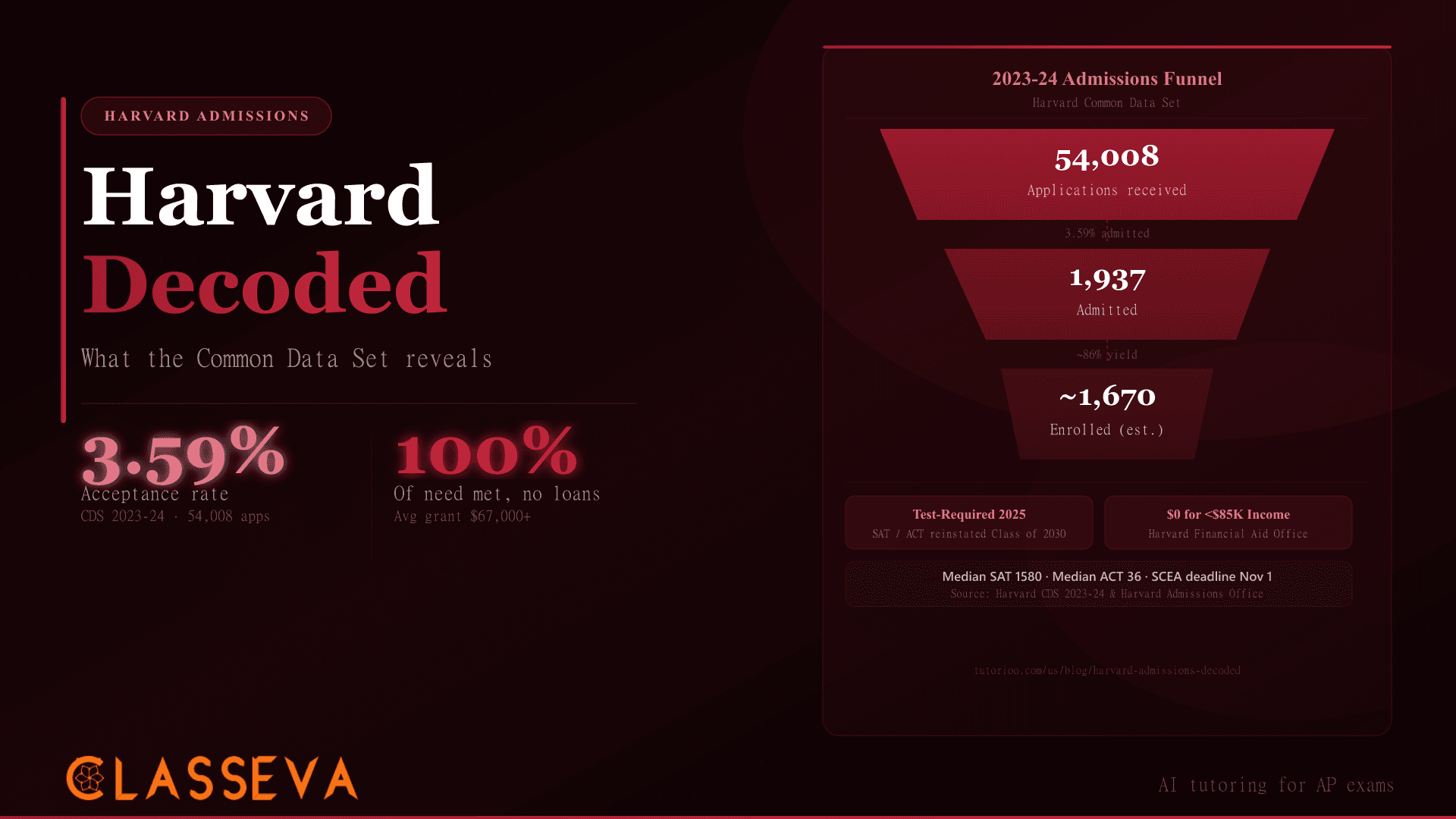
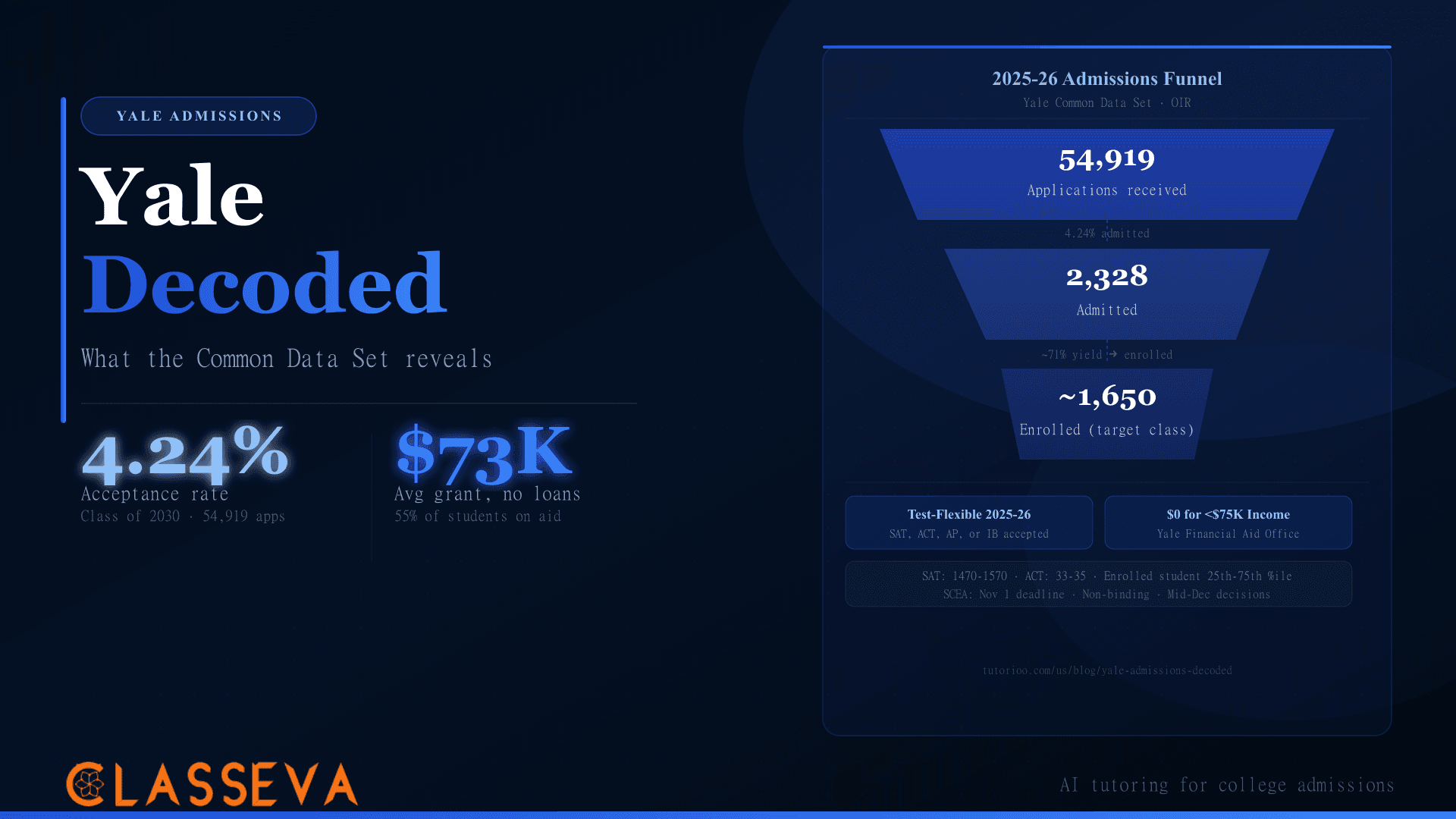
| Acceptance rate | 5.65% | 3.59% | ~3.7% |
| Early program | Binding ED | SCEA (non-binding) | SCEA (non-binding) |
| Early deadline | Nov 1 | Nov 1 | Nov 1 |
| Test policy | Required 2024-25+ | Required 2025-26+ | Required 2025-26+ |
| SAT mid-50% | 1480-1560 | 1500-1600 | 1500-1570 |
| ACT mid-50% | 34-35 | 34-36 | 34-36 |
| Core curriculum | None (Open Curriculum) | Distributional req. | Distributional req. |
| Need-blind intl. | Yes (from 2029) | Yes | Yes |
| No loans | Yes (Brown Promise) | Yes | Yes |
| Avg grant (aid rec.) | ~$65,370 | ~$61,000 | ~$70,000 |
Sources: Brown Admissions Office 2024-25; Harvard CDS 2023-24; Yale CDS 2024-25. Figures rounded.
The curriculum distinction matters beyond marketing. Students who genuinely want to combine fields that most universities would route into separate departments or force into an interdisciplinary major with prescribed courses may find Brown's structure uniquely enabling. Students who prefer structured requirements as scaffolding may find peer schools a better fit. Both are reasonable preferences; the application should reflect which one is actually true for you.
Brown's 5.65% acceptance rate sits above Harvard and Yale's rates but in the same tier. Read our full breakdowns of Harvard admissions, Yale admissions, and Stanford admissions for side-by-side detail on each school's distinct process. Our college admissions resource hub also covers the broader application strategy across the Ivy League and peer institutions.
Key Takeaways
Acceptance rate: 5.65% for the Class of 2029
Brown admitted 2,418 students from 42,765 applicants. Early Decision accounted for 907 admits. Enrolled class size was 1,768 students, with 95% ranking in the top 10% of their high school class.
Test-required from 2024-25 onward
SAT and ACT are both accepted. Middle 50% SAT range is 1480-1560; ACT range is 34-35. Scores are evaluated in context with no published minimum cutoff.
The Open Curriculum is the most distinctive feature in the Ivy League
No general education requirements. Students need 30 courses, one concentration, and written English competency. Every other Ivy mandates distribution or core requirements. Your Why Brown essay must engage with this model specifically.
Binding ED differs from Harvard's and Yale's non-binding early programs
Brown's November 1 ED deadline produces a binding commitment. Unlike Harvard SCEA or Yale SCEA, accepted ED students must withdraw all other pending applications.
PLME is the only combined BS/MD program in the Ivy League
Roughly 53 students enroll each year from more than 4,000 PLME applicants. The program-specific admission rate of approximately 1.3% is roughly four times more selective than the overall Brown pool.
Need-blind for all students; meets 100% of need with no loans
Brown extended need-blind admissions to international students beginning with the Class of 2029. The average grant for need-based aid recipients runs approximately $65,370. Families earning under $60,000 typically pay nothing for tuition, room, and board.
Demonstrated interest carries no weight
Brown's CDS explicitly rates demonstrated interest as Not Considered. Campus visits, emails to admissions officers, and event attendance do not affect your file.
One thing I find consistently underweighted in the advice given to Brown applicants: the Why Brown essay is not a logistics question about Providence or student-to-faculty ratio. It is a curriculum design question. Applicants who treat it as the former produce generic supplements. Applicants who treat it as the latter produce the essays that work.
If you are comparing Brown against other schools on your list, read the Early Decision vs. Early Action breakdown, review the net price versus sticker price guide, and check your estimated budget with the scholarship probability estimator before committing to any early program.
Source: Brown University Office of Institutional Research, Common Data Set 2023-24; Brown Admissions Office Class of 2029 statistics; Brown Office of Financial Aid 2024-25 data; PLME program enrollment data from admission.brown.edu; oir.brown.edu/institutional-data/common-data-set.