Is AP Art History Hard? The 250 Required Works Challenge
AP Art History is hard in one specific way: you have to know 250 works of art so well that you can analyze any of them, and attribute works you have never seen, under timed essay conditions. The 2025 data shows a 16.0% 5-rate and a 65.5% pass rate, numbers that sit squarely in the middle of the AP catalog. What separates the students who hit 5 from the larger group stuck at 3 is not talent or memory volume. It is whether they treated the 250 works as images to truly see or as a flashcard pile to cram.
Is AP Art History Hard?
AP Art History ranks as moderately hard among AP humanities exams, harder in scope than its reputation suggests but more predictable than open-ended reading courses. The single source of difficulty is the 250 required works. Every other element, the multiple-choice questions, the short essays, and the long comparison essays, draws from or tests against that fixed set. Master the 250 and the exam becomes tractable. Skim them and the exam punishes you.
Score Distribution and 5-Rate
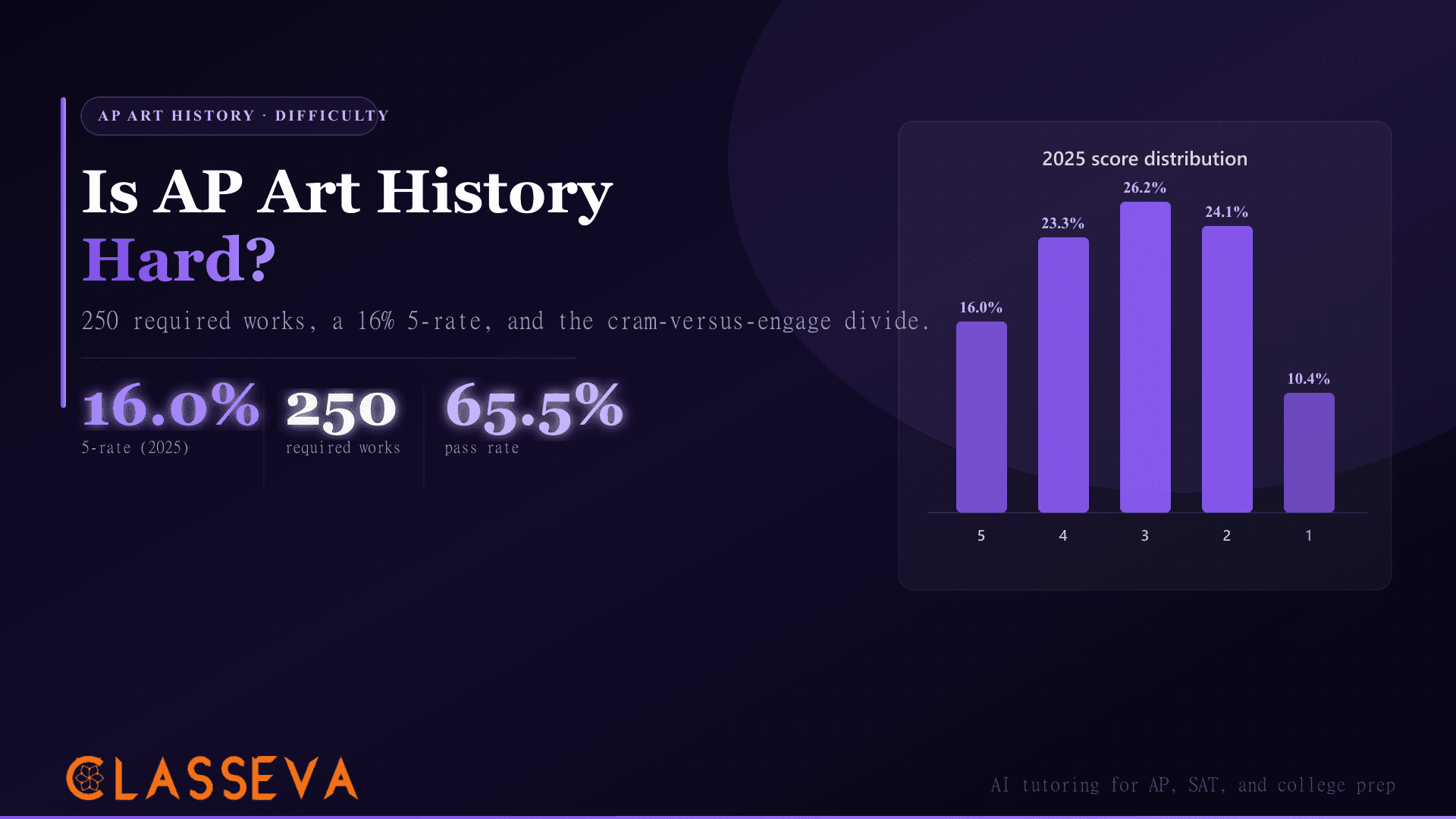
AP Art History's 2025 score distribution ran: 16.0% fives, 23.3% fours, 26.2% threes, 24.1% twos, and 10.4% ones, for a pass rate of 65.5% and a mean score of 3.10, per the College Board AP score distributions. About 25,600 students sat the exam, one of the smaller AP cohorts. According to College Board's AP Art History exam data, the distribution stays remarkably stable year to year, which makes sense: the corpus does not change, so the difficulty does not drift.
| AP Score | 2025 % of Test-Takers | College Readiness Signal |
|---|---|---|
| 5 | 16.0% | Extremely well qualified |
| 4 | 23.3% | Well qualified |
| 3 | 26.2% | Qualified |
| 2 | 24.1% | Possibly qualified |
| 1 | 10.4% | No recommendation |
2025 AP Art History score distribution. Source: College Board AP score reports.
Why Cramming Caps You at a 3
Here is the pattern I keep returning to when I study the AP Art History distribution. The modal score is a 3, and the 24.1% bunched at a 2 sit right beside it. That cluster of 2s and 3s tells a story: these are students who knew the works existed but could not do enough with them under pressure. They memorized that the Lamassu guarded an Assyrian gate. They could not write three sentences connecting its scale, its composite animal form, and its function as a symbol of royal power.
The 5-rate of 16.0% reflects a different relationship with the image set. A student who genuinely looks at the Great Mosque of Djenne sees the load-bearing torons, understands why mud-brick architecture demands annual re-plastering, and connects that maintenance ritual to community identity. That student can answer a question they never rehearsed. Memorization gets you recognition. Engagement gets you analysis, and analysis is what the rubric rewards.
AP Art History is not hard because the 250 works are hidden, they are published in advance. It is hard because knowing a work and being able to analyze it are two different skills, and the exam tests the second one.
What Are the 250 Required Works?
The 250 required works are a fixed list of artworks and monuments, published by College Board, that every AP Art History student must know in depth. They span from prehistoric cave paintings to twenty-first-century installations and cover Africa, the Americas, Asia, the Pacific, Europe, and the Islamic world. This defined corpus is what makes the course unusual: you know exactly what you are responsible for on day one.
The 10 Content Areas
College Board organizes the 250 works into 10 content areas, each tied to a region and time span. The works are not distributed evenly. Later Europe and the Americas carries the largest share, while content areas like the Pacific and Indigenous Americas hold fewer works but still appear on the exam. Knowing the weighting tells you where to spend your hours.
| Content Area | Coverage | Approx. Works |
|---|---|---|
| 1. Global Prehistory | 30,000 to 500 BCE | 11 |
| 2. Ancient Mediterranean | 3500 BCE to 300 CE | 36 |
| 3. Early Europe and Colonial Americas | 200 to 1750 CE | 51 |
| 4. Later Europe and Americas | 1750 to 1980 CE | 54 |
| 5. Indigenous Americas | 1000 BCE to 1980 CE | 14 |
| 6. Africa | 1100 to 1980 CE | 14 |
| 7. West and Central Asia | 500 BCE to 1980 CE | 11 |
| 8. South, East, and Southeast Asia | 300 BCE to 1980 CE | 21 |
| 9. The Pacific | 700 to 1980 CE | 11 |
| 10. Global Contemporary | 1980 CE to present | 27 |
The 10 AP Art History content areas and approximate work counts. [VERIFY: per-area counts against the current AP Art History CED image set.]
Five Facts You Memorize Per Work
For every one of the 250 works, you carry five anchor facts in your head: title, artist or culture, date, location or medium, and significance. Multiply that by 250 and you get 1,250 discrete data points before you have written a single sentence of analysis. That arithmetic is why the course rewards spaced repetition started in the fall, not a March panic.
Students build 250 flashcards with the title on the front and five facts on the back, then quiz themselves until recall feels automatic. That feels like progress. It is not enough. The exam rarely asks “what is the title of this work.” It asks you to analyze function, compare two works, or attribute an unknown piece. Flashcards build recognition; only writing practice builds the analytical fluency the rubric scores.
How Is the AP Art History Exam Structured?
The AP Art History exam runs 3 hours and splits evenly into two sections. Section I delivers 80 multiple-choice questions in 1 hour for 50% of the score. Section II delivers 6 free-response questions in 2 hours for the other 50%, broken into 2 long essays and 4 short essays. Starting in 2026, College Board administers the exam fully digitally.
The 80-Question Multiple Choice Section
You face 80 multiple-choice questions in 60 minutes, which leaves 45 seconds per question. Many questions cluster around an image set shown on screen, asking you to identify, contextualize, or compare. Some images are required works you have studied. Others are unfamiliar, and the question tests whether you can reason from visual evidence: style, materials, iconography, and period markers. Speed matters here, but careful looking matters more.
The 6 Free-Response Questions
The free-response section is where 5s are won and lost. Two long essays demand sustained analysis: one typically a comparison between a required work and an unknown work, the other a thematic argument supported by works you select. Four short essays each target a focused task, often attribution plus a one-paragraph justification. The 4 short essays move fast; the 2 long essays reward students who can structure an argument and cite specific visual evidence.
Long Essays (2 questions)
- •Roughly 35 minutes each, the heaviest analytical lift
- •One often compares a required work with an unknown work
- •One builds a thematic argument across multiple works
- •Rewards specific visual evidence over vague description
- •Where most of the gap between a 3 and a 5 opens up
Short Essays (4 questions)
- •Roughly 15 minutes each, focused single tasks
- •Frequently ask you to attribute an unknown work
- •Require justification from visual and contextual evidence
- •Pace is tight: partial answers beat blank responses
- •Reward breadth of recall across all 10 content areas
Attribution and the Unknown-Work Problem
The hardest skill on the exam is attribution: the test shows a work that is not on the 250 list and asks you to place it. You cannot memorize your way through this. You succeed by knowing the 250 so deeply that you recognize stylistic fingerprints, the proportions of Gothic tracery, the flattened space of Byzantine mosaic, the gesture of Baroque drama, and reason outward to a comparable known work. Attribution is the clearest proof that engagement beats cramming.
This is also why AP Art History rewards the same analytical habits as other reading-and-writing AP exams. Students weighing a humanities-heavy schedule often compare it against the AP European History difficulty breakdown and the related AP 2-D Art and Design portfolio path, which trades essay writing for studio production. The skills transfer: close looking, evidence selection, and timed argument construction show up across all three.
How Do You Study 250 Works Without Burning Out?
You study 250 works by starting in September and reviewing on a spaced schedule, never by cramming in April. Break the 250 into the 10 content areas, learn one area at a time, then interleave review of older areas as you add new ones. The students who score 5s treat the image set like a language they are learning to read fluently, not a list they are memorizing for one test.
A System That Beats Flashcard Cramming
Spaced review is the mechanism that moves 250 works into durable memory. The 2013 Dunlosky et al. review of learning techniques ranked spaced practice and retrieval practice as the two most effective study methods across subjects. Applied here, that means short daily sessions across months, not marathon weekends, paired with writing, not just recognition.
Pair the spacing with the right kind of retrieval. Instead of quizzing “what is this work,” quiz “analyze the function of this work in two sentences” or “compare this work to one other in the same content area.” You can read more on the underlying research in our coverage of spaced practice versus cramming and the broader case for active recall over passive review. Both apply directly to a 250-work corpus.
For each content area, draft one timed short essay per week using a released prompt from the official AP Art History exam page. Score it against the published rubric. Writing exposes the gap between “I recognize this work” and “I can argue about this work,” which is exactly the gap the exam measures.
Who Should Take AP Art History?
Take AP Art History if you enjoy reading, write analytically, and can commit to months of consistent review. It fits students who want a humanities AP that pairs well with history and English coursework. Skip it if you plan to cram, because this is the AP exam where cramming most reliably fails. The course rewards curiosity about why objects look the way they do across cultures and centuries.
No artistic skill is required, and that surprises people. You will never draw, paint, or sculpt for the AP Art History exam. The course is closer to a reading-and-analysis subject like AP World History than to a studio course. If you want the studio path instead, the AP Music Theory route tests a different creative discipline with its own ear-training demands rather than a timed visual-analysis exam.
AP Art History is one of the smallest AP cohorts: roughly 25,600 students sat the 2025 exam, compared with hundreds of thousands for AP US History or AP English Language. The small, self-selected pool is part of why the score distribution stays so stable from year to year.
AP Score Predictor
If you are mid-course and unsure whether your 250-work mastery is translating into exam scores, Classeva's AP Score Predictor maps your practice results to a projected score band so you know which content areas need more spaced review before May.
AP Score Predictor
Enter your AP Art History practice results to project your score band and pinpoint which of the 10 content areas need more review before the May exam.
For broader scheduling decisions, the difficulty of AP Art History also tracks with how much analytical writing you can carry alongside your other courses. Students balancing a heavy AP load find our guidance on senior year course rigor and admissions and the AP Research workload breakdown useful for deciding whether a writing-intensive humanities AP belongs on the transcript.
Key Takeaways
- AP Art History posted a 16.0% 5-rate and a 65.5% pass rate in 2025, with a mean of 3.10 across roughly 25,600 students. The numbers sit mid-pack in the AP catalog and stay stable year to year.
- The 250 required works are the entire game. Every section of the exam draws from or tests against this fixed, published image set, so mastering it is the single highest-leverage move.
- Cramming caps most students at a 3. The modal score and the cluster of 2s beside it are students who recognized works but could not analyze them under timed conditions.
- The exam runs 3 hours: 80 multiple-choice questions in 60 minutes (50%) and 6 free-response questions in 120 minutes (50%), split into 2 long essays and 4 short essays.
- Attribution is the skill cramming cannot solve. The exam shows unknown works and asks you to place them by reasoning from the 250 you know deeply.
- Spaced engagement beats flashcard volume. Start in the fall, interleave the 10 content areas, and practice timed writing weekly rather than memorizing titles in isolation.
- No drawing ability is required. AP Art History is a reading, memory, and analysis course, so most students enter with no art background and still earn high scores.