Is AP World History Hard? The 1200-Present Sprint Explained
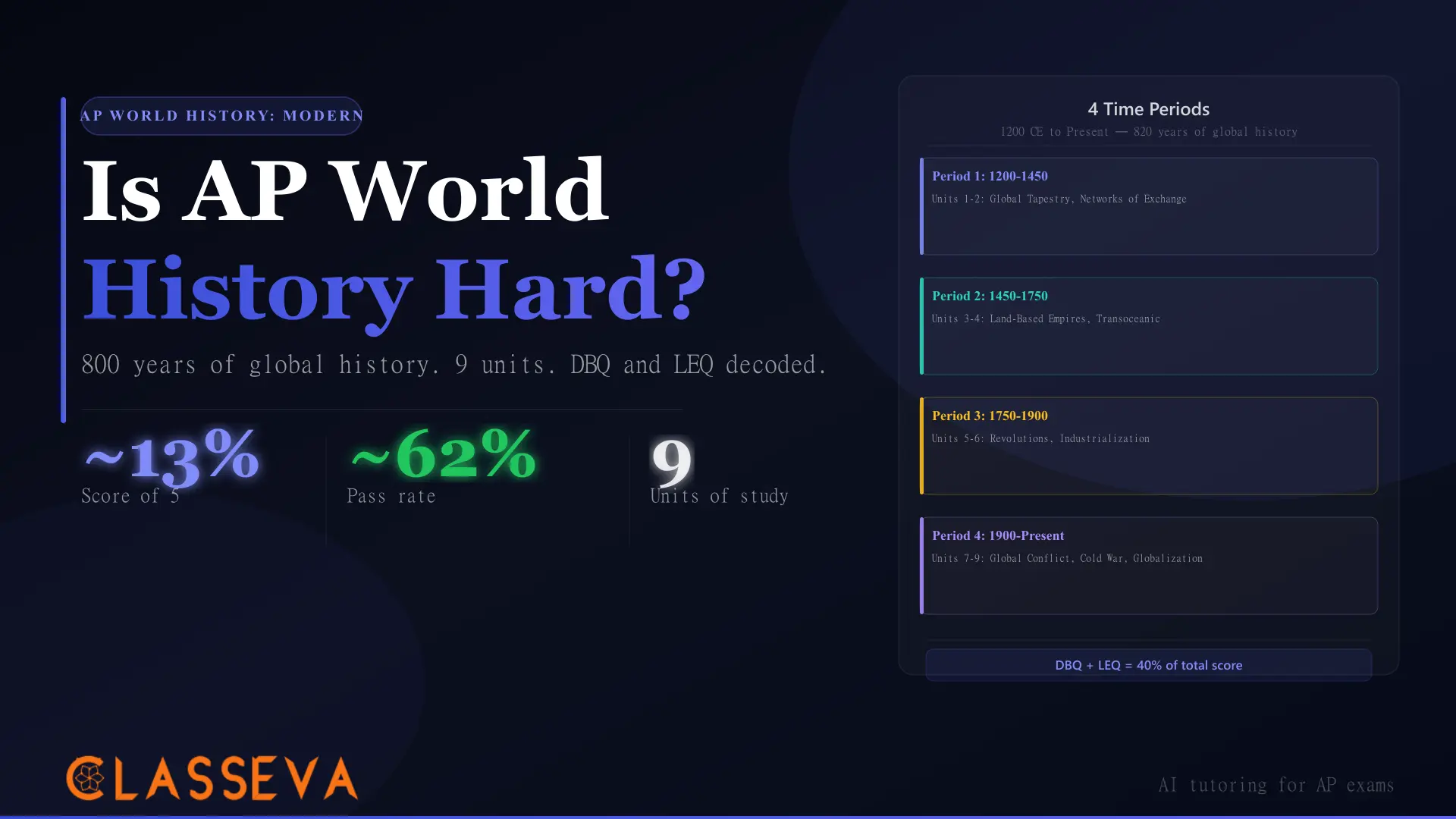
AP World History: Modern's 5-rate lands around 12-13% in recent exam cycles, placing it in the same tier as APUSH. The pass rate sits closer to 60-65%, meaningfully lower than APUSH's 73.7%. That gap tells the real story. AP World is harder to simply pass because the content breadth demands more: 800 years of global history across every major civilization on the planet, compressed into one school year. The DBQ and LEQ still carry 40% of your score, just as they do in APUSH. But before you sit that exam, what you need is a clear map of which 800 years matter most and why.
How Hard Is AP World History: Modern?
AP World History: Modern posts a pass rate around 60-65% and a 5-rate in the 12-13% range, making it moderately challenging by AP standards. It sits above AP Physics 1 (roughly 43% pass rate) and near AP European History in overall accessibility. The difficulty concentrates in the same place as every AP history exam: the Document-Based Question and Long Essay Question require historical argumentation, not memorization, and students who have never practiced timed writing against a rubric consistently underperform their content knowledge.
Pass Rate and 5-Rate
According to College Board's AP World History: Modern course page, the exam draws hundreds of thousands of test-takers annually. The score distribution below reflects recent exam cycles. These figures are approximate and sourced from College Board's published data; the exact 2025 distribution will be available from College Board's official score release.
| Score | Approximate % | What It Means |
|---|---|---|
| 5 | 12-13% | Exceptional: college credit at most schools |
| 4 | 19-21% | Strong: credit at most schools |
| 3 | 27-30% | Pass: credit at some schools |
| 2 | 24-27% | Below passing |
| 1 | 10-12% | No credit |
Source: College Board AP World History: Modern score distributions (recent cycles, approximate). Exact annual figures published each July.
How AP World Compares to Other AP History Exams
AP World sits in the same difficulty tier as APUSH and AP European History. All three courses share the identical writing structure (DBQ + LEQ + SAQ), the same Historical Thinking Skills rubric, and similar 5-rate ranges. Where they differ is scope. AP World demands the widest geographic lens of the three.
AP World History: Modern
- •5-rate: ~12-13% (recent cycles)
- •Pass rate: ~60-65%
- •9 units, 1200 CE to present
- •DBQ + LEQ + SAQ structure
- •Global comparative scope
APUSH
- •5-rate: 14.2% (2025)
- •Pass rate: 73.7% (2025)
- •9 periods, 1491 to present
- •Same DBQ/LEQ/SAQ structure
- •U.S. national focus
AP European History
- •5-rate: ~13-15% (recent cycles)
- •Pass rate: ~55-60%
- •Renaissance to present
- •Same writing structure
- •European regional focus
What Does AP World Modern Actually Cover?
The AP World History: Modern course on AP Central organizes 820 years of global history into 9 units grouped within 4 time periods. Every unit can appear on the multiple-choice and SAQ sections. The DBQ draws from all four time periods, which means unlike APUSH (where the DBQ is restricted to 1754-1980), AP World students cannot narrow their writing preparation to a subset of the course.
The 9 Units Across 4 Time Periods
Working through the AP World History: Modern Course and Exam Descriptionto map Classeva's curriculum structure, the first thing that stands out is how deliberately College Board organizes the 9 units around global connections rather than regional mastery. Each unit sits within a time period, and the College Board weights later periods more heavily on the exam. Period 4 (1900-present) carries the most exam content, even though it spans the fewest years.
Period 4 contains three units (7, 8, and 9) compared to two units in each earlier period. That structure reflects College Board's weighting: the 20th and 21st centuries carry more exam content than any earlier period. Students who over-invest in 13th-century Mongol empires and under-prepare for 20th-century decolonization and globalization are misallocating their time.
What Changed When College Board Redesigned the Course in 2019
Before 2019, AP World History covered all of human history from approximately 8000 BCE onward, organized into six sweeping time periods. College Board redesigned the course and added the “Modern” designation to signal a narrowed timeline: 1200 CE to present only. Content before 1200 CE no longer appears on the exam. The old Change and Continuity Over Time (CCOT) essay was replaced by the current LEQ format. The DBQ structure carried over largely intact.
College Board briefly piloted AP World History: Ancient (covering pre-1200 CE content) as a separate course following the 2019 redesign. The pilot was discontinued. If you have heard students mention “old AP World” covering ancient history, that is the pre-2019 format. No ancient history content appears on the current AP World History: Modern exam.
Why the DBQ and LEQ Determine Your Score
The DBQ carries 25% of your AP World score. The LEQ carries 15%. Together, they account for 40% of your total exam result, exactly as they do in APUSH. No combination of multiple-choice questions matches that weight concentration. A student who earns near-perfect marks on 55 multiple-choice questions but writes weak essays will not score a 5. The inverse is also true: a student who drops 10-12 multiple-choice questions but writes a strong DBQ can still reach a 4.
The 7-Point DBQ Rubric
AP World's DBQ uses the same 7-point rubric as APUSH and AP European History. Each point maps to a specific analytical task. The rubric categories below are sourced from AP Central's AP World past exam questions page:
The LEQ and Comparative Analysis
The LEQ gives you three time-period options and 40 minutes to write a full analytical essay using only your own knowledge. No documents. AP World's LEQ leans especially hard on comparative thinking: you will often need to explain how a development in one region compares to a parallel development elsewhere during the same period. That comparative skill does not come from content memorization. It comes from understanding why civilizations responded differently to the same forces.
College Board publishes every past AP World DBQ and LEQ with full scoring guidelines and sample scored responses at AP Central. Writing one timed DBQ per week against the official rubric teaches you more than any prep book. Sample responses show exactly how graders award the sourcing and contextualization points that most students miss.
How Does AP World Compare to APUSH?
Students choosing between AP World History: Modern and APUSH face a genuine strategic decision. Both exams use the same writing structure, the same rubric, and the same Historical Thinking Skills framework. The difference is entirely in what you are analyzing and how wide a lens you need to use.
Where the Two Courses Diverge
| Dimension | AP World History: Modern | APUSH |
|---|---|---|
| Geographic scope | All major world civilizations | United States only |
| Time period | 1200 CE to present (~820 years) | 1491 to present (~535 years) |
| Primary analytical skill | Cross-civilization comparison | Within-nation causation and change |
| DBQ time range | All 4 periods (full exam range) | Periods 3-8 only (1754-1980) |
| 5-rate (recent) | ~12-13% | 14.2% (2025) |
| Pass rate (recent) | ~60-65% | 73.7% (2025) |
| Writing structure | DBQ (25%) + LEQ (15%) + SAQ (20%) | Same |
Sources: College Board AP score distributions and Course and Exam Descriptions.
The deeper distinction is cognitive. APUSH lets you build a detailed mental model of one country's narrative and apply it across nine chronological periods. AP World requires you to hold multiple civilizations in mind simultaneously and trace how they interact, diverge, and respond to shared pressures. Students who find cross-cultural comparison engaging tend to prefer AP World. Students who prefer going deep on a single historical thread often prefer APUSH.
How Much Should You Study for AP World?
Most students who score a 4 or 5 on AP World History: Modern study between 4 and 6 hours per week during the school year, with the upper range in the final two months before the May exam. The total investment runs roughly 120-180 hours across the course. What matters more than total hours is the ratio between content coverage and writing practice.
Writing Practice vs. Content Coverage
Most AP World students over-invest in content review and under-invest in writing. By April, you will have covered all 9 units in class. The content gap between a 4 and a 5 is small. The writing gap is wide.
Weeks 1-20 (September through January): content by period
Aim for 4-5 hours per week. For each unit, focus on global connections and comparative patterns rather than memorizing individual rulers or battles. Build your understanding of how trade networks, disease, and ideology moved between civilizations. The 9-unit structure guides the sequence; let the four time periods anchor your chronological frame.
Weeks 21-30 (February and March): writing foundations
Start timed SAQ practice. Write at least one full DBQ response from a past AP World exam each week. Use the official scoring guidelines from AP Central to evaluate every essay; the rubric tells you exactly what earns each point. Focus especially on thesis construction and the distinction between contextualization (described vs. explained) and outside evidence.
Weeks 31-36 (April through early May): intensive writing and gap fill
Allocate 6-8 hours per week. Complete at least two full timed practice exams. Spend the last two weeks sharpening the contextualization and sourcing points; these are the most commonly missed rubric points and the most efficiently improved with deliberate targeted practice.
What If Memorization Is Not Your Strength?
AP World is well-suited for students who find memorizing disconnected facts difficult. The exam does not reward encyclopedic recall. It rewards students who can trace causes, compare outcomes, and explain change over time across civilizations. A student who understands why the Mongol Empire disrupted Eurasian trade routes matters more than a student who memorizes the names of every Mongol khan.
Learning science research supports this approach. The testing effect, documented by Roediger and Karpicke (2006), shows that retrieval practice outperforms repeated review for long-term retention. For AP World, that means practicing with past DBQ prompts and LEQ questions rather than re-reading textbook chapters. Each retrieval attempt forces you to reconstruct connections between civilizations, which builds exactly the comparative thinking the exam rewards.
College Board explicitly identifies “comparison” as a Historical Thinking Skill for AP World. Almost every DBQ and LEQ prompt rewards students who can frame their argument as a comparison across regions, time periods, or civilizations. Students who practice comparison writing from the start build this skill naturally; students who study content without writing practice often find the comparison requirement feels like a foreign imposition on exam day.
How to Know If You Are Ready
AP World History: Modern rewards curiosity about how the world works at a systems level, not just who ruled which territory when. If you find yourself asking “why did this happen, not just what happened,” the analytical frame the exam rewards comes naturally. If you consistently struggle to write organized arguments under time pressure, invest in writing practice before the exam rather than assuming content knowledge alone will carry you.
Two signals that you are well-positioned: you can explain a DBQ document's historical significance (not just its content) within 30 seconds of reading it, and you can write a thesis for an LEQ prompt on a topic you have not studied recently by applying the four Historical Thinking Skills to whatever you do know. Those skills generalize. Content does not.
For a sense of how the AP credit you earn from a 4 or 5 translates into tuition savings at specific colleges, the AP Credit Savings Calculator breaks it down by school. At many universities, a single 5 replaces one or two required gen-ed courses. The AP World History resources hub also has the most recent past FRQs organized by time period.
Where Does Your Practice Score Put You?
If you want to map your current preparation against the actual AP World score scale, Classeva's AP Score Predictor takes your practice test performance across all sections and projects your likely score range, flagging which section most needs attention. Use it after completing a full timed practice exam to get a calibrated sense of where your writing sections compare to your multiple-choice performance.
AP Score Predictor
Enter your AP World History practice test results to see your projected score and identify whether the writing sections or multiple-choice section most needs work before exam day.
Students preparing across multiple AP history exams can also read our AP Biology difficulty breakdown to see how the same score-distribution analysis applies to a science subject with a very different exam structure.
Key Takeaways
- AP World is slightly harder to pass than APUSH. A 60-65% pass rate versus APUSH's 73.7% reflects the wider content breadth; 5-rates are similar, around 12-14% for both courses.
- The course covers 820 years of global history across 9 units and 4 time periods. Period 4 (1900-present) carries the most exam content despite spanning the fewest years. Weight your preparation accordingly.
- The 2019 redesign removed all pre-1200 CE content. AP World History: Modern covers only 1200 CE to present. Content from the old course (ancient empires, early civilizations) does not appear on the current exam.
- The DBQ (25%) and LEQ (15%) carry 40% of your score. Writing skill determines your score ceiling, not content memorization. Practicing timed DBQs against the official rubric every week outperforms any amount of reading review.
- Contextualization and sourcing are the most commonly missed rubric points. Both require explanation, not just mention. A sentence noting historical context without connecting it to your argument earns zero; a developed connection earns the point.
- AP World favors comparative analysis over narrative recall. Students who find cross-civilization comparison engaging often prefer AP World to APUSH; students who prefer deep focus on a single historical narrative often prefer APUSH.
- Practice with the official free FRQ archive at AP Central. Past DBQs and LEQs with full scoring guidelines and sample scored responses are available at no cost. These primary materials teach you more about the exam than any prep book or review session.
Frequently Asked Questions
What percentage of students get a 5 on AP World History: Modern?
AP World History: Modern has a 5-rate of approximately 12-13% in recent exam cycles, placing it in a similar range as APUSH. The pass rate (scores 3-5) runs around 60-65%, lower than APUSH's 73.7%, which reflects the greater content breadth the course demands. Source: College Board AP score distributions.
Is AP World History harder than APUSH?
By pass rate, AP World is slightly harder than APUSH: roughly 60-65% pass AP World compared to 73.7% for APUSH. The 5-rates are similar, in the 12-14% range for both. The difference comes from scope: AP World covers global history across all major civilizations from 1200 CE to present, while APUSH covers one nation across nine periods. AP World demands comparative analysis across vastly different cultures; APUSH allows deeper focus on a single historical narrative.
Why is it called AP World History "Modern"?
In 2019, College Board redesigned AP World History and added the "Modern" designation to signal the course covers only 1200 CE to the present. Before the redesign, the full course covered all of history from roughly 8000 BCE onward. The pre-1200 period was briefly piloted as a separate AP World History: Ancient course but was discontinued. The modern scope narrows the timeline from all of human history to approximately 820 years of documented global interaction.
Do I need to memorize specific dates for AP World?
Not in the way most students assume. The exam rarely tests "what year did X happen?" Instead, it tests your ability to place events within the correct time period, trace causation across civilizations, and analyze continuity and change over time. The four time periods (1200-1450, 1450-1750, 1750-1900, 1900-present) give you the chronological structure you need. Knowing the century and period for major developments is more valuable than memorizing exact years.
Can I self-study AP World History: Modern?
Yes. The course follows a clear chronological and thematic structure, and College Board publishes past DBQs and LEQs with full scoring guidelines at AP Central, free of charge. The harder challenge with self-study is writing: without feedback on your thesis and analysis, you may not realize your DBQ arguments are not meeting the sourcing and contextualization rubric points. Use the official sample scored responses to calibrate your writing against what the rubric actually rewards.
How many DBQs are on the AP World exam?
One Document-Based Question appears on the AP World History: Modern exam. It provides seven primary source documents and asks you to construct a historical argument using at least six of them. The DBQ accounts for 25% of your total score and runs 60 minutes including a 15-minute reading period. There is also one Long Essay Question (LEQ), worth 15%, where you choose from three time-period options based on your content preparation.
What was the old AP World History format before 2019?
Before the 2019 redesign, AP World History covered all of human history from approximately 8000 BCE to the present, organized into six time periods. The course also included a Change and Continuity Over Time (CCOT) essay that has since been replaced by the LEQ format. The redesign dropped all content before 1200 CE from the standard course, narrowing the scope to allow deeper engagement with each period rather than racing through thousands of years of content.
Score data sourced from College Board's AP World History: Modern course page (approximate, recent cycles). Exam structure from the AP World History: Modern page on AP Central. Unit structure from the AP World History: Modern Course and Exam Description.