Digital SAT Standard English Conventions: Grammar Rules
Digital SAT Standard English Conventions is the one domain you can nearly perfect with a checklist. The reading questions hinge on interpreting a passage you have never seen; the grammar questions hinge on rules that never change. Studying the College Board's Reading and Writing specifications, the pattern that stands out is how few distinct rules carry the entire domain, and how predictably the test recycles them.
What Is Standard English Conventions on the Digital SAT?
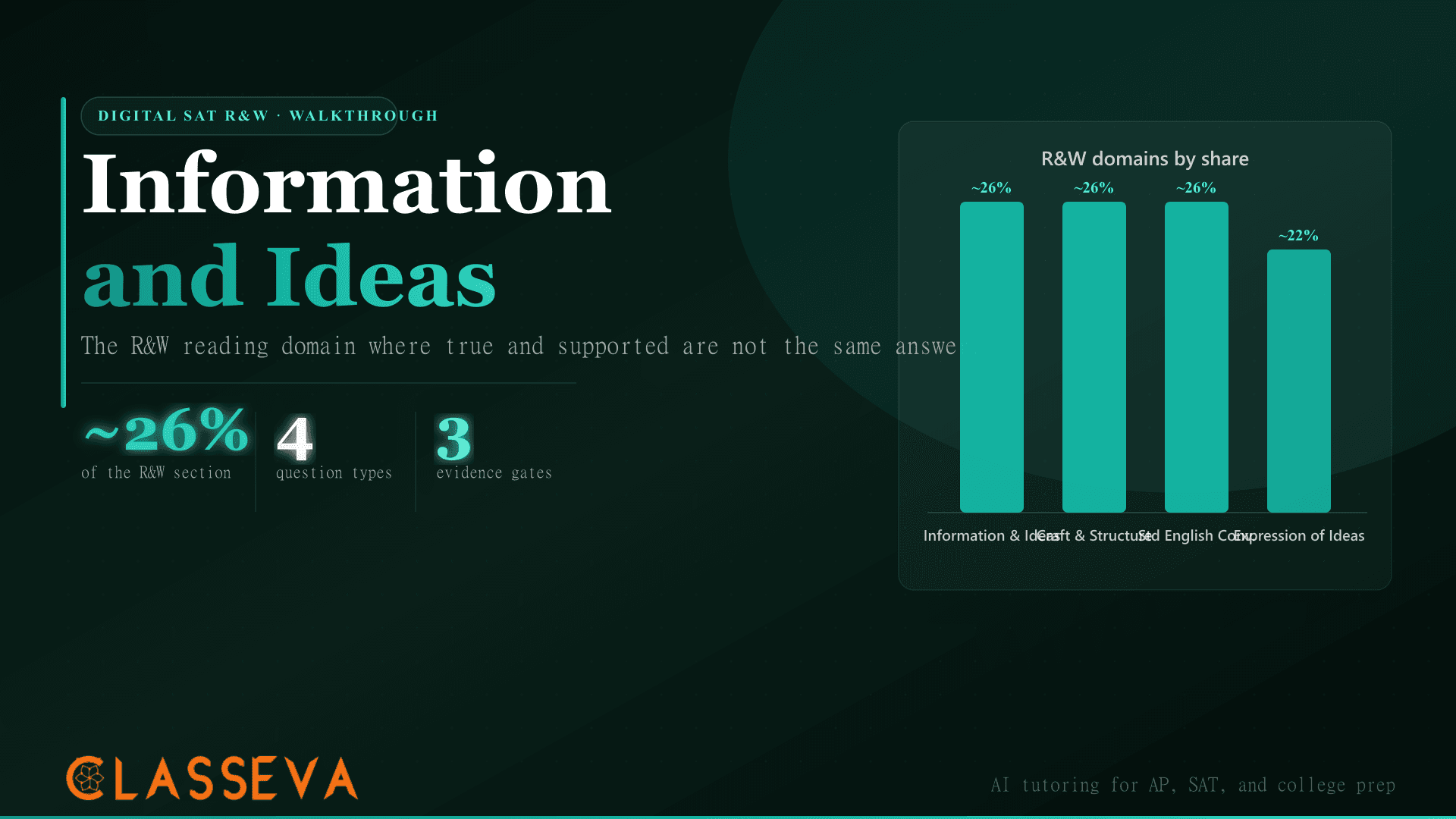
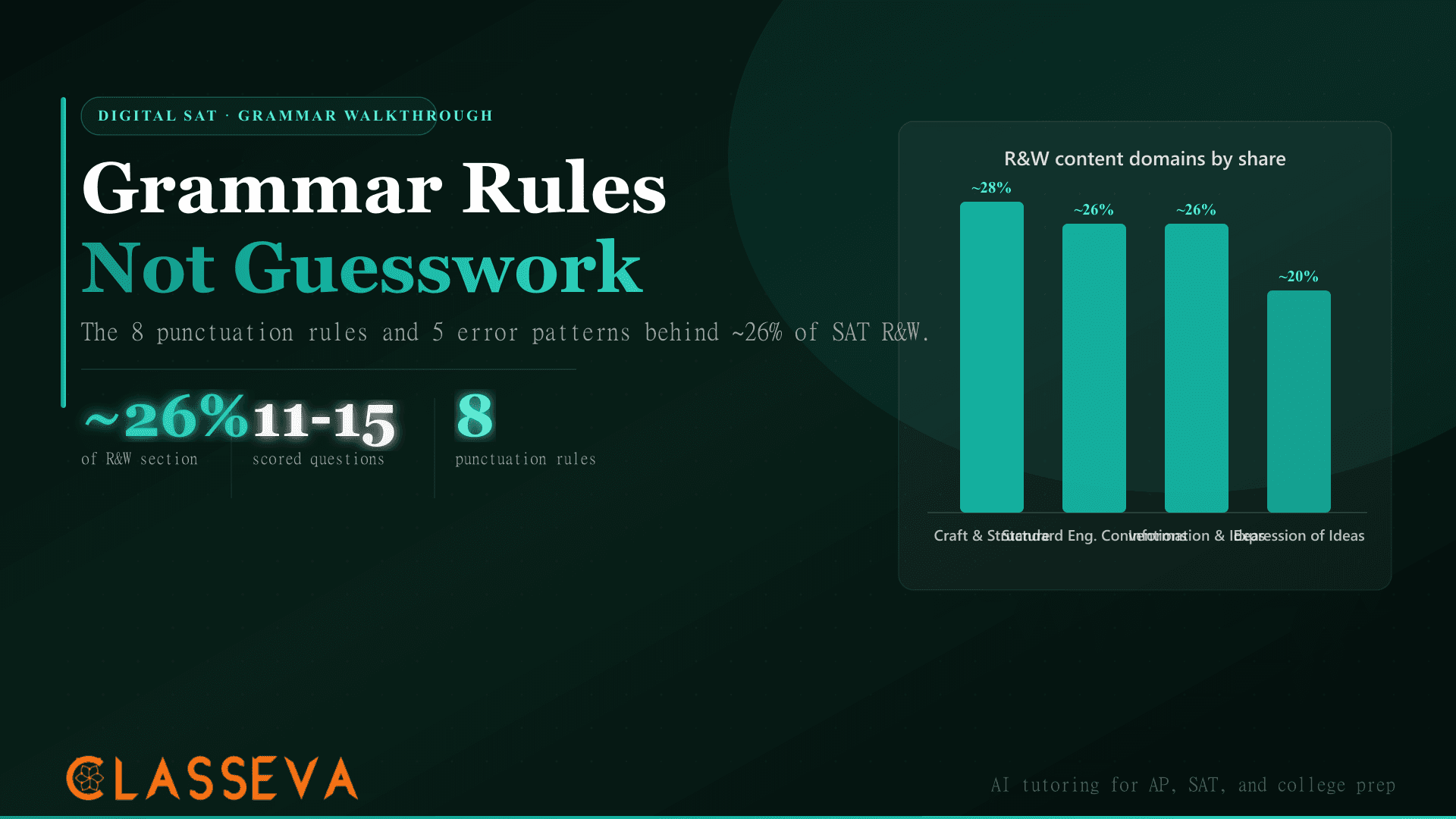
Standard English Conventions measures your ability to edit text so it follows core rules of usage, punctuation, and SAT sentence structure. It contributes 11 to 15 questions across the two adaptive Reading and Writing modules, about 26% of the section. [VERIFY: exact per-domain count, College Board question distribution] These questions cluster at the end of each module, sorted by difficulty rather than by topic.
Two Skills: Boundaries and Form, Structure, and Sense
The domain contains exactly two skills. Boundaries questions test punctuation and where one sentence ends and the next begins. Form, Structure, and Sense questions test grammatical relationships: subject-verb agreement, pronoun-antecedent agreement, verb tense, parallelism, and modifier placement. Every Standard English Conventions question on the digital SAT standard english conventions set falls into one of these two buckets, so identifying the bucket is the first move. Both skills surface in each of the two adaptive modules, a routing system the Digital SAT adaptive structure guide breaks down in full.
Why This Domain Is the Most Learnable on the Test
Grammar rules do not change between test dates. The College Board can write a new passage about photosynthesis or 19th-century poetry every administration, but a semicolon still joins two independent clauses the way it did last year. That stability turns Standard English Conventions into a finite study target. Master the rule set once, and it pays off on every future test form.
Compare that to a reading question. An Inferences item demands you interpret an unfamiliar passage under time pressure, and no amount of preparation guarantees the next passage behaves like the last. A grammar item asks whether a comma splice exists, and that answer follows a rule you already memorized. The reward curve bends sharply: a few weeks of focused grammar drilling lifts a student from missing half the domain to missing almost none, while the same effort on reading produces slower, less predictable gains.
Standard English Conventions questions appear at the end of each Reading and Writing module, after the reading and rhetoric questions. Unlike the other domains, they are sorted purely by difficulty, not grouped by topic, so a semicolon question can sit right next to a subject-verb agreement question. Expect to see them in the last third of each module.
What Are the SAT Punctuation Rules for Boundaries?
Boundaries questions test how you join, separate, and punctuate the parts of a sentence. Almost every one reduces to a single decision: is each side of the punctuation a complete sentence or not? Once you answer that, the correct punctuation follows from a short list of SAT punctuation rules, and the wrong choices reveal themselves as comma splices, fragments, or misused colons.
The 8 Boundaries Rules That Cover Every Question
Eight rules answer nearly every Boundaries question. Memorize them, then apply them mechanically. The test rarely invents a punctuation situation outside this list, which is why a checklist beats instinct here.
| Rule | When to Use It | Example Pattern |
|---|---|---|
| Period or semicolon | Two complete sentences, equal weight | The lab closed early. Students left. |
| Comma + FANBOYS | Two complete sentences joined by a conjunction | The lab closed, so students left. |
| Colon | Complete sentence introduces a list or explanation | She packed one thing: her notes. |
| Dash (single) | Complete sentence followed by an added detail | He won the prize, his first ever (dash also valid). |
| Paired commas | Nonessential information inside a sentence | The book, a classic, sold out. |
| Paired dashes | Nonessential information with emphasis | The result, finally, arrived (dashes also valid). |
| No comma | Between a subject and its verb | The student who studied passed. |
| Comma after intro | After an introductory phrase or clause | After the bell, class began. |
The 8 Boundaries rules that cover nearly every SAT punctuation question. The example uses a single dash to show added detail; the SAT does not test dash style preferences, only correct joining.
FANBOYS, Semicolons, and the Comma Splice
A comma splice glues two complete sentences with only a comma, and it is the most common Boundaries trap. Standard English forbids it. The SAT offers a comma-spliced choice on most punctuation questions precisely because it looks fine to a casual reader. Fix it three ways: split into two sentences with a period, join with a semicolon, or add a FANBOYS conjunction (for, and, nor, but, or, yet, so) after the comma.
Colons, Dashes, and Nonessential Information
A colon requires a complete sentence before it, then introduces a list, an explanation, or an example. Check the words to the left of the colon: if they form a full sentence, the colon is valid. Paired commas, paired dashes, and parentheses all do the same job, fencing off nonessential information that the sentence could drop without breaking. The pairs must match. A comma cannot open a clause that a dash closes.
The SAT loves placing a colon after an incomplete sentence, for example: “The kit included: a map, a compass, and rope.” That colon is wrong because “The kit included” is not a complete sentence. The fix removes the colon entirely. Always read what sits to the left of the colon before accepting it; if that part cannot stand alone, the colon fails.
How Do Form, Structure, and Sense Questions Work?
Form, Structure, and Sense questions test grammatical relationships, not punctuation. They check whether verbs agree with subjects, pronouns agree with antecedents, tenses stay consistent, lists stay parallel, and modifiers attach to the right noun. These questions reward recognizing five repeating error patterns. Once you know the patterns, you stop reading for meaning and start scanning for the specific mismatch the test planted.
Subject-Verb Agreement Error Pattern
Subject-verb agreement is the most common pattern in this skill. The SAT separates the subject from its verb with a long prepositional phrase or an interrupting clause, then offers a verb that agrees with the nearest noun instead of the true subject. The defense is simple: cross out everything between the subject and the verb, then check the match. A singular subject takes a singular verb no matter how many plural nouns sit between them.
Pronouns, Tense, and Misplaced Modifiers
Pronoun-antecedent agreement asks whether a pronoun matches the noun it replaces in number. A singular antecedent takes a singular pronoun, even when the surrounding sentence feels plural. Verb tense questions test consistency: the tense should match the time frame the rest of the passage establishes. Misplaced modifiers are the trickiest pattern, because the sentence often reads smoothly while describing the wrong noun.
When a sentence opens with a descriptive phrase, the noun right after the comma must be the thing that phrase describes. “Walking to school, the rain soaked her” says the rain was walking, which is wrong. The fix puts the walker right after the comma: “Walking to school, she got soaked by the rain.” The SAT plants this dangling-modifier error in at least one Form, Structure, and Sense question per test form. [VERIFY: per-form frequency]
Boundaries Skill
- •Tests punctuation and where sentences join
- •Answer choices differ only in marks (comma, semicolon, colon, dash)
- •Reduces to: is each side a complete sentence?
- •Covered by 8 memorized punctuation rules
- •Fastest points once the rule list is automatic
Form, Structure, and Sense Skill
- •Tests grammatical relationships, not punctuation
- •Answer choices change verbs, pronouns, or word order
- •Reduces to: find the real subject or antecedent
- •Covered by 5 repeating error patterns
- •Modifier placement is the hardest pattern to spot
Rules Versus Feel: The Approach That Scores Points
The single difference between a 600-level and a 750-level Reading and Writing scorer on grammar is method, not talent. Lower scorers read each sentence and pick the version that “sounds right.” Higher scorers run a checklist. The SAT engineers its wrong answers to sound right, so trusting your ear walks straight into the traps the test designed.
A rules-based reader does three things on every Standard English Conventions question. First, glance at the answer choices to classify the question as Boundaries or Form, Structure, and Sense. Second, apply the matching rule, punctuation logic for Boundaries or agreement logic for the other skill. Third, eliminate every choice that breaks a rule before selecting the survivor. That last step matters most, because elimination by rule removes the guesswork that feel-based reading leaves behind.
Watch the method on a single item. Suppose the sentence reads: “The committee, after months of debate, ___ its final decision.” The choices offer “announce,” “announces,” “have announced,” and “announcing.” A feel-based reader hears “months of debate” and leans plural. A rules-based reader crosses out “after months of debate,” sees the singular subject “committee,” and picks the singular verb “announces.” The interrupter that fools the ear becomes irrelevant once you isolate the subject. Every Form, Structure, and Sense question yields to that kind of isolation move.
Everyday spoken English accepts comma splices, vague pronouns, and dangling modifiers all the time. People understand the meaning, so the brain stops flagging the errors. The SAT targets exactly these casually accepted mistakes, which is why a reader who scores high on the conventions of English relies on rules rather than the intuition built from daily conversation.
How Should You Study SAT Grammar Questions?
Study Standard English Conventions in three stages: learn the rule set, drill questions by type, then review every miss back to the rule it tested. The rules are finite, so the bottleneck is recognition speed, not knowledge. Most students who target this domain reach near-ceiling accuracy within a few weeks because the same patterns recur on every official practice form.
Build a personal error log. Every time you miss a grammar question, write the rule it tested in your own words and the trap you fell for. After 40 to 50 logged misses, the patterns repeat so plainly that new questions feel familiar. Pair this with the official Bluebook practice tests, since they use the exact phrasing style of the real exam. For the broader section approach, the Digital SAT Reading and Writing strategy guide shows how grammar timing fits the full 32-minute module, and the 200-point score improvement plan sequences grammar gains alongside math and reading.
Reading questions need a different toolkit. If your reading accuracy lags behind your grammar accuracy, the Information and Ideas reading breakdown covers Command of Evidence and Inferences, the two reading types that cost most students the most points. Pairing grammar mastery with reading technique is how a Reading and Writing score climbs past 700.
How SEC Fits Your Total SAT Score
Standard English Conventions feeds the Reading and Writing scaled score, which runs 200 to 800 and combines with Math for a 400 to 1600 total. Because the domain holds 11 to 15 of the section's scored questions, SAT R&W grammar gains move the needle fast. Converting four or five missed grammar questions into correct ones can lift a Reading and Writing score by 30 to 60 points for many test-takers. [VERIFY: scaled-score conversion varies by form]
If you also sit the ACT, your grammar work transfers directly, because the Enhanced ACT English section tests the same punctuation and agreement rules under a different label. To compare where a target SAT score lands on the ACT scale, the converter below maps the two tests so you can set one consistent goal. Plan the calendar around it with the junior-year SAT timing guide.
SAT-ACT Converter
See how a target Digital SAT Reading and Writing score maps onto the ACT scale so you can set one consistent goal across both tests.
For context on what a strong section score looks like, College Board publishes percentile data in its understanding scores resources. A Reading and Writing score in the high 600s already clears the median for most four-year colleges, and grammar mastery is the cheapest path to get there because the rules never change.
Key Takeaways
- Standard English Conventions is ~26% of Reading and Writing, with 11 to 15 scored questions across both adaptive modules, placed at the end of each module and sorted by difficulty. [VERIFY: College Board question distribution]
- The domain splits into two skills. Boundaries tests punctuation and sentence joining; Form, Structure, and Sense tests agreement, tense, parallelism, and modifiers.
- Eight punctuation rules answer almost every Boundaries question. The decision always reduces to whether each side of the punctuation is a complete sentence.
- The comma splice is the most common Boundaries trap. Fix it with a period, a semicolon, or a comma plus a FANBOYS conjunction, never a comma alone or a comma before however.
- Subject-verb agreement is the top Form, Structure, and Sense pattern. Cross out the words between subject and verb, then match the verb to the true subject.
- Rules beat feel. The SAT writes wrong answers that sound acceptable in casual speech, so a checklist outperforms intuition on the exact cases the test targets.
- This is the fastest-improving domain. The rules transfer to every future test date, so a few weeks of targeted practice can lift a Reading and Writing score by 30 to 60 points.