Digital SAT Advanced Math: Nonlinear Functions Decoded
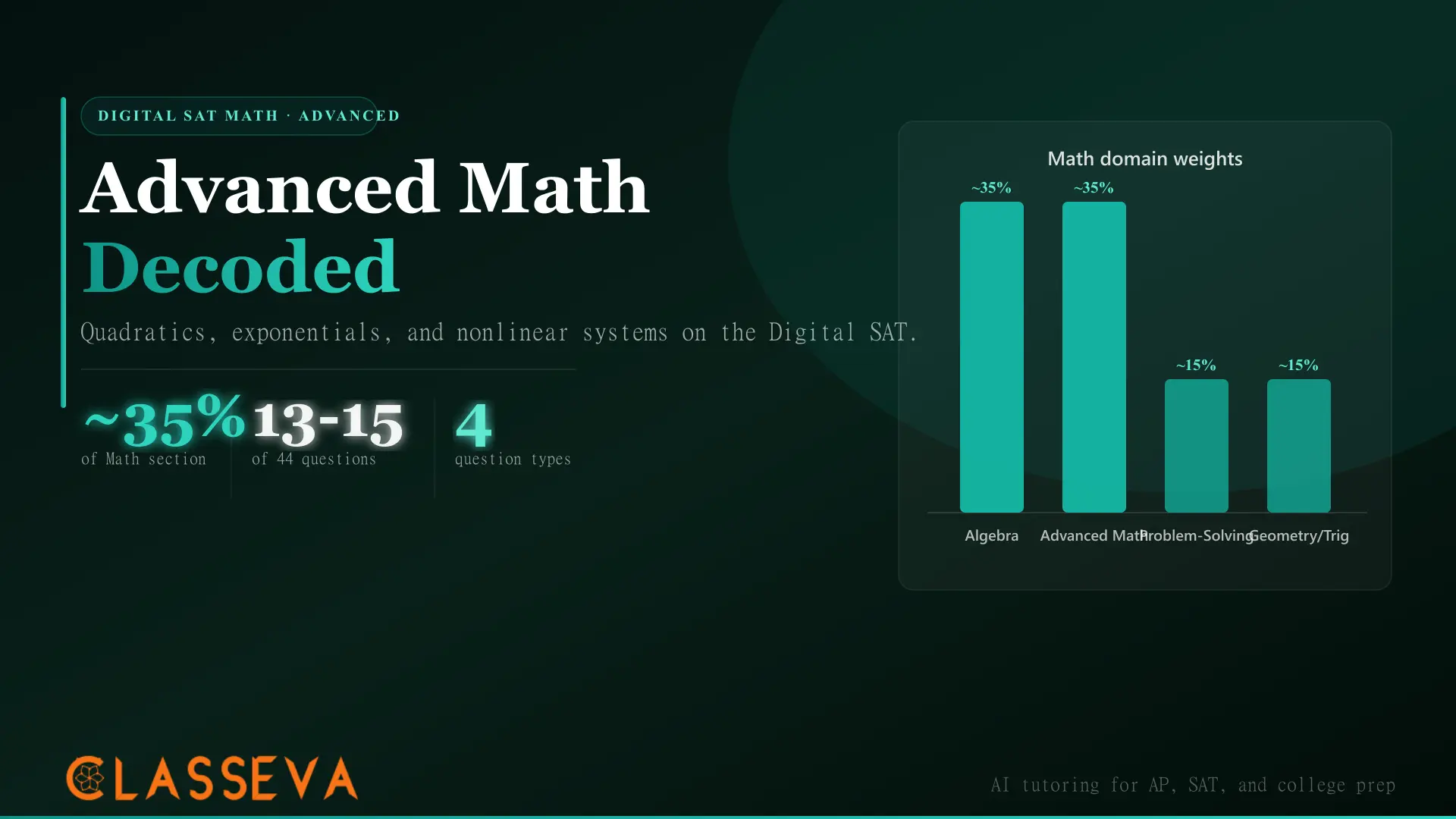
Advanced Math is the wall most students hit after they max out the Algebra questions. It carries about 35% of the Digital SAT Math section, the same weight as Algebra, but it trades straight lines for parabolas, exponential curves, and polynomial roots. [VERIFY: College Board math content domain weights] When I traced the four Advanced Math question types against released practice forms, one pattern stood out: nearly every question hands you an equation already written in a form that points to the fastest method, and students who do not read that form waste time grinding algebra the test never asked for.
What Is Digital SAT Advanced Math?
Advanced Math is the Digital SAT Math content domain that tests nonlinear relationships: quadratic, exponential, polynomial, rational, and radical equations. It accounts for roughly 35% of the 44 operational math questions, splitting evenly with Algebra as the two largest domains. [VERIFY: College Board math content domain weights] The College Board frames it as the math you need for college STEM coursework, which is why it leans on functions rather than single-variable solving.
The skills here build directly on Algebra, but the leap is real. A linear equation has one constant rate of change; a quadratic bends, an exponential accelerates, and a polynomial can cross the x-axis several times. According to the College Board Advanced Math content page, the domain assesses understanding of absolute value, quadratic, exponential, polynomial, rational, radical, and other nonlinear equations.
The Four Advanced Math Question Types
The College Board sorts Advanced Math into four named question types. Each one rewards a different recognition skill, and knowing which type you are looking at narrows your method before you compute anything.
| Question Type | What It Asks | Fastest Tool |
|---|---|---|
| Equivalent expressions | Rewrite or simplify a nonlinear expression | Factoring, expanding, common denominators |
| Nonlinear equations (1 variable) | Solve a quadratic, radical, or rational equation | Factor, vertex, or quadratic formula |
| Systems of equations (2 variables) | Find where a line meets a curve | Substitution or Desmos intersection |
| Nonlinear functions | Connect a function rule to its graph or value | Read the form, then Desmos |
The four Advanced Math question types on the Digital SAT, per the College Board content domain page.
Why Students Stall After the Algebra Questions
Algebra questions reward a single move: isolate the variable. Advanced Math punishes that habit. A student who reflexively expands and isolates on a quadratic written in factored form throws away the gift the test handed them. The stall is not a knowledge gap; it is a method gap, where students apply linear tactics to nonlinear shapes. The fix is a sat advanced math strategy built on recognition first, computation second.
Advanced Math questions almost always hand you an equation in a form that signals its own solution. Factored form points to roots. Vertex form points to the max or min. Standard form points to the quadratic formula or the discriminant. Read the form before you compute, and half the work disappears.
How Do You Handle SAT Quadratic Equations?
SAT quadratic equations are best solved by reading the form first, then choosing the matching method. Factored form gives roots directly, vertex form gives the maximum or minimum point, and standard form sets up the quadratic formula or the discriminant. Most SAT quadratics are written in factored or vertex form on purpose, so the quadratic formula is your last resort, not your first.
The Three Forms of a Quadratic
Every quadratic can be written three ways, and each form exposes a different feature. The same parabola hides its roots in one form and its vertex in another. Recognizing which form you have is the recurring pattern that separates a 650 Math scorer from a 750 scorer.
Reading the Form to Pick the Method
When a question asks for the x-intercepts and the equation is in factored form, you are done: the roots sit inside the parentheses. When it asks for the minimum value and the equation is in vertex form, read the vertex and stop. The discriminant earns its keep on a narrow but common question.
When the SAT asks for the value of a constant k that gives a quadratic exactly one solution, set the discriminant b² − 4ac equal to zero and solve for k. For two real solutions, the discriminant is positive; for no real solutions, it is negative. This one move answers a question type that appears on nearly every Digital SAT Math form.
How Do SAT Exponential Functions Work?
SAT exponential functions follow the form f(x) = a times b raised to the x power, where a is the starting value and b is the constant growth or decay factor. If b is greater than 1, the quantity grows; if b is between 0 and 1, it decays. The defining feature is that an exponential multiplies by the same factor each step, unlike a linear function that adds the same amount each step.
Growth, Decay, and the Base Rule
The base b carries all the meaning. A bank balance growing 5% a year has b = 1.05; a radioactive sample losing 12% per hour has b = 0.88. The SAT loves to test whether you can translate a percentage into the base, so a 5% increase becomes a multiplier of 1.05, not 0.05. Misreading the base is the most common exponential error students make.
Linear vs Exponential: The Trap Question
A recurring SAT question gives a table of values and asks whether the relationship is linear or exponential. Check the differences between consecutive outputs: equal differences signal linear, while a constant ratio signals exponential. Students who only check the first two rows fall for tables built to look linear early and reveal exponential behavior later.
Linear Function
- •Adds the same amount each step (constant difference)
- •Form: f(x) = mx + b
- •Graph is a straight line
- •A 5% increase is added once, not compounded
Exponential Function
- •Multiplies by the same factor each step (constant ratio)
- •Form: f(x) = a · b^x
- •Graph curves and accelerates
- •A 5% increase compounds: multiply by 1.05 each step
What Polynomial Skills Does the SAT Test?
The SAT tests polynomials through roots, factors, and end behavior, not through long division drills. The recurring idea is the factor theorem: if (x − r) is a factor of a polynomial, then r is a root, and the graph crosses or touches the x-axis at r. An sat polynomial question often shows a factored expression and asks for the sum or product of its roots.
Watch for the connection between factors and zeros. A polynomial written as (x + 2)(x − 5)(x − 5) has zeros at x = −2 and x = 5, with x = 5 a repeated root where the graph touches the axis instead of crossing. The College Board phrases these as nonlinear function questions that link an algebraic rule to a graph, one of the four Advanced Math question types described in the official Digital SAT structure overview.
On the SAT, the words root, solution, zero, and x-intercept all point to the same value: the x where the function equals zero. A question that asks for the solutions to p(x) = 0, the zeros of p, or the x-intercepts of the graph of p is asking for the identical set of numbers. Recognizing this synonym set saves you from re-deriving the same answer three different ways.
How Are Equivalent Expressions Tested?
Equivalent expression questions ask you to rewrite a nonlinear expression in a different but equal form, usually by factoring, expanding, or combining fractions. The answer choices are all valid expressions, and only one equals the original for every value of x. These reward clean algebra and punish sign errors, so the fastest reliable check is plugging in a test value.
The Plug-In Verification Method
When four answer choices look algebraically plausible, pick a simple value like x = 2, evaluate the original expression, then evaluate each choice. The choice that matches is your answer, no factoring required. This converts a hard algebra question into arithmetic, and it is the single most reliable Advanced Math safety net when your factoring stalls.
| Original | Test x = 2 | Verdict |
|---|---|---|
| (x² − 9) / (x − 3) | (4 − 9) / (2 − 3) = 5 | Target value to match |
| x + 3 | 2 + 3 = 5 | Matches: correct |
| x − 3 | 2 − 3 = −1 | No match: eliminate |
| x² − 3 | 4 − 3 = 1 | No match: eliminate |
Plug-in verification turns an equivalent-expression question into arithmetic. Pick a value, compute, compare.
How Do You Solve Nonlinear Systems?
A nonlinear system pairs a line with a curve, or two curves, and asks where they meet. Solve by substitution: replace one variable, collapse to a single quadratic, then find the roots. On the Digital SAT, graphing both equations in Desmos and reading the intersection points is usually faster and removes the algebra errors that cost students points under time pressure.
The number of intersection points is itself a question type. A line can miss a parabola entirely (no solution), graze it (one solution), or cut through it (two solutions). When a question asks for the value of a constant that makes a line tangent to a parabola, set the system equal, then apply the discriminant equals zero condition from the quadratics section above. For the full button-by-button Desmos workflow, the Digital SAT Desmos strategy guide walks through graphing systems and finding intersections.
How Should You Pace the Advanced Math Questions?
The Digital SAT Math section gives 35 minutes for 22 questions per module, roughly 95 seconds each. Advanced Math questions cluster in the back half of each module where difficulty rises, so bank time early on the linear Algebra questions to spend it on the nonlinear ones later. Both modules are separately timed, and you can move freely within a module before time runs out.
Pacing connects to the bigger picture of how the test routes you. Because the Digital SAT is section-adaptive, your Module 1 performance decides whether Module 2 serves harder or easier questions, which sets your score ceiling. The Digital SAT adaptive structure breakdown explains how Advanced Math accuracy in Module 1 can route you into the harder, higher-scoring Module 2.
Spending three minutes hand-solving a quadratic that does not factor cleanly wrecks your module timing. If factoring stalls after one attempt, stop and graph the function in Desmos to read the roots, or apply the quadratic formula directly. Sunk-cost solving on one hard question costs you two easier questions at the end of the module.
Convert Your Target Score
If you are setting a Math goal or comparing your SAT target to an ACT equivalent, the converter below maps scores between the two tests so you know exactly which section score you are chasing. Pair it with the broader Digital SAT Algebra walkthrough to build the linear foundation that Advanced Math sits on, and the Problem-Solving and Data Analysis guide for the remaining math domains.
SAT-ACT Converter
Convert your target SAT score to its ACT equivalent so you know exactly which Math section score to aim for as you drill Advanced Math.
For test-day mechanics beyond the Math section, the Digital SAT test-day walkthrough covers Bluebook check-in, breaks, and timing, and the broader Reading and Writing strategy guide rounds out the full test. Official practice forms live in Bluebook, the College Board app that delivers the real adaptive exam.
Key Takeaways
- Advanced Math is about 35% of the Digital SAT Math section, roughly 13 to 15 of the 44 questions, tying Algebra as the largest content domain. [VERIFY: College Board math content domain weights]
- The domain splits into four question types: equivalent expressions, nonlinear equations in one variable, systems of equations in two variables, and nonlinear functions.
- Read the form of a quadratic before solving. Factored form gives roots, vertex form gives the max or min, and standard form sets up the quadratic formula or the discriminant.
- The discriminant b² − 4ac counts solutions. Set it to zero for exactly one solution, positive for two, negative for none. This answers a question type on nearly every form.
- Exponential models multiply by a constant base b. A 5% increase means b = 1.05; a 12% decrease means b = 0.88. Constant ratio signals exponential, constant difference signals linear.
- For sat polynomial questions, roots, factors, and zeros are the same idea. If (x − r) is a factor, r is a root and an x-intercept. Repeated factors touch the axis instead of crossing.
- Graph nonlinear systems in Desmos. Reading intersection points is faster and more accurate than substitution under time pressure, and it never makes a sign error.