Digital SAT Math Algebra: Every Question Type Decoded
Digital SAT Math algebra accounts for close to 35% of the section, more than any other content domain. Most prep guides treat SAT Math as one undivided block, but College Board splits it into four named domains, and algebra is the one that decides scores. The thing I keep returning to while building Classeva's SAT engine is simple: a student who masters five algebra question types has already locked down a third of the Math score before touching geometry or data analysis.
Why Digital SAT Math Algebra Dominates the Section
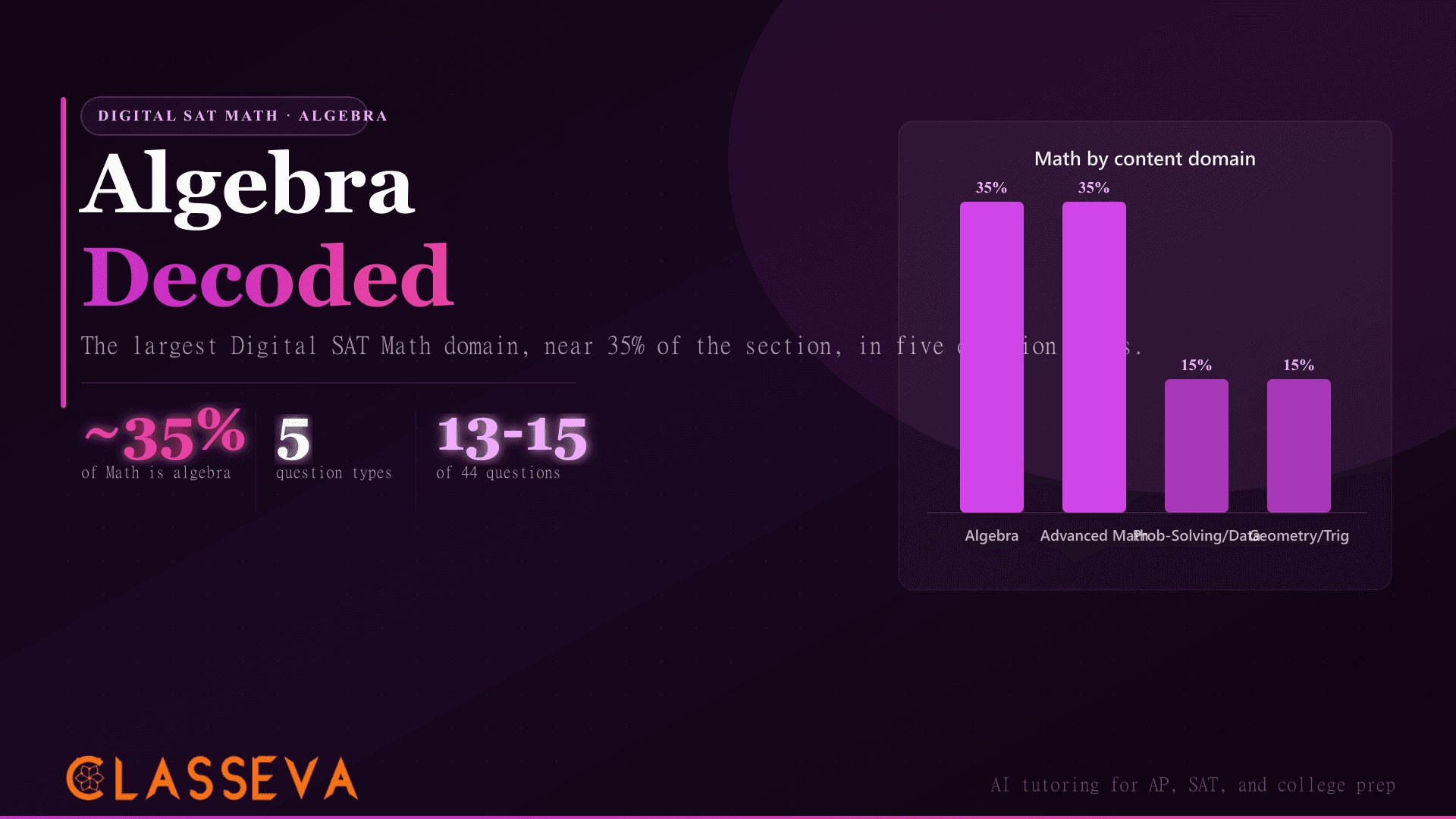
Algebra is the highest-weighted of the four Digital SAT Math content domains, contributing roughly 35% of scored questions. The Math section runs 44 questions across two adaptive modules of 35 minutes each, so algebra alone covers about 13 to 15 of them. [VERIFY: exact operational count per College Board test specifications] No other Math domain carries that share.
The Four Math Content Domains
College Board organizes Digital SAT Math into four content domains, listed in the official Types of Math Tested overview. Algebra leads on weight. The other three (Advanced Math, Problem-Solving and Data Analysis, and Geometry and Trigonometry) split the remaining questions. Knowing the split tells you where to spend study hours.
| Content Domain | Approx. Share of Math | Approx. Questions of 44 | Core Skill |
|---|---|---|---|
| Algebra | ~35% | 13-15 | Linear equations, functions, systems, inequalities |
| Advanced Math | ~35% | 13-15 | Quadratics, exponentials, nonlinear equations |
| Problem-Solving and Data Analysis | ~15% | 5-7 | Ratios, rates, percentages, data interpretation |
| Geometry and Trigonometry | ~15% | 5-7 | Area, volume, angles, circles, right triangles |
Approximate Digital SAT Math content domain weighting. [VERIFY: exact percentages per College Board test specifications overview]
How Many Algebra Questions You Face
You will see about 13 to 15 algebra questions, scattered across both Math modules rather than grouped together. College Board states that questions from all four content domains appear in each module, and within a module the questions run from easiest to hardest. That means an algebra question can sit anywhere in the section, including the final, hardest slots.
What Are the Five Algebra Question Types?
The algebra domain breaks into five skill points, named exactly by College Board: linear equations in one variable, linear equations in two variables, linear functions, systems of two linear equations, and linear inequalities. Every one of the SAT algebra questions you face maps to one of these five. Learn the five, and the domain stops feeling random.
Linear Equations in One Variable
A linear equation in one variable has a single unknown raised to the first power, such as 5(x − 2) = 3x + 4. You solve it by isolating x. SAT versions add a twist: they bury the equation in a word problem, or ask for the value of an expression like 2x + 1 rather than x alone. Read what the question asks before you solve, because answering for x when it wants 2x + 1 is the most common careless miss.
Take that example to the finish. Distribute the left side to get 5x − 10 = 3x + 4, subtract 3x from both sides for 2x − 10 = 4, then add 10 and divide to land x = 7. The whole solve takes under 30 seconds once the steps are reflexive. SAT one-variable items reward that fluency, since the hardest versions hide the same three moves inside a paragraph about ticket prices or temperature change.
Linear Equations in Two Variables
These relate two unknowns on a straight line, written as Ax + By = C or y = mx + b. SAT questions ask you to find slope, identify an intercept, or read a value off a graph. The fastest move is recognizing the form. Convert any two-variable line to y = mx + b in your head, and the slope and y-intercept become readable at a glance.
Linear Functions
A linear function models a constant rate of change as f(x) = mx + b. SAT questions wrap this in context: a phone plan charging a flat fee plus a per-minute rate, or a tank draining at a steady gallons-per-minute pace. The slope is the rate, the intercept is the starting amount. Match those two pieces to the words, and the function writes itself.
On linear function word problems, the phrase that signals a per-unit change (per hour, per item, each additional) gives you the slope. The phrase that signals a fixed starting value (initial, flat fee, base) gives you the intercept. Tagging those two phrases before you write anything cuts setup errors sharply.
Systems of Two Linear Equations
A system pairs two linear equations and asks for the values that satisfy both at once, the point where the lines cross. SAT systems show up as two equations to combine, or as a single word problem hiding two relationships (tickets and prices, two unknown quantities summing to a total). The number of solutions also matters: parallel lines with the same slope and different intercepts give no solution, identical lines give infinitely many.
Linear Inequalities
Linear inequalities swap the equals sign for a less-than or greater-than relation, describing a region rather than a single point. The one rule students forget: multiplying or dividing both sides by a negative number flips the inequality direction. SAT inequality questions often pair two constraints and ask which point satisfies both, a setup that Desmos shades instantly once you enter each inequality.
How Do You Solve an SAT Systems Question Fast?
Solve SAT systems by picking the fastest of three methods for the specific equations in front of you: graphing in Desmos, substitution, or elimination. Forcing one method on every problem wastes time. The worked example below shows the same system solved three ways, and which one wins under exam pressure.
Three Methods, Ranked by Speed
Substitution wins when one variable is already isolated, like y = 2x − 4 above. Elimination wins when coefficients line up for a clean add or subtract. Graphing in Desmos wins when both equations enter quickly and you only need the intersection point. Strong test-takers do not memorize one method; they read the equations and choose.
Solve by Hand (Substitution / Elimination)
- •Best when one variable is already isolated
- •Best when coefficients cancel cleanly
- •No risk of mistyping into the calculator
- •Builds the algebra fluency the harder module rewards
- •Slower on messy decimals or fractions
Solve in Desmos (Graphing)
- •Built into Bluebook on every Math question
- •Finds the intersection point in seconds
- •Shades inequality regions automatically
- •Removes arithmetic slips on ugly numbers
- •Slower if entering the equations takes longer than solving
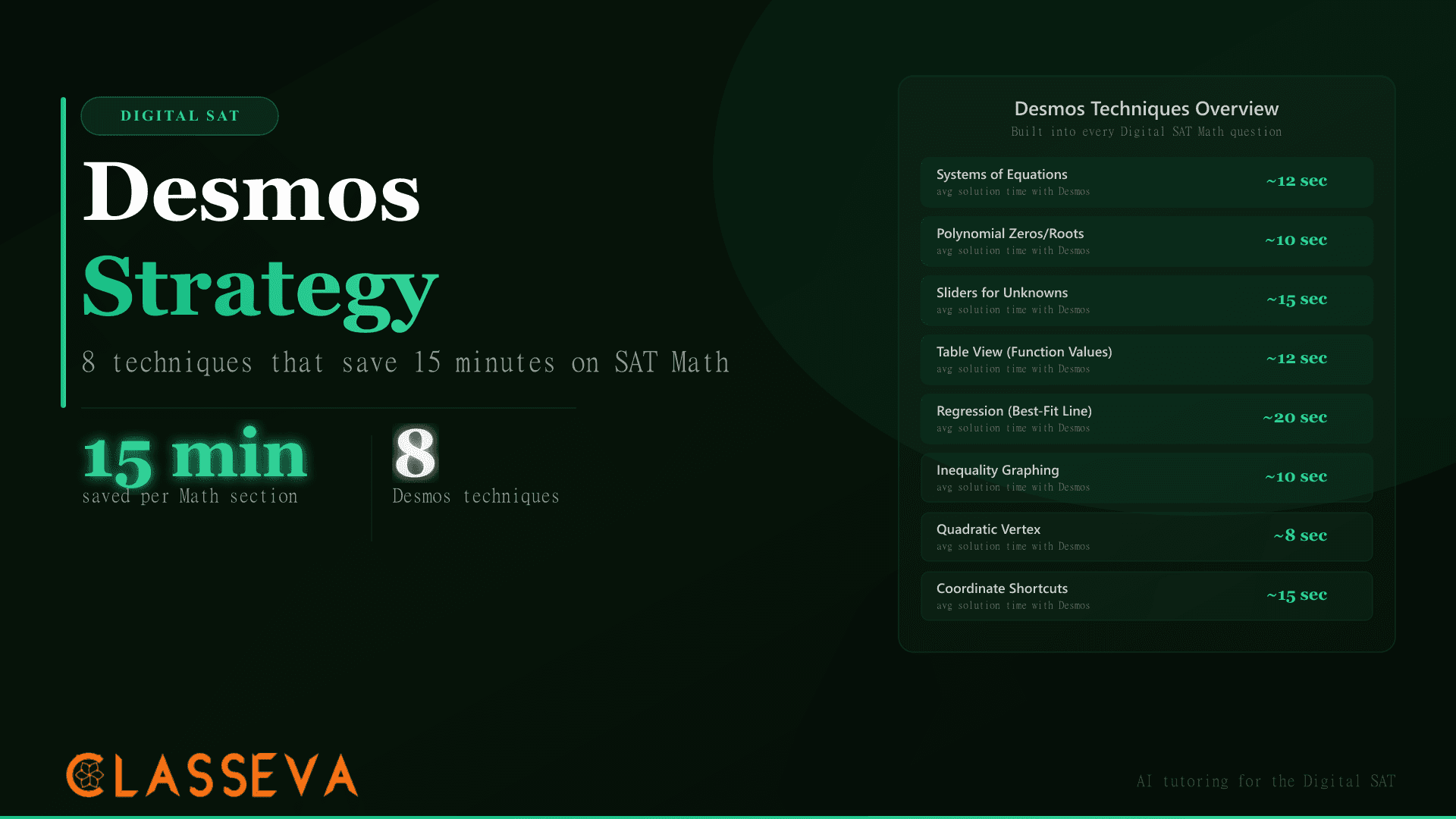
For a deeper Desmos walkthrough, including the keystrokes that turn a system into a one-click solve, the Digital SAT Desmos strategy guide covers the shortcuts that matter most on algebra questions. Pair it with this domain breakdown and most systems questions become near-automatic.
How Should You Study SAT Algebra?
The strongest SAT algebra strategy studies the domain by type, not by random mixed sets, until each of the five skill points is automatic. Diagnose which type costs you points, drill that one type in isolation, then rebuild speed with timed mixed practice. This sequence beats grinding full sections from day one, because a full section hides which specific skill is leaking points.
A Four-Step Algebra Study Sequence
The official Bluebook practice tests and the SAT Question Bank let you filter Math practice by content domain, so you can drill one algebra skill at a time. Work the sequence in order, and do not skip the diagnosis step. Knowing that you miss inequalities but ace one-variable equations changes where every study hour goes.
1. Diagnose. Take one Bluebook Math section and tag every miss as one of the five algebra types.
2. Isolate. Use the Question Bank to drill 15 to 20 questions of your weakest type before moving on.
3. Desmos. Practice entering each type into Desmos until a graphed solution takes under 20 seconds.
4. Mix and time. Run mixed algebra sets at 95 seconds per question to rebuild adaptive-section pacing.
Students building a full Math plan, not just algebra, should pair this with the Digital SAT adaptive structure breakdown to understand how module routing rewards early accuracy. The companion Digital SAT Advanced Math walkthrough covers the other 35% of the section, the quadratics and nonlinear topics that sit just past algebra.
What Pacing Should You Target?
Target about 95 seconds per Math question, since each module gives 35 minutes for 22 questions. Algebra questions should run faster than that average, because they are the most pattern-driven type on the section. Banking time on algebra leaves room for the slower geometry and data questions later.
One way to translate a target Math score into the right pacing and accuracy goals is to convert across tests first. If you have an ACT score and want the SAT equivalent, the SAT-ACT Converter maps it so you know which Math accuracy band you are aiming for.
SAT-ACT Converter
Convert between SAT and ACT scores to set a concrete Math accuracy target before you start drilling the algebra question types.
How Algebra Feeds Your Math Subscores
The Digital SAT reports one Math section score from 200 to 800, not the separate named subscores the old paper SAT printed. Your Bluebook score report and the official Question Bank still group questions by content domain, so you can measure algebra accuracy as a self-tracked subscore. Watching that number climb across practice tests is the clearest signal your study time is working.
Because algebra is the heaviest domain, your algebra accuracy moves the section score more than any other single area. A student stuck at 70% algebra accuracy who pushes to 90% often gains 60 to 100 Math points, depending on the form. [VERIFY: scaled-score conversion varies by test form] That leverage is why algebra deserves the first block of study time, ahead of geometry or data analysis.
For the full picture of how Math fits beside the verbal half of the test, the Digital SAT Reading and Writing strategy guide shows how to balance prep across both sections so neither half drags your composite down. Strong algebra alone will not carry a 1500; balanced sections will.
Key Takeaways
- Algebra is the largest Digital SAT Math domain, near 35% of the section, about 13 to 15 of the 44 scored questions. [VERIFY: exact count per College Board specifications] No other content area carries that weight.
- Five question types cover the whole domain: linear equations in one variable, linear equations in two variables, linear functions, systems of two linear equations, and linear inequalities.
- Questions from all four domains appear in both adaptive modules. Algebra is woven throughout the section, including the hardest final slots, not grouped into one block.
- Desmos is built into Bluebook on every Math question. Graphing solves most systems and inequalities faster than hand algebra once you practice the keystrokes.
- Choose the fastest method per question. Substitution for isolated variables, elimination for matching coefficients, graphing for quick-entry systems.
- Study by type, then mix and time. Diagnose your weakest of the five types, drill it in isolation, then rebuild pacing at 95 seconds per question.
- Algebra accuracy moves the Math score the most. Going from 70% to 90% algebra accuracy can lift the section by 60 to 100 points. [VERIFY: conversion varies by form]