Digital SAT Reading and Writing: Question Types Decoded
The thing I find most under-discussed about the digital SAT Reading and Writing section is that it does not test reading comprehension in the traditional sense. It tests ten specific question types, each with its own internal logic. A student who approaches every R&W question with the same general “read carefully and pick the best answer” strategy is bringing a single tool to a job that requires ten different ones.
College Board's official R&W content specification organizes the section into four domains. This post covers what each domain tests, what each question type within it asks, and the specific approach that works for that type.
What Does the Digital SAT R&W Section Test?
The Digital SAT Reading and Writing section tests close reading, vocabulary in context, text analysis, and standard written English. Unlike the old SAT, where you might spend 10-13 minutes reading a single passage before answering five questions about it, the Digital SAT gives you one short passage per question. That structural shift changes everything about how you should approach the section.
Two Adaptive Modules, One R&W Score
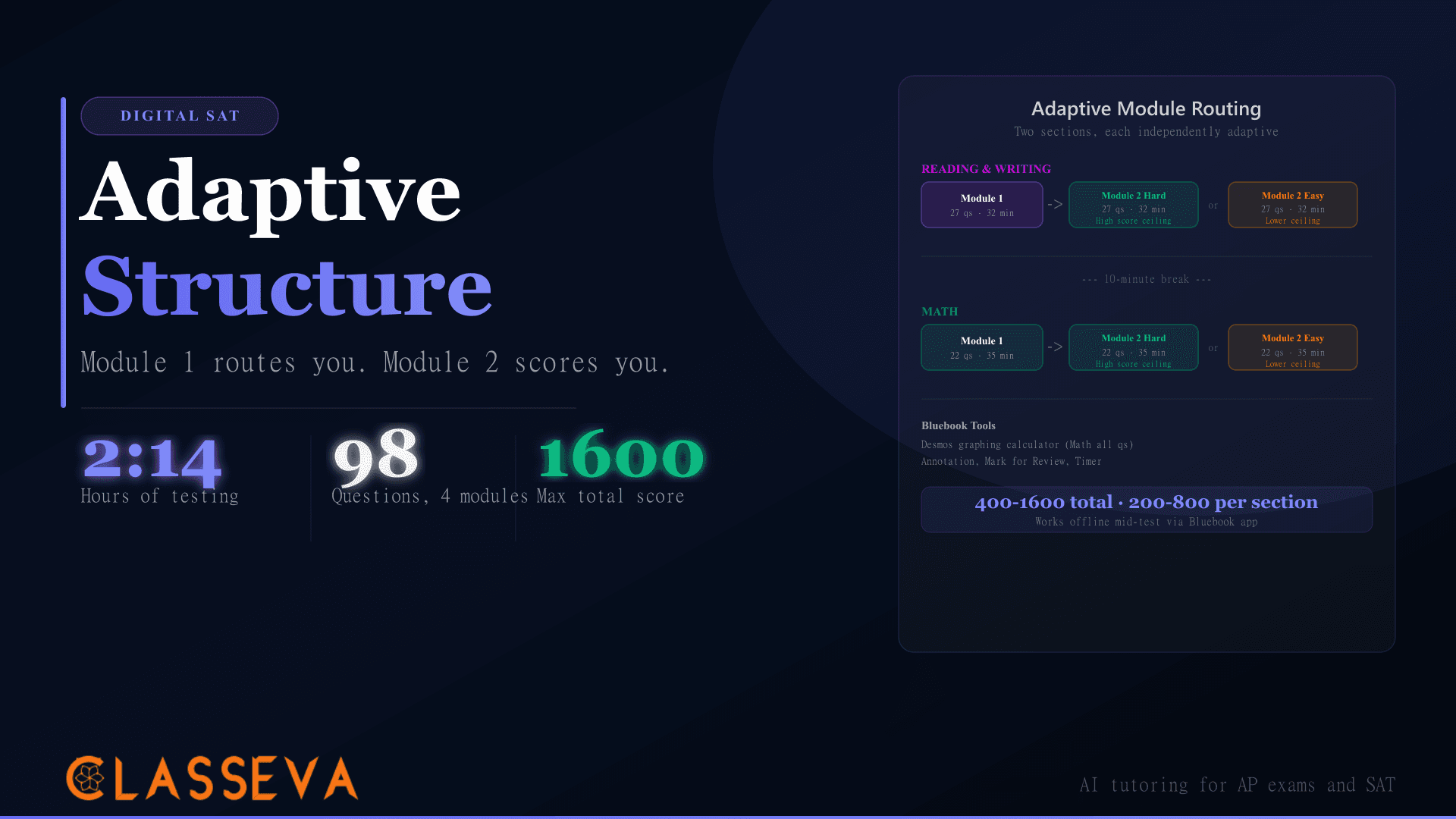
The R&W section runs across two independent modules. Module 1 contains a mix of question types from all four content domains. Based on your Module 1 performance, Bluebook routes you to either the harder or easier version of Module 2. The hard Module 2 gives you access to a higher score ceiling; the easy Module 2 caps your score range lower.
The full adaptive mechanics, including how score conversion tables differ between module pathways, are covered in the Digital SAT adaptive structure breakdown. For the purpose of this post, the key implication is that Module 1 performance matters more than any individual Module 2 question. Every question in Module 1 contributes to your routing decision.
The 4 Content Domains and 10 Question Types
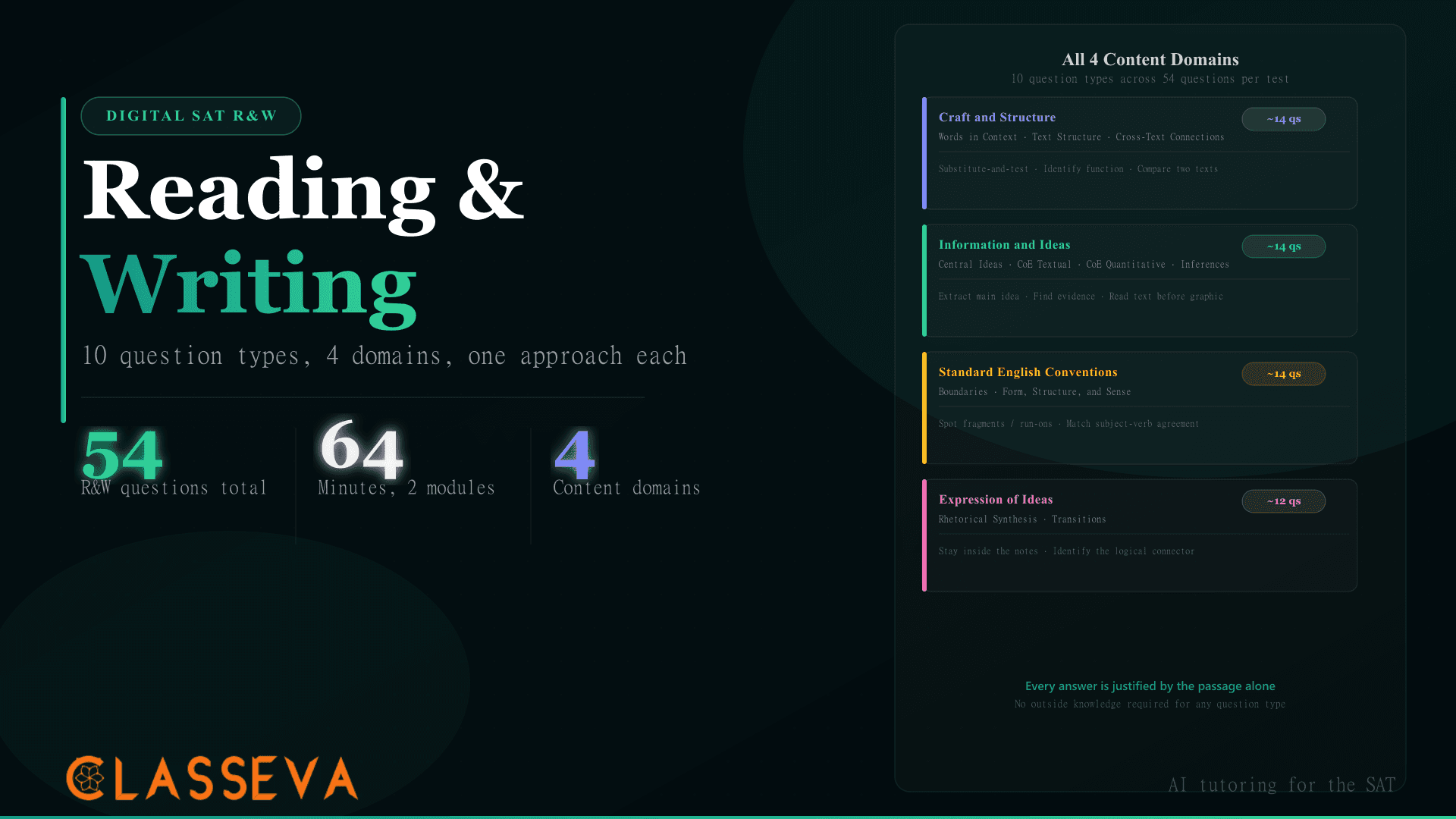
College Board organizes all R&W questions into four content domains. Each domain contains two to four distinct question types. The approximate distribution below is based on College Board's published content specifications; exact counts vary across test versions.
No R&W question on the Digital SAT tests isolated knowledge. Every question provides a passage, and the answer is always supported by that passage alone. There is no vocabulary list to memorize, no grammar rule to recall in isolation. Everything you need to answer each question is in the stimulus.
Information and Ideas: The Reading Questions
Information and Ideas questions ask you to extract, evaluate, and use information from a passage or graphic. This domain contains four distinct question types: Central Ideas and Details, Command of Evidence (Textual), Command of Evidence (Quantitative), and Inferences. Together they account for roughly a quarter of the R&W section.
Central Ideas and Details
Central Ideas and Details questions ask you to identify the main point of a passage or to select details that support it. The passages for these questions run 50-150 words and typically make one clear argument or observation.
The specific approach: read the passage once for the overall point, not for every detail. Then look at the answer choices. Wrong answers on Central Ideas questions are almost always one of three types: too narrow (they pick up a detail rather than the main point), too broad (they go beyond what the passage claims), or accurate but irrelevant (true statements from the passage that do not address the question). Correct answers restate the main point in different words.
Command of Evidence: Textual
Command of Evidence: Textual questions come in two formats. The first asks you to identify which quotation from a passage most directly supports a given claim. The second presents a claim and asks which sentence from the passage most effectively supports or undermines it.
For the first format, the question stem tells you exactly what claim to support. Find the sentence in the passage that most directly addresses that claim. For the second format, read the claim in the question stem before reading the answer choices, so you have a clear target. Eliminate choices that are tangentially related but do not directly address the specific claim. The correct answer typically uses the word “directly” for a reason: only one choice provides a direct logical connection.
Command of Evidence: Quantitative
Command of Evidence: Quantitative questions pair a short text passage with a graphic, typically a table, bar chart, or line graph. The question asks you to choose the statement that uses the graphic's data to illustrate a point made in the text, or to identify which data point most effectively supports a student's argument.
The most common mistake on Quantitative CoE questions is looking at the graphic first. Students who jump to the graphic without reading the text often select a choice that contains accurate data but does not connect to the specific claim the passage is making. Read the text, identify the claim, then find the data point that matches.
Inferences
Inferences questions ask you to select the conclusion most logically supported by the passage. These are not open-ended inference questions. The correct answer is directly entailed by the information in the passage, not merely consistent with it.
The elimination approach is reliable here: wrong answers on Inference questions are typically too strong (they make a claim that goes beyond what the passage states), too narrow (they address only one detail when the passage supports a broader conclusion), or simply unsupported (they introduce information not present). Look for the answer that requires no assumptions beyond what the passage explicitly provides.
Craft and Structure: Vocabulary and Analysis
Craft and Structure questions ask you to analyze how language works in a passage. This domain includes Words in Context, Text Structure and Purpose, and Cross-Text Connections. It accounts for roughly 26-28% of the R&W section and contains some of the most teachable question types on the entire Digital SAT.
Words in Context
Words in Context questions present a short passage with an underlined word and ask which answer choice most nearly means the same thing as the underlined word as it is used in the context of the passage. The key phrase is “as it is used in the context.” Every answer choice will be a real definition of the underlined word. Only one will fit the passage.
The substitute-and-test method works because College Board designs answer choices to test whether students are picking the most common definition of the word rather than the one that fits this specific context. If the underlined word is “critical,” the answer choices might include “important,” “analytical,” “negative,” and “decisive.” The passage context determines which one is correct. Substituting each back into the sentence reveals the mismatch.
Text Structure and Purpose
Text Structure and Purpose questions ask what a text (or a specific paragraph, sentence, or phrase within a text) is doing, not what it says. The question might be: “Which choice best states the main purpose of the text?” or “Which choice best describes the function of the underlined sentence?”
The shift in thinking: instead of extracting content, identify function. A sentence can be functioning as a contrast, an elaboration, an example, a concession, a counterargument, or a transition. Answer choices for Text Structure questions use functional verbs: “argues,” “illustrates,” “challenges,” “introduces.” Match the verb in the answer to the actual function the text is performing. A text that presents both sides of an issue without taking a position is not “arguing” for one position.
Cross-Text Connections
Cross-Text Connections are the only question type on the Digital SAT R&W section where you read two passages. Both passages are short (25-100 words each) and are labeled “Text 1” and “Text 2.” The question asks about the relationship between them: how one author might respond to the other, how the texts agree or disagree, or what one passage implies about the other.
Strategy: read Text 1 completely, then predict what direction Text 2 might go based on it, before reading Text 2. This prediction step prevents the common error of letting Text 2 override your memory of Text 1's specific claims. After reading Text 2, identify the relationship (agreement, disagreement, elaboration, contrast) and match it to the answer choices. Eliminate choices that mischaracterize what either text actually says.
Expression of Ideas: The Writing Questions
Expression of Ideas questions ask you to produce or improve written text rather than analyze existing text. This domain contains two question types: Rhetorical Synthesis and Transitions. Together they account for roughly 20-22% of the R&W section and represent the questions that feel most like a writing task rather than a reading task.
Rhetorical Synthesis
Rhetorical Synthesis questions present a bulleted list of notes, typically four to six items representing a student's research on a topic. The question asks you to pick the sentence that most effectively accomplishes a specific writing goal using information from the notes.
Read the task instruction first
The question stem tells you exactly what the sentence must accomplish: "emphasize a contrast," "present a cause and effect relationship," "introduce both findings," etc. This task instruction is the filter you apply to every answer choice.
Work backward from the answer choices
Each answer choice must pass two tests: is it factually supported by the notes, and does it accomplish the stated task? Eliminate any choice that adds information not present in the notes, even if that information seems reasonable. Eliminate any choice that accomplishes a different task than the one specified.
The correct answer stays inside the notes
College Board designs wrong answers that sound plausible but require inference or additional context beyond the provided notes. The correct answer always draws exclusively from the bullets given. If a choice makes a claim the notes do not explicitly support, cut it.
Transitions
Transitions questions present a passage with a blank where a transition word or phrase belongs. The four answer choices are different transition options (consequently, however, for example, furthermore, etc.). You select the one that correctly expresses the logical relationship between the ideas in the adjacent sentences.
Identify the logical relationship between the sentence before the blank and the sentence after it. If the second sentence contrasts the first, the answer is a contrast transition (however, nevertheless, in contrast). If it extends the first, use an additive (furthermore, additionally, moreover). If it gives an example, use (for example, for instance). If it gives a result, use (consequently, therefore, as a result). Plug in each answer choice, say the full sentence aloud mentally, and eliminate the ones that create a logical mismatch.
Most Transitions questions take 30-45 seconds once you can identify the logical relationship between the two sentences reliably. Consistent practice with identifying contrast, addition, causation, and example relationships builds speed here faster than for almost any other question type. Build this skill early in your prep and bank the time for Cross-Text Connections and Quantitative CoE questions later in the module.
Standard English Conventions: Grammar Questions
Standard English Conventions (SEC) questions test your ability to identify and correct errors in written English. College Board divides this domain into two sub-categories: Boundaries and Form, Structure, and Sense.
| Sub-type | What It Tests | Common Errors |
|---|---|---|
| Boundaries | Sentence fragments, run-ons, comma splices | Joining two independent clauses without a conjunction or semicolon; creating a dependent clause that stands alone |
| Form, Structure, and Sense | Verb form, subject-verb agreement, pronoun agreement, modifier placement | Verb not matching subject number; pronoun not matching antecedent; dangling or misplaced modifiers |
The two sub-categories of Standard English Conventions on the Digital SAT R&W section.
A crucial point: SEC questions require no grammar terminology. You never need to identify a gerund, a subordinate clause, or a participial phrase by name. You only need to recognize whether the resulting sentence sounds correct. The test rewards recognition over explanation. Students who can read a sentence and immediately hear whether it is a fragment, run-on, or agreement violation solve SEC questions faster and more accurately than students who try to diagram sentences.
A common SEC error is editing only the underlined portion without reading the complete sentence. Many SEC errors involve agreement between a subject and verb that are separated by a long phrase. Reading only the underlined verb without finding the subject first leads to selecting the wrong form. Always find the subject, then check agreement with the verb in the answer choices.
Pacing Yourself Across 54 Questions
With 27 questions and 32 minutes per module, you have an average of roughly 71 seconds per question. Some question types consistently require more time; others consistently take less. Knowing the distribution in advance lets you pace deliberately rather than reactively.
Fastest question types (typically 30-60 seconds each): Standard English Conventions, Transitions, Words in Context. These have consistent, teachable approaches, and the passages are short. Students who have practiced these types build automaticity that makes them nearly mechanical.
Slower question types (typically 90-120 seconds each): Cross-Text Connections (requires reading two passages and analyzing their relationship), Command of Evidence: Quantitative (requires reading text, reading the graphic, and connecting the two), and some Inferences questions where the passage requires close reading.
Practical pacing rule: if you have spent 90 seconds on a question without a clear answer, use the Bluebook annotation tool to mark it, select your best guess, and return to it at the end. A question left blank scores zero. A strategic guess on a hard question is statistically better than spending three minutes on it and rushing the last five questions.
For planning your SAT score target and understanding how an R&W improvement translates to a total score change, the SAT-ACT Score Converter lets you see what your current or target SAT score corresponds to on the ACT composite scale, useful if you are deciding which test to prioritize. And if your test date is approaching, the Optimal Test Date Selector maps your prep timeline to the most strategic registration window.
Plan Your Score Target
If you know your current practice score on the R&W section, the SAT-ACT Score Converter below helps you understand how your R&W performance feeds into your total SAT score and how that total compares across testing formats. Many students find that R&W and Math score improvements compound on each other because both sections use the same adaptive structure: a strong Module 1 in either section opens the high-scoring Module 2 pathway.
SAT-ACT Score Converter
Convert your SAT total score to an ACT composite equivalent, or compare target scores across both tests to decide which format gives you the better competitive score.
Key Takeaways
- The Digital SAT R&W section has 54 questions across two 32-minute adaptive modules. Module 1 routes you to the hard or easy Module 2, which determines your score ceiling. Every Module 1 question matters.
- All R&W passages are 25-150 words. There are no long reading passages. One question per passage is the rule, except for Cross-Text Connections, which pairs two short passages.
- Words in Context questions require contextual fit, not dictionary meaning. Substitute each answer choice back into the sentence and eliminate choices that create a logical mismatch with the surrounding text.
- Command of Evidence: Quantitative questions require reading the text first, then the graphic. The correct answer uses only data visible in the graphic. No outside knowledge or additional inference is needed.
- Rhetorical Synthesis answers must be 100% supported by the provided notes. Choices that add information beyond the bulleted notes, even plausible information, are wrong by design.
- Standard English Conventions requires recognition, not terminology. Identify whether a sentence has a fragment, run-on, or agreement error. No grammar label is required, only the ability to hear whether the sentence is correct.
- Standard English Conventions and Words in Context together account for roughly half the section. Mastering both types' consistent approaches delivers disproportionate score gains relative to study time invested.
Frequently Asked Questions
How many questions are on the Digital SAT Reading and Writing section?
The Digital SAT Reading and Writing section has 54 questions total: 27 questions in Module 1 and 27 questions in Module 2. Each module has a 32-minute time limit, giving you 64 minutes total for the R&W section. Module 2 difficulty is determined by your Module 1 performance.
How long is the Digital SAT Reading and Writing section?
The Digital SAT Reading and Writing section runs 64 minutes total, split across two 32-minute modules. There is a 10-minute break between the R&W and Math sections. Each module gives you roughly 71 seconds per question, though question types vary considerably in the time they typically require.
What is the difference between Command of Evidence textual and quantitative?
Command of Evidence: Textual questions ask you to identify which quote from a passage best supports or contradicts a claim. Command of Evidence: Quantitative questions ask you to use data from a table, graph, or chart to complete a claim about the text. Quantitative questions always include a graphic alongside the passage; textual questions never do.
Are there long reading passages on the Digital SAT?
No. The Digital SAT eliminated the long reading passages used in the old SAT. Every R&W passage is 25-150 words. Each passage has exactly one question, with the sole exception of Cross-Text Connections questions, which pair two short passages and ask you to compare them.
How is Rhetorical Synthesis different from other writing questions?
Rhetorical Synthesis questions provide a bulleted list of notes (research findings, facts, or observations) and ask you to choose the sentence that best accomplishes a specific writing task using only those notes. The key constraint: the correct answer must be 100% supported by the provided notes. You cannot use outside knowledge or infer beyond what is explicitly given.
What grammar topics appear in Standard English Conventions?
College Board divides Standard English Conventions into two sub-categories: Boundaries (identifying and fixing sentence fragments, run-on sentences, and comma splices) and Form, Structure, and Sense (subject-verb agreement, pronoun-antecedent agreement, verb tense and form, and modifier placement). No knowledge of grammar terminology is required; you only need to recognize whether a sentence is correct or contains a specific type of error.
How can I improve my Digital SAT R&W score quickly?
The fastest score gains on Digital SAT R&W typically come from Standard English Conventions and Words in Context, because both have teachable, consistent approaches that apply to almost every question of that type. For Standard English Conventions, learn to identify fragments, run-ons, and agreement errors on sight. For Words in Context, practice the substitute-and-test method. Together these two domains account for roughly half the R&W section.
Can I use scratch paper on the Digital SAT Reading and Writing section?
Yes. The testing center provides scratch paper for all Digital SAT sections, including R&W. Bluebook, the Digital SAT testing app, also has a built-in annotation tool that lets you mark up passages, highlight text, and take digital notes directly on screen. Most students combine digital annotation for the passage with scratch paper for process-of-elimination work on the answer choices.
R&W section structure and content domain specifications from College Board: What's on the Digital SAT Reading and Writing Test. Adaptive module mechanics from the Bluebook testing application documentation. For full adaptive structure breakdown, see the Digital SAT adaptive module structure post.