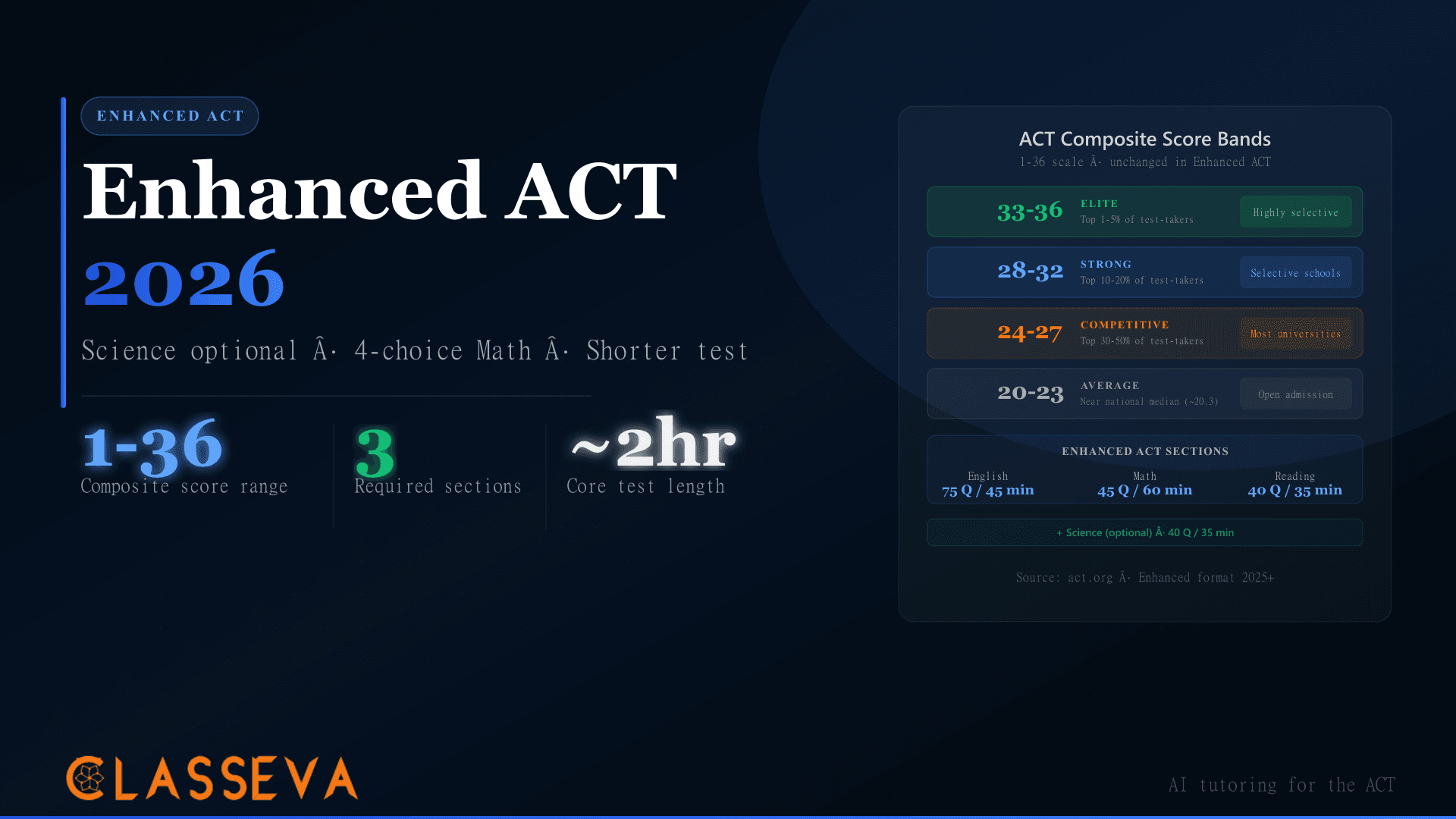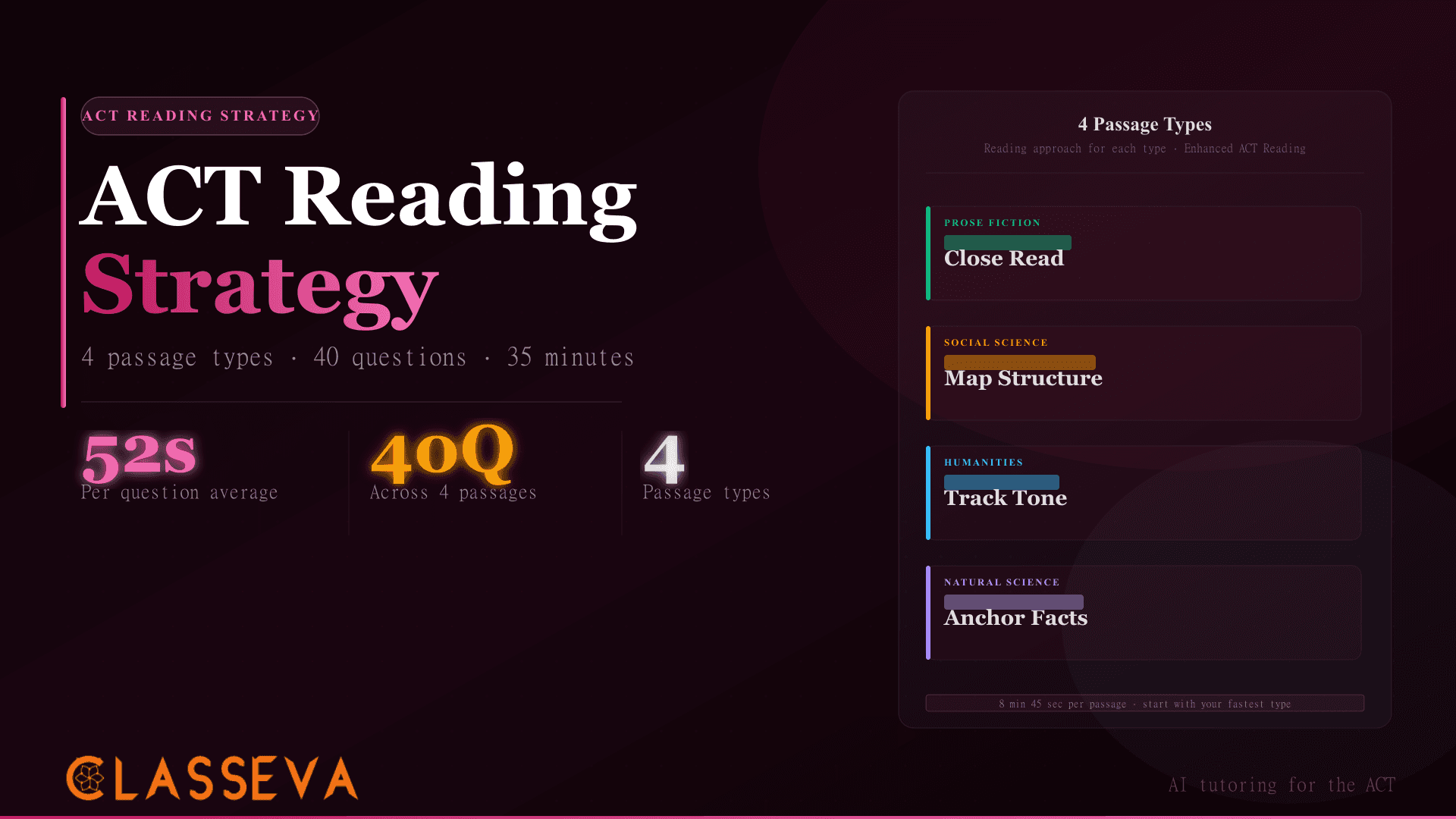
Enhanced ACT English Strategy: 5 Question Types
Students scoring 30 or above on ACT English share one habit that mid-20s scorers lack: they recognize which question category they are looking at before reaching for a strategy. Punctuation questions need memorized rules. Rhetorical skills questions need author-intent thinking. Treating both the same way is the most consistent English section mistake, and it explains why many students study "grammar" for weeks and see no score movement.
The Enhanced ACT format gives the English section 50 questions in 35 minutes, making it the fastest-paced section of the test. The good news: those 50 questions fall into five identifiable categories, each with a specific approach that produces right answers faster than generic re-reading. This post covers each category in order from the most rule-bound (punctuation) to the most judgment-dependent (organization), then closes with a pacing plan and practice framework.
What Is the Structure of Enhanced ACT English?
The Enhanced ACT English section has 50 questions across five passages in 35 minutes. [Verify the exact format at act.org before your test date, as ACT may update the section structure.] Each passage runs roughly 400-500 words with numbered and underlined portions. The corresponding questions ask either about a specific underlined section or about the passage as a whole. ACT samples five broad passage types: natural science, social studies, humanities, narrative prose, and a fifth rotating type. Passage topic does not predict question category distribution, so do not adjust strategy based on whether the passage is about ecology or history.
The 42-Second Reality
Thirty-five minutes divided by 50 questions gives you exactly 42 seconds per question on average. That is less than Math's 80 seconds and less than Reading's 58 seconds. English is the tightest section on the test.
The saving grace is category variance. Punctuation questions take 20-25 seconds for a student who knows the rules. That surplus accumulates across 8-10 punctuation questions per test, generating 2-3 minutes of buffer time for the rhetorical skills questions that need the full 50-60 seconds each. The category-by-category time budget in the practice section below shows exactly where to spend that buffer.
Passage-Based Format
Unlike the Digital SAT, which presents grammar questions on isolated sentences, ACT English ties every question to a full passage. This distinction matters for roughly 40-50% of questions. Punctuation and grammar questions can be answered by examining the underlined portion alone. Rhetorical skills and organization questions cannot: they require knowing what the surrounding paragraph is doing. Students who skip the passage and jump directly to underlined portions consistently miss strategy and organization questions because those questions depend on passage context that single-sentence inspection cannot supply.
What Are the 5 Question Categories on ACT English?
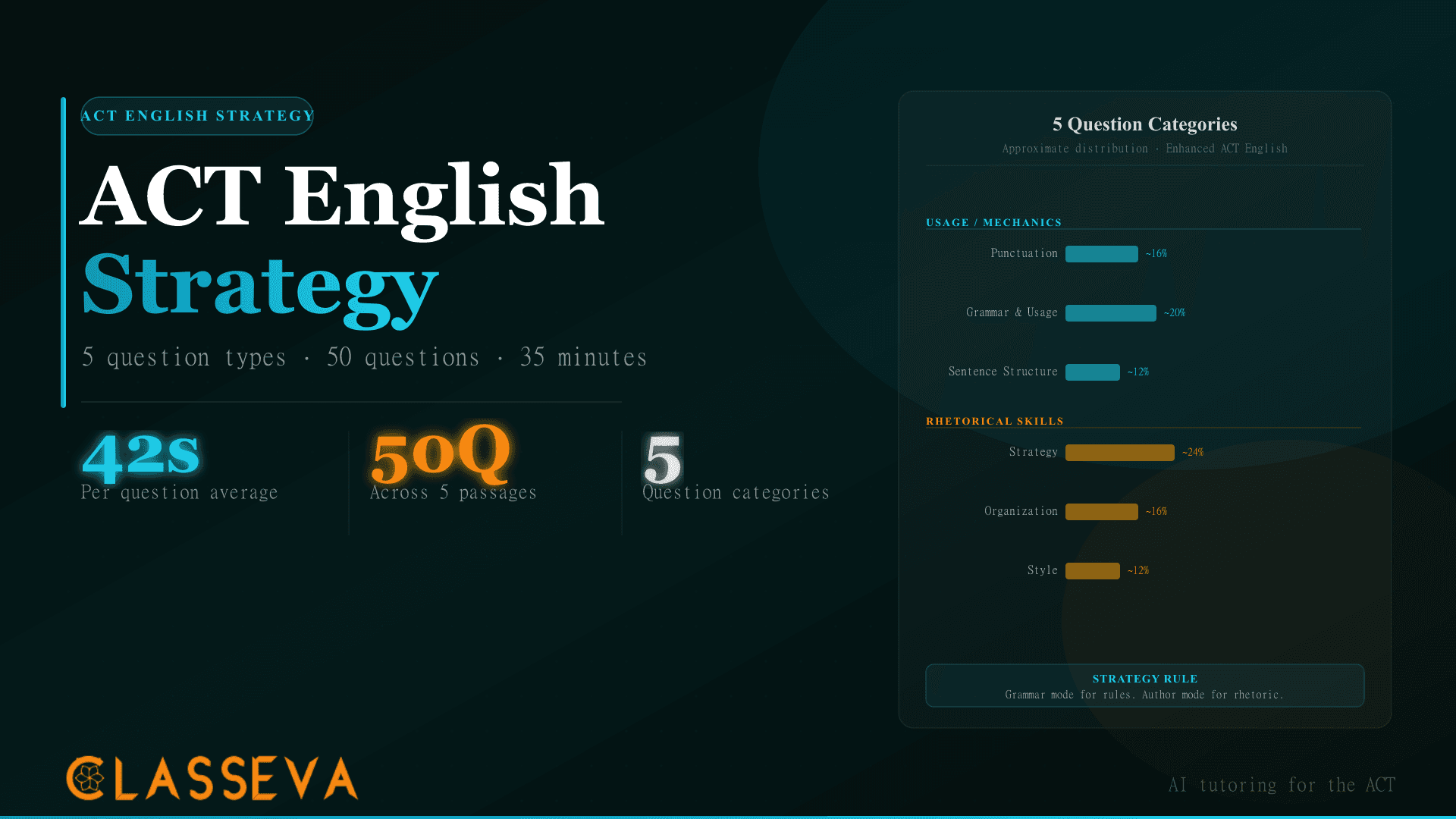
ACT groups English questions into two families with five distinct categories. The split is roughly equal between the two families, though the exact distribution varies by test form. The figure below shows an approximate breakdown across the 50 questions. [Approximate distribution based on ACT content documentation; verify at act.org.]
Usage and Mechanics: The Rule-Based Half
Usage and Mechanics covers three categories: Punctuation, Grammar and Usage, and Sentence Structure. Together they account for roughly 45-50% of questions. Every question in this family has an objectively correct answer based on grammar rules. There is no judgment call about what the author intended. The right answer follows from knowing the specific rule and applying it to the underlined text.
This family rewards investment in rule memorization. A student who has internalized the six comma rules and the semicolon rule can answer punctuation questions in under 30 seconds each. A student who relies on reading the sentence aloud and guessing by rhythm will miss roughly half of these questions, because ACT deliberately constructs sentences that sound fine with incorrect punctuation.
Rhetorical Skills and Organization: The Judgment Half
Rhetorical Skills covers Strategy, Organization, and Style, accounting for the remaining 50-55% of questions. These questions do not have grammar-correct answers. They have “most effective for this passage” answers. A transition word that is grammatically fine in isolation is wrong if it signals the opposite relationship from what the adjacent sentences actually have.
Usage & Mechanics
- •Punctuation, grammar, sentence structure
- •Right answer follows grammar rules
- •Apply the rule — no context needed for most questions
- •Faster: 20-35 seconds per question with rule knowledge
- •Rewards memorization before test day
Rhetorical Skills
- •Strategy, organization, style
- •Right answer serves the passage's purpose
- •Read surrounding paragraph before answering
- •Slower: 40-60 seconds per question
- •Rewards reading comprehension and judgment
How Do You Master ACT Punctuation Rules?
Punctuation questions show up across all five passages. ACT does not test obscure edge cases from style guides. It tests a fixed, learnable set of rules — the same rules that appear on virtually every test form. Master this list before test day and these questions become among the fastest on the section.
The Comma Rules Worth Memorizing
Six comma rules cover the vast majority of ACT punctuation questions. Know all six; know them in both directions (when to add a comma and when to remove one).
- Compound sentence: Place a comma before a coordinating conjunction (for, and, nor, but, or, yet, so) joining two independent clauses.
- Introductory element: Place a comma after an introductory clause or phrase that precedes the main clause.
- Non-restrictive clause: Place commas around a clause or phrase that adds non-essential information and can be removed without changing the core meaning.
- Series: Use commas between items in a list. ACT treats the Oxford comma as correct.
- Coordinate adjectives: Use a comma between two adjectives that each independently modify the same noun.
- No comma between subject and verb: Never place a comma between the subject and its verb, or between a verb and its direct object.
Rule 6 catches more students than the other five combined. ACT constructs sentences where a long subject phrase makes the comma feel natural: “The results of the three-year study, show a clear pattern.” That comma is wrong. Remove it. Subject and verb are never separated by a comma.
Semicolons, Colons, and Dashes
Three additional punctuation marks follow one rule each.
Semicolonsjoin two independent clauses. The clause on each side of the semicolon must be able to stand alone as a complete sentence. If the second clause starts with a subordinating conjunction (“because,” “although,” “when”), the semicolon is wrong.
Colonsintroduce a list, explanation, or restatement, but only after a complete independent clause. “The study found: three significant results” is wrong because “The study found” is incomplete without an object. “The study produced three significant results: lower dropout rates, higher test scores, and improved attendance” is correct.
Dashesfunction either in pairs (like parentheses, setting off parenthetical information) or as a single dash introducing an explanation after a complete clause. If an answer choice removes one dash of a pair, the remaining solo dash changes the sentence's meaning.
How Do You Handle Grammar and Usage Questions?
Grammar and usage questions test subject-verb agreement, pronoun-antecedent agreement, verb tense consistency, pronoun case (who vs. whom, I vs. me), and adjective vs. adverb usage. Most students know these rules instinctively in simple sentences. ACT's grammar questions are specifically engineered to exploit the gap between instinct and rule precision in complex sentence structures.
Subject-Verb Agreement Under Pressure
ACT inserts prepositional phrases between subjects and verbs: “The results of the long-term study shows a clear pattern.” Most students choose “shows” because “study” is the closest noun and “study shows” sounds natural. But the subject is “results” (plural), not “study.” The correct verb is “show.”
The fix that works every time: mentally cross out all prepositional phrases (any phrase beginning with of, in, at, by, from, with, between, among, for) and check what remains. Subject and verb must agree in that stripped-down version of the sentence.
Pronoun Agreement and Modifier Placement
Pronoun questions follow the same pattern as subject-verb questions: the antecedent is often separated from the pronoun by several sentences or clause boundaries. The pronoun must agree with its antecedent in number and gender. ACT commonly tests ambiguous pronouns, where “they” or “it” could refer to two different nouns in the preceding text. On these questions, the correct answer usually replaces the ambiguous pronoun with the explicit noun.
Misplaced modifiers produce a distinct type of error. A participial phrase at the start of a sentence must modify the subject of the main clause. “Running through the rain, the essay was finally finished” is wrong because the essay is not running. The subject of “Running through the rain” must be whatever is actually running. ACT answer choices that correct misplaced modifiers typically restructure the sentence so the agent performing the action appears immediately after the comma.
When you see “they,” “them,” “it,” or “this” underlined, trace the pronoun back to its antecedent explicitly before choosing an answer. If two nouns in the previous sentence could both claim the pronoun, ACT will have an answer choice that replaces the pronoun with the correct noun. That replacement is almost always the right answer.
How Do You Approach Rhetorical Skills Questions?
Rhetorical skills questions account for roughly half the section and confuse students who approach them with grammar logic. Reading a rhetorical skills question and picking the answer that is grammatically correct produces consistent wrong answers, because the question is not asking about grammar.
When I study ACT English sample questions from ACT's published practice materials, the pattern that stands out most sharply is the transition word question. The four answer choices (However, Therefore, In addition, For example) are each grammatically correct. They fail or succeed entirely based on whether they accurately signal the relationship between the adjacent sentences. Students who choose “However” because it “sounds like a transition” will miss the question if the sentences actually agree rather than contrast.
The Author-Purpose Frame
Before answering any strategy question, establish three things about the surrounding passage: what is the author arguing or describing, what tone runs through the passage (formal, conversational, scientific), and what has the paragraph just established before the underlined portion.
Transition questions reduce to one diagnostic: do the adjacent sentences agree, contrast, or does one give an example of the other? “However” signals contrast. “Therefore” signals a conclusion following from evidence. “In addition” signals continuation. “For example” signals illustration. Pick the word whose relationship matches the actual relationship between the sentences, not the word that sounds most formal or transitions-like.
Deletion Questions
Organization and strategy questions sometimes ask whether an underlined sentence should be kept or removed. These are among the most commonly missed question type on the section. Students default to “OMIT” because removing text often feels safer than defending it. That instinct is wrong more than half the time.
Keep the sentence if it supplies specific evidence, provides a necessary transition between ideas, or completes a structural pattern established earlier in the paragraph. Delete it if it repeats information already stated earlier in the passage, introduces a topic unrelated to the paragraph's central idea, or contradicts the passage's established tone. Read the paragraph without the sentence before choosing. If the paragraph flows better without it, delete. If a gap appears, keep.
How Should You Pace Yourself Across 50 Questions?
Five passages at 7 minutes each gives you the exact 35-minute budget. The split within each passage is asymmetric: punctuation and grammar questions run fast (20-30 seconds each), while organization questions run slow (45-60 seconds each). A passage with six strategy questions will take 8-9 minutes at full effort. A passage with eight punctuation questions might take 5 minutes. The pacing plan below accounts for this variance.
The Five-Passage Plan
Skim each passage before answering (45-60 seconds)
Read quickly for topic, tone, and the general direction of the argument. Do not stop on underlined portions yet. This skim is what lets you answer organization and strategy questions without re-reading the passage per question.
Answer punctuation and grammar questions immediately (20-35 sec each)
When you reach a punctuation or grammar underline, apply the relevant rule directly. These questions do not require passage context. Mark any you are unsure about and move on rather than spending more than 40 seconds on a single rule-based question.
Return to rhetorical skills questions with context (45-60 sec each)
Strategy and organization questions often reference earlier or later paragraphs. If you already skimmed the passage, locating that context takes seconds. If you skipped the skim, you will re-read the passage once per rhetorical skills question, which doubles the time cost.
Flag stuck questions and move on (10-second decision)
If a question takes more than 90 seconds, guess your best answer, mark it, and continue. Running overtime on one strategy question while three punctuation questions remain unanswered is the most common way English scores drop on test day.
Review flagged questions with any remaining time
The goal is to finish each 7-minute passage in 5.5-6 minutes, banking 30-60 seconds per passage. Across five passages, that accumulates 2.5-5 minutes of review time for flagged questions at the end.
What Is the Best Practice Strategy for ACT English?
Full timed passages are not the right starting point for most students. Practice by category first: run 20-question drills of punctuation-only questions, then grammar-only, then rhetorical skills. Category isolation reveals exactly which rules you do not know and which question types cost the most time. Once you are scoring above 85% by category, move to mixed timed passages to build section-level pacing.
Setting a specific score target before starting timed practice sharpens the focus. The calculator below converts your score goal into a concrete target: how many questions you can miss and still hit your number, which tells you whether to focus prep time on eliminating errors in categories you almost know or on unlocking categories you currently skip entirely.
ACT Score Goal Setter
Enter your current ACT English practice score and your target school's score range to see exactly how many more questions you need to get right and which category improvements yield the fastest gains.
If you are also preparing for the SAT, the SAT-ACT Converter translates your ACT English score into an equivalent SAT Reading and Writing score so you can compare your standing on both tests. Many students discover they perform differently across the two formats, and the converter surfaces that difference before you commit test dates. The The ACT resources hub has the full Enhanced ACT format breakdown, including how English, Math, Reading, and Science interact in composite scoring.
| Category | Primary Strategy | Avg Time Budget | Highest-Yield Rule |
|---|---|---|---|
| Punctuation | Identify mark; apply specific rule | 25 sec | Comma before FANBOYS in compound sentences |
| Grammar & Usage | Find true subject; strip prepositional phrases | 30 sec | Subject-verb agreement across intervening phrases |
| Sentence Structure | Check for complete clauses on each side | 25 sec | Semicolons require independent clauses on both sides |
| Strategy | Read for author purpose; check surrounding sentences | 50 sec | Transition word must match the logical relationship |
| Organization | Read paragraph before and after placement target | 55 sec | Sentence placement follows the logical thread |
| Style | Eliminate redundancy; match passage tone precisely | 30 sec | Most concise option wins when all choices are grammatically correct |
Time budgets are averages. Your actual times will shift based on rule familiarity.
The Enhanced ACT Math strategy post covers the parallel logic for the Math section: how the 4-choice format shifts elimination odds and backsolving speed. Reading both posts together gives you a complete Enhanced ACT framework across the two highest-weighted sections.
Key Takeaways
- Enhanced ACT English has 50 questions in 35 minutes (42 seconds per question average), making it the fastest-paced section of the Enhanced ACT. [Verify at act.org before test day.]
- The five question categories split into two families: Usage and Mechanics (punctuation, grammar, sentence structure) and Rhetorical Skills (strategy, organization, style). Each family rewards a different approach.
- Punctuation questions reward memorizing six comma rules and one rule each for semicolons, colons, and dashes. Reading the sentence aloud to check rhythm produces wrong answers because ACT constructs sentences that sound right with incorrect punctuation.
- Grammar questions reward stripping prepositional phrases before checking subject-verb agreement, and tracing pronouns back to explicit antecedents rather than the nearest noun.
- Rhetorical skills questions reward thinking about what the author is trying to accomplish at that point in the passage, not about grammatical correctness. Transition word questions turn on whether adjacent sentences agree, contrast, or exemplify.
- Pacing: 7 minutes per passage is the target. Fast punctuation questions generate buffer time for slower organization questions. Never run overtime on one strategy question while rule-based questions remain unanswered in the same passage.
- Practice by category before moving to full timed sections. Category isolation reveals specific rule gaps that full-passage practice obscures.