Enhanced ACT 2026: Every Change Explained
ACT's Enhanced ACT is the most significant redesign the test has undergone in over a decade. Tracking ACT's official announcements through 2024, the change that struck me hardest was not the shorter running time but the strategic complexity the optional Science section creates for students targeting engineering schools, pre-med programs, and research universities. The "optional" label sounds like a free pass. For a meaningful share of applicants, it isn't. This post traces every specific format change, its scoring implications, and exactly how to decide whether Science belongs on your scorecard.
What Is the Enhanced ACT?
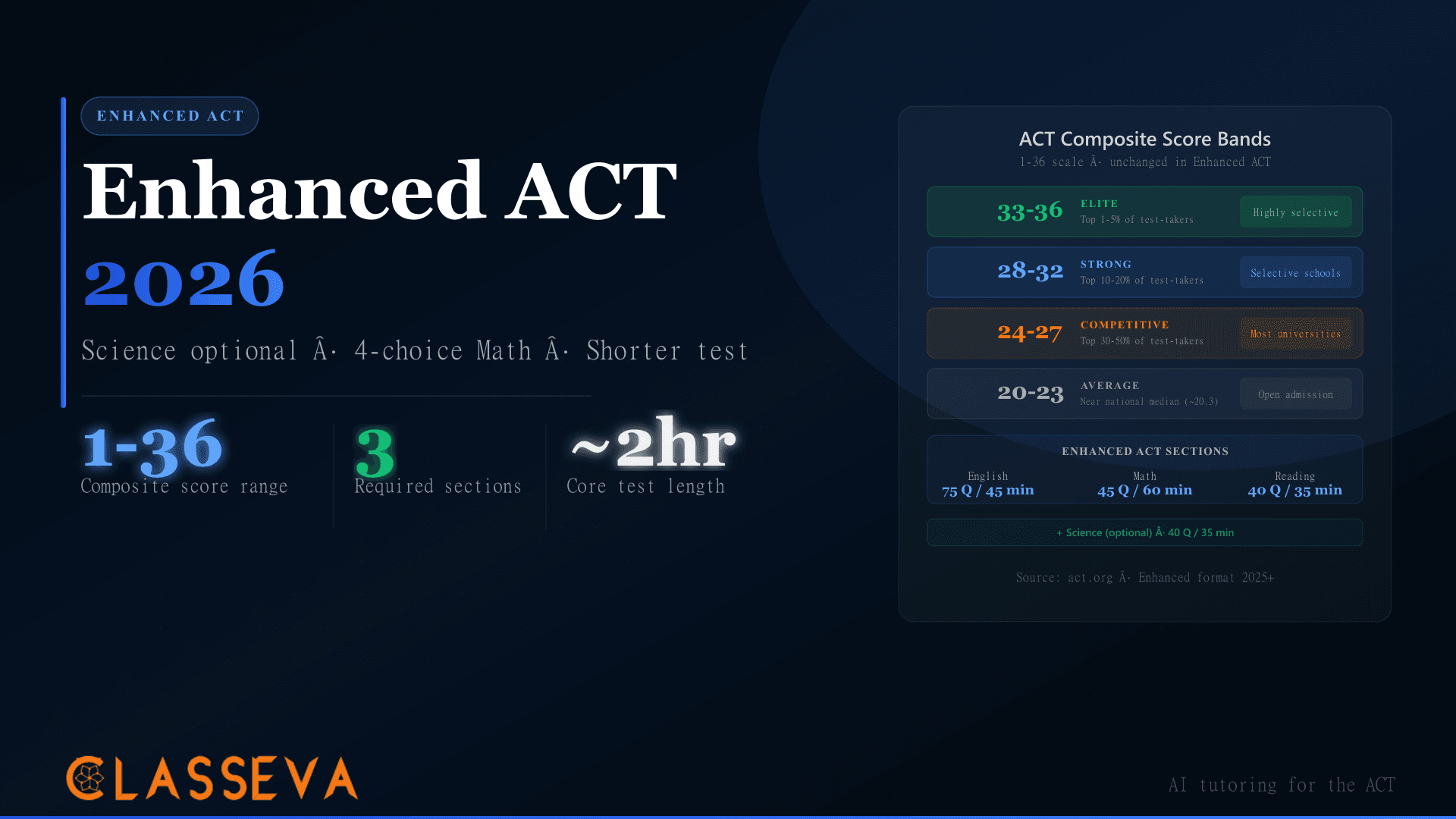
The Enhanced ACT is the redesigned version of the ACT exam, with three required sections (English, Math, and Reading) and two optional sections (Science and Writing). The redesign announced by ACT in 2024 and available to US students beginning in 2025 keeps the 1–36 composite scoring scale while cutting total required test length by roughly 35 minutes.
The composite score still runs 1–36. Every section still scores on that same scale. What changed is which sections count toward the composite by default and how many answer choices each Math question presents.
Classic vs. Enhanced: The Full Format Breakdown
The classic ACT required all four multiple-choice sections: English, Math, Reading, and Science. Writing was already optional. Under the Enhanced ACT, Science joins Writing as an add-on. The result is a shorter core test that most students complete in roughly two hours, compared to two hours 55 minutes for the classic four-section version.
When Did the Enhanced ACT Launch?
ACT rolled out the Enhanced ACT at US national test centers starting in spring 2025. Students who registered for ACT national test dates beginning in that cycle took the new format. When registering at ACT's official test page, students now select whether to include the optional Science section at sign-up time, not on test day. Check your specific test date on the ACT website to confirm which format applies to that administration.
What Changed in the Enhanced ACT 2026?
The Enhanced ACT introduced four specific changes from the classic format: Science shifted from required to optional, Math reduced from 60 questions to 45 with answer choices cut from 5 to 4, total required test time dropped by 35 minutes, and the composite calculation now reflects only the sections you actually take.
Science Is Now Optional
Under the classic ACT, every student took Science whether they wanted to or not. The Enhanced ACT ends that. Science remains a 40-question, 35-minute section, but you add it to your registration by choice. The section format itself did not change: data representation, research summaries, and conflicting viewpoints passages all appear at the same proportions as before.
The strategic question is not whether Science is difficult but whether your target schools will look at the Science subscore. For students applying to STEM fields, flagship research universities, or scholarship programs that have historically weighted Science heavily, the answer often points toward taking it regardless of the optional label. The guidance on specific school categories appears in the section below.
Math Drops to 4 Answer Choices and 45 Questions
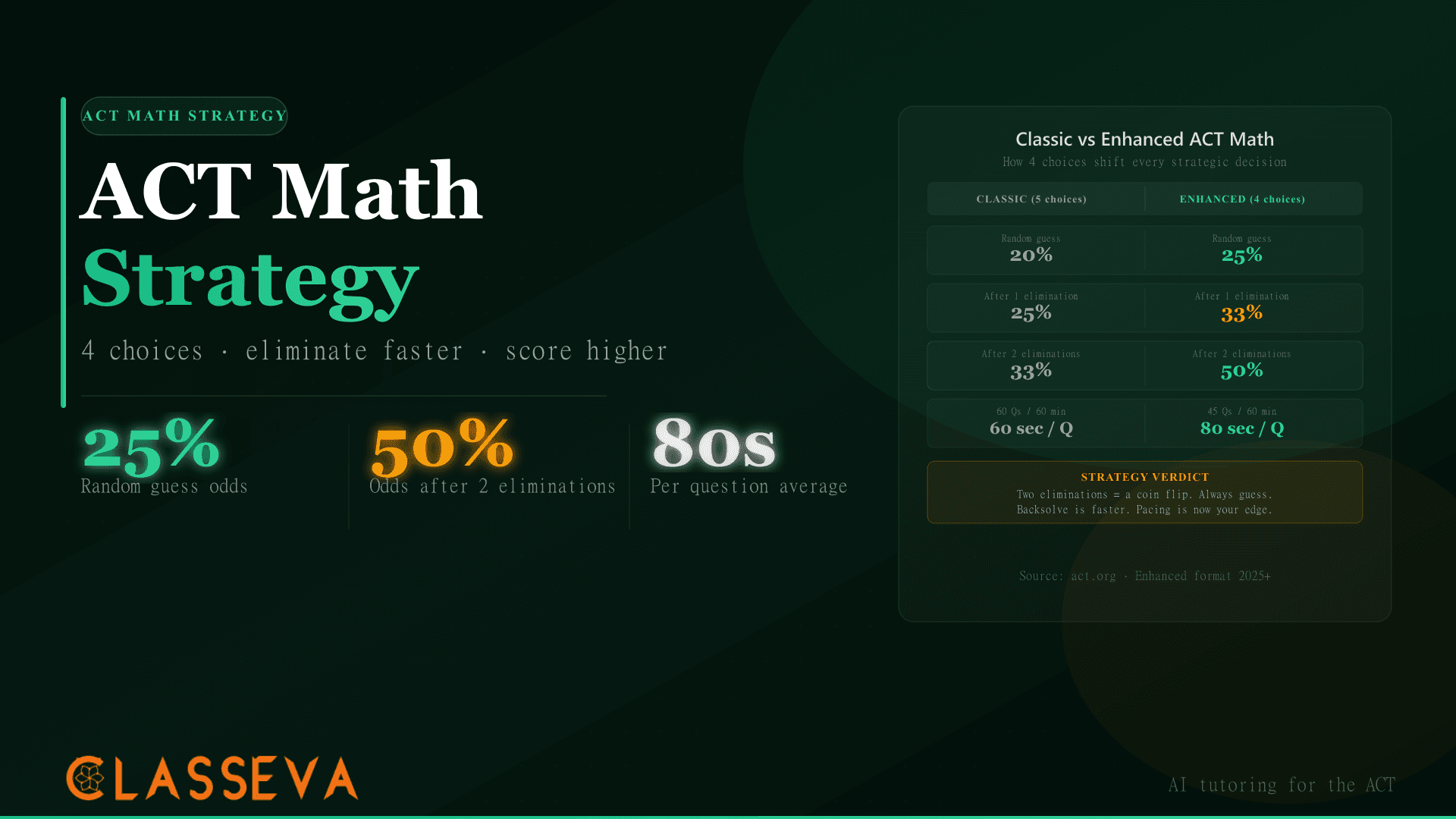
This is the change with the largest day-of-test impact. The classic ACT Math section offered five answer choices per question (A through E), which meant eliminating four wrong answers to isolate one correct one. The Enhanced ACT cuts that to four choices (A through D). One fewer wrong answer per question changes both the elimination workload and the probability math for strategic guessing.
A second shift hides inside this change. With 45 questions and 60 minutes, each question gets about 80 seconds of available time. The classic ACT forced one minute per question across 60 problems. That extra 20 seconds sounds minor. On a multi-step algebra problem or a trigonometry item, it's often enough to work through the full solution rather than having to shortcut or guess.
Total Test Time Shrinks by 35 Minutes
The Enhanced ACT's three required sections total 140 minutes of test time: English (45 minutes), Math (60 minutes), and Reading (35 minutes). Include standard breaks and you leave the testing room in roughly two hours to two hours 15 minutes for the core test. Students who add the optional Science section return to approximately 175 minutes of test time, close to the classic ACT's full-section running time.
Is the Science Section Really Optional?
Yes, the Science section is optional under the Enhanced ACT. But "optional" in standardized testing rarely means irrelevant. The practical answer depends entirely on where you are applying and what you plan to study.
Which Colleges Still Expect Science Scores
No US college currently requires ACT Science as a formal admissions prerequisite, since ACT made it optional. But several categories of programs treat Science subscores as meaningful signal in their review. Engineering programs, pre-med tracks, and STEM honors colleges at large research universities have historically leaned on Science subscores to gauge scientific reasoning ability. Some merit scholarship committees at flagship state schools also reference Science when ranking applicants for their top awards.
The safest approach: read the admissions guidance pages of every school on your target list and note whether they reference ACT subject scores individually. State flagship universities in the Midwest and South have placed more weight on ACT Science historically than selective liberal arts colleges, many of which have moved test-optional or have always weighted composite scores rather than subscores.
Taking Science costs 35 minutes of test time and produces a subscore that can only help at schools that value it. Skipping it saves time but eliminates that data point from your application permanently.
If you plan to apply to engineering programs, pre-med tracks, or STEM-intensive research universities, take the Science section. The subscore signals scientific data reasoning that many STEM admissions reviewers specifically reference, and the "optional" label does not reduce its weight at those programs.
How to Decide Whether to Take Science
Five questions determine whether Science belongs on your registration.
Check each target school's guidance
Visit the admissions pages for every school on your list. If any mention ACT subject scores or Science specifically in their review criteria, register for Science.
Take a timed Science practice test
Score it and compare to your English, Math, and Reading practice scores. If your Science score is at or above your Math score, it will lift your composite. If it trails by more than two points, it will lower it.
Identify your intended major
Biology, chemistry, engineering, nursing, and pre-med applicants should almost always take Science. English, history, arts, and social science applicants have less to gain from the subscore.
Review any merit scholarship criteria
Some merit scholarship programs at flagship universities specify ACT composite thresholds that include Science when it is taken. Read the fine print before skipping the section.
Default to taking it if unsure
The downside of a below-average Science score (a slightly lower composite) is recoverable through superscoring. The downside of missing a subscore entirely at a school that values it is not. When in doubt, take Science.
How Is the Enhanced ACT Scored?
Each Enhanced ACT section scores on a scale of 1 to 36. The composite score is the average of all section scores for the sections you take, rounded to the nearest whole number. A student who takes English, Math, and Reading receives a composite averaging those three scores. A student who adds Science receives a composite averaging all four section scores.
Composite Score With and Without Science
The arithmetic matters here. If you score 34 in English, 32 in Math, and 30 in Reading, your composite is (34 + 32 + 30) / 3 = 32. Add a Science score of 28, and your composite drops to (34 + 32 + 30 + 28) / 4 = 31. A strong Science score can raise your composite; a weak one lowers it. Students whose Science practice scores trail their other sections sometimes produce higher composites by omitting it.
ACT superscoring works the same way it always has: colleges that superscore take your highest section scores across multiple test dates. One nuance worth noting: a student who takes Science on one test date but not another may end up with a partial superscore that mixes section scores from different sittings. Confirm with each school how they treat split-format superscoring before making that decision.
Per ACT's official guidance, your score report shows every section score you earned, including Science if you took it. Colleges requesting your scores receive the full report, not just the composite.
| Sections Taken | Composite Formula | Example Score |
|---|---|---|
| English + Math + Reading | (E + M + R) / 3 | (34 + 32 + 30) / 3 = 32 |
| English + Math + Reading + Science | (E + M + R + S) / 4 | (34 + 32 + 30 + 28) / 4 = 31 |
| English + Math + Reading + Science (strong) | (E + M + R + S) / 4 | (34 + 32 + 30 + 34) / 4 = 33 |
How the composite changes based on Science section performance
Should You Take the Enhanced ACT or the Digital SAT?
Both tests run roughly two hours for their core sections and both are accepted equally by every US college. The Enhanced ACT uses a linear format: every student at every ability level sees the same questions in the same order. The Digital SAT is adaptive: the difficulty of Module 2 adjusts based on your Module 1 performance. That structural difference changes how you prepare and how the test feels on the day.
Which Test Fits Your Strengths?
The Enhanced ACT Math section has no calculator-free segment. The Digital SAT's first Math module prohibits calculators; its second module allows them. Students who rely on calculator use throughout Math often find the ACT format more comfortable. The ACT Reading section presents longer passages and rewards literal comprehension more consistently. The Digital SAT's Reading and Writing section uses shorter excerpts and tests inference and rhetoric more heavily.
The optional Science section has no Digital SAT equivalent. Students who excel at chart reading, data interpretation, and experimental design can use ACT Science as a composite booster. That option simply doesn't exist on the SAT.
If you are unsure which test suits you better, run timed practice tests for both and compare your scaled scores using the SAT-ACT Converter. It maps your score on one test to the equivalent score on the other, so you can see at a glance which test puts you closer to your target range.
SAT-ACT Converter
Enter a score on either the Enhanced ACT or the Digital SAT to see the equivalent score on the other test. If you are deciding between them, this shows which test puts you closer to your admissions target.
For more detail on how the Digital SAT's adaptive structure works and what it means for preparation, see the Digital SAT adaptive structure breakdown. The two tests share more surface-level similarities than they once did, but their underlying question mechanics differ in ways that matter for how you prepare.
How Do You Prepare for the Enhanced ACT Format?
Preparation for the Enhanced ACT follows the same broad pattern as for the classic version: official practice materials first, full-length timed tests second, targeted weak-area work third. Two format-specific adjustments improve your score meaningfully compared to classic ACT preparation.
Before choosing a test date, use the Optimal Test Date Selector to map your timeline against your application deadlines. Once you have a score target, the Test Score Goal Setter breaks that target into section-level benchmarks so you can allocate study time efficiently across English, Math, and Reading.
Adjusting Your Math Pacing for 45 Questions
With 45 questions in 60 minutes, the natural pacing target is 80 seconds per question. That extra 20 seconds per question, compared to the classic one-minute target, shifts the optimal test strategy. Slower, more careful work on multi-step problems pays off more than it used to. Frantic question-skipping to preserve time becomes less necessary.
The shift to four answer choices also changes elimination strategy. With five choices, experienced test-takers sometimes eliminated two answers and guessed among three. With four choices, eliminating one wrong answer already puts you at 33% guessing probability. Eliminating two reaches 50/50. That's a meaningful upgrade for questions where you're stuck after partial work.
Classic ACT Math Pacing
- •60 questions in 60 minutes
- •60 seconds per question
- •5 answer choices to eliminate
- •20% blind-guess probability
- •Tight pacing forces frequent skipping
Enhanced ACT Math Pacing
- •45 questions in 60 minutes
- •80 seconds per question
- •4 answer choices to eliminate
- •25% blind-guess probability
- •Extra time rewards careful work
Using Official ACT Practice Materials
ACT publishes practice tests aligned to the Enhanced ACT format at ACT's test preparation page. These are the most accurate materials available. Third-party prep books published before 2025 reflect the classic five-choice, 60-question Math format and will give you practice on a structure that no longer exists at national test centers.
For the optional Science section, the preparation approach remains unchanged from the classic ACT. The section format itself did not change when Science became optional: data representation passages, research summary questions, and conflicting viewpoints passages all appear at the same proportions as before. If you plan to take Science, prepare for it exactly as you would have under the classic format.
Browse the ACT resources hub for section-by-section practice guides, scoring explanations, and prep timelines. When you are ready to send your official scores, the Score Report Send Optimizer shows which schools to send to first given your composite and timeline.
Any ACT Math prep book published before spring 2025 covers 60 questions with 5 answer choices. The Enhanced ACT has 45 questions and 4 choices. Use those older books only for content review, not for format or pacing practice.
Key Takeaways
- Three sections are now required. English, Math, and Reading make up the Enhanced ACT's core. Science and Writing are both optional.
- Math changed substantially. The section dropped from 60 questions with 5 answer choices to 45 questions with 4 answer choices, raising available time per question from 60 to 80 seconds.
- Core test time runs 140 minutes. Adding optional Science returns the total to approximately 175 minutes, close to the classic ACT's full running time.
- The composite averages only what you take. A weak Science score lowers your composite; a strong one raises it. Run the math with your practice scores before deciding.
- STEM applicants should take Science. Engineering, pre-med, and research-university applicants face meaningful risk by skipping a subscore that STEM programs actively review.
- Use official Enhanced ACT materials only for format practice. Pre-2025 prep books cover the wrong Math format. Supplement them with ACT's official Enhanced practice tests for accurate pacing work.