Enhanced ACT Math Strategy: 4 Answer Choices
ACT changed one number: five answer choices became four. That sounds minor. The strategic implications compound through every question on the section. Random guessing odds shift from 20% to 25%. Eliminating two wrong answers turns a 1-in-3 shot into a coin flip. Backsolving (testing answer choices directly in the problem) becomes faster because you have one fewer value to check. Pacing math also changes: 45 questions in 60 minutes gives you 80 seconds per question instead of 60, a genuine margin that most students do not use effectively. This post walks through every strategic implication of the 4-choice format and gives you a specific framework for each decision point on the section.
How Does Enhanced ACT Math Compare to the Classic Format?
The Enhanced ACT Math section runs 45 questions in 60 minutes with 4 answer choices per question, labeled A through D. The classic ACT Math section had 60 questions in 60 minutes with 5 choices per question, labeled A through E. Those three changes: 15 fewer questions, one fewer choice, same time block. Together, they restructure the entire section from a speed test into a precision-and-judgment test.
What Actually Changed
Studying ACT's published format documentation closely, what struck me was how the question count reduction compresses the score curve at the high end. On the classic ACT, missing 10 questions might put you at a 30. On Enhanced ACT Math, missing 10 out of 45 represents a higher error rate, which affects scaling. ACT has not published a full raw-to-scaled concordance table for Enhanced Math as of mid-2026, so treat any raw-score targets from old prep books with skepticism.
The choice count change is the more tractable strategic shift. Here is the specific arithmetic:
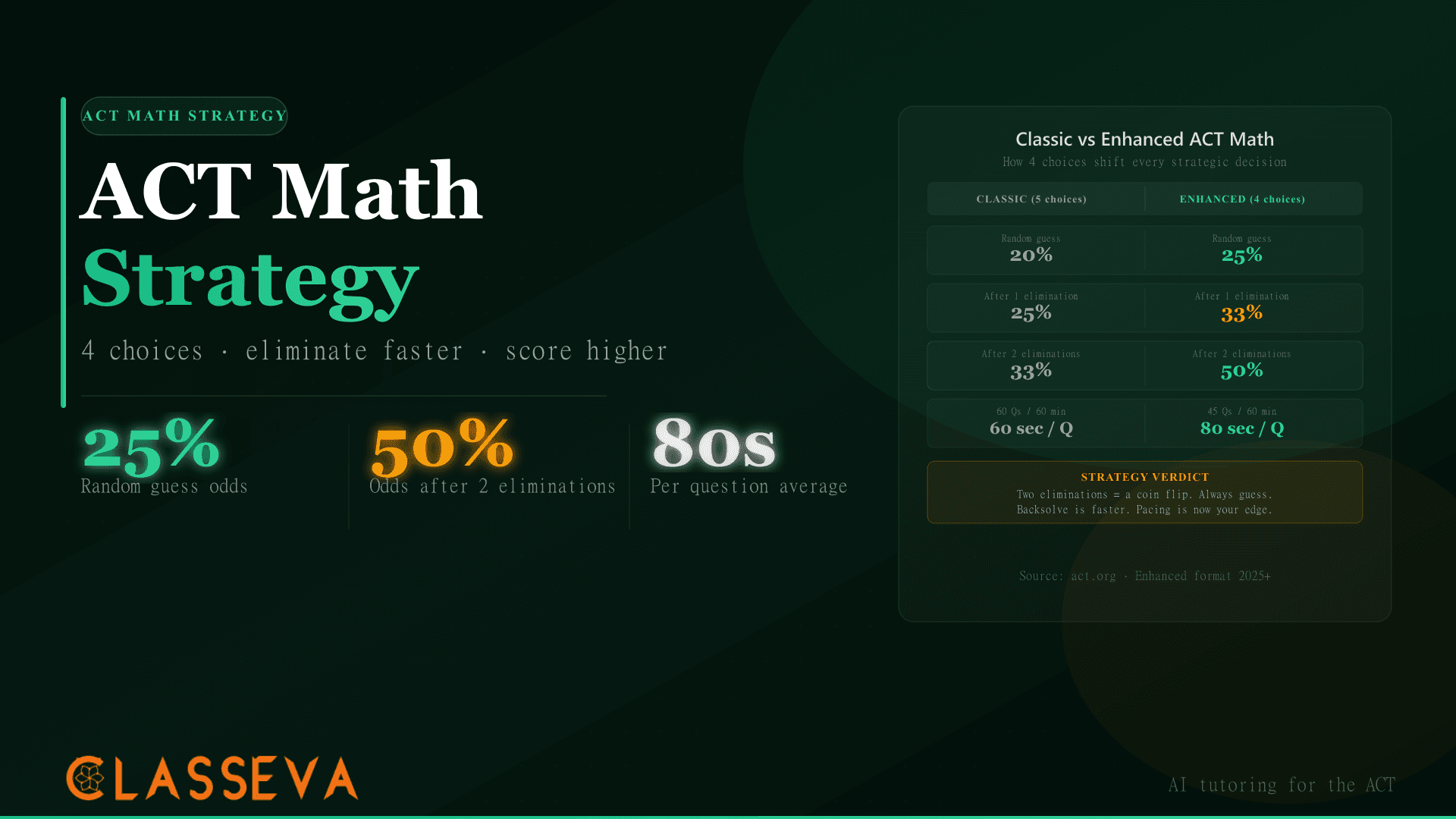
| Scenario | Classic ACT (5 choices) | Enhanced ACT (4 choices) |
|---|---|---|
| Random guess (no info) | 20% | 25% |
| After eliminating 1 wrong answer | 25% | 33% |
| After eliminating 2 wrong answers | 33% | 50% |
| After eliminating 3 wrong answers | 50% | 100% |
| Seconds per question | 60 sec | 80 sec |
Guessing odds and pacing comparison: classic ACT Math vs Enhanced ACT Math. Source: act.org Enhanced ACT format documentation.
What Stayed the Same
The content domains did not change with the Enhanced format. ACT Math still tests pre-algebra, elementary algebra, intermediate algebra, coordinate geometry, plane geometry, and trigonometry. The 1-36 score scale stays identical. No wrong-answer penalty remains in effect. Calculators are still permitted throughout the section. Students who prepared for the classic format have a meaningful content head start; the strategic adjustments are what require dedicated practice.
Why Do 4 Answer Choices Change Your Strategy?
The jump from 5 choices to 4 choices changes the math at every decision point. A 5-point improvement in raw guessing odds (20% to 25%) understates the real benefit, because the value of elimination also increases. Each wrong answer you cross off is worth more when there are fewer wrong answers to start with.
The Math Behind Better Guessing Odds
On the classic ACT, a completely random guess gave you a 1-in-5 chance of scoring. On Enhanced ACT Math, a random guess gives you a 1-in-4 chance. Over 45 questions where you had to guess completely blind, that difference projects to roughly one additional correct answer, which can shift your scaled score by one point. That is meaningful at the margins of any target score band.
Why Elimination Is Now More Powerful
Eliminating one wrong answer on a 5-choice question raised your odds from 20% to 25%, a gain of 5 percentage points. On a 4-choice question, eliminating one wrong answer raises your odds from 25% to 33%, a gain of 8 percentage points. The absolute gain per elimination is larger, and you need fewer eliminations to reach a coin flip.
Two eliminations on a 4-choice question leave a 50% chance. That required three eliminations on the classic format. For any question where you can narrow the field to two choices, you have effectively turned it into a fair coin flip. That threshold is now reachable in less time.
How Should You Use Process of Elimination?
Process of elimination on Enhanced ACT Math works best as a two-pass system. The first pass identifies questions you can solve directly. The second pass handles everything else through elimination, backsolving, or educated guessing. Trying to apply the same time budget to every question regardless of difficulty is the single biggest pacing mistake on the section.
The Two-Pass Elimination Workflow
Read the question, not the choices first
Identify the question type before looking at A, B, C, D. If you read choices first, wrong answers plant incorrect approaches in your working memory and slow you down.
Attempt a direct solve within 45 seconds
Set up the equation, apply the formula, or draw the diagram. If you reach a clean answer within 45 seconds, confirm it matches a choice and move on. If you are stuck, switch to elimination immediately rather than spending more time on setup.
Cross off clearly wrong choices
Eliminate choices with the wrong sign, wrong units, outside the plausible range, or that fail an obvious sanity check. On a geometry question asking for a positive length, eliminate any negative answer. On a percent question, eliminate any answer over 100%. You need only two eliminations to reach a 50% shot.
Select your best guess and flag for review
Choose the most plausible remaining answer and mark the question for review if time permits. Never leave a blank. With no wrong-answer penalty, any guess is better than no answer.
When Elimination Beats Solving Outright
Elimination is often faster than full algebraic solving on questions that test number sense, estimation, or units. If a question asks for the approximate value of a complex expression, estimate the magnitude first and eliminate choices that land outside that range. If a question asks for a linear equation that passes through two given points, plug each choice into both points; often two of the four choices fail immediately on the first point without any algebra.
When Should You Backsolve Instead of Solving?
Backsolving means plugging answer choices back into the question to test which one works. It bypasses algebra entirely on questions where the answer is a specific number, and it becomes faster on Enhanced ACT Math because you test four choices instead of five.
How Backsolving Works with 4 Choices
Start with the numerically middle choice (usually B or C when choices are ordered smallest to largest). If the middle choice produces a result that is too high, you can immediately eliminate any choice larger than it. If it produces a result that is too low, eliminate any choice smaller. That single test narrows four choices to two, turning the question into a coin flip with one more substitution at most.
On the classic ACT with five choices, the same approach started in the middle (usually C) and still left up to four tests in the worst case. On Enhanced ACT Math, the worst case is three substitutions, and the average case is two. That sounds like a small difference. Across a 45-question section with pacing pressure, it adds up to meaningful time savings.
Backsolving works best when the question says “which value satisfies the equation,” “which is a solution to the inequality,” or “what is the value of x that makes this true” and all four choices are distinct numbers. It works poorly on abstract setup questions where the choices are expressions (like 2x + 3) rather than numbers, because substituting an expression requires more algebra than solving directly.
Which Question Types Reward Backsolving
Backsolving pays off on elementary algebra questions (solve for x), intermediate algebra questions (quadratic roots, system solutions), and some word problems where the unknown is a specific count or measurement. It rarely helps on coordinate geometry questions that require geometric reasoning, on trigonometry questions that need function evaluation, or on pre-algebra questions involving ratios and proportions where setting up the equation is faster than testing choices.
How Should You Pace Yourself Across 45 Questions?
The Enhanced ACT Math section gives you 80 seconds per question on average (60 minutes divided by 45 questions). That average conceals a structure the best scores exploit: questions appear in rough order of difficulty, with the first third of the section substantially easier than the last third. Allocating time evenly across all 45 questions wastes your margin on easy questions and leaves too little for hard ones.
The 80-Second Rule
The 80-second average is your budget, not your target for every question. Budget 40-60 seconds on the first 15 questions, where pre-algebra and elementary algebra dominate. Budget 80-90 seconds on questions 16-30, the mid-range of intermediate algebra and coordinate geometry. Reserve up to 120 seconds for questions 31-45, where complex geometry and trigonometry appear, and where most students slow down significantly.
The practical implication: if you finish the first 15 questions in 12-14 minutes instead of the 20 minutes a flat 80-second budget would suggest, you bank 6-8 minutes of extra time for the harder back third of the section. That reserve is the single biggest mechanical difference between students who score in the 28-30 range and those who break 32.
Strategic Pacing Zones
| Questions | Recommended Budget | Content Focus | Primary Strategy |
|---|---|---|---|
| Q1-15 | 40-60 sec each (~13 min total) | Pre-algebra, basic algebra | Solve directly, confirm answer |
| Q16-30 | 80-90 sec each (~22 min total) | Intermediate algebra, coordinate geometry | Solve or eliminate 2+ choices |
| Q31-45 | Up to 120 sec each (~22 min total) | Plane geometry, trig, complex algebra | Backsolve or eliminate, always guess |
| Final 3 min | Review and fill blanks | Any unanswered questions | Guess on every blank, never leave empty |
Pacing targets for Enhanced ACT Math (45 questions / 60 minutes). Questions appear in approximate order of difficulty.
What Topics Show Up Most on Enhanced ACT Math?
ACT's published content specifications divide the Math section into six domains. Pre-algebra and plane geometry together account for roughly 46% of questions, making them the two highest-yield areas by volume. Trigonometry contributes only about 7% but tends to have the steepest per-question difficulty.
The practical implication: if you have two weeks before the Enhanced ACT and need to prioritize, review pre-algebra and plane geometry first. Formulas for area, perimeter, volume, angles in polygons, and the Pythagorean theorem cover roughly 23 questions between them. Trigonometry prep is low-yield per hour spent; trig questions are rare and hard enough that guessing with elimination is often the right call unless your score target is above 32. See the complete Enhanced ACT format breakdownfor a detailed look at each section's structure and timing.
Setting Your ACT Math Score Goal
Before drilling any strategy, you need a specific Math score target, not a vague “do better” goal. Your target should flow from the colleges on your list: the 75th-percentile ACT Math score at your target school is a concrete, achievable benchmark. Students who aim at a specific number can track their practice-test performance against it and identify exactly which question types stand between them and the goal.
The calculator below lets you set your score goal and see how far your current practice score sits from the target, so your prep time goes toward the right content.
Test Score Goal Setter
Enter your current ACT Math practice score and your target school's 75th-percentile score to see exactly how many points you need to gain and which improvement strategies to prioritize.
If your target school primarily tracks the SAT, the SAT-ACT Converter translates your ACT Math score into an equivalent SAT Math section score so you can compare options on a single scale. Students often find they have a natural advantage on one format over the other, and the converter surfaces that difference quickly.
What Calculator Can You Use?
The Enhanced ACT permits most scientific and graphing calculators throughout the Math section. The ACT calculator policy page at act.org lists specific approved and prohibited models. The most common approved calculator is the TI-84 Plus series. Prohibited calculators include any model with built-in computer algebra system (CAS) functionality (such as the TI-89 or TI-Nspire CAS), any model with a QWERTY keyboard, and any device with wireless or Bluetooth capability.
A graphing calculator helps most on coordinate geometry questions involving lines, parabolas, and circles. For pre-algebra and elementary algebra, mental math or a basic scientific calculator is often faster because graphing-calculator setup takes time the question does not demand. Practice with your actual test calculator, not a different one. Switching calculators between practice and test day adds unnecessary friction under time pressure.
What Should You Do at the End of the Section?
With three minutes remaining, stop solving new questions and shift entirely to fill-in-blank mode. Any question without an answer should get a guess, even a random one. The ACT has no wrong-answer penalty: an unanswered question scores zero, a guessed question has a 25% chance of scoring one point. Over ten blank questions, that expected value of 2.5 additional correct answers can shift your scaled score by one full point.
Students who practice timed sections regularly report that the final-three-minutes habit is easy to neglect in low-stakes practice but worth drilling explicitly. Set a phone alarm for the three-minute mark when you practice. The habit should be automatic by test day.
For a full overview of how ACT scores are calculated, scale conversion, and what your Math score means for your composite, see the ACT resources hub. The Digital SAT uses a different scoring system; if you are weighing both exams, the Digital SAT adaptive structure guideexplains how that test's two-module format compares to the ACT's linear approach.
Key Takeaways
- Enhanced ACT Math runs 45 questions in 60 minutes with 4 answer choices, giving you 80 seconds per question on average.
- Random guessing odds rose from 20% to 25%; eliminating two wrong answers gives a 50% probability, up from 33% on the classic format.
- Use process of elimination as your primary fallback: cross off two clearly wrong choices before guessing on any question you cannot solve directly.
- Backsolve on questions where all four choices are specific numbers; start at the numerically middle choice to cut your search to two tests in most cases.
- Bank time on easy questions (Q1-15) to fund harder questions (Q31-45); the section is roughly ordered by difficulty.
- Pre-algebra and plane geometry together account for roughly 46% of questions. Trigonometry is only 7%, hard but rare.
- Always fill every blank before time runs out. No wrong-answer penalty means guessing is always the correct decision on any unanswered question.