Digital SAT Information and Ideas Questions Decoded
When I map the Digital SAT Reading and Writing section by domain, Information and Ideas stands out as the part students misjudge most. It looks like plain reading comprehension, so they read carefully, trust their gut, and miss questions they felt sure about. The reason is hidden in plain sight: this domain rewards a precise relationship between a claim and its support, and one question type, Command of Evidence, punishes the answer that is true but off-target.
College Board groups Information and Ideas as one of four content domains in its official Reading and Writing specification. This post breaks down each of the four question types with a worked example, then hands you the decision framework that separates support from truth on Command of Evidence.
What Does the Information and Ideas Domain Test?
Information and Ideas measures whether you can locate, interpret, evaluate, and integrate information from a passage or an informational graphic. College Board defines it as comprehension, analysis, and reasoning applied to texts and to tables, bar graphs, and line graphs. In practice, it tests one skill in four costumes: can you connect a specific claim to the exact evidence that supports it?
How Much of the R&W Section Is Information and Ideas?
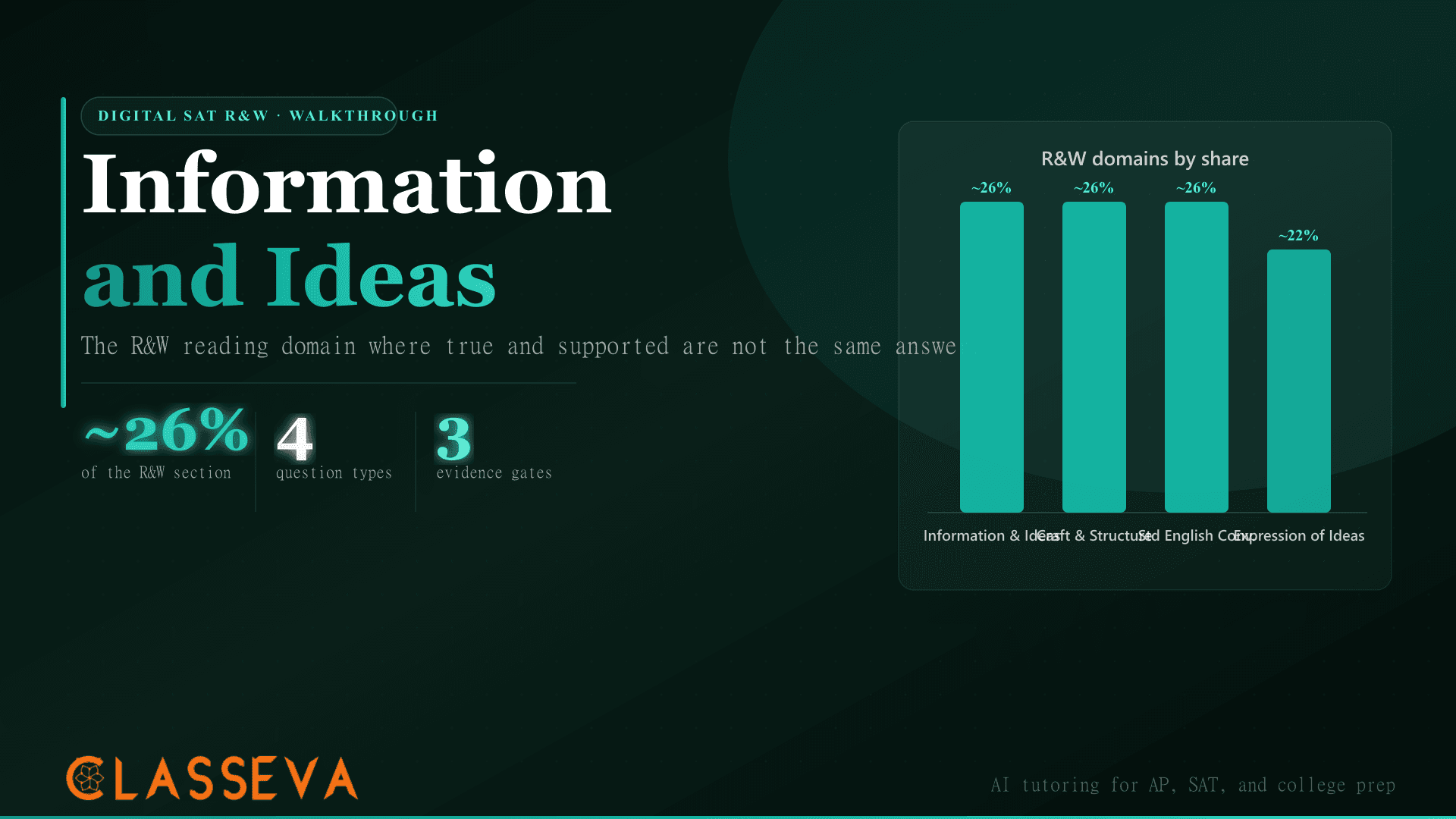
Information and Ideas accounts for roughly 26% of the Reading and Writing section, which works out to about 12 to 14 questions across both modules. [VERIFY: exact operational distribution in the College Board Assessment Framework for the Digital SAT Suite] The full R&W section runs 54 questions in 64 minutes, split into two 32-minute modules of 27 questions each. That makes Information and Ideas the largest reading-focused domain, tied with Craft and Structure and Standard English Conventions near a quarter of the section apiece.
| Content Domain | Approx. Share of R&W | Question Types |
|---|---|---|
| Information and Ideas | ~26% | Central Ideas, CoE Textual, CoE Quantitative, Inferences |
| Craft and Structure | ~26% | Words in Context, Text Structure, Cross-Text |
| Standard English Conventions | ~26% | Boundaries, Form/Structure/Sense |
| Expression of Ideas | ~22% | Rhetorical Synthesis, Transitions |
Approximate R&W domain distribution. [VERIFY: exact operational counts vary by test form; see College Board Assessment Framework]
For how those domains fit into the section as a whole, the Digital SAT Reading and Writing strategy guide walks all 10 question types. This post zooms into the four that live inside Information and Ideas.
The 4 Question Types in This Domain
The domain holds four question types, and College Board groups questions of the same type together within each module, ordered easiest to hardest. Knowing which type you are looking at changes the approach you reach for. A Central Ideas question wants synthesis; a Command of Evidence question wants a proof link; an Inferences question wants a logical conclusion.
How Do You Answer Central Ideas and Details Questions?
Read the passage once for its single main point, predict that point in your own words, then match it to the choice that restates it differently. Central Ideas and Details questions hand you a 50 to 150 word passage that makes one clear argument or observation. The correct answer captures the whole point, not a fragment of it and not more than the passage claims.
Take a short passage that argues a desert plant survives drought by storing water in thick stems, then notes its shallow roots spread wide to catch brief rain. A Central Ideas question asks for the main idea. The answer is not “the plant has shallow roots,” which is one detail. It is the synthesis: the plant survives drought through paired adaptations for storing and capturing water. The detail is true, but it is not the central idea.
The Three Wrong-Answer Shapes
Wrong answers on Central Ideas questions almost always fit one of three shapes, and naming the shape speeds elimination. The first is too narrow: a true detail mistaken for the whole point. The second is too broad: a claim that stretches past what the passage supports. The third is accurate but irrelevant: a true statement that does not answer what the question asks. Cut all three and the synthesis answer remains.
Before looking at a single answer choice, say the passage's main point out loud in your own words. This prediction step protects you from the too-narrow trap. When you read the choices already holding a target, a detail-level option looks obviously incomplete instead of tempting. Students who skip prediction and shop the four choices for the best-sounding one fall for narrow distractors far more often.
Why Is Command of Evidence the Hardest Pattern?
Command of Evidence is the hardest Information and Ideas pattern because the trap is built from true statements. You must pick the choice that best supports a specific claim, not the choice that is merely accurate. Several answer choices will be real quotes or real data points, all factually correct, yet only one provides direct support for the exact claim named in the question stem.
This is where careful readers lose the most points. They confirm a choice is true, feel satisfied, and select it. The question never asked whether the choice was true. It asked which choice supports the claim. That gap between truth and support is the single most useful idea on this entire domain, and it splits into two formats: Textual and Quantitative.
Command of Evidence: Textual
Command of Evidence: Textual questions give you a passage and a claim, then ask which quotation most directly supports or undermines that claim. One format hands you a finished claim and four quote options. Another presents a researcher's hypothesis and asks which finding would most strongly support or weaken it. In every version, support is the test, not accuracy.
Read the claim in the question stem before you read the answer choices, so you hold a fixed target. Then judge each quote on one question: could a careful reader use this exact quote as proof of this exact claim, with no extra reasoning bridging the gap? A quote that describes a related but different point is a distractor, even when every word of it is true. The correct quote closes the logical distance to the claim by itself.
The Best-Support Decision Framework
The framework below is the differentiator for this domain. Run each candidate answer through three gates in order, and stop at the first gate it fails. Most students only apply Gate 1, which is why they pick true-but-unsupportive answers. The choice that clears all three gates is the best support.
True but NOT best support
- •Accurately restates something the passage says
- •Addresses a nearby point, not the claim in the stem
- •Needs an extra logical step to connect to the claim
- •Feels safe because you can verify it is factually correct
- •Clears Gate 1, fails Gate 2 or Gate 3
Best support (correct)
- •Directly addresses the exact claim named in the stem
- •Functions as proof on its own, no bridge required
- •Often uses the word "directly" or "most strongly" in the stem
- •May feel less obvious than a familiar true statement
- •Clears all three gates
The most common Command of Evidence error is selecting a choice because you confirmed it is true. Verifying truth is Gate 1, and every plausible distractor passes Gate 1 by design. The question asks which choice supports the claim, so a true statement about a different point is wrong even though you can prove it accurate. Always finish Gate 2 and Gate 3 before you commit.
Command of Evidence: Quantitative
Command of Evidence: Quantitative questions pair a short text with a graphic, usually a table, bar graph, or line graph. The question asks which statement uses the graphic's data to support a point in the text. The same support-over-truth logic applies, with a data-reading twist layered on top.
Read the text first and pin down the precise claim before you glance at the graphic. Then find the single data point or comparison that completes that claim. The wrong choices follow a predictable script: one misreads an axis or unit, one cites a real number that supports a different claim, and one adds interpretation the data never shows. The correct choice uses only what is visible in the graphic, nothing more.
That worked example shows the trap directly. A distractor that says “Site A measured 31 units” is factually correct and pulled straight from the graphic, yet it does nothing for a claim about which site reads highest. The number is real; the support is absent. Practice official graphic questions in the College Board Student Question Bank to build the habit of reading the claim before the data.
How Do You Answer Inferences Questions?
Pick the conclusion the passage logically entails, never one it merely allows. Inferences questions end with a blank or a “which choice most logically completes the text” prompt, and the correct answer follows from the passage with no outside assumption. These are tight, evidence-bound inferences, not open-ended interpretation.
Consider a passage stating that a fungus only fruits after three consecutive days below 50 degrees, and that this year those conditions never occurred. The logical completion is that the fungus did not fruit this year. A choice predicting the fungus will go extinct overreaches; the passage gives no evidence about survival. The entailed conclusion stays inside the text's own logic.
Inference Is Not Evidence
Students blur Inferences with Command of Evidence because both reward staying close to the text, but the tasks differ. Command of Evidence asks you to locate support that already exists in the passage. Inferences asks you to derive a new conclusion the passage forces. One finds; the other follows. Keeping the two distinct stops you from hunting for a quote when the question wants a deduction.
The decisive test on Inferences is entailment, not consistency. A wrong choice is often perfectly consistent with the passage: nothing in the text contradicts it. That is not enough. The correct choice is one the passage actively requires, the conclusion you cannot avoid once you accept the stated facts. If a choice could be false while the passage stays true, it is not the answer.
How Should You Pace the Information and Ideas Questions?
Budget about 60 seconds for Central Ideas and Inferences, and closer to 90 seconds for the two Command of Evidence types. With 27 questions in each 32-minute module, your average lands near 71 seconds per question, so the faster Information and Ideas types bank time for the slower ones. Spend that banked time where the graphic and the claim both demand a read.
Command of Evidence: Quantitative is the time sink in this domain because it asks you to read prose, read a graphic, and connect them. If a single question stalls you past 90 seconds, use the Bluebook annotation tool to flag it, lock in your best gate-tested guess, and move on. A blank scores zero. A reasoned guess on a hard graphic question beats burning two minutes and rushing three later questions.
| Question Type | Typical Time | First Move |
|---|---|---|
| Central Ideas and Details | 45-60 sec | Predict the main point before reading choices |
| Command of Evidence: Textual | 75-90 sec | Read the claim in the stem first |
| Command of Evidence: Quantitative | 90-120 sec | Read the text claim, then the graphic |
| Inferences | 60-75 sec | Find the conclusion the text entails |
Approximate pacing targets for Information and Ideas question types. Adjust to your own accuracy data from practice tests.
For more on how Module 1 performance routes you to a harder or easier Module 2, see the Digital SAT adaptive structure breakdown. The grammar domain that pairs with this one for fast points is covered in the Standard English Conventions guide, and the on-screen tools you will use to annotate passages are detailed in the Bluebook app features walkthrough.
Plan Your Score Target
Once you know your practice R&W score, it helps to see how that number compares across testing formats before you commit a prep plan. The SAT-ACT Converter below maps an SAT total to its ACT composite equivalent, useful if you are deciding which test rewards your reading strengths more. Many students find their Information and Ideas accuracy is the lever that moves their R&W score the most, because the domain is large and its approaches are teachable.
SAT-ACT Converter
Convert your SAT total score to an ACT composite equivalent, or compare target scores across both tests to decide which format gives you the stronger competitive score.
If you are weighing the math side of the section too, the Problem-Solving and Data Analysis walkthrough covers the math domain that, like Quantitative evidence, leans on reading graphs and tables accurately. Students starting their broader prep timeline can also map out registration windows in the guide to when to take the SAT in junior year.
Key Takeaways
- Information and Ideas is the largest reading domain, near 26% of R&W, roughly 12 to 14 questions across both modules. [VERIFY: exact operational count] It covers Central Ideas, Command of Evidence (textual and quantitative), and Inferences.
- Command of Evidence rewards support, not truth. Several choices are factually correct; only one directly supports the exact claim in the stem. The true-answer trap is the top error in this domain.
- Run every evidence choice through three gates: is it true, does it address this exact claim, and does it prove the claim with no extra reasoning. Most students stop at Gate 1 and lose the point.
- On Quantitative evidence, read the text claim before the graphic. The correct choice uses only data visible in the graph or table. Real numbers attached to the wrong claim are distractors.
- Inferences reward entailment, not consistency. The answer is the conclusion the passage forces, not one it merely permits. Eliminate choices that are too strong, too narrow, or unsupported.
- Central Ideas wants synthesis. Predict the main point in your own words first, then cut choices that are too narrow, too broad, or true but off-topic.
- Pace by type: spend less time on Central Ideas and Inferences, bank it for Command of Evidence, and flag any question that stalls you past 90 seconds rather than sacrificing later questions.
Frequently Asked Questions
How many Information and Ideas questions are on the Digital SAT?
Information and Ideas makes up roughly 26% of the Digital SAT Reading and Writing section, which translates to about 12 to 14 questions across the two modules. [VERIFY: exact operational count in the College Board Assessment Framework for the Digital SAT Suite] The domain covers Central Ideas and Details, Command of Evidence (textual and quantitative), and Inferences.
What is the difference between Central Ideas and Inferences questions?
Central Ideas and Details questions ask what the passage already states as its main point, so the answer restates information present in the text. Inferences questions ask for a conclusion the passage supports but does not state directly. The inference must be logically entailed by the text, never just consistent with it.
Why do I keep picking the wrong Command of Evidence answer?
Most students pick the choice that is true rather than the choice that best supports the specific claim. On sat command of evidence questions, several answer choices are accurate statements drawn from the passage or graphic, but only one directly proves the claim named in the question stem. Read the claim first, then judge each choice on direct support, not on accuracy alone.
Are graphs and tables tested in Information and Ideas?
Yes. Command of Evidence: Quantitative pairs a short text passage with a table, bar graph, or line graph. You select the answer that uses data from the graphic to support a claim made in the text. The correct choice uses only numbers visible in the graphic and adds no outside knowledge or interpretation beyond what the data shows.
How long are the passages for Information and Ideas questions?
Every passage on the Digital SAT Reading and Writing section runs 25 to 150 words, including the passages used for digital sat information and ideas questions. Each passage carries exactly one question. There are no long multi-question reading passages of the kind that appeared on the old paper SAT.
Do I need outside knowledge to answer these questions?
No. Every Information and Ideas answer is justified by the passage or the graphic alone. You never need prior knowledge of the topic, and bringing in outside facts is a common way to get tricked. If a choice depends on something the passage does not provide, eliminate it even when the statement sounds correct.
What is the fastest way to improve on sat inferences questions?
Drill the elimination pattern until it is automatic. Wrong inference answers are almost always too strong, too narrow, or unsupported. Practice naming which failure shape each wrong choice fits, then confirm the surviving choice is fully entailed by the passage. Naming the failure trains you to spot it faster under time pressure.
Where can I practice official Information and Ideas questions?
College Board publishes free practice in the Student Question Bank and full adaptive practice tests in the Bluebook app. Both let you filter or review by content domain, so you can isolate Information and Ideas and study Command of Evidence and Inferences separately until each approach feels mechanical.
Content domain definitions and R&W structure from College Board: The Reading and Writing Section. Operational question distribution from the Assessment Framework for the Digital SAT Suite. Practice questions available in the Student Question Bank.