How to Improve Your Digital SAT Score by 200 Points
A 200-point improvement on the Digital SAT requires 12-16 weeks of consistent, structured prep. That number comes from what the spacing research actually shows, not from what prep services want you to believe. Most competitors promise 200 points in four weeks because it sells. What they do not tell you is where those points come from or which students actually see them.
Reading the College Board's own score data closely, what stands out is how much the starting score matters. The path from 1100 to 1300 looks different from the path from 1500 to 1700, even though both cover the same distance. This post is honest about both.
Is a 200-Point SAT Score Gain Realistic?
Yes, a 200-point SAT improvement is realistic for most students starting below 1400, with 12-16 weeks of deliberate, structured prep. Students who work with official College Board practice materials, maintain an error log, and apply spacing across their review schedule routinely achieve this range. The gain is not automatic, and it requires more than just “studying more.”
Who Sees the Biggest Gains
Starting score predicts gain potential more reliably than any other factor. Students scoring 1050-1350 have significant room in both sections to convert careless errors and knowledge gaps into correct answers. Students scoring 1400-1500 have less slack because the curve is already steeper at the top.
Students above 1500 rarely see 200-point gains. The Digital SAT scores 400-1600, and at 1500, a student already sits at approximately the 96th percentile. Getting to 1700 would require a score that does not exist on the current scale. The score improvement discussion for 1500+ students looks different, and the section on ceiling effects below covers it directly.
Where the 200 Points Come From
Score gains on the Digital SAT cluster around three identifiable sources: Desmos mastery, careless error elimination, and targeted weak-area drilling. Each source produces 50-100 points for the right student. The specific contribution from each varies by starting score and current weaknesses, but the framework applies across skill levels.
Mastering Desmos for SAT Math
Every Math question on the Digital SAT gives you access to the built-in Desmos graphing calculator inside Bluebook. This is not a minor convenience. Students who learn to use Desmos strategically convert what would otherwise be algebra-heavy problems into quick graphical checks. The complete Desmos strategy guide covers all eight high-yield techniques, but the core principle is this: graph the equation, find the intersection or vertex visually, confirm your answer in seconds.
Students who have never practiced Desmos before their SAT typically spend 8-12 minutes of Math section time navigating the tool they did not prepare for. That is roughly a quarter of each module's time budget lost to an avoidable inefficiency. Converting those minutes to productive problem-solving is worth 50-100 points for most students.
Open Bluebook, go to any practice Math module, and spend the first two study sessions doing only Desmos exercises. Learn to graph linear equations, identify intersections, and check quadratic roots before you drill any question types. This foundation pays dividends on every subsequent Math question you practice.
Eliminating Careless Errors Through Practice Test Review
Careless errors drive more missed points than knowledge gaps for most students scoring between 1100 and 1400. The problem is not that students do not know the material. It is that they misread the question, applied the wrong formula under time pressure, or skipped the re-read step before selecting an answer.
The fix is systematic. After every practice test, categorize each wrong answer into one of three buckets: careless error (you had the concept but made a mechanical mistake), knowledge gap (you did not know the content), or timing error (you ran out of time before finishing). This categorization is what the testing effect researchcalls “retrieval with feedback”: actively recalling why you missed something produces stronger correction than passively reviewing the answer key.
| Error Category | What It Looks Like | The Fix |
|---|---|---|
| Careless | Misread "least" as "most," wrong sign, arithmetic slip | Re-read every question before selecting; write out arithmetic steps |
| Knowledge Gap | Did not recognize the concept or formula required | Add to the drilling list; practice that specific skill type this week |
| Timing | Left blank or guessed with no attempt | Pacing adjustment: skip and flag, return at end of module |
| Concept Misapplication | Knew concept but applied wrong version (e.g., perimeter vs. area) | Note the exact confusion; drill similar problems within 48 hours |
Keep this log for every practice test. Patterns across three tests reveal your highest-leverage target areas.
Targeted Weak-Area Drilling
Most students study all SAT topics with roughly equal time, regardless of where their errors cluster. This wastes prep hours. The Digital SAT tests 22 named skill categories across Reading and Writing and Math. If your error log shows 60% of wrong answers in three categories, those three categories deserve 60% of your study time.
Use only official College Board released questions for drilling. Third-party practice problems vary widely in difficulty calibration and sometimes test question structures the real Digital SAT does not use. College Board's Digital SAT site and the Bluebook app both provide released practice content. The deliberate practice framework applies directly here: work at the edge of your current ability, get immediate feedback on each attempt, and adjust before the next problem.
How Long Does a 200-Point SAT Improvement Take?
Most students who achieve a 200-point SAT improvement spend 12-16 weeks of consistent structured prep. Compress this into 4-6 weeks and the gains rarely hold. The reason is the spacing effect: distributed practice across time produces stronger long-term retention than massed practice, even when total study hours are equal.
The 12-Week Minimum: What Spacing Research Shows
Cepeda et al. (2006) found in a large-scale review of spacing research that distributing practice sessions across time significantly outperforms massed practice for retention of complex material. For SAT prep, this means reviewing a skill category once in week 2, again in week 5, and again in week 8 produces better retention than drilling it for three consecutive days in week 2 and never returning to it.
Twelve weeks gives you enough spacing cycles to solidify skill improvements. At 3-5 hours per week, that is 36-60 hours of prep. The spacing vs. cramming breakdown covers this research in detail, but the practical implication is straightforward: build a schedule, stick to it, and resist the urge to cram before each practice test.
Practice Test Cadence During Active Prep
Take one full practice test every 2-3 weeks during active prep. At 12 weeks, that produces four to six tests. Space them farther apart early in prep (weeks 1 and 4) and closer together near the end (weeks 8, 10, 12) as you simulate test-day conditions more frequently.
Each practice test must be followed by a 2-3 hour review session within 48 hours. Not reviewing test results is the single most common prep mistake. Students who take six practice tests with no systematic review see almost no score improvement. Students who take four tests with thorough review sessions after each one routinely outperform them.
Taking tests weekly does not accelerate improvement. It accelerates burnout and compresses the spacing that drives retention. The testing effect research, documented by Roediger and Karpicke (2006), shows that retrieval practice with feedback outperforms re-studying, but only when spaced appropriately. Weekly testing with no spacing benefit is less effective than biweekly testing with time to consolidate.
The 12-Week SAT Improvement Schedule
The schedule below assumes 3-5 hours of study per week, a baseline practice test in week 1, and an error log maintained throughout. Adjust the weekly hour count up or down based on your available time, but maintain the structure.
Weeks 1-4: Diagnostic and Foundation
Week 1: Baseline practice test
Take a full-length official practice test in Bluebook. Record your exact section scores and total. Set up your error log spreadsheet with columns for: question number, section, skill category, error type (careless/knowledge/timing), and corrective action.
Weeks 1-2: Desmos foundation
Before drilling any question types, spend your first two weeks practicing Desmos exclusively inside Bluebook. Graph linear equations, identify vertex and intersections on parabolas, use the calculator to check quadratic roots. This investment pays back on every Math question from week 3 onward.
Weeks 3-4: Identify and begin weak-area drilling
Use your error log to identify your three weakest skill categories. Drill only those categories in weeks 3-4 using official released questions. Do not practice topics where your error rate is low; that time is wasted.
Weeks 5-8: Targeted Drilling
Week 5 opens with Practice Test 2. Review it within 48 hours, update your error log, and compare your error categories to the baseline. Your Desmos efficiency should show improvement in Math; your careless error count should be dropping.
Weeks 6-8 shift to interleaved practice: mix two or three skill categories within each study session rather than dedicating one session entirely to systems of equations and the next entirely to rhetorical synthesis. Rohrer and Taylor (2007) found that interleaved practice produced 43% retention compared to 20% for blocked practice on a delayed test. Applied to SAT prep, mixing question types within sessions builds the discrimination skills the exam requires.
Weeks 9-12: Simulation and Consolidation
Practice Test 3 opens week 9. By this point, your error log should show a clear pattern of improvement in the skill categories you targeted. Persistent errors in the same categories signal a deeper knowledge gap that needs direct instruction, not more practice.
Weeks 10-12 shift to full test-day simulation: same time of day as your actual SAT, same device (Bluebook app), no interruptions, 10-minute break in the correct position. Practice Test 4 in week 11 or 12 should be your most realistic simulation. The Digital SAT test day walkthrough covers every logistics detail worth knowing before you sit.
What If You Are Starting at 1500 or Above?
Students starting at 1500 or above should not expect a 200-point gain. The ceiling effect shows up clearly in College Board's own score distribution data. A student at 1500 sits at approximately the 96th percentile. Reaching 1700 would require a score above the 1600 maximum. A realistic target for this range is 50-100 points, with strong math performance and near-elimination of careless errors.
The Ceiling Effect Explained
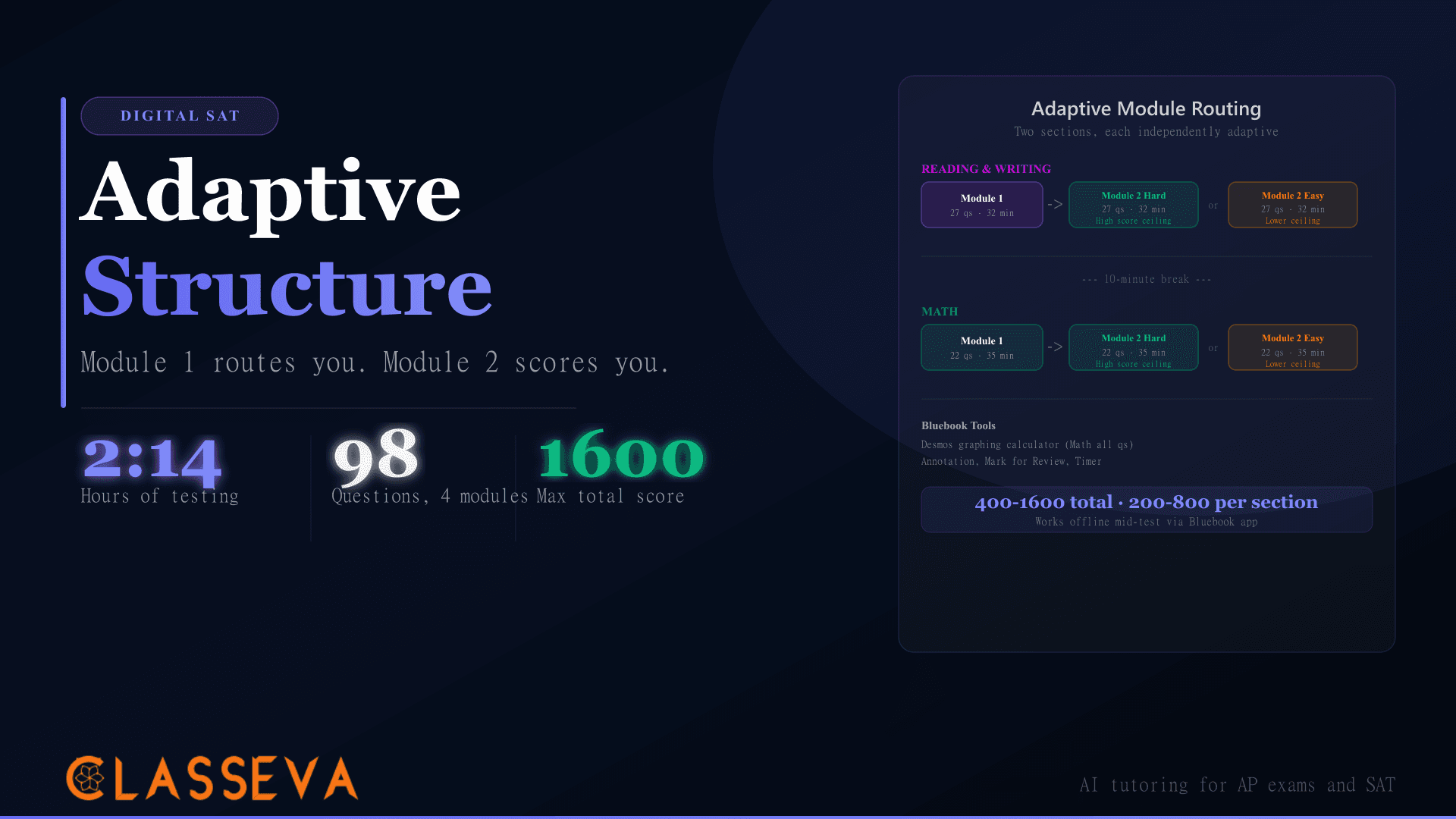
The Digital SAT uses an adaptive structure where Module 1 performance gates your access to harder Module 2 questions. Students who reach the harder Module 2 path in both sections face the most difficult questions in the entire pool. Getting every one of those right requires near-perfect execution, not just understanding.
For students in the 1500-1550 range, the improvement framework shifts. Careless error elimination becomes the dominant lever because almost every wrong answer at this level traces back to a misread or execution error, not a knowledge gap. Desmos mastery remains valuable for saving time. Targeted drilling focuses on the two or three question types that still produce errors after careful review.
If your goal is a score above 1500 for a specific college's 75th percentile benchmark, the SAT-ACT converter and Optimal Test Date Selector can help you plan whether another attempt makes strategic sense given your application timeline.
Four Mistakes That Cap Your Score Gains
Most students who do not see expected gains from SAT prep can trace the problem to one of four patterns. All four are correctable once identified.
How the Research-Based Methods Apply Here
The 12-week plan above encodes four research-backed learning principles. They are not abstract theory. Each one maps directly to specific prep behaviors.
Retrieval Practice (Testing Effect)
- •Practice tests are retrieval practice, not just diagnostic tools
- •Roediger and Karpicke (2006): retrieval practice outperforms re-study even for short-term retention
- •Error log review is retrieval with feedback - the strongest learning signal
- •Post: testing-effect deep dive explains how to structure each review session
Spacing, Interleaving, Deliberate Practice
- •Spaced practice beats cramming: distribute sessions across 12+ weeks
- •Interleave skill categories within sessions, not one topic per session
- •Deliberate practice: work at the edge of ability, immediate feedback, adjust
- •Posts #038, #053, #070 cover the full methodology if you want the research detail
The testing effect post and the spacing post each cover their respective research in depth. For the SAT context, the practical synthesis is simple: practice tests plus spaced review sessions, not re-reading notes, produce the score gains students are trying to achieve.
Set Your Target Score
Before committing to a 200-point improvement goal, confirm that the target score is actually meaningful for your college list. A student targeting schools with a 75th percentile SAT of 1350 does not need to reach 1500 to be competitive. Use the Test Score Goal Setter to set a realistic target based on where you are applying, then work backward to how many points you actually need.
Test Score Goal Setter
Enter your current SAT score and your target schools to find out exactly how many points you need and whether a retake makes strategic sense for your application.
Key Takeaways
- Improve SAT score 200 points is achievable for students starting below 1400 with 12-16 weeks of structured prep. Students above 1500 should target 50-100 point gains realistically.
- Three sources drive most gains: Desmos mastery (learn before any other prep), careless error elimination through systematic review, and targeted weak-area drilling using official content.
- Practice tests every 2-3 weeks, followed by a 2-3 hour error log review within 48 hours, produce far better results than more frequent testing without review.
- Spacing research supports a 12-week minimum: cramming the same study hours into 4-6 weeks produces weaker retention and smaller sustained gains.
- Interleave skill categories within study sessions during weeks 5-8 rather than blocking one topic per session. Rohrer and Taylor (2007) found interleaved practice produced 43% retention versus 20% for blocked practice.
- The four mistakes that cap gains: no error review after tests, studying what you already know, using non-official materials, and re-reading instead of retrieval practice.
- Set a score target that matches your actual college list, not a round number. The Test Score Goal Setter can tell you whether 200 more points changes your competitive position at the schools you are actually applying to.