Deliberate Practice for AP and SAT Prep: Beyond the 10,000-Hour Myth
Ericsson never wrote that 10,000 hours produces expertise. His 1993 paper found that the best violinists in a Berlin music academy had accumulated roughly 10,000 hours of a specific type of practice by age 20. Malcolm Gladwell read that as "hours = expertise" in Outliers. Ericsson spent the next 23 years clarifying that Gladwell had missed the point entirely.
The point Gladwell missed: not all practice hours produce the same result. Ericsson's research identifies a specific category of practice he called "deliberate practice," and it requires four features that most students never apply to their AP or SAT prep. This post breaks down what those features are, where the evidence comes from, and how to apply the framework to score improvement in concrete terms.
What Is Deliberate Practice, Really?
Deliberate practice is "activity especially designed to improve the current level of performance," as Ericsson, Krampe, and Tesch-Römer defined it in their 1993 Psychological Review paper. The definition carries a specific technical meaning. It excludes work performed for enjoyment, for competition, or out of habit. Deliberate practice refers only to sessions structured explicitly around identifying and correcting current performance limitations.
This differs from what most students do. Running through practice problems in categories you already understand, re-reading chapters that feel familiar, reviewing flashcards you have already memorized: none of these qualify as deliberate practice under Ericsson's definition. They feel like studying. But they build comfort with existing skills rather than building new ones.
The Violinists Study That Started It All
The 1993 paper studied violin students at the Academy of Music in Berlin. Ericsson's team divided them into three groups: the best (on track for international solo careers), the good (headed for professional orchestra positions), and the less accomplished (expected to become music teachers). By age 20, the best students had logged an average of 10,004 hours of deliberate practice. The good students: approximately 7,800 hours. The music teachers: around 4,606 hours.
The more revealing finding was that all three groups estimated comparable total hours of music involvement when you included ensemble playing, music theory classes, and informal sessions. The best performers had not spent more total time with music. They had spent more of their total time in deliberately structured improvement sessions, with a teacher directing each practice session toward specific technical weaknesses. That distinction is where the expertise gap lived.
Why "10,000 Hours" Is Wrong
The "10,000-hour rule" tells students that expertise requires 10,000 hours of practice. It does not specify what kind of hours. That omission turns a precision instrument into a vague motivational claim.
Ericsson pushed back against Gladwell's framing directly in his 2016 book Peak, co-authored with Robert Pool. He wrote that the 10,000-hour figure was a rough average across one group of violinists, not a universal rule, not a threshold, and not a guaranteed outcome of any particular amount of time. Ericsson called the Gladwell interpretation a distortion that had undermined genuine understanding of how improvement actually works.
The Macnamara 2014 Meta-Analysis
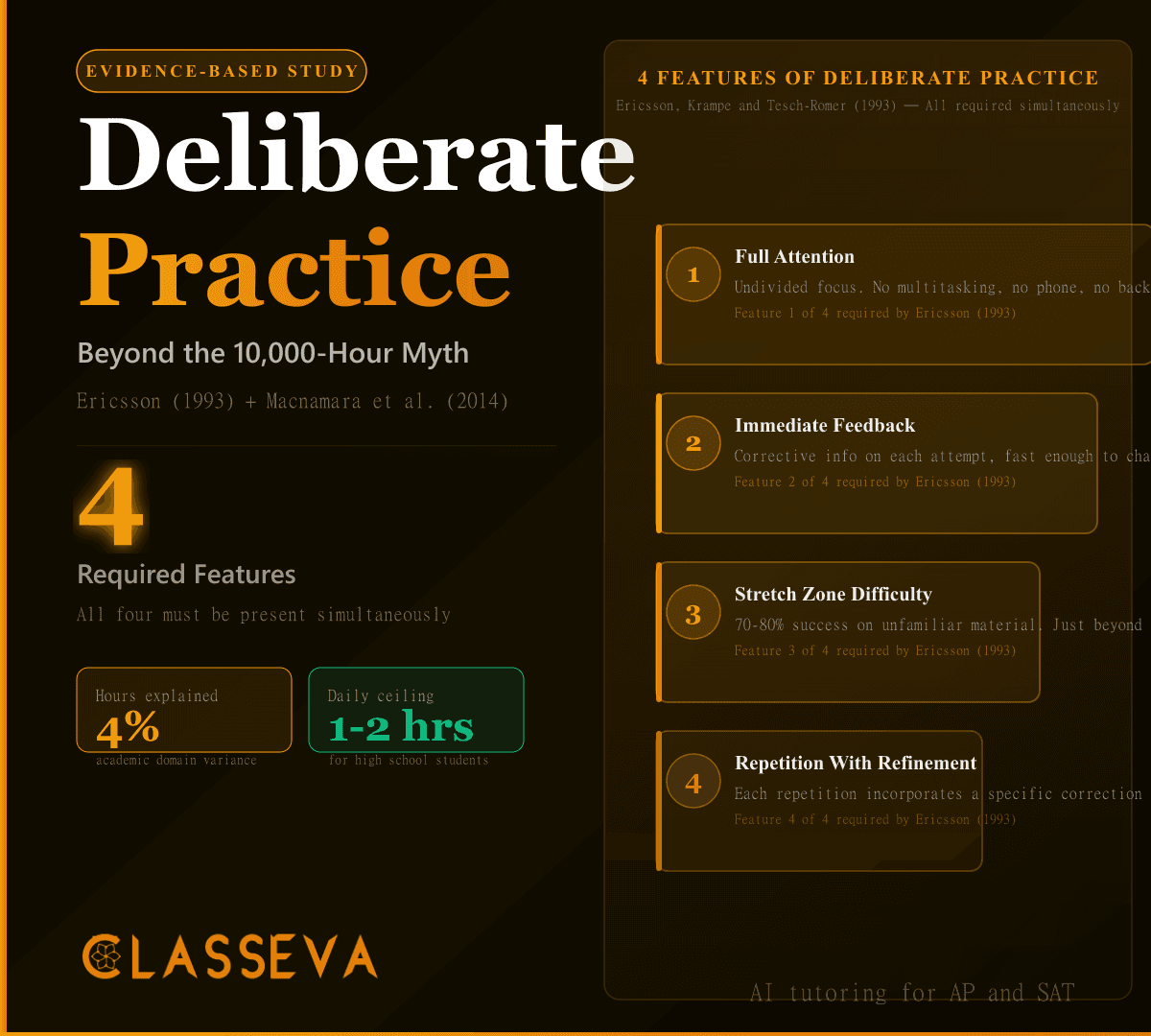
The strongest empirical challenge to the hours-equal-expertise claim came from Macnamara, Hambrick, and Oswald in their 2014 meta-analysis, which reviewed 88 studies across six performance domains. Their findings: deliberate practice explained 26% of performance variance in games, 21% in music, 18% in sports, and just 4% in education.
That 4% figure carries a direct implication for AP and SAT prep. In academic domains, hours of practice alone predict almost nothing about eventual performance. The methodology of each session, including what is being practiced, how feedback is delivered, and at what difficulty level, predicts far more. Students who understand this shift their effort from counting hours to optimizing session quality.
The 4 Features of Deliberate Practice
Deliberate practice, as Ericsson defined it, requires four specific features operating simultaneously. Remove any one of them and the session degrades toward comfortable repetition.
Full attention. Deliberate practice demands undivided cognitive focus. Background music, phone notifications, and simultaneous tasks eliminate this feature entirely. Ericsson's elite performers practiced in focused sessions of 60-90 minutes with no distractions, followed by deliberate rest periods that allowed cognitive recovery before the next session.
Immediate feedback. Each attempt must generate corrective information quickly enough to influence the next attempt. A practice test you score two weeks later provides minimal feedback value. A teacher who corrects each error in real time, or an AI tutor that flags mistakes immediately, provides the feedback loop that drives rapid improvement.
Stretch zone difficulty. The task must sit just beyond current ability. Work that is too easy builds comfort, not skill. Work that is too hard produces guessing rather than learning. Research from the Bjork lab at UCLA, which studies desirable difficulty adjacent to Ericsson's framework, places the stretch zone at roughly 70-80% success on unfamiliar material: enough errors to require corrective attention, but enough success to maintain productive learning.
Repetition with refinement. Each repetition incorporates a specific correction from the previous attempt. Practice that repeats the same error without correction teaches the error, not the correct form. The refinement step is what transforms repetition from habit into skill development.
How Deliberate Practice Differs From Regular Practice
Most AP and SAT students practice. Few do deliberate practice. The gap between the two is not effort or time; it is structure and targeting.
Regular practice runs through familiar material in comfortable conditions. Performance during the session stays high: 85-95% accuracy on problems you already understand. It feels productive because the session goes smoothly. But smooth sessions do not produce new skill. They reinforce existing skill.
Deliberate practice looks different from the inside. It targets areas where you currently fail. Error rates during a deliberate session run higher than during a comfortable review session. That is the point. If you are not making errors, you are not working in your stretch zone, and you are not doing deliberate practice.
Regular Practice
- •Reviews familiar, already-understood material
- •Operates in comfort zone (85-100% success)
- •No structured feedback mechanism
- •Repeats the same approach each session
- •Feels productive; builds comfort, not new skill
Deliberate Practice
- •Targets current weak areas and error patterns
- •Works in stretch zone (70-80% success)
- •Immediate feedback on each individual attempt
- •Incorporates a specific correction each repetition
- •Exhausting; builds skill, not just confidence
How to Apply Deliberate Practice to AP Exam Prep
The highest-leverage application of deliberate practice to AP exams is structured error analysis after every practice test, paired with targeted drilling of the specific weak areas each test reveals. This combination hits all four of Ericsson's features: attention during the drill session, immediate feedback per question, stretch zone difficulty targeting weak content, and refinement per attempt.
Most students take a practice test, check their score, and move on. That approach provides a performance signal but triggers no deliberate practice. Ericsson's framework requires treating the score as a starting point, not an endpoint.
Error Analysis After Every Practice Test
After scoring a practice test, conduct a deliberate error review before reading any answer explanations. The sequence matters. For each wrong answer, first identify what you thought the correct answer was and why. Then diagnose whether the error came from a content gap, a reasoning mistake, or time pressure. Then write one sentence stating the specific correction.
The deliberate practice component comes 48 hours later. Return to each missed question without consulting the explanation or your notes. Attempt it again from scratch under the same conditions as the original test. The 48-hour gap forces retrieval under conditions close to the error, with the specific correction loaded in memory. That retrieval attempt, not the original error or the explanation review, is where the skill builds.
Targeted Weak-Area Drilling
Once error analysis identifies a consistent weak area, schedule a deliberate practice session targeting exactly that content. The session should use questions slightly harder than those you missed. Check each answer individually before moving to the next question. Write one corrective sentence for each wrong answer. This is slower than standard review: a 30-minute deliberate session typically covers 10-15 AP questions rather than 20-30 in a casual pass. That speed gap reflects the difference in cognitive load per question.
Score and categorize the practice test
Score the test and sort each wrong answer into three buckets: content gap (you did not know the material), reasoning error (you knew it but applied it incorrectly), or time pressure (you ran out of time and guessed).
Diagnose each wrong answer before reading explanations
For each error, write one sentence identifying what you thought the answer was and what specific gap or mistake produced that response. Do this before consulting the answer key explanation.
Return to every missed question 48 hours later
Without looking at the explanation or your notes, attempt each missed question again. This return attempt is the deliberate practice session: retrieval under stretch conditions with a correction loaded in memory.
Build a targeted drill session around the identified weak area
Select 10-15 questions specifically in the weak topic, one difficulty level above the errors you made. Attempt each individually and check the answer before moving to the next.
Log corrections in a dedicated error journal
Record one corrective sentence per wrong answer. Review this log for 10 minutes before each subsequent practice test session, not after.
How to Apply Deliberate Practice to SAT and ACT Prep
SAT and ACT prep fits the deliberate practice framework differently than AP, because the test structure is modular and section-based rather than topic-sequential. The goal on the Digital SAT is not to master a curriculum; it is to improve performance on specific question types at specific difficulty levels.
The Digital SAT's adaptive structure routes you into a Module 2 difficulty band based on Module 1 performance. Students who consistently land in the lower Module 2 band face a specific problem: they are practicing at their comfort level. Raising the band requires deliberate practice specifically targeting the question types at the upper edge of current ability, not more volume at the comfortable level.
Working in Your Stretch Zone on the SAT
For most SAT test-takers, the stretch zone lands at difficulty levels where they answer roughly 70-75% of questions correctly on cold attempts. Identify 10-15 questions at that difficulty band. Attempt each without timing pressure first. Identify the reasoning pattern behind each error. Then drill that exact pattern with five more questions at the same difficulty, checking each answer before moving to the next.
Ericsson's violinists did not practice the full concert piece from beginning to end every day. They isolated the passages where they made errors and drilled those passages specifically. The same logic scales to SAT prep: isolate the question type or reasoning pattern where errors concentrate, and drill that pattern with immediate feedback per attempt.
Use the AP Score Predictor to identify which score band your current accuracy rate targets. If your current trajectory points to a 3, deliberate practice on your weakest unit can shift that to a 4 faster than general review across all units.
Tutoring ROI Calculator
Calculate whether adding an AI tutor to your deliberate practice schedule generates enough score improvement to justify the cost in AP credit and college outcomes.
The Honest Limits of Deliberate Practice
Deliberate practice is not sustainable for long sessions. Ericsson's data on elite performers across music, chess, and sports consistently showed a ceiling of 2-3 hours of deliberate practice per day. The best Berlin violinists averaged around 3.5 hours during peak training phases, but they built deliberate afternoon naps into their schedules for cognitive recovery. The nap was not optional padding. It was part of the protocol.
The 1-2 Hour Daily Volume Ceiling
For high school students managing a full course load, the realistic deliberate practice ceiling sits at 1-2 hours per day. That limit reflects cognitive resource depletion: deliberate practice draws on working memory and executive function continuously, resources that deplete faster than motivation or physical stamina. A student who runs four hours of deliberate practice after six hours of school will find the last two hours producing worse quality than comfortable review.
The practical implication: two hours of deliberate practice focused on weak areas, with immediate feedback per question, produces more score improvement than four hours of comfortable review. The session length matters far less than the quality of attention within it. A student who understands this stops measuring study effort in hours and starts measuring it in deliberate attempts.
Integrating With the Other Study Pillars
Deliberate practice does not replace the testing effect, spaced practice, or interleaving. It sits alongside them as the quality-control layer that determines how each session executes.
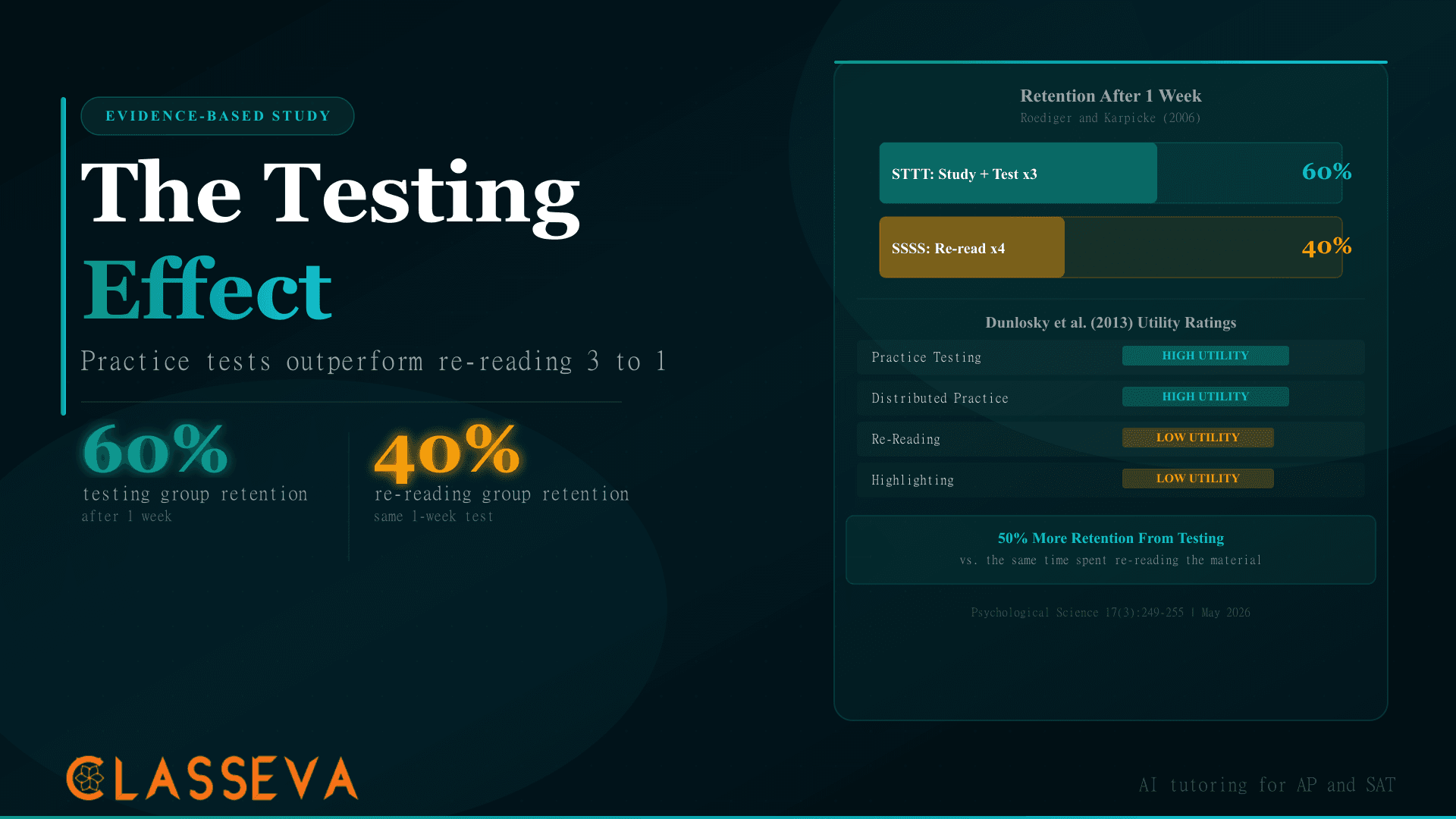
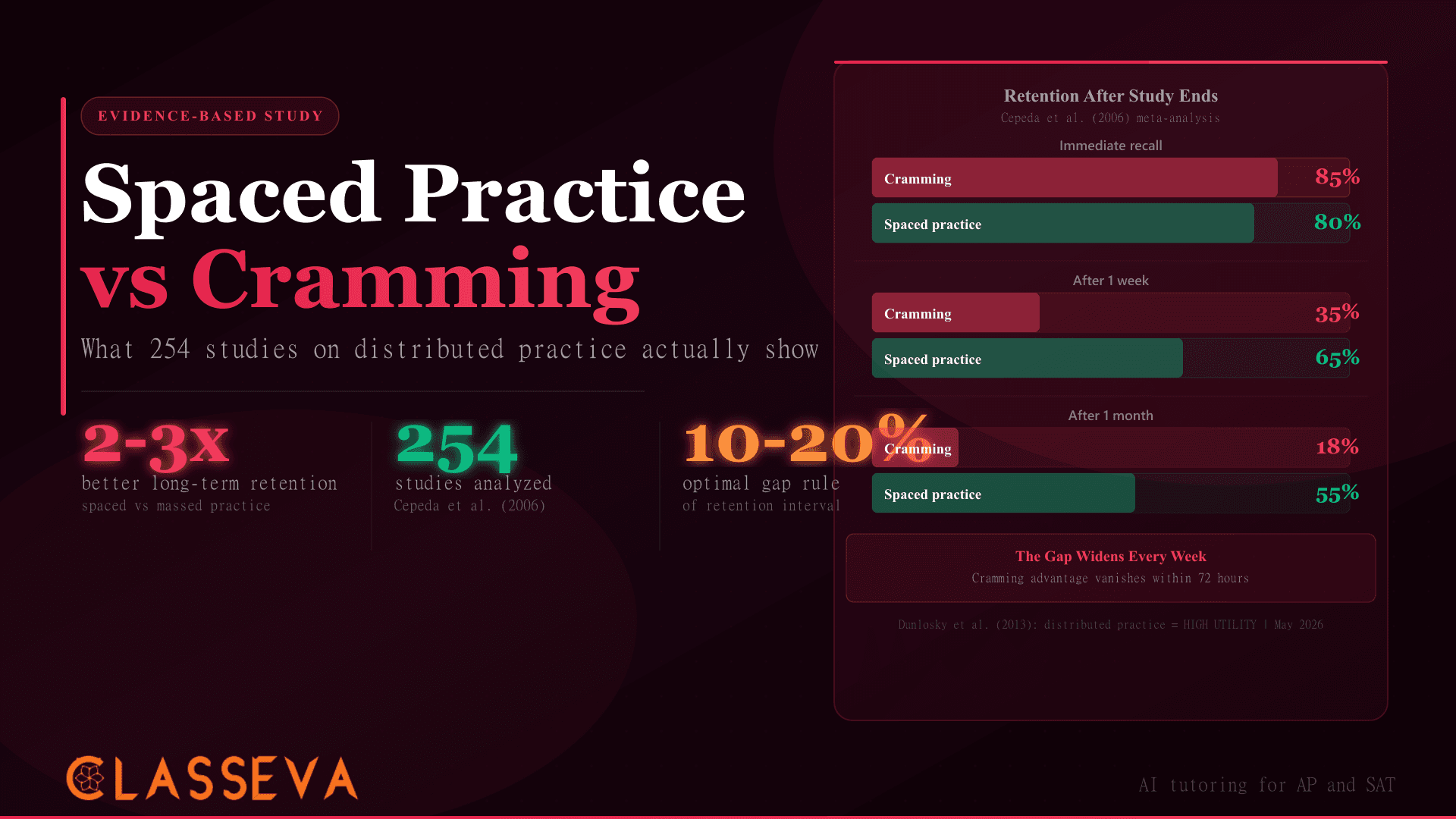
The testing effect (Roediger and Karpicke, 2006) identifies the TYPE of activity that produces the best retention: retrieval practice beats re-reading within any session. Spaced practice (Cepeda et al., 2006) identifies WHEN to schedule those sessions: distributed over time rather than massed before a test. Interleaving (Rohrer and Taylor, 2007) identifies HOW to mix problem types within sessions: varied categories rather than blocked by type.
Deliberate practice answers HOW WELL each session executes: full attention, immediate feedback, stretch zone difficulty, and refinement per attempt. A student who spaces sessions correctly and interleaves problem types within them, but works in the comfort zone throughout without feedback, uses the scheduling right but the execution wrong. The compound benefit of all four pillars requires applying each dimension correctly.
Pair deliberate practice sessions with the spacing schedule from your AP prep calendar. If spaced review sessions fall every 9-18 days across a four-month prep plan, each of those sessions should apply deliberate practice principles internally. Spacing ensures consolidation between sessions. Deliberate practice ensures quality within them. Neither substitutes for the other.
Students who want to benchmark their current prep approach against evidence-based methodology can explore the full study methodology resource hub, which covers all four pillars alongside practical implementation schedules.
| Pillar | Answers | Core Research | AP Application |
|---|---|---|---|
| Testing Effect | What to do in each session | Roediger and Karpicke (2006) | Self-test rather than re-read notes |
| Spaced Practice | When to schedule sessions | Cepeda et al. (2006) | Distribute review every 9-18 days |
| Interleaving | How to mix problem types | Rohrer and Taylor (2007) | Mix topics within each session |
| Deliberate Practice | How well each session executes | Ericsson et al. (1993) | Error analysis + stretch zone + feedback |
The four evidence-based study pillars, each addressing a distinct dimension of effective preparation.
Key Takeaways
- Ericsson defined deliberate practice in 1993 as practice specifically designed to improve current performance, requiring full attention, immediate feedback, stretch zone difficulty, and repetition with refinement. All four features must be present simultaneously.
- The "10,000-hour rule" misread Ericsson's research. Macnamara et al. (2014) found deliberate practice explains only 4% of performance variance in academic domains when measured as accumulated hours. Session quality predicts far more than session count.
- Most AP and SAT students practice in the comfort zone at 85-100% success rate. Deliberate practice requires working in the stretch zone at 70-80% success, where errors generate the feedback that drives skill development.
- For AP prep, the highest-leverage application is structured error analysis 48 hours after every practice test, followed by targeted drilling of the specific weak areas each test reveals. The 48-hour return attempt, not the original test or the explanation review, is where the skill builds.
- For SAT and ACT prep, identify the question difficulty level where you score 70-75% on cold attempts. Drill that difficulty band with immediate per-question feedback, not batch review.
- Ericsson's violinists capped deliberate practice at 2-3 hours per day. For students with a full course load, 1-2 hours of genuine deliberate practice outperforms four hours of comfortable review in score-improvement terms.
- Deliberate practice combines with the testing effect (what to do), spaced practice (when to schedule), and interleaving (how to mix) as the quality-execution layer. All four pillars address different dimensions. None substitutes for another.