ChatGPT vs Dedicated AI Tutors for AP and SAT Prep
Building Classeva, the question that came up in every early conversation with students was a practical one: why not just use ChatGPT? It is free, it knows biology, it explains things in plain English, and it is available at 2 a.m. the night before an AP Biology FRQ. Those are real advantages. The question I had to answer honestly was whether those advantages add up to something that can actually prepare a student for exam day. The answer depends entirely on what you need the tool to do.
ChatGPT and a dedicated AI tutor solve different problems. ChatGPT solves the “explain this to me” problem. A curriculum-grounded AI tutor solves the “help me learn this well enough to perform under exam pressure” problem. Both problems are real. They are not the same problem. This comparison covers where each tool wins, where each fails, and the specific case where using both makes more sense than choosing one.
Can ChatGPT Actually Help You Study for AP Exams and the SAT?
ChatGPT can help you study for AP exams and the SAT, but the kind of help depends on what you ask it to do. For conceptual explanation and rephrasing, it performs well. For curriculum-precise exam preparation, it has reproducible failure modes that compound over a full AP prep cycle.
Where ChatGPT Genuinely Helps
Three tasks where ChatGPT works well as a chatgpt study tool: explaining a concept in a different way when a textbook explanation does not click, generating practice prompts on a topic you specify, and reviewing an essay draft for clarity and structure. These are genuine use cases. Most students underuse ChatGPT for the second task (generating practice prompts) and overuse it for the third (asking it to polish an essay when the real problem is argument structure, not sentence-level writing).
The explanation strength is real. If your AP Biology teacher's explanation of signal transduction does not land, asking ChatGPT to explain it through a different analogy often helps. It can restate the same concept five different ways, adjust its level of technicality on request, and connect it to real-world examples that textbooks omit. For that specific job, it is better than most educational resources.
ChatGPT is at its best when you give it constraints: “Explain incomplete dominance using only an example involving flowers, in three sentences.” Unconstrained, it tends to give comprehensive answers that are harder to encode quickly. Constrained, it produces tight, memorable explanations.
Where ChatGPT Consistently Falls Short
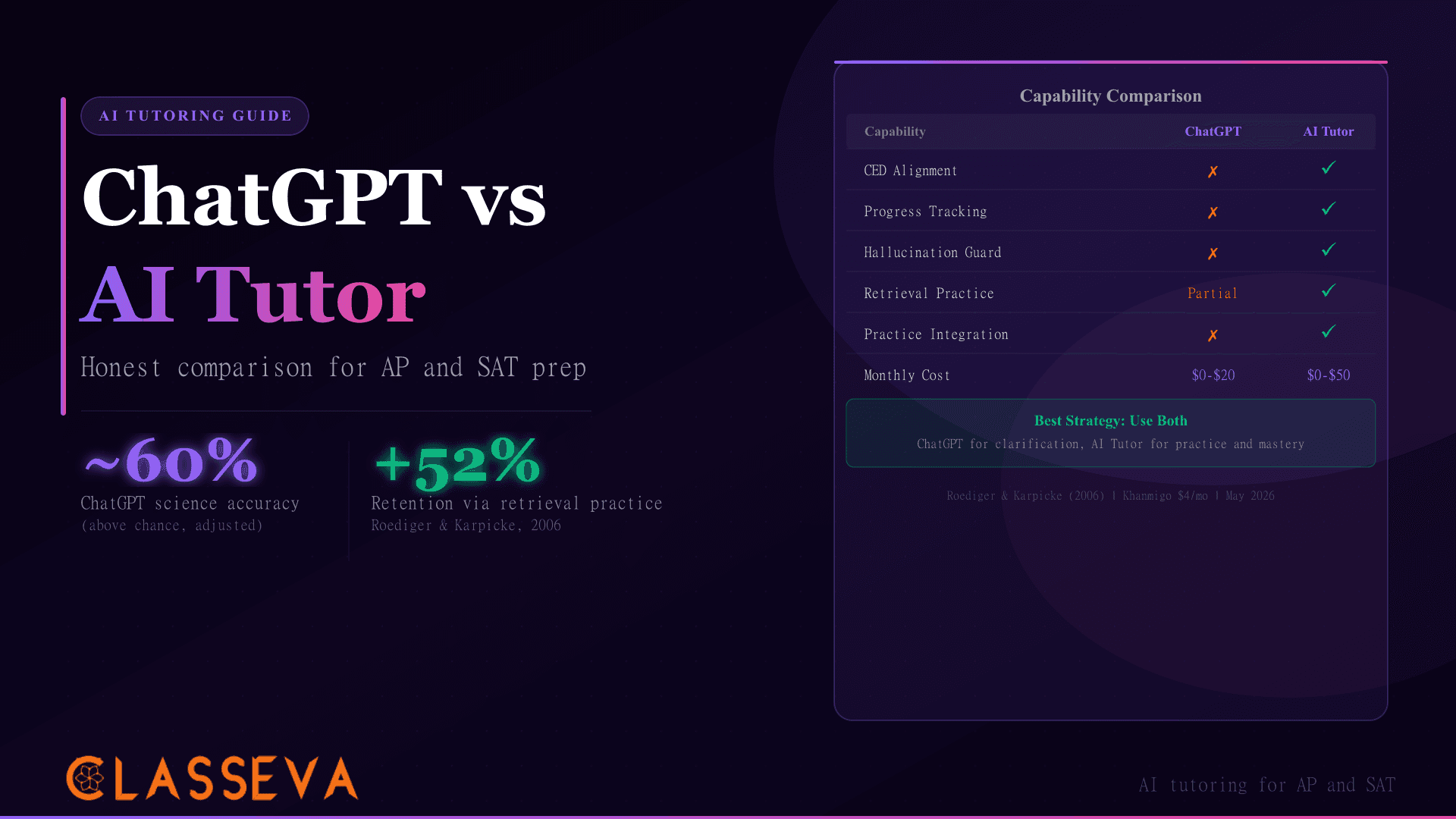
ChatGPT's failure modes in AP and SAT prep cluster around three problems. First, it has no alignment to the current AP CED or SAT Bluebook. When you ask it about Unit 5 genetics content, it draws from the full breadth of genetics knowledge in its training data, which spans decades of textbook content and internet text, some of which predates or diverges from the current CED's specific scope. It does not know which non-Mendelian patterns the 2025 AP Biology exam emphasizes at a quantitative level. It does not know how the Bluebook's adaptive module structure changes the pacing strategy for digital SAT math.
Second, it tracks nothing. ChatGPT has no memory across sessions (unless you specifically use its memory feature and populate it yourself). It does not know that you scored 60% on Unit 3 last week and 85% on Unit 1 last month. Every session starts from zero. That makes systematic progress impossible; you are always working from your own internal accounting of where you stand, which students consistently get wrong.
Third, and most significantly: it answers when it should ask. Receiving an explanation from ChatGPT is structurally identical to reading a textbook passage. Your brain did not retrieve the information; the AI retrieved it for you. That design choice matters enormously for long-term retention, as the evidence in the retrieval practice section below shows.
What Is a Dedicated AI Tutor?
A dedicated AI tutor is a system built around a specific curriculum document. The key word is “built.” ChatGPT was trained on internet text and knows AP Biology content approximately as well as it knows everything else: broadly, but imprecisely. A dedicated AI tutor has been constructed around a defined set of learning standards (the AP Biology CED, the Digital SAT Bluebook, or Khan Academy's content library), and every response it generates stays within those boundaries by design.
Two dedicated AI tutors worth knowing: Khanmigo(Khan Academy's tool, $4/month for learners) and Classeva, which is built specifically around AP exam CEDs and the Digital SAT Bluebook. Both take the same fundamental approach: curriculum-first, with a pedagogical design that prioritizes teaching over answering. Both differ from ChatGPT in architecture, not just in content.
General Chatbot vs Curriculum-Grounded Tutor
When a student asks ChatGPT to explain incomplete dominance, it draws from any genetics source in its training data. The answer might be accurate, clear, and well-structured. It might also use an example that does not appear in the current AP Biology CED, or emphasize a level of quantitative treatment that the exam does not require, or omit the specific distinction that the 2025 FRQ scoring rubric rewards. None of these failures are obvious to a student who does not already know the CED well enough to spot them.
A curriculum-grounded tutor draws from the CED first. When you ask it about incomplete dominance, it gives you the explanation that maps to what the exam actually tests: the specific examples in the CED, the level of quantitative depth the FRQ expects, and the contrast with codominance that appears in past FRQ scoring guidelines. The breadth of ChatGPT's knowledge is genuinely impressive. For targeted exam prep, that breadth creates as many problems as it solves.
Why Curriculum Alignment Matters for AP and SAT Prep
The AP Biology CED changes. Not dramatically year to year, but College Board refines unit weightings, clarifies which examples appear on FRQs, and occasionally adds or removes content areas. A student spending 40 hours on AP prep who drills on slightly misaligned content is not just wasting 40 hours. They build expectations about the exam that the exam will not meet.
The CED Updates Annually
The technical reason curriculum alignment became the foundational constraint in building Classeva was not philosophical. It was practical. When we mapped general AI explanations against the current AP Biology CED line by line, we found consistent coverage of the large concepts (Mendelian genetics, cell signaling, natural selection) and inconsistent coverage of the specifics that distinguish a 3 from a 5: the depth of non-Mendelian quantitative treatment in Unit 5, the exact FRQ scoring expectations for chi-square analysis, and which non-Mendelian patterns require a numerical answer versus a written explanation. A student who trains on a misaligned source gets systematically penalized for the wrong answer to the right question.
The Digital SAT Bluebook framework introduces a different alignment problem. The Bluebook's adaptive structure (where Module 2 difficulty depends on Module 1 performance) changes the optimal pacing strategy in ways that general ChatGPT guidance does not reflect. Ask ChatGPT how to approach the digital SAT's math section and it may describe strategies calibrated for the paper-and-pencil version. The surface answer sounds helpful. The underlying strategy diverges from what Bluebook test-takers actually encounter.
What the Research Shows on AI Accuracy
The curriculum alignment problem would matter less if ChatGPT were nearly always right. The research on science content accuracy suggests it is not. College professors testing ChatGPT on standardized science exam questions in 2024 and 2025 found that accuracy adjusted for random guessing landed at roughly 60% above chance. The system showed particular difficulty identifying false statements, correctly classifying them only 16.4% of the time. On AP exams, which specifically test whether students can distinguish accurate from plausible-but-wrong scientific reasoning, that failure mode is material.
The hallucination risk compounds on exam-specific questions. ChatGPT can state with complete confidence that a particular molecule plays a specific role in a pathway, and can be wrong in a way that would cost points on an AP FRQ. Unlike a curriculum-grounded tutor that draws from the CED, ChatGPT has no mechanism to flag when its confidence exceeds its accuracy on exam-specific detail. Students who do not already know the correct answer cannot spot the error. That is exactly the scenario AP prep is trying to prevent.
Do not use ChatGPT to check whether your AP FRQ answer is correct. It cannot compare your response to the College Board scoring rubric and may confirm wrong answers enthusiastically. Use AP Central's released scoring guidelines for that.
Progress Tracking vs Answer Extraction
Every time you ask ChatGPT for an explanation, you receive information passively. Your brain does not retrieve it; the AI retrieves it for you. That design choice conflicts directly with the best-established finding in cognitive science on how learning actually works.
Why Retrieval Practice Beats Re-Reading
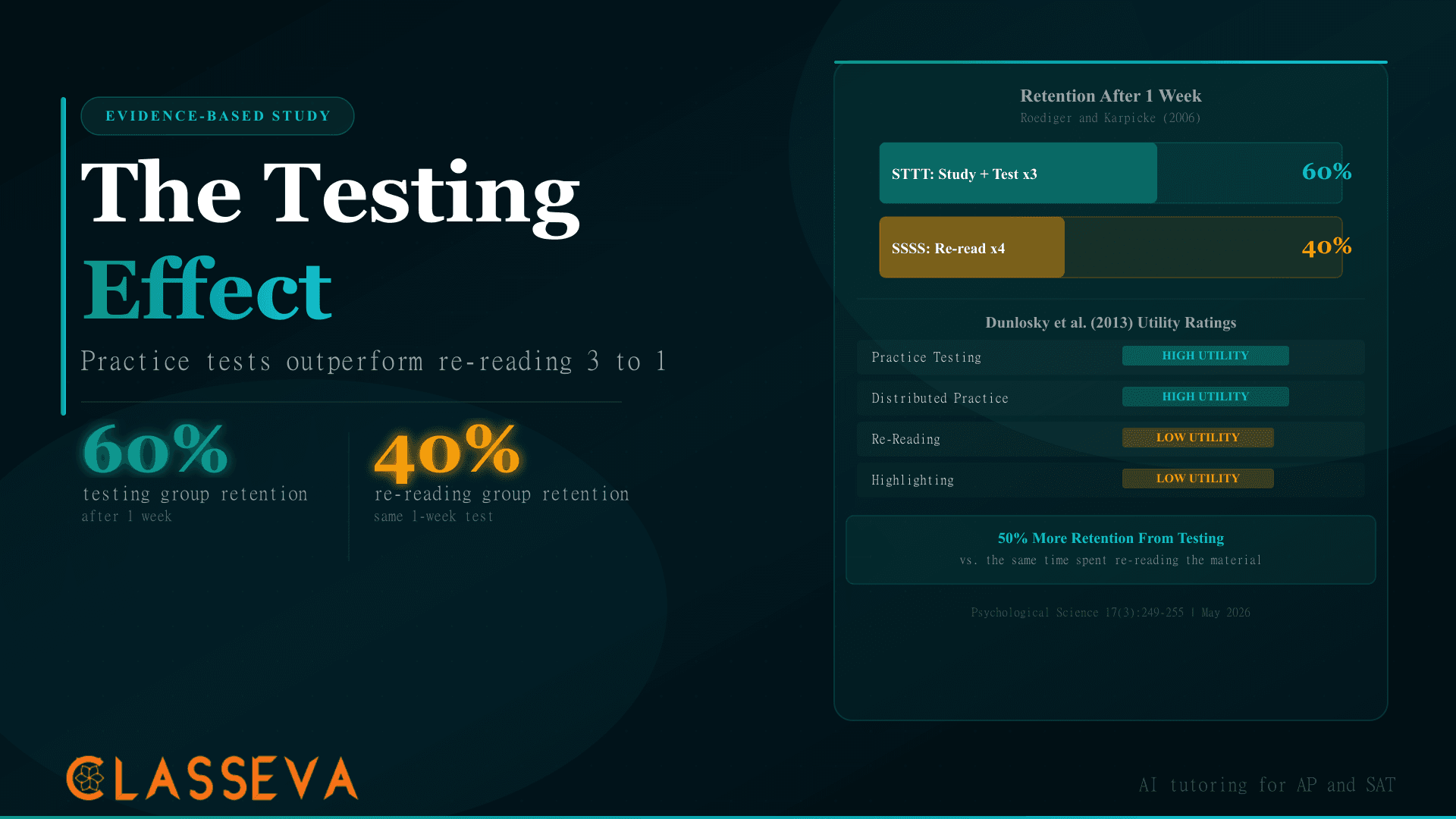
What I find persuasive in Roediger and Karpicke's 2006 paper in Psychological Science is not just the headline finding. Retrieval practice produces better long-term retention than re-reading. What matters too is the mechanism. When you are forced to retrieve information from memory, to answer a question or work through a problem, you strengthen the retrieval pathway itself. Passive reading (or passively receiving an explanation from ChatGPT) does not. You encode the information in a format that is easy to access immediately and hard to access under pressure, which is precisely when the AP exam requires you to access it.
A dedicated AI tutor asks you questions. It forces retrieval. ChatGPT answers them. That difference is not a minor feature gap. It is a fundamental architectural choice about whether the tool is designed to teach or to inform. Khanmigo, for instance, is built around the Socratic method: it guides students through problems with questions rather than providing direct answers. That approach aligns with retrieval practice principles in a way that standard ChatGPT usage does not.
Progress tracking compounds this advantage. A dedicated AI tutor records that you struggled with codominance in Week 2, correctly answered incomplete dominance problems in Week 3, and has not been tested on nondisjunction at all. It can route you back to weak units before they become exam-day gaps. ChatGPT offers none of that. Your prep calendar stays in your head, which means the units you find boring get fewer sessions than the units you find interesting. That is not the distribution that produces a 5.
If you are weighing the cost of a dedicated AI tutor against alternatives (ChatGPT, human tutoring, or self-study), the Tutoring ROI Calculator gives you a data-grounded comparison based on hours of practice and target score improvement. Use it before committing to any study plan.
Tutoring ROI Calculator
Compare the cost and expected score improvement of AI tutoring, human tutoring, and self-study. Enter your situation to see a personalized cost-benefit analysis.
ChatGPT, Dedicated AI Tutor, or Both?
The choice between a chatgpt vs ai tutor for AP and SAT prep depends on one question: are you trying to understand something, or are you trying to master it? ChatGPT handles the first task well. Mastery, the kind that holds up under exam pressure, requires a tool that tracks your progress, tests your recall, and stays within the curriculum boundaries that will actually appear on your exam.
Cost Breakdown for AI Study Tools
| Tool | Monthly Cost | CED Aligned | Progress Tracking | Best For |
|---|---|---|---|---|
| ChatGPT Free | $0 | No | No | Quick concept clarification |
| ChatGPT Plus | $20 | No | No | Browsing, longer sessions |
| Khanmigo | $4 | Khan Academy | Partial | K-12 math, Socratic guidance |
| Dedicated AP/SAT AI Tutor | $0-50 | Yes (CED/Bluebook) | Yes | Exam prep, FRQ practice |
Cost and capability comparison as of May 2026. Dedicated AI tutor costs vary by provider and plan.
The cost comparison here makes the decision clearer than most students expect. Khanmigo at $4/month is the strongest value for students who primarily need math support and can work within Khan Academy's curriculum scope. For AP exam prep specifically (where the CED defines exactly what gets tested and how), a dedicated AI tutor built around that document earns its cost quickly. One month of AP-specific AI tutoring costs less than two hours of human tutoring, and delivers far more practice volume. The test prep cost comparison covers these trade-offs in detail.
Using ChatGPT and an AI Tutor Together
I will say plainly what I tell every student who asks: using both makes sense if you can afford the dedicated AI tutor. ChatGPT serves as a conceptual dictionary. When a tutor's explanation of codominance does not click, ChatGPT can often rephrase it in a way that does. For generating alternative examples, exploring adjacent concepts, or working through an essay draft's argument structure, ChatGPT is genuinely useful alongside the core study workflow.
For the core workflow itself (practice problems, feedback on reasoning, unit progression, and mock FRQ assessment), the curriculum-grounded tutor handles that better. The study methodology guide covers how to build a full prep schedule that integrates both tools effectively, including when to switch between them and how to use ChatGPT for interleaving practice without losing CED alignment.
One honest caveat: dedicated AI tutors for AP prep are not all equal. Some are AI wrappers around generic content; others are genuinely built from the current CED. Before committing, ask whether the tool was trained on the College Board's actual CED document or on general biology content. That distinction determines whether the tool can tell you, with confidence, what will and will not appear on your May exam. The AP Biology difficulty breakdowncovers which units carry the highest exam weight. That is the right frame for evaluating any prep tool's curriculum coverage.
Key Takeaways
- ChatGPT handles concept explanation and brainstorming well. It fails on CED precision, cross-session progress tracking, and retrieval-practice design: the three things that separate a 3 from a 5 on AP exams.
- A dedicated AI tutor is built around a specific curriculum document (AP CED or Digital SAT Bluebook). ChatGPT is not. That architectural difference is not a minor gap; it compounds over a full prep cycle.
- Research on ChatGPT's science accuracy found roughly 60% above-chance performance after adjusting for guessing, with only 16.4% accuracy on false statements. AP exams specifically test the ability to identify plausible-but-wrong reasoning.
- Retrieval practice (the mechanism dedicated AI tutors are built around) produces significantly better long-term retention than passive re-reading. Asking ChatGPT for answers is structurally equivalent to passive re-reading.
- Khanmigo ($4/month) covers Khan Academy's curriculum with Socratic guidance and is the strongest value for math support. It is not aligned to AP exam CEDs or the Digital SAT Bluebook specifically.
- The best strategy is to use both: ChatGPT for rephrasing explanations that do not click, a dedicated AI tutor for the core practice-and-feedback workflow that produces exam-day retention.
- Curriculum alignment compounds over time. A 5% content mismatch in week one becomes a systematic gap by exam week, especially in units like AP Biology's Unit 5, where quantitative non-Mendelian treatment is specifically tested.
AI accuracy research from college professor studies published 2024-2025, sourced via peer-reviewed reporting and OpenAI's own documentation on hallucination. Retrieval practice findings from Roediger and Karpicke (2006), Psychological Science. Khanmigo capabilities and pricing from khanmigo.ai as of May 2026. AP Biology CED from AP Central (College Board).