Spaced Practice vs Cramming: What the Research Shows
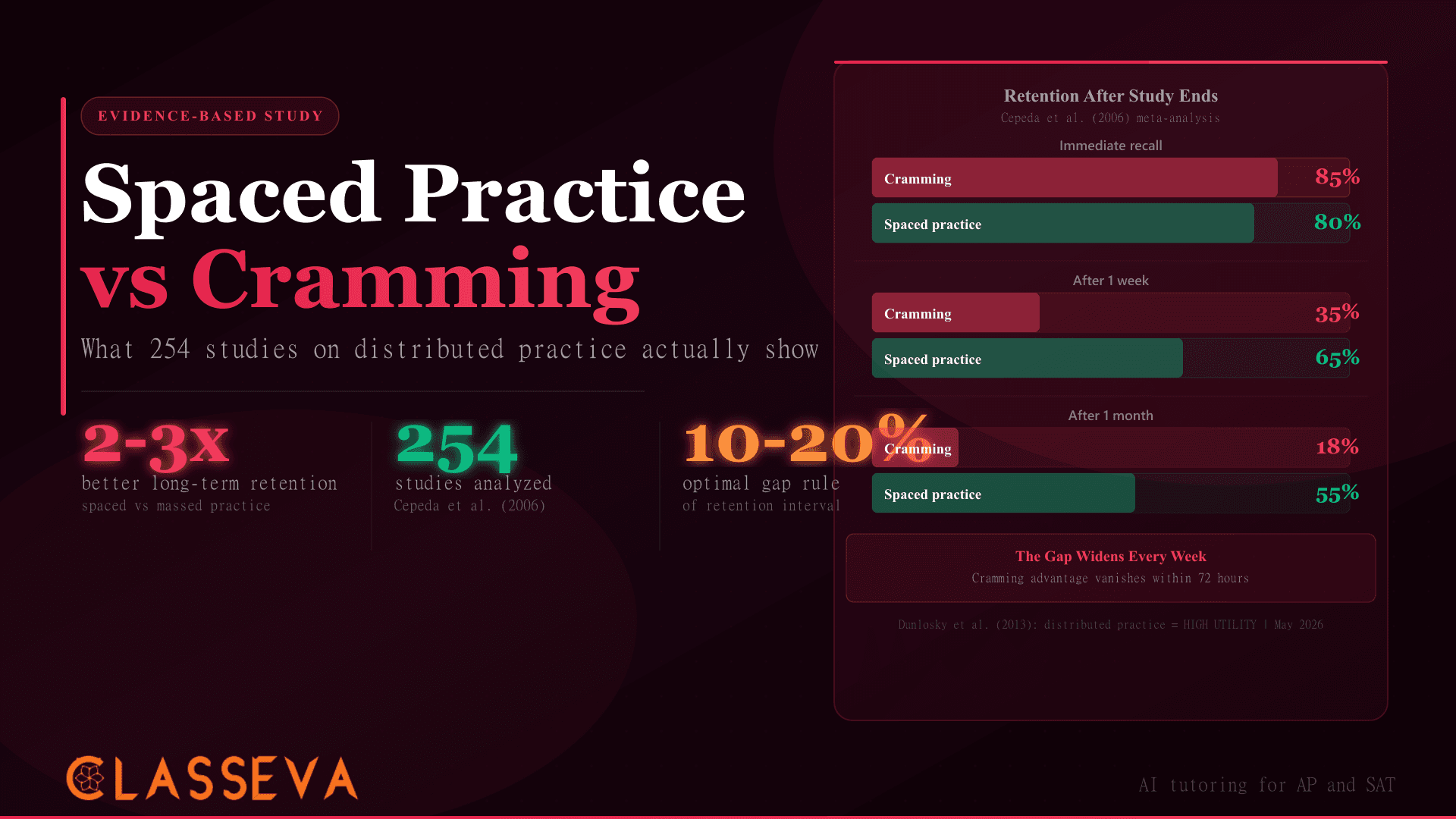
Nicolas Cepeda and colleagues analyzed 254 published studies on distributed versus massed practice in a 2006 meta-analysis in Psychological Bulletin(132(3):354–380). Their finding was straightforward: distributing study sessions over time produces two to three times better long-term retention than concentrating the same sessions into a single block before an exam. The result held across vocabulary, science facts, mathematics, and reading comprehension. Cramming eliminates the gap between sessions and loses most of the retention benefit in doing so.
Cramming feels effective because short-term recall is high the morning after. A student who studies six hours the night before a quiz can often recall most of what they covered. That recall evaporates within days. Designing Classeva's session scheduler forced a confrontation with this tradeoff directly: students optimize for feeling prepared the night before, not for retaining material across the months between September and the May AP exam. This post translates the spacing effect research into concrete AP, SAT, and ACT prep schedules.
What Is the Spacing Effect?
The spacing effect is the finding that memory for studied material is stronger when study sessions are distributed over time than when the same sessions are massed together. This holds even when total study time is identical. Two hours of study spread across four sessions over two weeks produces better long-term retention than two hours in a single session the night before.
The effect is not subtle or situational. It shows up across age groups, subjects, and formats. The research consensus, going back to Ebbinghaus in 1885 and reinforced by hundreds of modern experiments, is that spacing is one of the most reliable and potent improvements a student can make to their study approach.
The Ebbinghaus Forgetting Curve
Hermann Ebbinghaus documented the foundational data in 1885, using himself as the sole subject. He memorized lists of nonsense syllables and measured how much time it took to re-memorize them after delays of varying length. The result is now called the forgetting curve: without rehearsal, memory decays steeply in the first 24 hours, then more slowly. After a month without review, retention drops to roughly 20% of the original material.
The forgetting curve is a measurement, not a prediction. Every student who reads two chapters on Sunday night and takes a test the following Friday is sliding down that curve. Spacing study sessions resets it. Each retrieval attempt before forgetting is complete raises the curve back toward 100%, and each successive reset makes the decay rate slower.
The Cepeda (2006) Meta-Analysis: 254 Studies
The most rigorous quantitative review of this research is Cepeda et al. (2006), published in Psychological Bulletin. The researchers synthesized 254 studies spanning verbal recall, paired-associate learning, and free recall tasks. Spaced practice outperformed massed practice in the large majority of studies. The advantage grew larger as the retention interval increased: cramming might pass a quiz the next morning, but the disadvantage compounded over the weeks and months that followed.
The meta-analysis also produced an actionable finding: the optimal spacing gap is not fixed. It depends on how long you need to retain the material. The practical translation of this finding appears in the optimal spacing interval section below.
Why Does Cramming Feel Effective But Fail Long-Term?
Cramming produces strong immediate recall because the material is still in short-term working memory when the test occurs. A student who studies for six hours the night before a quiz often does well the next morning. The problem: short-term memory decays within 24-72 hours if not consolidated into long-term memory. Consolidation requires time and sleep between sessions, not more exposure to the same material.
The Short-Term Recall Illusion
Cognitive psychologists describe this as the fluency illusion: material feels familiar because it was just reviewed, and familiarity gets mistaken for durable knowledge. Students who reread chapters feel confident immediately after the session. That confidence reflects their current short-term memory state, not how much they will remember in two weeks.
Robert Bjork's research on desirable difficulties explains this from the other direction. Study conditions that feel harder produce better long-term retention than conditions that feel easy. Spacing sessions farther apart feels harder because retrieval is less fluent; you have to work to recall the material. That difficulty is exactly what encodes it more durably. The harder retrieval feels, the stronger the memory trace becomes.
Cramming (Massed Practice)
- •All sessions compressed before the exam
- •Strong recall the next morning
- •50-60% retention within 72 hours
- •Near-complete forgetting within one month
- •Low desirable difficulty: feels smooth
- •Does not build AP-level conceptual depth
Spaced Practice
- •Sessions distributed over weeks or months
- •Each session encounters some forgetting
- •75-90% retention across the retention interval
- •Durable recall months after the final session
- •Higher desirable difficulty: retrieval takes effort
- •Builds the connected reasoning AP FRQs require
What Is the Optimal Spacing Interval?
The optimal gap between study sessions depends on how long you need to retain the information, per Cepeda et al. (2006). For a test in seven days, space sessions one to two days apart. For a test in 30 days, space sessions three to six days apart. For AP exam prep spanning four months, the optimal major review spacing is in the range of two to three weeks per full-content cycle.
The 10-20% Rule of Retention Intervals
Cepeda et al. found that the optimal gap equals approximately 10-20% of the intended retention interval. Space sessions too closely (daily cramming) and there is not enough forgetting for retrieval to be effortful, which weakens the encoding effect. Space them too far apart and too much forgetting occurs before the next session, reducing the cumulative gain.
The practical implication for AP prep: a student studying from January through May has a retention interval of roughly 120-150 days. The optimal spacing gap for major content review cycles is 12-30 days per pass. Most students space their review sessions zero days apart (cramming) or one day apart (daily review without adequate gaps), neither of which is close to optimal.
| Time Until Test | Optimal Spacing Gap | Sessions to Schedule |
|---|---|---|
| 7 days | 1-2 days apart | 4-5 sessions |
| 14 days | 2-3 days apart | 5-7 sessions |
| 30 days | 3-6 days apart | 5-8 sessions |
| 90 days | 9-18 days apart | 5-10 sessions |
| 180 days (AP prep) | 18-36 days per review cycle | 5-8 full content cycles |
Optimal spacing intervals by time to test, derived from the 10-20% rule in Cepeda et al. (2006), Psychological Bulletin 132(3):354-380.
How to Apply Spaced Practice to AP Exam Prep
Start AP prep no later than January for May exams. Students who begin four months out and schedule two to three sessions per week retain significantly more than students who study the same total hours compressed into the final two weeks. The spacing gap does the work. Even studying daily in March and April beats cramming in May, as long as each session covers different content rather than repeating the same material.
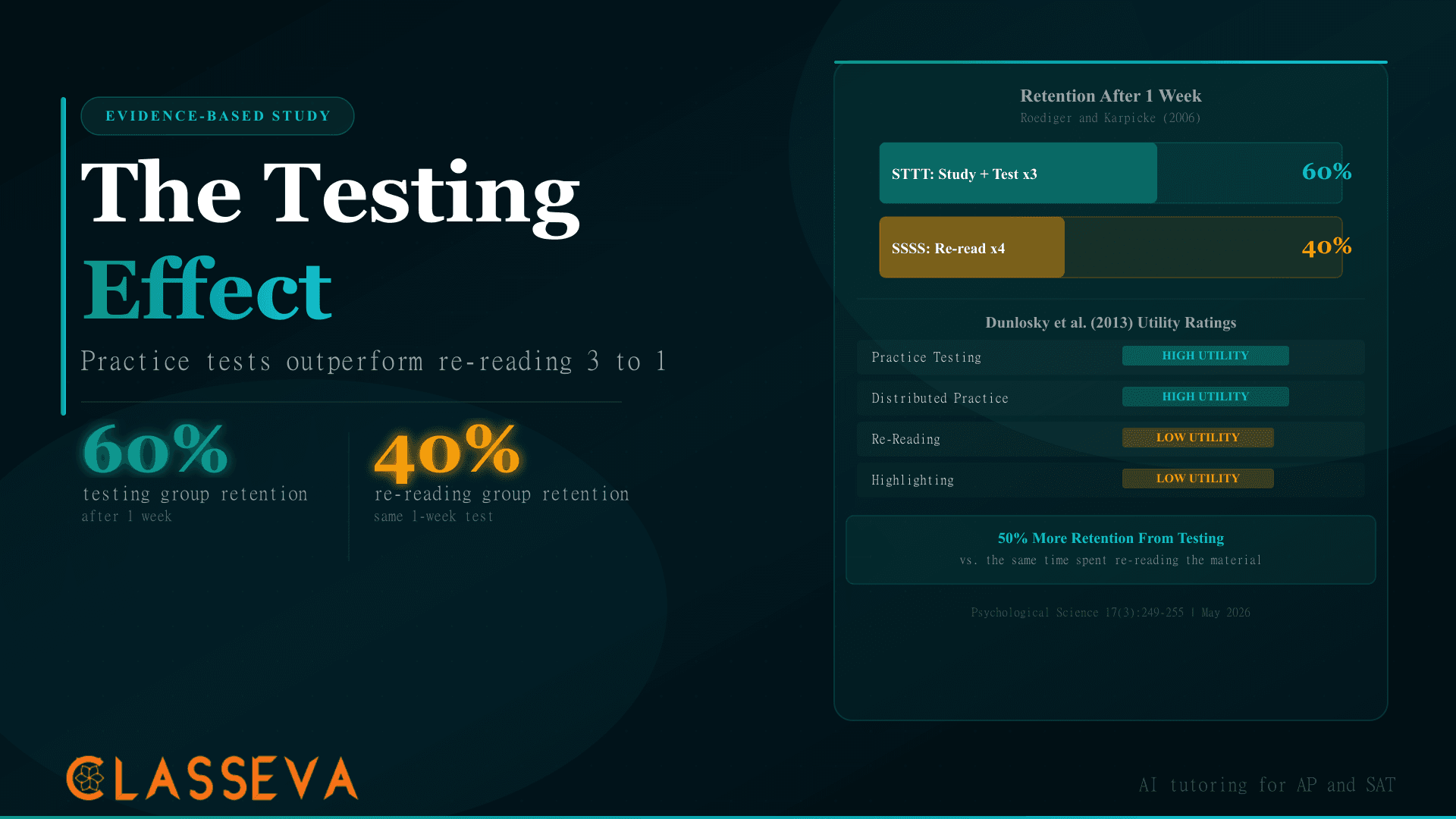
The study methodology that produces the highest AP scores combines spacing with retrieval practice: space your practice tests and self-quizzes over time, not your passive re-reading sessions. Re-reading spaced over four months is better than cramming, but retrieval practice spaced over four months beats both.
A 4-Month AP Prep Schedule Built on Spacing
Here is a concrete schedule that applies the Cepeda optimal intervals to AP exam prep beginning in January. The total weekly study time is four to five hours, well within the range most AP students can manage alongside coursework.
January to February: one session per week, one unit at a time
Cover one AP unit per week. Focus on building accurate mental models before testing yourself. At the end of each week, close your notes and write down everything you remember from that unit. This is your first retrieval session.
March: two sessions per week, 3-4 days apart
Add a second session each week covering a different unit than the first. The 3-4 day gap between sessions ensures enough forgetting for retrieval to be effortful. Introduce unit-level practice FRQs and mixed-unit multiple-choice sets.
April, first three weeks: three sessions per week, 2-3 days apart
Full-length timed sections and targeted weak-area drills. Space sessions 2-3 days apart. If you studied Unit 3 on Monday, review your errors on Wednesday and cover a different unit on Friday rather than repeating Unit 3 the next day.
Exam week: one light review session two days before the exam
No new content. No cramming. Your long-term retention is built from four months of spaced retrieval. A light 90-minute review of your notes two days before the exam is sufficient. Cramming the night before degrades already-consolidated memory through sleep interference.
Why May Crammers Consistently Underperform
AP Chief Reader Reports across multiple subjects note consistently that students who earn scores of 1 or 2 demonstrate surface-level familiarity with content but cannot apply it across contexts. That pattern is what cramming produces: enough recognition to feel confident, not enough consolidation to reason with the material under exam conditions.
Cramming also creates a capacity problem. Compressing eight or nine AP units into a 10-day window means each session covers too much for effective processing. The brain cannot consolidate multiple dense units during a single night's sleep. Distributed practice allows each session to focus on a limited scope, which produces deeper encoding per hour of study time.
How to Apply Spacing to SAT and ACT Prep
The digital SAT and the Enhanced ACT both reward procedural fluency built over time. Pattern recognition on SAT math, grammatical error identification on the ACT English section, and reading comprehension speed all improve more with distributed practice than with concentrated drilling. Taking ten SAT practice tests in the final two weeks does not produce the same result as taking ten tests spread over four months.
SAT Spacing: Start 4-6 Months Out
The digital SAT's adaptive structure makes pacing and pattern recognition especially dependent on repeated exposure over time. The Bluebook app provides eight official full-length practice tests. Use them as the anchor of a spaced schedule, not as a final-week sprint.
4-6 months out: one practice section per week
Score each section and identify error patterns before moving to new content. Do not take a full test yet. Targeted section work builds the underlying skills that full-length tests measure.
2-3 months out: one full-length practice test every 2-3 weeks
Review all errors between tests, not the night before the next one. The gap between tests is study time. Each error category you close between tests shows up as a point gain on the next test.
1-2 months out: one full-length test every 10-14 days
Targeted drill on persistent error types between tests. If algebra errors keep appearing, schedule two focused algebra sessions before the next full test, then check whether the rate drops.
2 weeks out: one final full-length test, then rest
Take a final timed practice test two weeks before exam day. Spend the final week reviewing errors from that test, not taking more tests. Rest for 2-3 days before exam day.
Tutoring ROI Calculator
Calculate whether adding an AI tutor to your spaced study schedule produces enough score improvement to justify the cost in AP credit and college outcomes.
Do Spaced Repetition Apps Like Anki Actually Work?
Anki implements the SM-2 algorithm, which schedules flashcard reviews at intervals that approximate the Cepeda optimal gap based on your self-reported recall rating. Quizlet Learn uses a proprietary variant. Both automate the spacing intervals, which means they can produce strong retention for vocabulary, AP Biology facts, AP Psychology terms, and AP US History events: exactly the declarative knowledge categories where spacing produces its largest gains.
The failure mode is passive use. AI-based tools and flashcard apps share the same weakness when used passively: reading the answer before attempting recall forfeits the retrieval practice benefit. The algorithm schedules the card at the right interval, but if you flip to the answer without first generating a response, the session is essentially passive re-reading, and produces the same weak encoding.
One additional caution: spaced repetition apps work best for reinforcing content you have already learned through active instruction. Trying to learn brand-new AP Biology mechanisms solely through Anki cards produces poor results because the initial encoding was passive (reading a card) rather than active (working through the mechanism). Use Anki to reinforce; use worked examples and practice questions to learn initially.
Where Spaced Practice Falls Short
Spaced practice excels at building declarative memory: facts, definitions, formulas, dates, vocabulary. It is less directly effective for procedural skills that require worked examples and deliberate feedback. AP Calculus AB problem-solving, AP Computer Science debugging, and AP Music Theory composition all depend on practice under feedback, where spacing determines when that practice occurs but does not replace the feedback itself.
Spacing also does not rescue ineffective study sessions. Passive re-reading done in a spaced schedule produces better encoding than cramming, but both lose to retrieval practice in any schedule. The research consensus from Dunlosky et al. (2013)is clear: distributed practice and practice testing are the only two of 10 reviewed techniques rated “high utility.” Both require active engagement to deliver their full benefit.
The strongest results come from combining both findings: space your retrieval practice sessions rather than your passive review sessions. A timed practice FRQ once every ten days produces better retention than daily re-reading of the same FRQ prompts. A full-length SAT practice test every two weeks produces better pattern recognition than a test every night in the final week.
Key Takeaways
- Cepeda et al. (2006) analyzed 254 studies and found spaced practice produces 2-3x better long-term retention than cramming, an effect that grows larger the longer the retention interval.
- The Ebbinghaus forgetting curve shows retention drops to roughly 20% within a month without rehearsal. Spaced sessions reset the curve by forcing retrieval before forgetting is complete.
- The optimal spacing gap is 10-20% of the retention interval: 1-2 days for a test in a week, 3-6 days for a test in a month, 18-36 days per review cycle for AP prep spanning four months.
- Dunlosky et al. (2013) rated distributed practice as one of only two “high utility” study techniques across 10 methods reviewed. The other is practice testing. Spacing your practice tests amplifies both.
- For AP exams, start prep in January. Four months of spaced practice with two to three sessions per week outperforms two weeks of daily cramming, even with identical total study hours.
- Spaced repetition apps like Anki work only when used with active retrieval effort. Passively reading cards without attempting recall first forfeits the spacing benefit the algorithm was designed to deliver.
- Combine spacing with the testing effect: space your retrieval practice sessions, not your passive re-reading sessions. This combination produces the strongest long-term retention the research has documented.