Testing Effect: Why Practice Tests Outperform Re-Reading
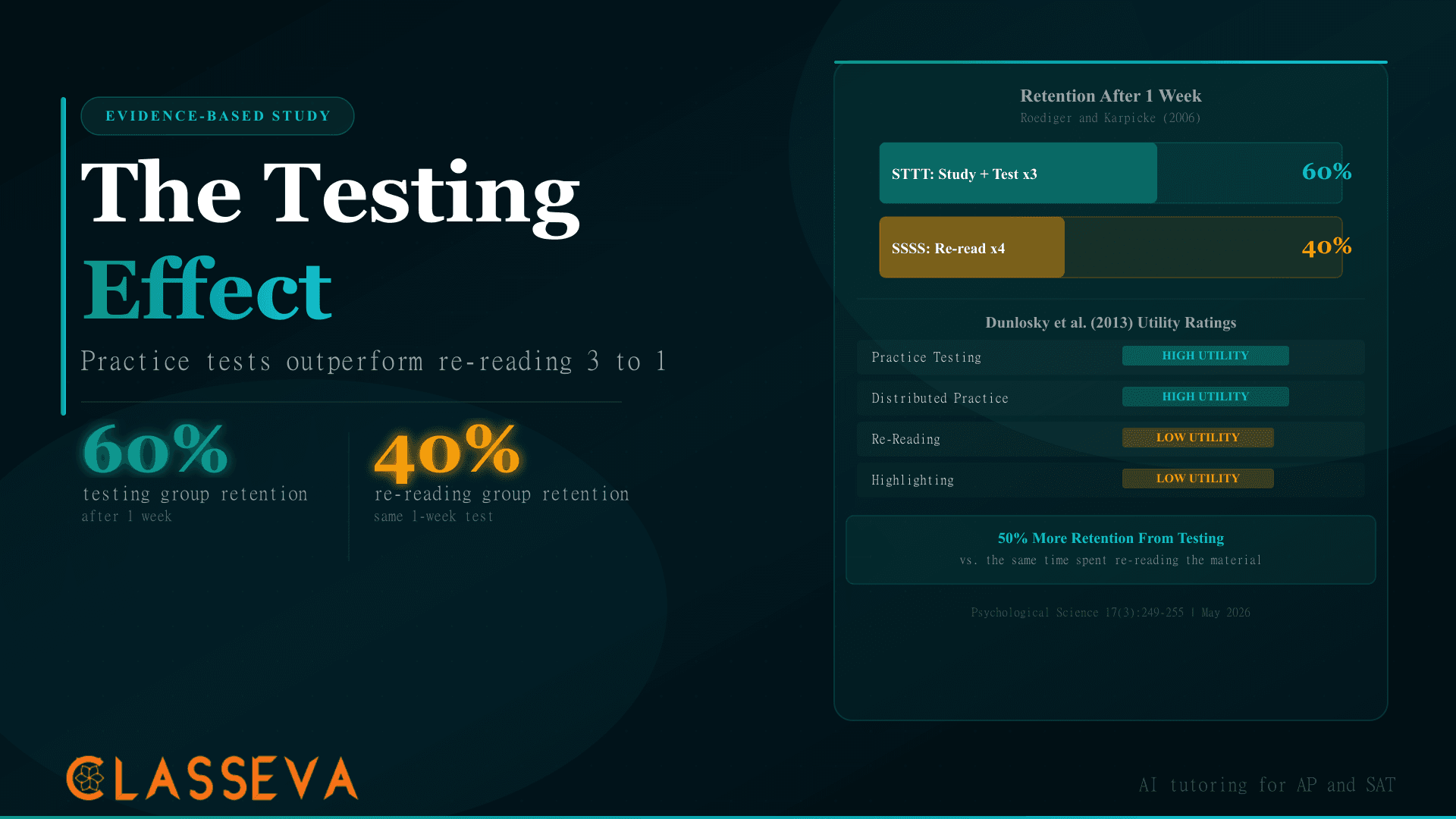
In Roediger and Karpicke's landmark 2006 experiment, students who studied a passage once and then tested themselves three times retained 60% of the material on a final test one week later. Students who re-read that same passage four times retained only 40%. Those students invested more time in passive study and remembered less. That result, replicated across hundreds of subsequent studies, sits at the core of what cognitive psychologists call the testing effect.
Most students respond to feeling underprepared by studying harder: re-reading chapters, re-watching lecture videos, annotating the same textbook sections again. All of that feels productive. None of it matches the retention benefit of closing the book and testing yourself on what you just read. Working through the learning science literature to design Classeva's practice architecture, this was the finding I kept returning to: the mental effort of retrieval is exactly what strengthens memory. This testing effect study breaks down the research and translates each finding into concrete strategy for AP exams, the Digital SAT, and the ACT.
What Is the Testing Effect?
The testing effect is the research finding that retrieving information from memory produces better long-term retention than spending the same time re-studying the same material. It contradicts the most common student instinct, which is to re-read and re-expose rather than self-test.
The Roediger and Karpicke Experiment
The seminal paper is Roediger and Karpicke (2006), published in Psychological Science (17(3):249-255). The researchers gave college students a prose passage to learn, then assigned them to one of two conditions before a delayed final test one week later.
The SSSS condition: students studied the passage four separate times, spending all their time in re-reading. The STTT condition: students studied once and then took three practice recall tests, writing down everything they could remember from the passage after each test.
| Condition | What Students Did | 1-Week Retention |
|---|---|---|
| STTT: Study + Test | Studied once, then self-tested 3 times | ~60% |
| SSST: Study + 1 Test | Studied 3 times, then self-tested once | ~50% |
| SSSS: Re-Read Only | Re-read the passage 4 times, no testing | ~40% |
Roediger and Karpicke (2006) Experiment 2: final test one week after the study phase.
What the 60% vs 40% Finding Actually Means
Students in the SSSS condition did more passive work. They spent all four sessions with the material directly in front of them. At a one-week follow-up, they retained 40%. Students in the STTT condition spent most of their time struggling to retrieve the material without looking, and retained 60%. That gap persisted even though the SSSS group had longer and more comfortable exposure to the text.
The implication for exam prep is direct. Every hour you spend highlighting and re-reading AP Biology chapters could produce better retention if spent on self-quizzing, practice questions, or flashcard retrieval instead. You don't have to study longer. You have to study differently.
Why Does Testing Yourself Work Better Than Re-Reading?
Testing works better than re-reading because retrieval itself is the learning event. Re-reading is passive: you move your eyes over familiar material, recognize it as correct, and feel like you understand. Recognition and recall are not the same skill. The exam tests recall. Re-reading trains recognition.
The Science of Retrieval Practice
When you retrieve a memory, you do not just read it back like a file from disk. You reconstruct it. That reconstruction process strengthens the neural pathways associated with that information, making the next retrieval faster and more reliable. The harder the retrieval attempt (because you are fighting against some forgetting), the stronger the encoding that follows.
This is why testing early in the prep cycle, before you feel ready, produces better retention than waiting until you feel prepared. Struggling to retrieve material you partially know does more learning work than retrieving material you just re-read three times.
The mechanism also explains why practice tests transfer better to actual exam performance than passive review: the cognitive demand of exam conditions (time pressure, no notes, novel question phrasing) closely mirrors the retrieval conditions during the test itself. In the ChatGPT vs dedicated AI tutors comparison, retrieval practice is exactly what distinguishes a curriculum-grounded tutor from a general chatbot: one forces recall, the other enables passive answer-receiving.
Bjork's Desirable Difficulties Framework
Robert Bjork's research at the Bjork Memory and Forgetting Lab at UCLA frames this as “desirable difficulties.” Conditions that make encoding harder during study produce better long-term retention, even when they reduce immediate performance. Testing yourself before you feel ready is a desirable difficulty: it feels harder, you get more wrong in the short term, and you retain more in the long term.
Re-reading is the opposite of a desirable difficulty. It is frictionless and feels good precisely because recognition is easy. But that ease signals that no real retrieval work is happening. Bjork calls this the “illusion of knowing”: familiarity with material mimics understanding, and students consistently overestimate how well they know content they have only passively reviewed.
What the Broader Research Shows
The Roediger and Karpicke experiment is one of hundreds. Two comprehensive reviews confirm that the testing effect generalizes far beyond a single passage-recall study.
Dunlosky et al. (2013): The Comprehensive Learning Techniques Review
Dunlosky et al. (2013) published “Improving Students' Learning With Effective Learning Techniques” in Psychological Science in the Public Interest (14(1):4-58). The paper reviewed 10 widely used study techniques and rated each on overall utility based on the breadth of evidence, effect sizes, and applicability across subjects and learner types.
Two techniques earned “high utility” ratings: practice testing and distributed practice (spacing). Re-reading, highlighting, and summarization all received “low utility” ratings because the evidence for their effectiveness is either weak or narrow. The techniques that feel most productive to students (re-reading, highlighting) are rated lowest. The techniques that feel hardest (retrieval practice, spacing) are rated highest.
Practice Testing
- •Utility: HIGH
- •Forces active retrieval from memory
- •Transfers directly to exam conditions
- •Works for facts, formulas, and concepts
- •Benefits multiply with spaced repetition
Re-Reading
- •Utility: LOW
- •Passive recognition, not active recall
- •Produces illusion of knowing
- •Collapses under novel question phrasing
- •Time-intensive with minimal retention gain
How to Apply the Testing Effect to AP Exam Prep
AP exams test recall under pressure. Five questions per minute on the multiple-choice section. No notes. No second chances to re-read a passage. Every AP subject benefits from shifting the study ratio away from passive review and toward retrieval practice.
When to Start Practice Tests in Your AP Cycle
Start taking practice tests in month 1, not month 3. The instinct is to wait until you feel prepared enough to take a realistic test. The research says that instinct costs you retention. Testing yourself before you feel ready forces more effortful retrieval, which produces better encoding than testing after you feel prepared.
Month 1-2: Unit-level practice sets and self-quizzes after each chapter. Month 3: Timed section practice using past AP FRQs from AP Central's released materials. Month 4: Full-length timed practice exams every 10-14 days. Use the AP Score Predictor after each full test to track score trajectory.
Active Recall After Each AP Unit
After completing each AP unit, do a brain dump before reviewing your notes: write everything you remember about the unit without looking at anything. Compare what you wrote to your notes. The gaps reveal exactly where your retrieval is failing, not where you feel uncertain.
For AP Biology, this means closing the textbook after each cell signaling or heredity unit and writing out the pathway, mechanism, or process from memory. For AP US History, it means narrating the causes and effects of each period without your timeline. For AP Psychology, it means explaining each theory or study in your own words, covering the setup, finding, and implication. See the AP Biology practice questions post for examples of how retrieval practice questions are structured for specific unit content.
How to Apply It to the SAT and ACT
The Digital SAT and ACT respond to the same retrieval practice principles, but the application looks different because these are skills-based exams rather than content-knowledge exams. The testing effect still applies: retrieval under timed, exam-like conditions beats passive review every time.
SAT Practice Test Timing: Earlier Than You Think
Most students take their first SAT practice test after two or three weeks of content review. The research argues for taking a diagnostic test before any prep at all. A cold diagnostic reveals your actual baseline, not your aspirational baseline, and the struggle of answering questions you can't fully answer encodes the skill gaps better than reviewing the same skills passively.
For the Digital SAT, the adaptive module structure means Module 1 performance routes you to hard or easy Module 2, setting your score ceiling. Practice tests teach you the pacing and difficulty calibration for Module 1 in a way no amount of reading about it can. Take one full Bluebook practice test per week during your main prep cycle. Six to eight tests across 3-4 months is the right range for most students targeting a 1400+.
What About Flashcards and Active Recall?
Flashcards trigger the testing effect when used correctly. The correct use: look at the front of the card (the prompt), close your eyes, retrieve the answer, then flip. The incorrect use: flip the card immediately to read the answer, then say “oh right, I knew that.” The second approach is re-reading with extra steps.
For AP subjects with high content volume, AP Biology, AP US History, AP Psychology, and AP Spanish among them, flashcard decks with active recall are among the highest return-per-hour study methods available. The testing effect says the card should make you struggle slightly before you see the answer. If you feel like you “already know” most of the cards in your deck, the deck is probably too easy: add more cards, increase the specificity of the prompts, or add application-level questions rather than simple definitions.
Spaced repetition software (Anki is the most studied) combines active recall with optimal spacing: cards you answer correctly move to a longer review interval; cards you get wrong come back sooner. This automates the spacing schedule that most students fail to implement manually. For AP content with 400+ vocabulary terms or historical events, spaced repetition with active recall is the highest-return flashcard approach available.
Where the Testing Effect Falls Short
The testing effect is strongest for declarative knowledge and weakest for complex procedural skills. This distinction matters for AP prep planning.
AP Calculus AB and BC require procedural fluency: you need to execute multi-step derivations and integrations under time pressure. Practice problems develop that fluency, but you also need worked examples, conceptual understanding of when to apply each technique, and feedback on where your algebra breaks down. Retrieval practice alone will not build the procedural automaticity the exam requires.
AP English Language and Composition is another case. Rhetorical analysis essays require synthesis of evidence, argument structure, and stylistic judgment. Practice writing produces better results than practice identifying rhetorical devices, because the exam tests production, not recognition. The testing effect still applies at the vocabulary and concept level, but the higher-order skills need different practice types.
The same applies to AP Physics and AP Chemistry: plug-and-chug formula application responds well to retrieval practice; the harder conceptual reasoning and multi-step problem design require a different depth of worked-example study. Use retrieval for the content layer and deliberate problem-solving practice for the application layer.
Your Testing-Based Study Plan
Putting the testing effect into practice means restructuring the standard study session: less reading time at the start, more retrieval time from the first week.
Combining Testing, Spacing, and Interleaving
The testing effect, spacing effect, and interleaving work together. Spacing spreads retrieval sessions over time so each attempt fights against some forgetting. Interleaving mixes practice problems from different units rather than blocking all Unit 3 questions together. The combination produces better retention and transfer than any one technique alone.
Diagnostic test first
Before any content review, take a timed practice test or unit quiz. The struggle will reveal your actual starting point and encode the gaps in memory better than reading a syllabus.
Study a unit, then immediately self-quiz
After reading or watching content on a unit, close your materials and write out everything you remember. Compare the gaps to your notes. This is your first retrieval practice session.
Space your retrieval sessions
Schedule retrieval on the same unit 2-3 days after the initial study session, then again one week later. Each spaced retrieval produces stronger encoding than re-reading the same material the next day.
Interleave units in practice sets
Mix problems from Units 1, 2, and 3 in the same practice session rather than doing all Unit 1 problems first. Interleaving forces you to identify which strategy or concept applies, which is exactly what the exam requires.
Progress to timed practice exams
Once you have retrieval sessions across at least 3 units, add full-length timed practice exams. Treat these as retrieval events, not diagnostic tools. After each exam, study the explanations for every wrong answer before re-testing on similar content.
Track score trajectory, not study hours
Hours studied is a passive metric. Score trajectory on practice tests is a retrieval metric. If your score is not rising, the problem is almost always retrieval depth, not total study time.
Tutoring ROI Calculator
Calculate whether the score gains from your current prep method justify the cost. Factor in AP exam fees, tutoring costs, and projected college credit savings from a higher AP score.
Key Takeaways
- The testing effect shows students who self-test retain 60% vs. 40% for re-readers after one week, per Roediger and Karpicke (2006).
- Retrieval works because the effort of reconstruction strengthens memory traces. Recognition (re-reading) does not produce the same effect.
- Dunlosky et al. (2013) rated practice testing and distributed practice as the only two “high utility” study techniques across 10 reviewed methods.
- For AP prep, start retrieval practice from month 1, not month 3. Early testing before you feel ready produces stronger encoding than comfortable review.
- For the Digital SAT and ACT, take at least 6-8 full-length practice tests spread over 3-4 months. Cramming tests into the final week sacrifices the spacing benefit.
- Flashcards require actual retrieval to work: cover the answer, attempt recall, then verify. Reading the answer immediately is re-reading, not retrieval.
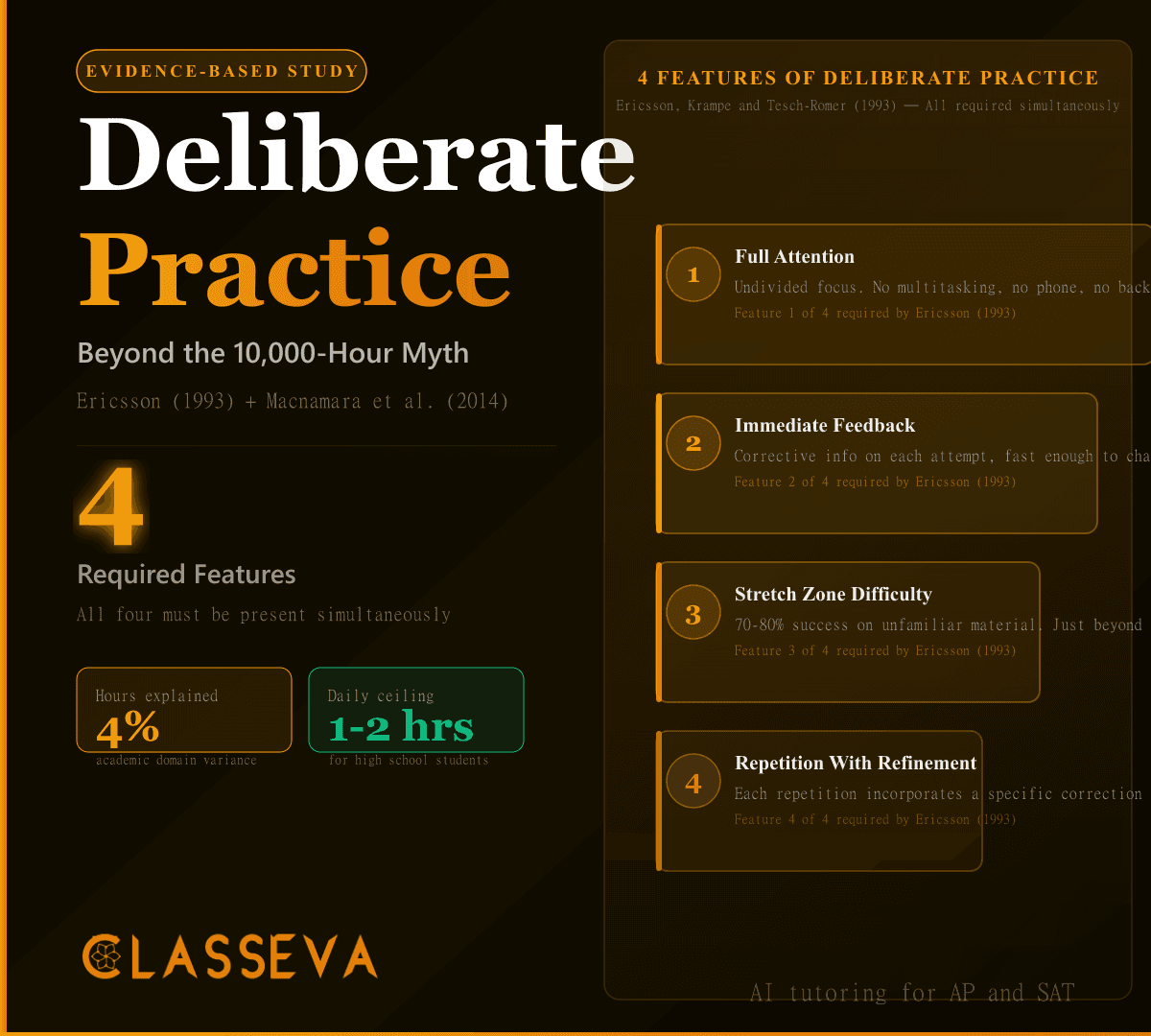
- The testing effect is weakest for complex procedural skills. AP Calculus and AP English essay production require deliberate practice methods alongside retrieval.