AP Biology Difficulty Decoded: Pass Rate and 5-Rate
The short answer: AP Biology is genuinely challenging, but it is one of the more achievable AP exams for students who study strategically. Looking at the College Board's score data, a few patterns stand out immediately that change how you should approach this exam.
How Hard Is AP Biology?
AP Biology has a pass rate of roughly 70% and a 5-rate that has climbed significantly since 2022. It sits in the middle of the AP difficulty spectrum — harder than AP Environmental Science and AP Psychology, but substantially more approachable than AP Chemistry or AP Physics C: Mechanics.
Pass Rate and 5-Rate in 2025
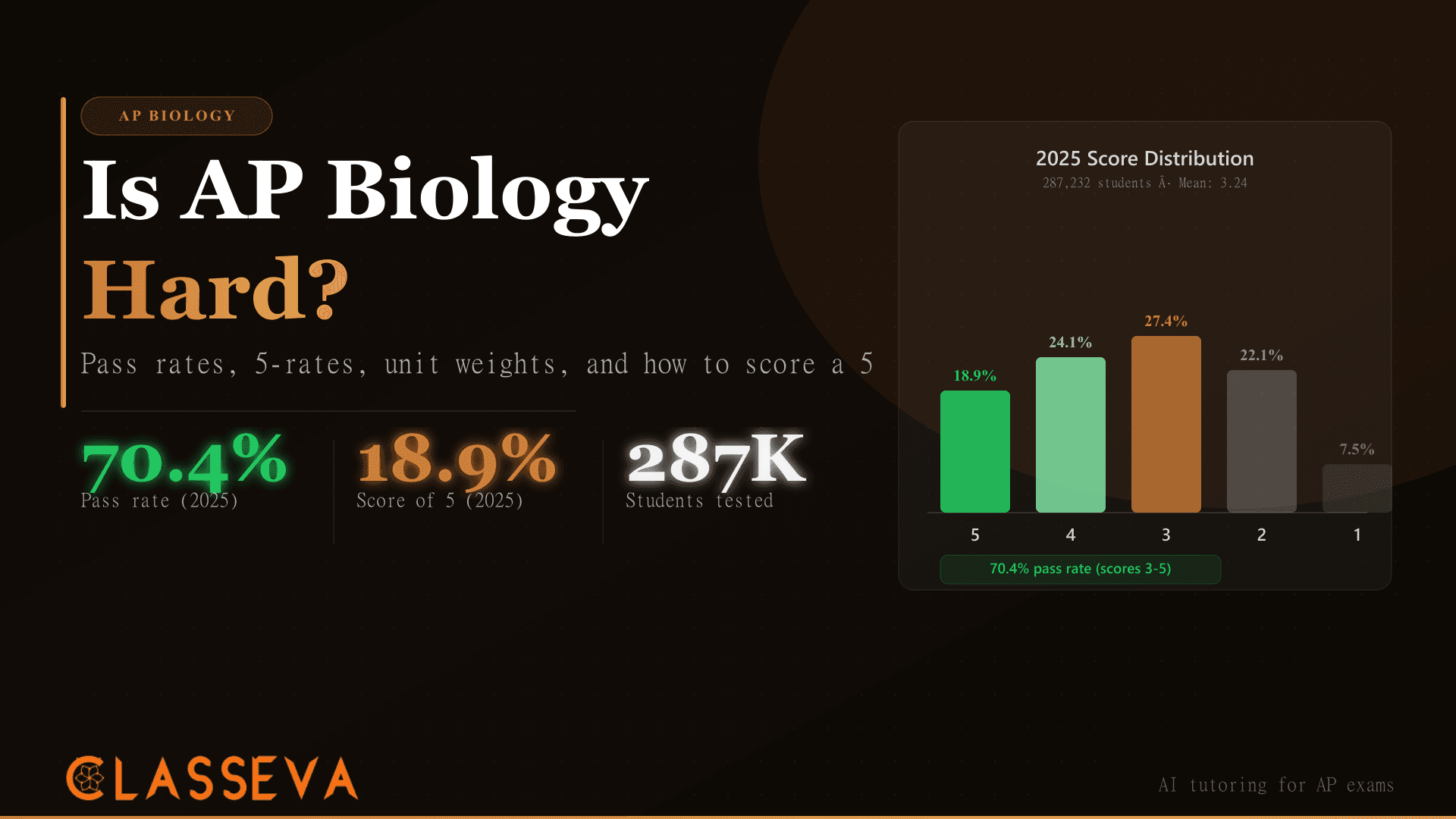
In 2025, 287,232 students sat the AP Biology exam. Here is the full score distribution:
| Score | Percentage | What It Means |
|---|---|---|
| 5 | 18.9% | Exceptional — college credit at most schools |
| 4 | 24.1% | Strong — credit at many schools |
| 3 | 27.4% | Pass — credit at some schools |
| 2 | 22.1% | Below passing |
| 1 | 7.5% | No credit |
Source: College Board AP Biology Score Distributions, 2025. Mean score: 3.24.
The 70.4% pass rate (scores 3 and above) and mean score of 3.24 put AP Biology among the more student-friendly AP exams. What is striking in the data is how much the 5-rate has changed: before 2022, it hovered between 7% and 9%. The shift to the current course framework — which emphasizes scientific practices and reasoning over content recall — appears to have rewarded students who study conceptually rather than memorizing definitions.
How AP Biology Compares to Other AP Sciences
AP Biology
- •5-rate: 18.9% (2025)
- •Pass rate: 70.4%
- •Broad conceptual scope
- •13 required lab investigations
AP Chemistry
- •5-rate: ~11-13%
- •Pass rate: ~56%
- •Heavy math and problem-solving
- •Harder to self-study
AP Environmental Science
- •5-rate: ~9%
- •Pass rate: ~53%
- •Often misjudged as easy
- •High 1-rate among underprepared students
AP Physics 1
- •5-rate: ~7%
- •Pass rate: ~43%
- •Hardest pass rate of any AP
- •Deep conceptual reasoning required
What Makes AP Biology Difficult?
What I find most consistent in studying AP Biology performance data is that the difficulty is rarely about raw content volume. Students who struggle are usually caught by one of three things: the breadth of topics, the lab-based analysis questions, or the open-ended FRQ section. Understanding which one affects you is the first step to fixing it.
Unit Weightings and the High-Stakes Zones
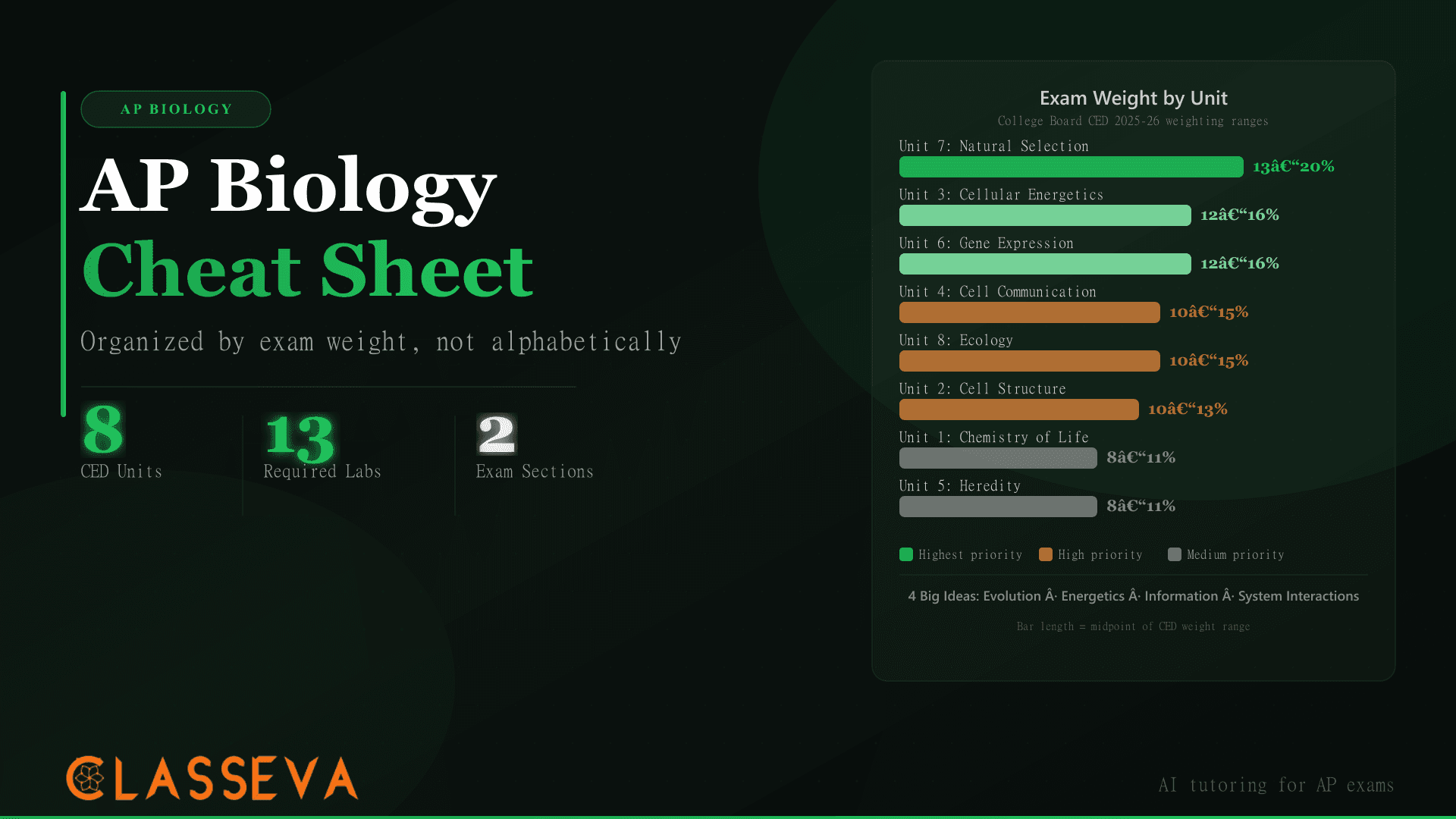
The AP Biology course is organized into eight units. College Board's Course and Exam Description (CED) assigns each unit a weighting range that reflects approximately how many exam points come from that area:
Unit 7 (Natural Selection and Evolution) carrying 13-20% is the most important single insight from the CED. Evolution is not just one unit to check off — it is the conceptual backbone of the entire course. Questions about genetics, ecology, and cell biology will often tie back to evolutionary principles.
Units 3 (Cellular Energetics), 6 (Gene Expression and Regulation), and 7 (Natural Selection and Evolution) together account for roughly 37-52% of your total exam score. If you are short on time, build these units first and build them deep.
The Lab Component
AP Biology requires 13 specific lab investigations, covering everything from osmosis and diffusion to gel electrophoresis to population genetics simulations. These labs are not peripheral — the exam actively tests lab data interpretation in both the multiple-choice and FRQ sections.
Students who engage seriously with labs during the school year tend to score higher on FRQs, because the exam repeatedly asks you to design experiments, interpret data tables, identify controls, and evaluate conclusions. That reasoning pattern is best learned by actually doing labs, not just reading about them.
Exam Structure: What You Are Actually Tested On
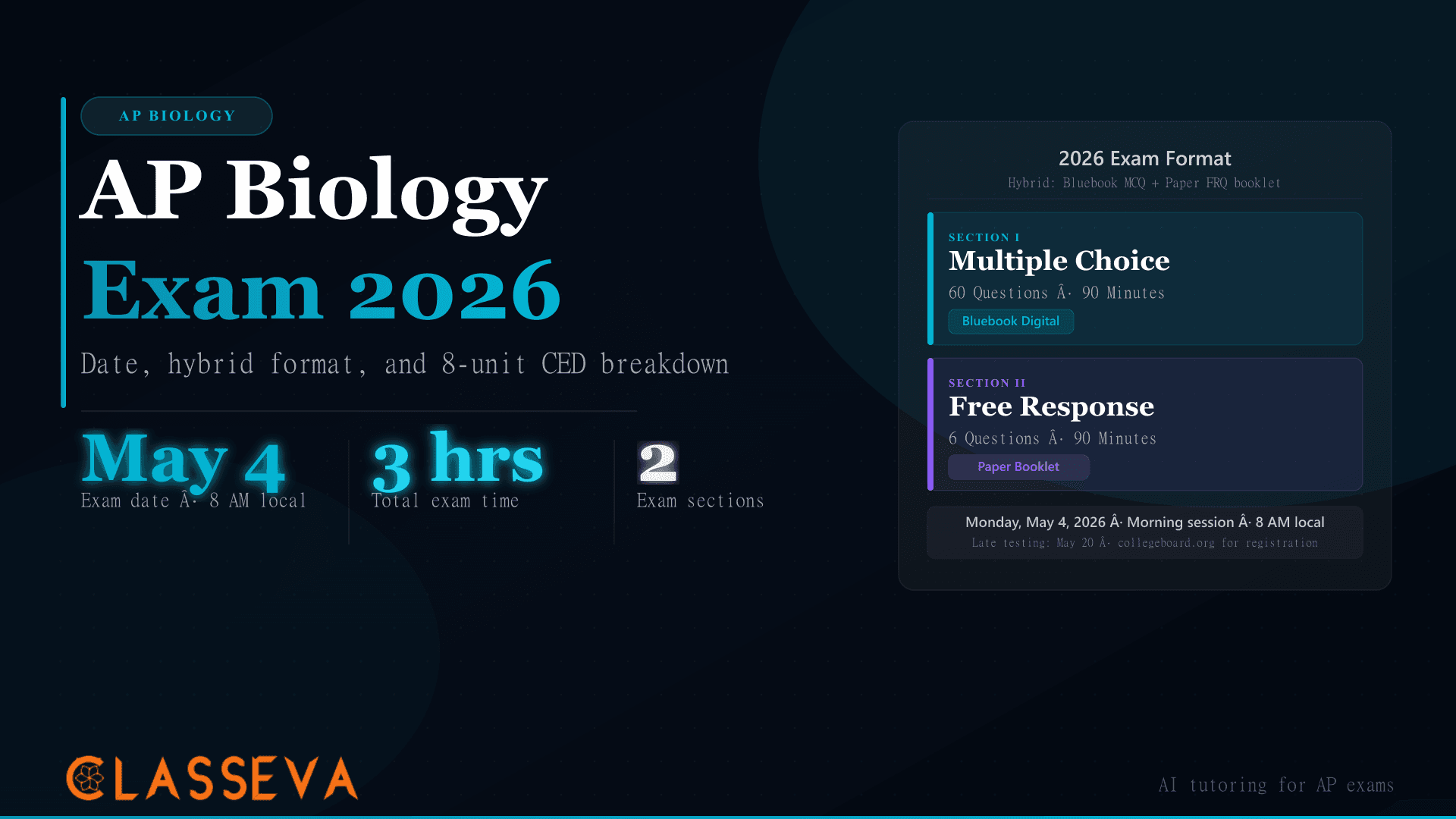
The AP Biology exam runs 3 hours and 15 minutes and is divided into two sections of equal weight:
| Section | Format | Time | Weight |
|---|---|---|---|
| Section I | 60 multiple-choice questions | 90 minutes | 50% |
| Section II | 6 free-response questions (2 long-form at 9 pts each, 4 short-answer at 4 pts each) | 90 minutes | 50% |
The 50/50 split means FRQ performance is just as important as MC accuracy.
The long-form FRQs typically ask you to analyze experimental data, design an experiment, and explain biological mechanisms. A student who can ace multiple-choice but writes vague FRQ answers will cap out around a 3.
How Long Should You Study for AP Biology?
Most students who earn a 4 or 5 on AP Biology study somewhere between 150 and 200 total hours over the school year. That range sounds large, but it breaks down into manageable weekly commitments.
Building a Study Schedule
Weeks 1-20 (September through January): Learn and engage deeply with each unit
Aim for 4-5 hours per week. The goal is not memorization — it is understanding mechanisms. For every concept, ask why it works the way it does, not just what it is. Work through the assigned lab investigations with that same curiosity.
Weeks 21-30 (February through March): First full-course review pass
Increase to 5-6 hours per week. Use College Board's AP Classroom progress checks as diagnostic tools, not just assignments. Identify which units still feel uncertain and schedule targeted review sessions.
Weeks 31-36 (April through early May): Intensive exam preparation
Allocate 8-10 hours per week. Complete at least two full practice exams under timed conditions. Score your FRQs against the official scoring guidelines — this is where most students discover whether their writing answers the actual question being asked.
The Final Two Months Before May
The 8 weeks before the AP Biology exam (March and April) are the highest-leverage study window. By this point, you have covered all the content in class. The goal is to consolidate, identify gaps, and practice under realistic test conditions.
Specifically in the final two months: complete every available free-response question from the past five years. College Board posts them with official scoring guidelines at no cost. Comparing your answer to the scoring rubric — point by point — is more revealing than any review book.
Strategies to Score a 5 on AP Biology
The 18.9% 5-rate in 2025 tells you that nearly one in five students who sit the exam earns the top score. These students are not smarter — they study differently. Three habits consistently separate 5-scorers from 3-scorers.
Focus on High-Weight Units First
Build your study sequence around the CED weightings, not the order units appear in class. Units 7, 3, and 6 together represent roughly 45% of the exam. Get those locked in before spending equal time on Unit 1 (Chemistry of Life, 5-11% weight), which — while important — will not rescue a weak Unit 7.
Start your final review with Unit 7 (Evolution), then work backward through Unit 6 (Gene Expression) and Unit 3 (Cellular Energetics) before moving to the remaining units. Evolution concepts reinforce the logic of genetics and cell function — studying it first makes the other units click faster.
Use the Testing Effect for Retention
Reading notes is comfortable. It also does very little for long-term retention. Research by Roediger and Karpicke (2006) showed that retrieval practice — actively trying to recall information — produces significantly better retention than re-reading the same content, even when students feel like re-reading is more effective.
For AP Biology, this means: close your notes and write down everything you remember about photosynthesis before re-reading the section. Use AP Classroom progress checks as retrieval practice, not as a way to check whether you learned something. The moment of struggling to recall is where learning happens.
Practice FRQs Under Timed Conditions
AP Biology FRQs are not essay questions. Each point in the rubric corresponds to a specific biological concept, accurately stated. Vague answers that are directionally correct but missing the precise mechanism earn zero. The only way to learn the graders' expectations is to write full practice FRQ answers and compare them against the official scoring guidelines.
Writing full sentences without hitting the specific biological term the rubric requires earns zero credit. A student who writes "the cell uses energy to move molecules against the gradient" instead of "the sodium-potassium pump uses ATP hydrolysis to actively transport ions" may lose every point on that sub-question. Precision matters more than paragraph length.
Where Do You Stand? Use the AP Score Predictor
If you want to gauge your likely AP Biology score based on your current practice test performance, use Classeva's AP Score Predictor. It maps raw scores and section breakdowns to the likely AP score range, adjusted for the specific score distributions of each AP subject.
AP Score Predictor
Enter your practice test results to see your projected AP Biology score and what you need to improve to reach the next band.
Key Takeaways
- AP Biology is moderately difficult — a 70.4% pass rate and 18.9% 5-rate put it in the middle of the AP science difficulty spectrum, well above AP Physics 1 but easier than AP Chemistry.
- Unit 7 (Natural Selection) is the highest-weighted unit, carrying up to 20% of the exam. Study it first and revisit it last.
- The exam splits evenly between MC and FRQs. Ignoring FRQ practice is how otherwise prepared students cap at a 3.
- Active retrieval practice outperforms re-reading for long-term retention — a finding consistently supported by cognitive science research since Roediger and Karpicke (2006).
- Most 4s and 5s come from students who practice past FRQs against official scoring guidelines, not just from students who covered more content.
- 150-200 total study hours is the realistic range for a strong score, spread across the school year with an intensified final 8-week block.
- The 5-rate jumped after 2022 because the current exam rewards conceptual reasoning over memorization — a shift that favors students who understand the why behind each biological mechanism.
Frequently Asked Questions
Is AP Biology harder than AP Chemistry?
AP Chemistry has a lower pass rate (roughly 56%) and a 5-rate around 11-13%, which makes it statistically harder than AP Biology. AP Biology demands more breadth; AP Chemistry demands more mathematical precision. Pre-med students typically take both, starting with AP Biology in junior year.
What is a good AP Biology score?
A score of 3 passes the exam and may earn college credit, but many selective universities require a 4 or 5 for credit in introductory biology. Pre-med students aiming at credit-worthy placement should target a 5. Check each university's AP credit policy directly using their Common Data Set or academic catalog.
How many hours do you need to study for AP Biology?
Most students need 150-200 total hours: roughly 4-6 hours per week during the school year plus 30-50 additional focused hours in the 8 weeks before the May exam. Students who engage seriously with the 13 required lab investigations tend to need fewer catch-up hours, because lab work builds conceptual understanding that pure reading does not.
Can I self-study AP Biology and still pass?
Yes. AP Biology is one of the more accessible self-study AP exams because its concepts build logically and College Board publishes full FRQ scoring guidelines that double as self-teaching tools. The main challenge is the 13 required lab investigations — if you self-study, focus extra time on conceptual lab analysis since you may not complete wet labs.
What units are most important for AP Biology?
Unit 7 (Natural Selection and Evolution) carries 13-20% of the exam weight, making it the single highest-weighted unit. Units 3 (Cellular Energetics) and 6 (Gene Expression and Regulation) each contribute 12-16%. Together these three units account for 37-52% of your score — study them first and return to them last.
Does AP Biology have a lot of math?
AP Biology includes quantitative reasoning but is not math-intensive in the way AP Calculus or AP Physics C are. You need to interpret graphs, calculate chi-squared statistics, apply Hardy-Weinberg equilibrium equations, and use basic algebra. Students comfortable with those concepts rarely describe math as a barrier in AP Biology.
When is the AP Biology exam in 2026?
The AP Biology exam is scheduled for Monday, May 4, 2026, in the morning session. College Board publishes the complete AP exam schedule on apstudents.collegeboard.org each fall.
Score data sourced from College Board AP Score Distributions (2025). CED unit weightings from the AP Biology Course and Exam Description.