AP Biology Cheat Sheet: Process and Cycle Reference Guide
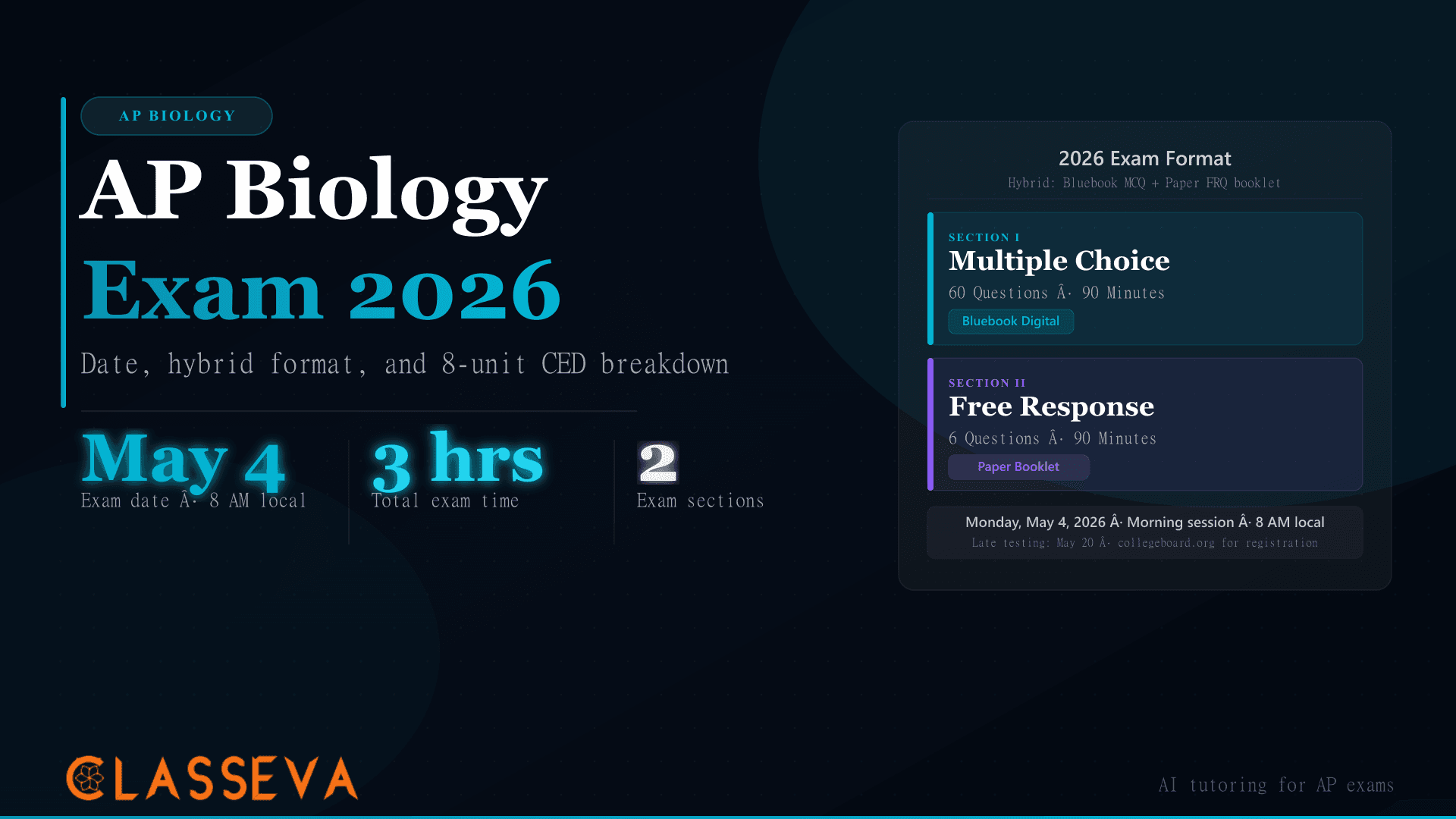
Building Classeva's AP Biology content, the pattern I kept seeing was students spending equal time on every unit as if Unit 1 (Chemistry of Life, 8-11% weight) and Unit 7 (Natural Selection, 13-20% weight) carry the same stakes. They do not. This AP Biology cheat sheet corrects that. Every section is ordered by exam weight, not by where it falls in the textbook. For pass rate data and study hour estimates, see AP Biology Difficulty Decoded. For score distribution breakdowns by unit, see the AP Biology score distribution guide. For 2026 exam dates and format changes, see the AP Biology 2026 exam overview.
The 8 AP Biology Units and How Much They Count
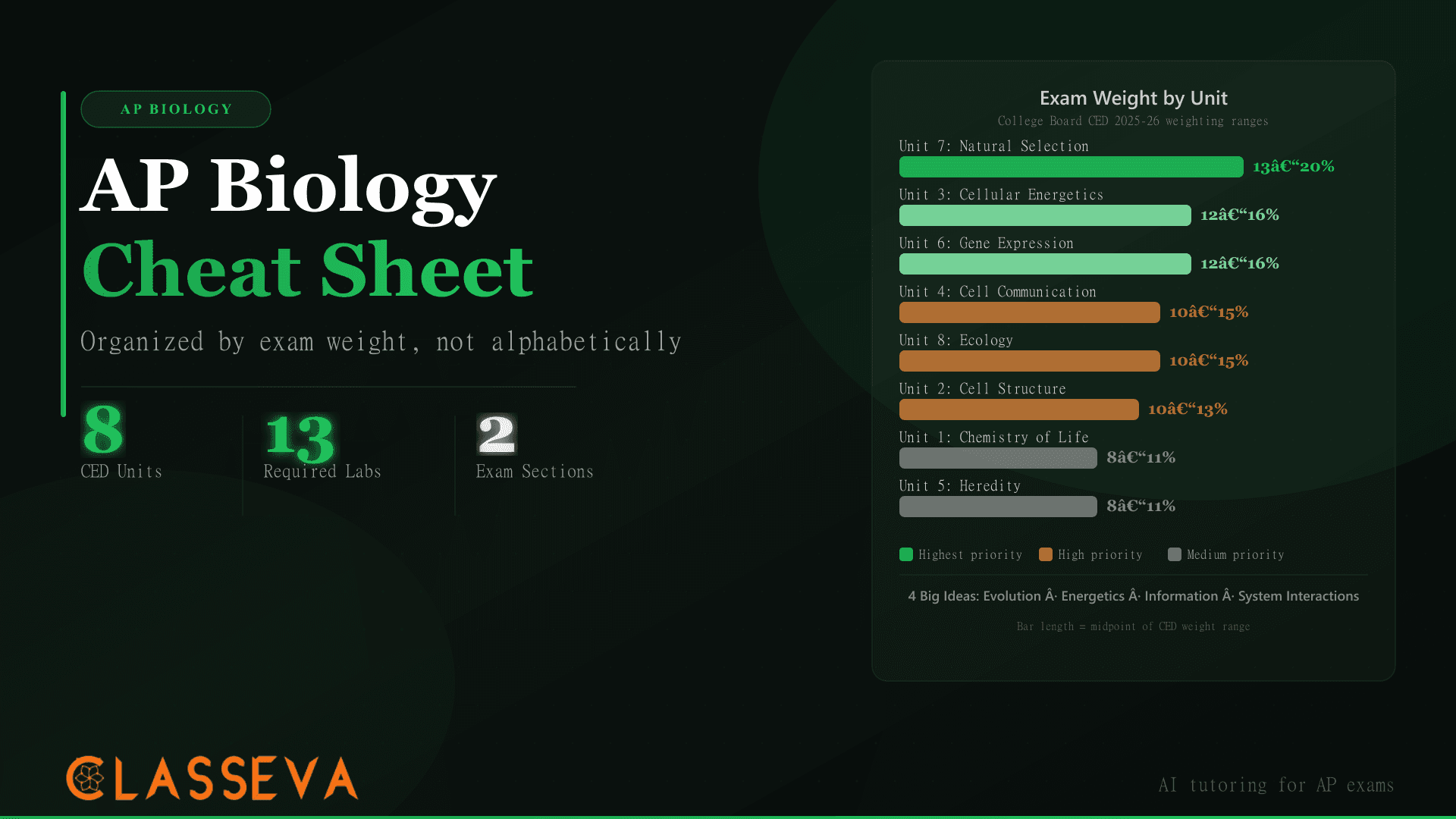
The College Board's AP Biology Course and Exam Description assigns each unit an exam weight range. These percentages determine how many multiple-choice questions and FRQ points derive from each unit. Knowing them changes how you allocate study time.
| Unit | Topic | Exam Weight | Priority |
|---|---|---|---|
| 7 | Natural Selection and Evolution | 13–20% | Highest |
| 3 | Cellular Energetics | 12–16% | High |
| 6 | Gene Expression and Regulation | 12–16% | High |
| 4 | Cell Communication and Cell Cycle | 10–15% | High |
| 8 | Ecology | 10–15% | High |
| 2 | Cell Structure and Function | 10–13% | Medium |
| 1 | Chemistry of Life | 8–11% | Medium |
| 5 | Heredity | 8–11% | Medium |
Source: AP Biology Course and Exam Description, College Board (2025-26 CED). Weights reflect the percentage of exam questions drawn from each unit.
How to Prioritize Using Exam Weights
The top five units by weight (Units 7, 3, 6, 4, 8) together cover 57-82% of the exam. Build your study sequence around them first. Units 1, 2, and 5 still matter, but gaps in the high-weight units cost more points.
Start your final review with Unit 7 (Natural Selection), then move through Units 3 and 6 (Cellular Energetics, Gene Expression), then Units 4 and 8 (Cell Signaling, Ecology), then the remaining units. Evolution concepts reinforce everything else: selection acts on genetic variation (Unit 6), which depends on cellular processes (Unit 3). Use the AP Exam Date Countdown to map this review sequence to your actual calendar before the May exam.
Unit 7: Natural Selection and Evolution (13–20%)
Unit 7 carries the highest exam weight of any single AP Biology unit. Natural selection drives the diversity and unity of life. That is Big Idea 1, and it connects to content across every other unit on the exam. FRQs from recent years (speciation via the Isthmus of Panama in 2025, peppered moth data analysis in prior years) confirm this unit generates some of the most complex questions.
The Hardy-Weinberg Principle
The Hardy-Weinberg principle is the null hypothesis for population genetics: it describes a theoretical population where allele and genotype frequencies remain constant across generations. The two key equations are p + q = 1 (allele frequencies) and p² + 2pq + q² = 1 (genotype frequencies), where p = frequency of the dominant allele and q = frequency of the recessive allele.
Hardy-Weinberg equilibrium requires five conditions: large population size, random mating, no mutation, no migration (gene flow), and no natural selection. The 2025 CED clarifies that Hardy-Weinberg should be treated as a null hypothesis, not a description of real populations. On the exam, deviations from equilibrium signal that evolution is occurring.
Key Evolution Terms for the Exam
| Term | Definition | FRQ Connection |
|---|---|---|
| Natural selection | Differential reproductive success based on heritable variation in traits | Link to fitness consequences in any population scenario |
| Genetic drift | Random changes in allele frequency, strongest in small populations | Bottleneck and founder effect questions |
| Gene flow | Movement of alleles between populations via migration | Explains deviation from Hardy-Weinberg |
| Allopatric speciation | Species divergence caused by geographic isolation | 2025 FRQ: Isthmus of Panama separating marine populations |
| Phylogeny | Evolutionary relationships shown as a branching tree | Cladogram interpretation and shared derived characters |
| Convergent evolution | Independent evolution of similar traits in unrelated lineages | Analogous vs. homologous structures |
Terms organized by exam FRQ frequency. Allopatric speciation appeared on the 2025 FRQ (Question 4, Isthmus of Panama scenario).
Units 3 and 6: Cellular Energetics and Gene Expression (12–16% Each)
Units 3 and 6 together cover 24-32% of the AP Biology exam. Both connect to Big Idea 2 (Energetics) and Big Idea 3 (Information). The 2025 FRQs tested protein transport to the endoplasmic reticulum (Unit 6) and metabolic enzyme pathways (Unit 3) in the same exam, confirming these two units generate a disproportionate share of the harder FRQ questions.
Photosynthesis: Light Reactions and the Calvin Cycle
Photosynthesis converts light energy into chemical energy stored in glucose. The process splits across two stages in the chloroplast. Light reactions occur in the thylakoid membrane; the Calvin cycle runs in the stroma.
Light reactions:Photosystem II absorbs light, splits water (photolysis), and releases O² as a byproduct. Excited electrons pass through the electron transport chain, generating a proton gradient that drives ATP synthesis via ATP synthase. Photosystem I generates NADPH. Net products per two water molecules split: 3 ATP + 2 NADPH + O².
Calvin cycle (carbon fixation):CO² is fixed by RuBisCO onto RuBP (5-carbon). Three-carbon intermediates (3-PGA) are reduced using ATP and NADPH to form G3P. Some G3P exits to build glucose; the remainder regenerates RuBP. Net cost per CO² fixed: 3 ATP + 2 NADPH.
Cellular Respiration: Glycolysis, Krebs, and the ETC
Cellular respiration converts glucose back into ATP through three stages. Glycolysis runs in the cytoplasm; the Krebs cycle and electron transport chain run in the mitochondria.
Glycolysis (cytoplasm): Glucose (6C) splits into 2 pyruvate (3C), producing 2 net ATP and 2 NADH. No oxygen required. Krebs cycle (mitochondrial matrix): Each pyruvate is converted to acetyl-CoA, releasing CO². Per glucose: 2 ATP, 6 NADH, 2 FADH². Electron transport chain(inner mitochondrial membrane): NADH and FADH² donate electrons, driving ATP synthesis via chemiosmosis. Oxygen accepts electrons at the end, forming water. Yield: approximately 32-34 ATP per glucose.
Transcription and Translation: The Central Dogma
The central dogma of molecular biology describes the flow of genetic information: DNA is transcribed into mRNA, which is then translated into protein. The 2025 CED added explicit requirements for transcription and translation details that previously were implicit.
Transcription (nucleus): RNA polymerase binds to the promoter region of DNA. It reads the template strand in the 3′ to 5′ direction, building pre-mRNA in the 5′ to 3′ direction. The pre-mRNA receives a 5′ cap and poly-A tail, then introns are spliced out, leaving mature mRNA. Translation (ribosome): The ribosome reads mRNA codons (triplets). Each codon pairs with a tRNA anticodon carrying a specific amino acid. The AUG codon (start codon) sets the reading frame. Peptidyl transferase catalyzes peptide bond formation. The UAA, UAG, or UGA stop codon releases the polypeptide.
Mutations: Types and Consequences
The 2025 CED added explicit definitions for point mutations, frameshift mutations, nonsense mutations, and silent mutations. Each type produces distinct consequences for protein structure and function.
| Mutation Type | What Changes | Effect on Protein |
|---|---|---|
| Point mutation (missense) | Single nucleotide substitution changes one amino acid | Altered protein function (may be gain- or loss-of-function) |
| Silent mutation | Nucleotide change produces same amino acid (codon degeneracy) | No change: protein identical |
| Nonsense mutation | Substitution creates a premature stop codon | Truncated, nonfunctional protein |
| Frameshift (insertion) | Extra nucleotide shifts reading frame downstream | Completely different amino acid sequence after insertion point |
| Frameshift (deletion) | Missing nucleotide shifts reading frame downstream | Nonfunctional protein; often more severe than insertion |
Frameshift mutations are generally more damaging than point mutations because they alter every codon downstream of the mutation site.
Students often describe any nucleotide substitution as “nonsense.” Nonsense specifically means the new codon is a stop codon (UAA, UAG, UGA). A substitution that changes one amino acid but not to a stop codon is missense. The distinction matters because the consequences on protein length differ completely.
Units 4 and 8: Cell Communication and Ecology (10–15% Each)
Units 4 and 8 both sit at 10-15% exam weight. Cell communication (Unit 4) connects to Big Idea 3 (Information) and focuses on how cells detect and respond to signals. Ecology (Unit 8) expanded substantially in the 2025 CED, with dedicated content on all four major biogeochemical cycles.
Signal Transduction Pathways
Signal transduction converts an extracellular signal into a cellular response through three stages: reception, transduction, and response.
Reception: A ligand (signal molecule) binds to a receptor. Receptor types include G protein-coupled receptors (GPCRs), receptor tyrosine kinases (RTKs), and ligand-gated ion channels. Lipid-soluble signals (steroid hormones) cross the membrane and bind intracellular receptors directly. Transduction: Binding triggers a phosphorylation cascade (kinases add phosphate groups to activate downstream proteins) or second messenger production (cAMP, IP₃, Ca²♠). Response: The final signal reaches transcription factors, enzymes, or cytoskeletal proteins, altering gene expression, metabolism, or cell movement.
The 2025 FRQ Question 2 tested signal transduction in the context of moth pheromone response, confirming that the exam connects Unit 4 mechanisms to real-world scenarios rather than isolated definitions. Apoptosis (programmed cell death) also sits in Unit 4: when internal signals trigger caspase activation, the cell dismantles itself in a controlled sequence. This prevents the cellular damage that would result from necrosis, and it matters because cancer often involves mutations that disable apoptosis signaling.
Mitosis vs. Meiosis: The Key Differences
Mitosis produces two genetically identical diploid daughter cells for growth and repair. Meiosis produces four genetically unique haploid cells for sexual reproduction. The 2025 CED added explicit stage-by-stage descriptions for both processes.
Ecology: Populations, Cycles, and Ecosystems
Unit 8 expanded in the 2025 CED, with individual learning objectives now dedicated to each major biogeochemical cycle. These cycles appear on FRQs as experimental design scenarios (buffelgrass and desert ecosystems, for example, appeared in the 2025 FRQ).
| Cycle | Key Reservoir | Key Process | FRQ Connection |
|---|---|---|---|
| Carbon | Atmosphere (CO₂), organic matter | Photosynthesis (fixation), respiration (release) | Climate change, ocean acidification scenarios |
| Nitrogen | Atmosphere (N₂ gas) | Nitrogen fixation (bacteria), nitrification, denitrification | Eutrophication, fertilizer runoff questions |
| Phosphorus | Rock (geological), soil | Weathering releases phosphate; no atmospheric form | Limiting nutrient in freshwater ecosystems |
| Water | Oceans, groundwater | Evaporation, transpiration, precipitation, runoff | Transpiration experiments (Lab 11) |
Phosphorus is the only major biogeochemical cycle with no significant atmospheric phase, a fact that frequently appears in AP Biology FRQs.
Population Ecology
- •Exponential growth (J-curve): unlimited resources
- •Logistic growth (S-curve): carrying capacity (K)
- •Density-dependent vs density-independent limiting factors
- •r-strategists (many offspring, low parental care) vs K-strategists
- •Survivorship curves: Type I, II, III
Community and Ecosystem Ecology
- •Trophic levels: producers → primary consumers → secondary → tertiary
- •10% rule: ~10% of energy transfers between trophic levels
- •Primary vs secondary succession
- •Keystone species: disproportionate ecosystem impact
- •Species diversity: richness + evenness
Units 2, 1, and 5: The Foundation Units (8–13%)
These three units carry the lowest individual exam weights, but they provide foundational concepts that appear in the reasoning required for higher-weight units. Missing gaps here shows up as lost FRQ points when a question about evolution or energetics requires cellular or chemical context.
Unit 1: The Four Macromolecules
The 2025 CED reorganized Unit 1 so each macromolecule gets its own dedicated topic. Sulfur was added as a biological element (the list is now CHONPS: carbon, hydrogen, oxygen, nitrogen, phosphorus, sulfur). Lipids expanded to include distinctions between saturated and unsaturated fatty acids and cholesterol's role in vertebrate animal membranes.
| Macromolecule | Monomer | Bond | Primary Function(s) |
|---|---|---|---|
| Carbohydrate | Monosaccharide (glucose, fructose) | Glycosidic bond | Energy storage (glycogen, starch); structural support (cellulose, chitin) |
| Lipid | Glycerol + fatty acids | Ester bond | Membrane bilayer (phospholipids); long-term energy storage (triglycerides); signaling (steroid hormones) |
| Protein | Amino acid | Peptide bond | Enzymes; structural support; signaling; transport; defense (antibodies) |
| Nucleic acid | Nucleotide | Phosphodiester bond | Genetic information storage (DNA); protein synthesis (RNA); energy transfer (ATP) |
Proteins have four levels of structure: primary (amino acid sequence), secondary (alpha helix or beta sheet via H-bonds), tertiary (3D folding), quaternary (multiple polypeptides). Enzyme activity is temperature- and pH-sensitive because both disrupt hydrogen bonds.
Unit 2: Cell Structure and Membrane Transport
Unit 2 covers organelle function, the fluid mosaic model of membranes, and transport mechanisms. The 2025 CED introduced the endomembrane system as a connected concept (ER, Golgi, lysosomes, vesicles) and separated facilitated diffusion and active transport into distinct learning objectives for clearer exam targeting.
Transport quick reference: Passive diffusion moves substances down their concentration gradient, no ATP required. Facilitated diffusion uses transport proteins but still moves down the gradient. Active transport moves substances against their concentration gradient and requires ATP (e.g., sodium-potassium pump). Bulk transport (endocytosis, exocytosis) moves large molecules via membrane vesicles.
Enzyme kinetics (Lab 13 connection): Enzymes lower activation energy without being consumed. Substrate concentration affects reaction rate up to Vmax (maximum velocity when all active sites are saturated). Km (Michaelis constant) is the substrate concentration at half Vmax — a lower Km means the enzyme has higher affinity for its substrate. Competitive inhibitors block the active site and raise apparent Km without changing Vmax; noncompetitive inhibitors bind elsewhere and lower Vmax without changing Km. FRQs routinely present enzyme activity graphs and ask students to identify inhibitor type from the data.
Unit 5: Heredity and Mendelian Genetics
The 2025 CED significantly revised Unit 5. Meiosis now requires explicit stage-by-stage knowledge (prophase I through anaphase II). Nondisjunction moved into Topic 5.2. Codominance, incomplete dominance, and pleiotropy received explicit definitions. Polygenic traits and multiple alleles were removed, as was the full chromosomal inheritance topic (5.6) except for sickle cell disease as the example of heterozygote advantage.
Key inheritance patterns: Complete dominance (Aa shows dominant phenotype). Incomplete dominance (Aa shows intermediate phenotype, as in snapdragon flower color). Codominance (Aa shows both phenotypes simultaneously, as in blood type AB). Pleiotropy (one gene affects multiple traits, as in sickle cell disease affecting red blood cell shape, oxygen transport, and joint pain). Nondisjunction during meiosis I or II produces aneuploid gametes carrying an extra or missing chromosome, which can lead to trisomy (e.g., trisomy 21) or monosomy in offspring.
Punnett squares remain tested but only for monohybrid crosses with the patterns above. Dihybrid crosses were removed from the 2025 CED. Use chi-square analysis to determine whether observed offspring ratios deviate significantly from Mendelian predictions — the exam provides the chi-square formula and critical values table.
The 13 Required Lab Investigations
College Board requires 13 specific lab investigations, organized by the four big ideas. Lab reasoning (experimental design, identifying controls, interpreting data) appears on FRQs every year. The 2025 FRQ Question 6 tested meiosis and genetic mutations in gamete-producing cells, connecting directly to Labs 7 and the heredity content.
| Lab | Title | Big Idea |
|---|---|---|
| 1 | Artificial Selection | Evolution |
| 2 | Mathematical Modeling: Hardy-Weinberg | Evolution |
| 3 | Comparing DNA Sequences to Understand Evolutionary Relationships (BLAST) | Evolution |
| 4 | Diffusion and Osmosis | Energetics |
| 5 | Photosynthesis | Energetics |
| 6 | Cellular Respiration | Energetics |
| 7 | Cell Division: Mitosis and Meiosis | Information |
| 8 | Biotechnology: Bacterial Transformation | Information |
| 9 | Biotechnology: Restriction Enzyme Analysis of DNA | Information |
| 10 | Energy Dynamics | System Interactions |
| 11 | Transpiration | System Interactions |
| 12 | Fruit Fly Behavior | System Interactions |
| 13 | Enzyme Activity | System Interactions |
Source: AP Biology Investigative Labs (College Board, AP Central). Lab reasoning, not just the results, is what the exam tests.
College Board publishes the full lab manual and investigation protocols through AP Central's investigative labs page. Every lab connects to at least one big idea, which is exactly how FRQ questions frame their prompts. Students who earn a 4 or 5 typically qualify for college credit that skips introductory biology; the AP Credit Savings Calculator shows how that translates to tuition at specific colleges.
How to Use This AP Biology Cheat Sheet
A reference guide works for active recall, not passive review. Here is the pattern that produces the most score improvement:
Step 1: Cover each unit section. Recite the key process steps from memory before reading. Step 2: For any process you cannot recite fully, write it out once without looking. Then check. Step 3: Connect each concept to its big idea. AP FRQs almost always ask “explain how [mechanism] relates to [evolution / energetics / information flow / systems interactions].” If you cannot make that connection, you will lose points even on content you know. Step 4: Cross-reference with released FRQ questions from the AP Central past exam questions page to confirm which sections actually appear on FRQs.
The downloadable PDF version of this guide is available through the AP Biology resources hub, which also links to official College Board FRQ scoring guidelines and past exams. Use both together.
If you want to estimate where you stand before the May exam, Classeva's AP Score Predictor maps your practice performance to a projected AP Biology score range. Pair the predictor with this reference to identify which units are dragging your score.
Key Takeaways
- Unit 7 (Natural Selection) is the highest-weighted unit at 13-20%. Study it first in your final review and return to it last.
- Units 3 and 6 together (Cellular Energetics + Gene Expression) cover 24-32% of the exam. Photosynthesis, respiration, transcription, and translation generate more FRQ points than any other content area.
- The 2025 CED made significant changes: CHONPS (not CHONP), explicit meiosis and mitosis stages, Hardy-Weinberg as null hypothesis, expanded biogeochemical cycles, and removed chromosomal inheritance patterns and polygenic traits.
- All four big ideas organize the exam: Evolution, Energetics, Information, System Interactions. Every FRQ asks you to connect a specific mechanism to at least one big idea.
- Lab reasoning matters as much as content recall. FRQs test experimental design, identifying controls, and interpreting data tables, not just naming the lab investigation.
- Precision in terminology is how FRQ points are earned. Describing “the enzyme that links RNA nucleotides” instead of naming “RNA polymerase” typically earns zero credit, even if the surrounding reasoning is correct.
- The AP Biology resources hub at /us/resources/ap/biology carries the downloadable PDF of this reference, official FRQ archives, and scoring guidelines from College Board.
Frequently Asked Questions
How do I use an AP Biology cheat sheet effectively?
Use this reference for active recall, not passive reading. Cover each section, recite the key process steps from memory, then check. For each unit, connect the content to the big ideas (Evolution, Energetics, Information, Interactions): AP exam FRQs almost always ask you to link a specific mechanism to one of these overarching themes.
What are the most-tested concepts on the AP Biology exam?
Unit 7 (Natural Selection) carries the single largest exam weight at 13-20%. Units 3 (Cellular Energetics) and 6 (Gene Expression) each contribute 12-16%. Together these three units account for 37-52% of the exam. Hardy-Weinberg equilibrium, photosynthesis, cellular respiration, transcription, translation, and signal transduction appear on FRQs most consistently across years.
Is memorization enough to score a 4 or 5 on AP Biology?
No. The AP Biology exam explicitly tests applied reasoning across all six science practices, not recall alone. Concept Explanation (25-33% of the exam) and Argumentation (20-26%) together account for up to 59% of the score. Students who memorize definitions but cannot explain mechanisms or evaluate experimental data consistently cap around a 3.
How many units does AP Biology cover?
AP Biology covers 8 units in the 2025-26 CED: Chemistry of Life, Cell Structure and Function, Cellular Energetics, Cell Communication and Cell Cycle, Heredity, Gene Expression and Regulation, Natural Selection, and Ecology. Each unit connects to at least one of the four big ideas that organize the entire course.
What changed in the 2025 AP Biology CED?
The 2025 CED made several notable changes: sulfur was added to the biological elements list (CHONPS, not CHONP); mitosis and meiosis phases are now explicitly required content; Hardy-Weinberg equilibrium is clarified as a null hypothesis rather than a real-world condition; chromosomal inheritance patterns and polygenic traits were removed; and biogeochemical cycles (water, carbon, nitrogen, phosphorus) received dedicated coverage in Unit 8.
Where can I download an AP Biology PDF cheat sheet?
Classeva offers a downloadable PDF version of this reference guide through the AP Biology resources hub at tutorioo.com/us/resources/ap/biology. The PDF is organized by exam weight and includes the key process summaries, term definitions, and lab investigation list from this post.
What is the hardest unit in AP Biology?
Unit 6 (Gene Expression and Regulation) consistently draws the lowest FRQ scores according to College Board scoring statistics. Transcription and translation require precise terminology: losing a single term like "AUG start codon" or "peptidyl transferase" can cost multiple points on a single FRQ question. Unit 3 (Cellular Energetics) ranks a close second in difficulty due to its detail on photosynthesis and respiration mechanisms.
Should I use a printed or digital AP Biology cheat sheet?
Printed works better for active recall sessions: write over blank sections, fold the page to cover definitions, and physically annotate connections between concepts. Digital works better for search and cross-referencing during timed review. Many students keep the digital version on their phone for commutes and pull out the printed version for focused study blocks.
Unit weightings sourced from the AP Biology Course and Exam Description (2025-26, College Board). Score distributions sourced from 2025 AP Score Distributions. CED changes verified against AP Central released FRQ materials. Last verified May 2026.