AP Biology Exam 2026: Date, Time, and 8-Unit Format
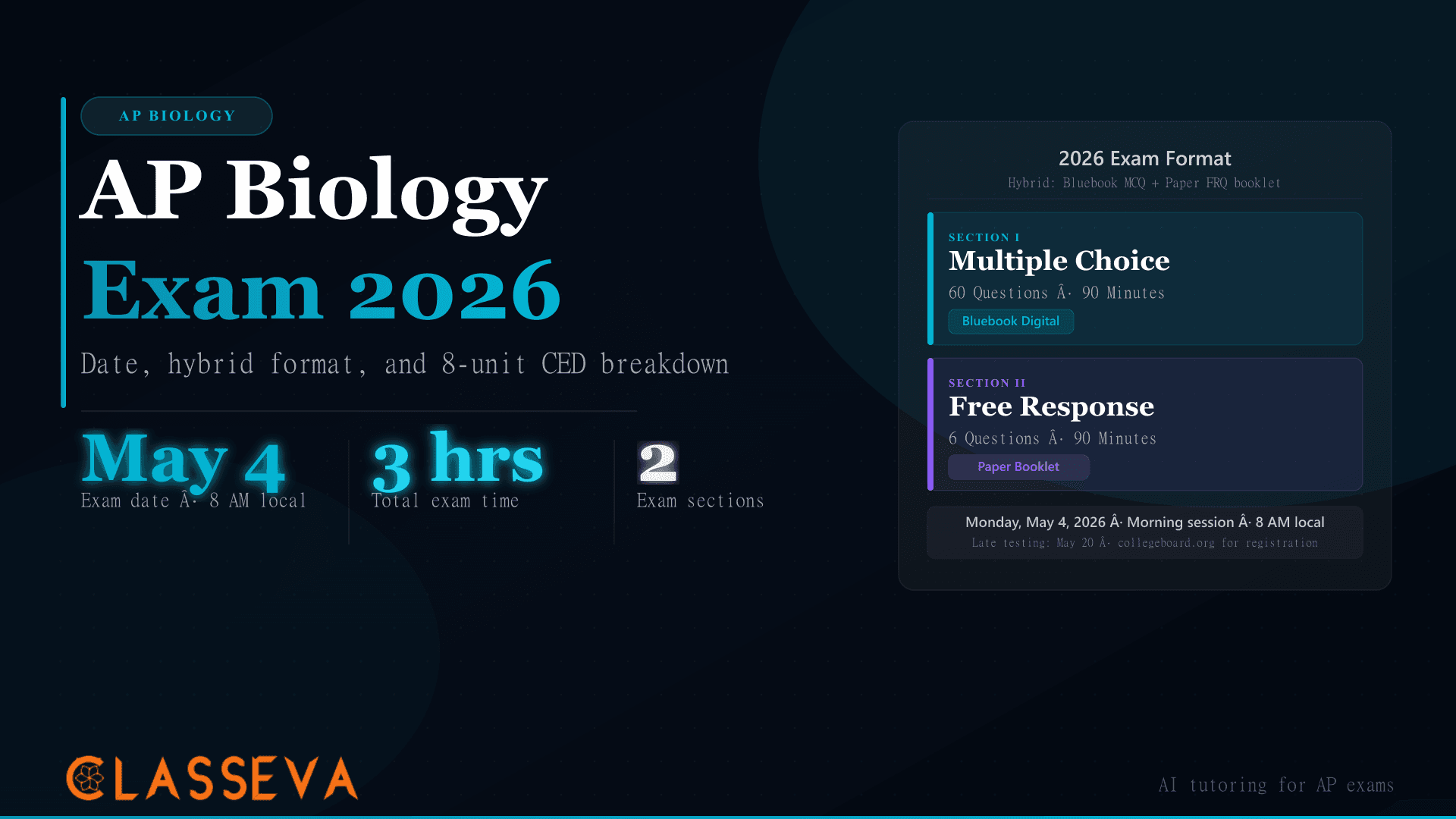
The AP Biology exam in 2026 lands on Monday, May 4, at 8 a.m. local time. Three hours, two sections, eight curriculum units, one hybrid digital format. The exact date, format breakdown, and exam-day logistics are all verified below against the current College Board schedule.
When Is the AP Biology Exam in 2026?
According to the College Board's 2026 AP exam calendar, the AP Biology exam falls on Monday, May 4, 2026, in the morning session. Schools must begin between 8 and 9 a.m. local time. May 4 opens the first administration week, which runs May 4-8; a second week follows May 11-15. AP Biology sits on the first day of the entire 2026 exam window.
The AP Exam Date Countdown below tracks how many days remain between today and May 4. Use it to map your final study weeks against the actual calendar. Knowing the exact gap between now and exam day changes how you allocate time across the eight CED units.
AP Exam Date Countdown
See exactly how many days remain until the May 4, 2026 AP Biology exam. Track your final weeks of prep against the real calendar.
How Long Is the AP Biology Exam?
The AP Biology exam runs exactly 3 hours. Section I and Section II each run 90 minutes, with a short break of roughly 10 minutes between them. That break does not count toward your testing time. Your actual time in the testing room runs closer to 4 hours once you add Bluebook sign-in, instruction reading, and the break itself. Plan your morning with this in mind, especially if you have a long commute to the testing location.
What Is the AP Biology Late Testing Date for 2026?
The AP Biology late testing date is Wednesday, May 20, 2026, at 8 a.m. local time. Late testing applies to students with a documented conflict on May 4: a religious observance, another AP exam scheduled simultaneously, or a school-verified emergency. Request late testing through your school's AP coordinator before May 4 passes. Students who miss both dates do not receive a refund and cannot submit a score for that year.
What Is the Format of the AP Biology Exam in 2026?
The AP Biology exam divides into two sections of identical length and equal score weight. AP Central's AP Biology exam page confirms Section I covers 60 multiple-choice questions in 90 minutes and Section II covers 6 free-response questions in 90 minutes. Each section contributes exactly 50% to your composite AP score. The full exam runs 3 hours.
Section I: 60 Multiple-Choice Questions in 90 Minutes
Sixty questions in 90 minutes works out to 90 seconds per question on average. The section mixes standalone discrete questions with stimulus-based sets, where a single graph, data table, diagram, or experimental setup anchors two to four related questions. Stimulus sets reward students who can parse scientific data quickly and shift between conceptual frames without losing their footing.
College Board designs AP Biology's MCQ section around eight science practices, not content recall alone. Questions test data analysis, quantitative reasoning, model interpretation, and connections across units. Students who spend the most time memorizing vocabulary and the least time interpreting graphs consistently underperform in Section I, even with thorough content coverage.
Section II: 6 Free-Response Questions (2 Long, 4 Short)
Section II runs 90 minutes and contains 6 FRQs: 2 long questions worth 9 points each and 4 short questions worth 4 points each. The 2 long FRQs focus on experimental design and data interpretation. A typical long FRQ asks you to sketch a graph from described results, predict outcomes when a variable changes, or identify the controls in a presented procedure.
The 4 short FRQs each follow a distinct format: scientific investigation, conceptual analysis, model or visual representation analysis, and data analysis. Knowing which format you are answering before you write your first sentence, rather than mid-response, saves several minutes across Section II.
| FRQ Type | Count | Points Each | Total Points | Focus Area |
|---|---|---|---|---|
| Long FRQ | 2 | 9 | 18 | Experimental design and data interpretation |
| Short: Scientific Investigation | 1 | 4 | 4 | Designing or analyzing investigations |
| Short: Conceptual Analysis | 1 | 4 | 4 | Explaining mechanisms and relationships |
| Short: Representation Analysis | 1 | 4 | 4 | Interpreting models, diagrams, graphs |
| Short: Data Analysis | 1 | 4 | 4 | Reading and interpreting data sets |
AP Biology Section II breakdown. Source: AP Central AP Biology exam page.
Is the AP Biology Exam Digital or Paper in 2026?
AP Biology uses a hybrid digital formatfor 2026. The 60 multiple-choice questions run in Bluebook, College Board's testing app, on a device. For Section II, you view the free-response prompts in Bluebook but write all answers by hand in a paper exam booklet that your school collects and ships to College Board for scoring. AP Biology is neither fully digital nor a traditional paper exam.
What the Hybrid Format Means on Exam Day
Section I opens entirely on-screen in Bluebook. When Section II begins, you receive a paper exam booklet. Your device stays open so you can read the FRQ prompts, but all answers go to paper by hand. The school collects the booklet at the end and sends it to College Board for scoring.
Handwriting pace matters more than most students anticipate. Ninety minutes for 6 FRQs leaves 15 minutes per question. Students who practice typing responses instead of handwriting them routinely run short on time. Write complete FRQ responses by hand under timed conditions at least three times before the exam, not outlines, full responses.
Bluebook requires your College Board account email and password. Saved browser passwords do not work during the exam sign-in screen. Write down or memorize your login credentials before exam day. A failed login during setup eats directly into your testing time.
Which 8 Units Does the AP Biology Exam Cover in 2026?
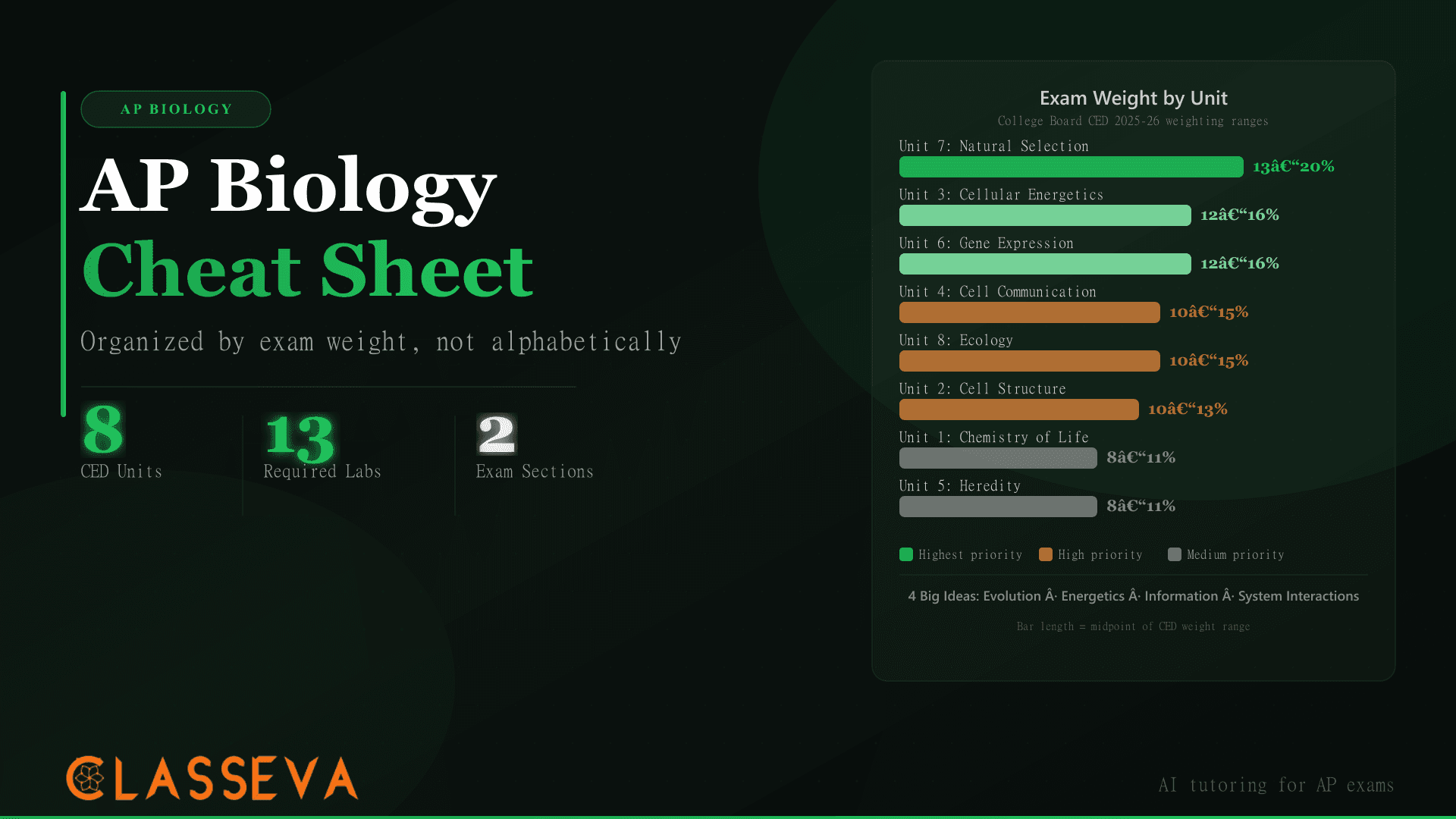
The AP Biology Course and Exam Description organizes the curriculum into 8 units, each carrying a weighting range that reflects its share of exam points across both sections combined. The ranges represent the minimum and maximum percentage of exam content drawn from each unit in any given year.
Which Units Carry the Most Exam Weight?
Unit 7 (Natural Selection and Evolution) carries 13-20%, the highest single-unit range on the exam. Units 3 (Cellular Energetics) and 6 (Gene Expression and Regulation) each contribute 12-16%. Those three units alone account for 37-52% of your total score. Students who allocate study time evenly across all 8 units reach exam day underprepared in the sections that matter most.
| Unit | Topic | Exam Weight | Study Priority |
|---|---|---|---|
| 7 | Natural Selection and Evolution | 13-20% | Highest |
| 3 | Cellular Energetics | 12-16% | High |
| 6 | Gene Expression and Regulation | 12-16% | High |
| 4 | Cell Communication and Cell Cycle | 10-15% | Medium-High |
| 8 | Ecology | 10-15% | Medium-High |
| 2 | Cells | 10-13% | Medium |
| 1 | Chemistry of Life | 8-11% | Medium |
| 5 | Heredity | 8-11% | Medium |
Source: AP Biology CED, College Board. Study priority reflects midpoint exam weight.
Evolution underpins more of the exam than its standalone unit suggests. Unit 7 content appears in explicit evolution questions but resurfaces in genetics, ecology, and cellular biology questions framed in evolutionary terms. Build it early and return to it regularly rather than treating it as a unit to finish and move on from.
The AP Biology resources hub provides study material organized by unit against these CED weights. The AP Biology visual reference guide organizes all 8 units by exam weight with horizontal bar charts you can study from directly. The AP Score Predictor can help you translate practice-test performance into a projected AP score before the exam.
How Do AP Biology Lab Investigations Appear on the Exam?
The 13 required AP Biology lab investigations appear on both exam sections. Stimulus-based MCQ sets in Section I frequently anchor around data, graphs, or experimental setups drawn directly from lab-type reasoning. In Section II, the two long FRQs routinely ask you to apply experimental design logic: identify variables, describe controls, predict outcomes from altered conditions, or interpret a results graph.
Reading through the AP Biology CED carefully, what stands out is how the labs connect to the eight science practices rather than just content topics. Students who analyzed their own lab data, even once, build an instinct for experimental reasoning that reading summaries cannot replicate. The short FRQ on data analysis most consistently separates students who engaged seriously with labs from those who only read about them.
Past FRQs from 2019 onward are available free on AP Central. Working through three or four past FRQ sets tells you more about how lab-connected reasoning appears on the exam than any review guide, because you see the actual question structures and scoring rubrics rather than summaries of them. For curated practice sets organized by question type, the AP Biology practice questions collection breaks FRQs down by section format.
For a full breakdown of how the lab component affects scoring and 5-rate patterns, the AP Biology difficulty breakdown covers what a 5-score response looks like in the FRQ section and which lab reasoning patterns appear most often in the scoring rubrics.
What Do You Need to Bring to the AP Biology Exam?
For AP Biology's hybrid exam, bring the following: a fully charged device with Bluebook installed, two sharpened No. 2 pencils with erasers, and two pens with black or dark blue ink. The pencils cover any scratch work on school-provided paper; the pens go directly into the FRQ exam booklet. Mechanical pencils are not permitted.
Calculators are permitted for AP Biology. Bring up to two approved calculatorsif you plan to use a physical one during the FRQ section; Bluebook also provides a built-in Desmos calculator for Section I. Verify your specific model is on College Board's approved calculator list before exam day; not all scientific calculators qualify.
Technology Requirements for Hybrid Testing
Your Bluebook device needs to be fully updated before the exam. Download any pending app updates at least one day in advance. Bring a charging cord in case your testing room has charging stations; some schools provide them, some do not.
A photo ID is only required if you are testing at a school other than your own. Smartwatches, earbuds, and all other wearable technology are prohibited. Standard non-smart digital watches are permitted.
Managing fees for multiple AP exams this spring? The AP Exam Cost Calculator breaks down the total cost for any combination of AP exams, including fee-reduction eligibility by income.
Key Takeaways
- The AP Biology exam is Monday, May 4, 2026, in the morning session starting at 8 a.m. local time.
- The exam runs exactly 3 hours: 90 minutes of MCQ (60 questions, 50% of score) followed by 90 minutes of FRQ (6 questions, 50% of score).
- AP Biology uses a hybrid digital format in 2026: MCQ completed in Bluebook, FRQ handwritten in a paper exam booklet.
- Unit 7 (Natural Selection, 13-20%) carries the highest exam weight; Units 3 and 6 (12-16% each) round out the top three and together with Unit 7 account for roughly 37-52% of your score.
- The AP Biology late testing date is May 20, 2026 for students with a documented conflict on May 4.
- Bring a charged Bluebook device, two No. 2 pencils, two pens (black or blue ink), and up to two approved calculators.