AP Biology Score Distribution: The Complete 5-Year Picture
AP Biology's 5-rate sat at 7.4% in 2021, its lowest point in recent history. Three years later, that number stood at 18.9%. The AP Biology statistics in this breakdown cover the complete 2020-2025 arc: what changed, why it changed, and what the numbers mean for your score goal.
What Is the AP Biology Score Distribution in 2025?
The AP Biology score distribution for 2025 shows 18.9% scoring a 5, 24.1% scoring a 4, and 27.4% scoring a 3, producing a pass rate of 70.4%. The mean score reached 3.24, the highest recorded in at least five years. A total of 287,232 students sat the exam, per the College Board's official AP score distributions.
| Score | Percentage of Test-Takers | Cumulative from Top |
|---|---|---|
| 5 | 18.9% | 18.9% |
| 4 | 24.1% | 43.0% |
| 3 | 27.4% | 70.4% (pass rate) |
| 2 | 21.0% | 91.4% |
| 1 | 8.6% | 100% |
Source: College Board AP Biology Score Distributions, 2025. Total test-takers: 287,232. Mean score: 3.24.
The AP Biology percentage at 5 has more than doubled since 2020, making this a meaningfully different exam environment than students encountered five years ago.
How the College Board Sets the AP Biology Curve
The AP Biology exam does not grade on a curve relative to other test-takers. The College Board uses a process called standard setting, where panels of college faculty and AP teachers determine what score represents college-level mastery. A student who performs at the level of an A/B student in an equivalent college course earns a 5. That standard holds regardless of whether 7% or 25% of students meet it in any given year.
This matters because it means the 5-rate reflects genuine changes in student preparation, not a statistical adjustment. When the 5-rate jumped from 7.4% to 15.0% between 2021 and 2022, the exam did not get easier. More students reached the mastery threshold.
Your AP Biology score reflects whether you met the College Board's mastery threshold for each score level. Whether 100 or 100,000 other students earn a 5 does not affect your score. This distinguishes AP exams from tests like the SAT, where scoring is norm-referenced.
How Has the AP Biology 5-Rate Changed Over Five Years?
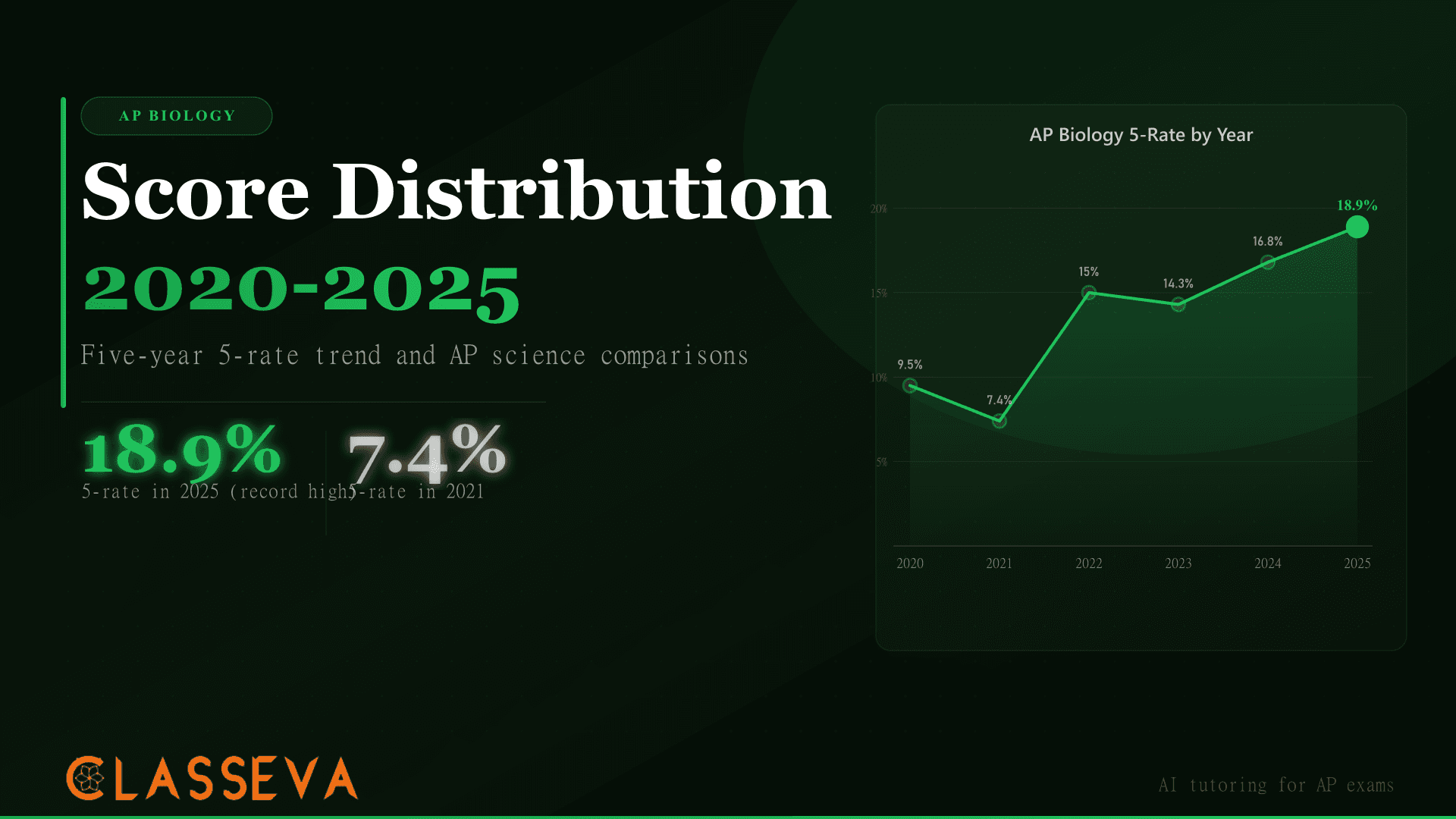
The AP Biology 5-rate rose from 9.5% in 2020 to 18.9% in 2025, but the movement was not gradual. It dropped to 7.4% in 2021, then jumped by more than seven percentage points in 2022 alone. Since then, it has climbed steadily each year. The pass rate tells a similar story: from 59.2% in 2021 to 70.4% in 2025.
The AP Biology score data for 2020-2025, compiled from the College Board's annual score releases, shows a consistent upward movement in both the 5-rate and the mean score since 2022.
| Year | 5-Rate | 4-Rate | 3-Rate | Pass Rate (3+) | Mean Score | Test-Takers |
|---|---|---|---|---|---|---|
| 2025 | 18.9% | 24.1% | 27.4% | 70.4% | 3.24 | 287,232 |
| 2024 | 16.8% | 23.1% | 28.4% | 68.3% | 3.15 | 260,062 |
| 2023 | 14.3% | 23.0% | 27.2% | 64.4% | 3.04 | 239,470 |
| 2022 | 15.0% | 23.1% | 29.7% | 67.8% | 3.11 | 237,338 |
| 2021 | 7.4% | 19.4% | 32.4% | 59.2% | 2.83 | 212,198 |
| 2020 | 9.5% | 22.7% | 36.9% | 69.1% | 3.04 | 233,444 |
Source: College Board AP Biology Score Distributions, 2020-2025.
The 2021 Low Point
The 7.4% 5-rate in 2021 sits as the lowest recorded in recent history, and context matters here. Students who took the 2021 exam faced a full academic year disrupted by the pandemic. Classroom instruction varied wildly by school and district. The 2021 pass rate (59.2%) was also the lowest in the six-year span, suggesting the dip reflected cohort circumstances rather than a shift in exam standards.
The 2020 exam (9.5% 5-rate, 69.1% pass rate) was administered online as a shortened emergency format, which makes direct comparison difficult. The pre-pandemic baseline is better understood as the 2019 data, where the 5-rate historically hovered around 7-9%.
The 2022 Redesign That Changed Everything
Pulling six consecutive years of College Board score releases side by side reveals something the headline numbers miss entirely: the AP Biology 5-rate did not drift upward gradually. It jumped by 7.6 percentage points in a single year, from 7.4% in 2021 to 15.0% in 2022.
That jump coincided directly with the College Board's redesigned AP Biology framework, which restructured the course around six science practices (applying science, reasoning, mathematical analysis, and others) rather than treating biology as a content-heavy subject where memorizing facts earns points. Students who understood mechanisms and could reason across contexts benefited immediately. Those who had relied on rote recall found the new format harder to game.
In 2025, Trevor Packer, who leads the AP program at the College Board, noted that the psychometric analyses found strong increases in content and skill mastery over 2024, explaining why the 5-rate continued rising. The trajectory suggests the 2022 redesign permanently shifted what AP Biology rewards.
How Does AP Biology Compare to Other AP Sciences?
In 2025, AP Biology posted a 5-rate of 18.9% and a pass rate of 70.4%, placing it between AP Chemistry (77.9% pass rate, 17.8% 5-rate) and AP Environmental Science (69% pass rate, 12% 5-rate) across the key metrics. AP Physics 1, redesigned for 2025, landed at roughly 18% 5-rate and 66% pass rate in a dramatically different configuration from prior years.
AP Chemistry: Highest Pass Rate, Different Challenge
AP Chemistry posted a 77.9% pass rate in 2025 and a 5-rate of 17.8%, with 170,283 test-takers, according to the College Board's AP Chemistry score distributions. Its pass rate exceeds AP Biology's by 7.5 percentage points, which surprises students who expect chemistry to be harder. The explanation lies in the self-selection of the test-taking pool. AP Chemistry attracts students who have deliberately chosen a math-intensive science and who typically arrive with strong quantitative preparation. AP Biology draws a broader field.
The exams test different skills. AP Chemistry demands precise mathematical reasoning through equilibrium, thermodynamics, and stoichiometry. AP Biology demands broad conceptual understanding and lab analysis across eight units. Students who struggle with one often thrive with the other.
AP Environmental Science: Not as Easy as It Looks
AP Environmental Science has a reputation as the “easy AP science,” but the 2025 data does not support that framing. Its 12% 5-rate and approximately 69% pass rate sit below AP Biology on both measures. The exam draws a large cohort of students who underestimate its quantitative demands: math calculations, energy flow models, and policy analysis all appear on the free-response section. Students who approach it expecting an easy credit often score 1 or 2.
AP Physics 1: A Redesigned Exam in 2025
AP Physics 1 was substantially redesigned for 2025, with the College Board removing waves, sound, and modern physics content and moving those topics to a revised AP Physics 2. The redesigned AP Physics 1 now covers only mechanics. The 2025 5-rate of approximately 18% represents a dramatic improvement from the old exam's consistent 7-8% 5-rate. Comparing AP Physics 1's 2025 data to prior years misreads what the exam now covers.
What Score Do You Need for College Credit?
Most universities use AP Biology scores for placement decisions, and the threshold varies by institution. A 3 passes the exam, but it earns credit only at a subset of colleges. Selective universities typically require a 4 or 5. Pre-med students face especially strict thresholds, since many programs require documented intro bio credit before upper-level science courses.
Schools That Accept a 3
Many public universities accept a score of 3 on AP Biology for credit in a general introductory biology course. This includes much of the University of California system, many Big Ten schools, and most regional public universities. The credit typically satisfies a one-semester intro bio requirement but may not fulfill major prerequisites for pre-health tracks.
Check your target school's AP credit policy directly. The College Board publishes a searchable credit policy database at AP Central, but individual department requirements may differ from university-wide credit policies.
Schools That Require a 4 or 5
Highly selective universities including most Ivy League schools, MIT, Stanford, Caltech, and similar institutions typically require a 4 or 5 for any AP Biology credit. Some grant credit only for a 5. AP credit policies update each year, so confirm your target school's current thresholds directly with the registrar or through the College Board's credit policy database.
If you plan a pre-med track, target a 4 or 5 on AP Biology. A 3 may not satisfy the intro bio prerequisite at the specific institution where you plan to complete medical school prerequisites, even if it earns some general credit. Use Classeva's AP Credit Savings Calculator to estimate exactly how much college credit a given score unlocks at your target school.
What Score Should You Realistically Aim For?
The honest answer depends on where you plan to go to college and what you intend to do once you get there. A pre-med student applying to selective research universities should target a 5. A student at a state school who wants to clear a general science requirement can often accomplish that with a 3 or 4.
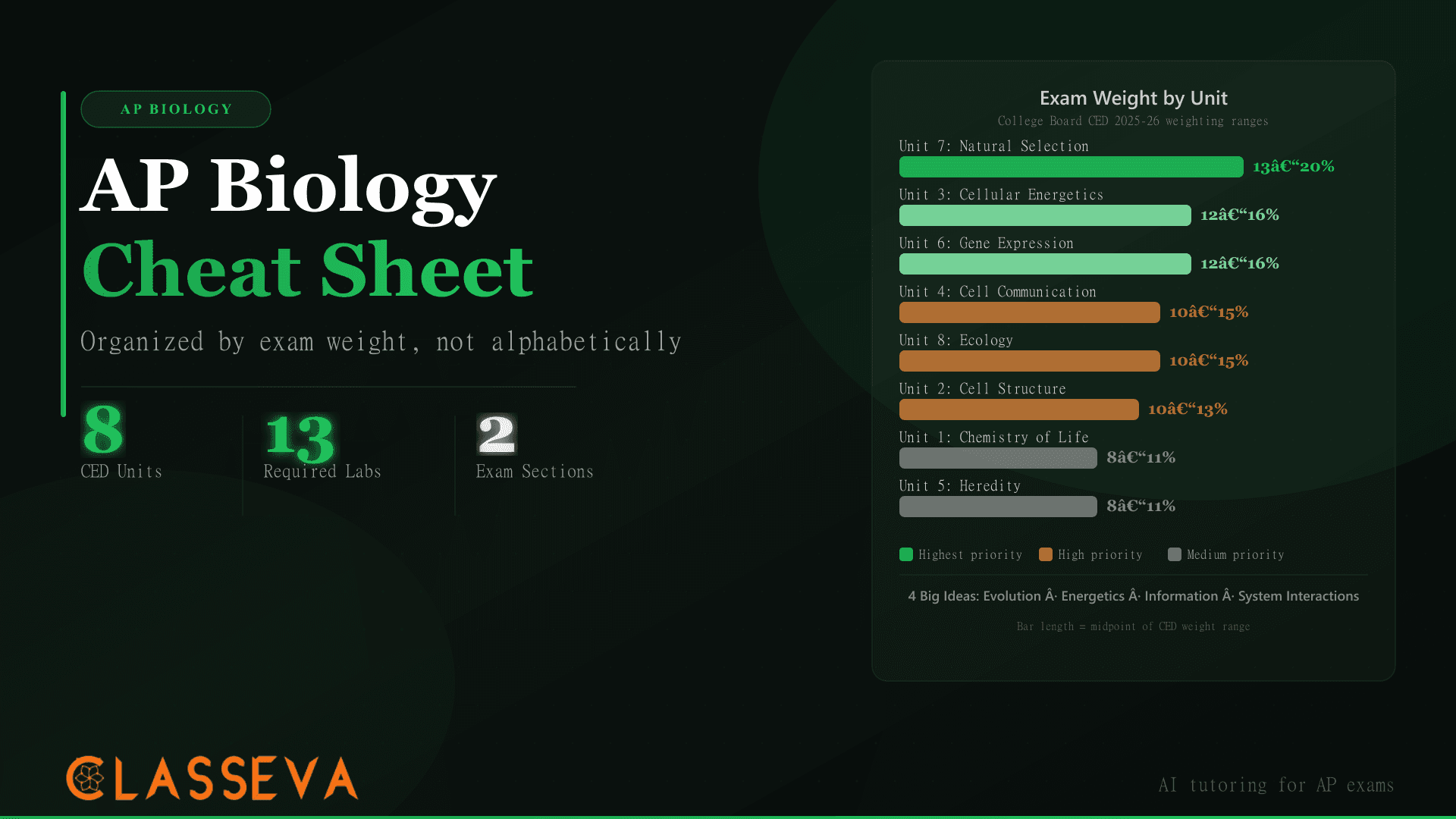
The 2025 data shows that nearly 43% of test-takers earned a 4 or 5. That is not a small slice. Students who study the CED unit weightings, practice free-response questions against official rubrics, and spend focused time on the three highest-weight units (Cellular Energetics, Gene Expression, and Natural Selection) consistently land in the upper score bands. The exam rewards preparation that mirrors how it is actually scored, not preparation that covers every unit at equal depth.
If you want to translate your current practice test performance into a projected AP Biology score, the AP Score Predictor below maps raw scores and section breakdowns to the most likely score range for this specific exam's distribution. For FRQ archives, scoring guidelines, and CED-aligned topic resources, the AP Biology resource hub is the starting point.
AP Score Predictor
Enter your practice test results to see your projected AP Biology score and what you need to improve to reach the next score band.
One thing the score distribution data makes clear: a student who earns a 3 today, but consistently works through past FRQs with official scoring guidelines, is closer to a 4 than the gap in score numbers suggests. The FRQ section accounts for 50% of the exam. A student who understands the rubric format and writes precise, biology-specific answers on FRQs can close a one-point gap without touching the multiple-choice section at all. Read the full breakdown in our AP Biology difficulty analysis for the specific study habits that drive that shift.
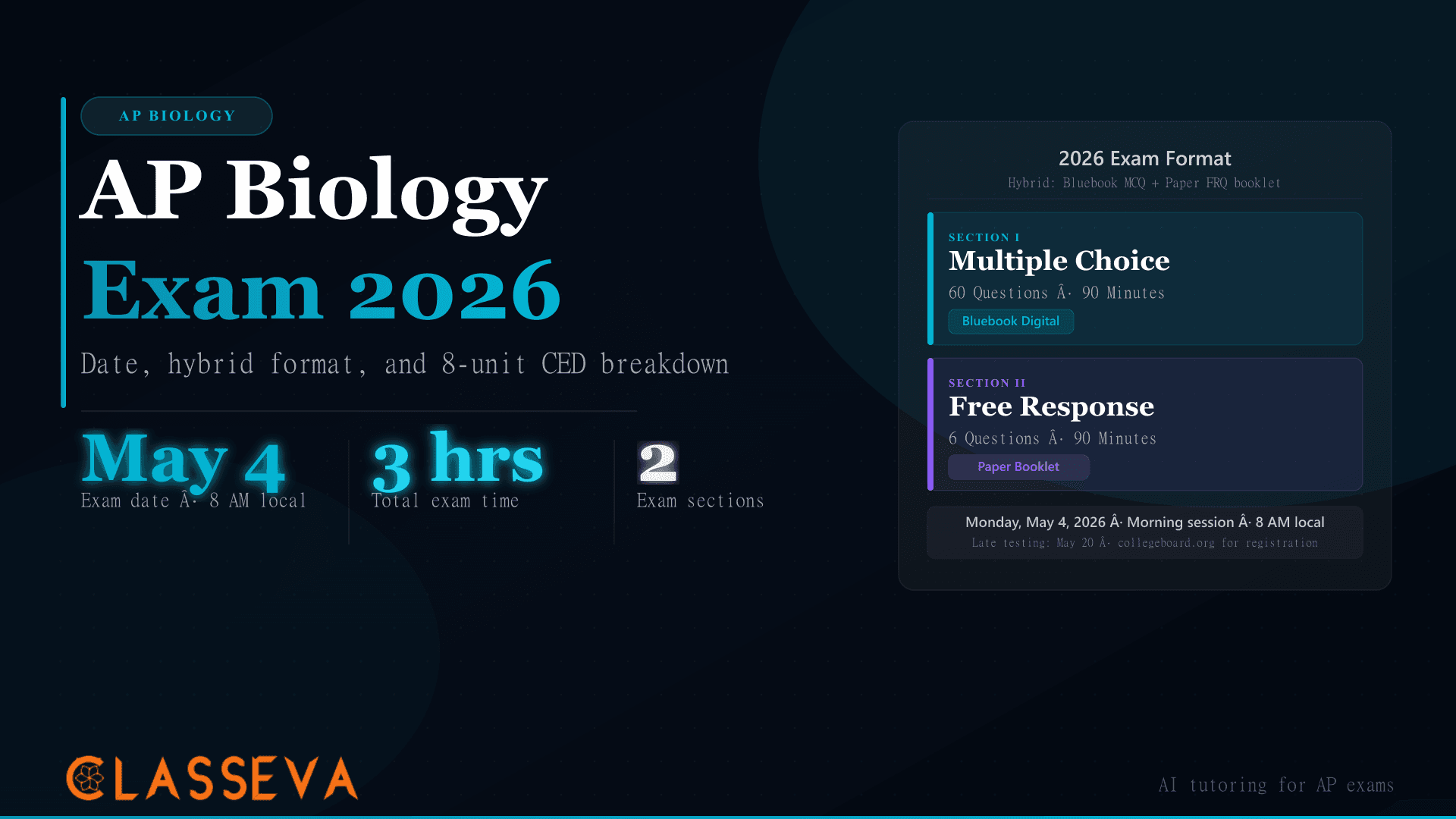
For the full breakdown of what the exam covers, how each section is scored, and what question formats appear in 2026, read our AP Biology exam format and structure guide.
Key Takeaways
- The 2025 AP Biology 5-rate is 18.9%, the highest recorded, with 287,232 students tested and a mean score of 3.24. Source: College Board AP Biology Score Distributions.
- The 5-rate tripled since 2021 (7.4% to 18.9%) following the 2022 course redesign, which shifted emphasis from content memorization to scientific reasoning and lab analysis.
- AP Chemistry had a higher pass rate in 2025 (77.9% vs. 70.4%), but AP Biology had a higher 5-rate (18.9% vs. 17.8%). The difference reflects cohort composition, not exam difficulty in isolation.
- A 3 on AP Biology earns credit at many public universities but rarely at selective schools. Pre-med students should target a 4 or 5 to reliably skip intro biology at their target institution.
- AP Environmental Science is not an easier path to a 5 than AP Biology. Its 12% 5-rate sits well below AP Biology's 18.9% in 2025.
- The grading standard is absolute, not relative. Your score reflects whether you met the college-level mastery threshold, not how you ranked among other test-takers that year.
- FRQ practice against official rubrics is the highest-leverage preparation move. The FRQ section carries 50% of your score, and rubric-specific writing closes score gaps faster than additional content review.
Frequently Asked Questions
What percentage of AP Biology students get a 5?
In 2025, 18.9% of AP Biology test-takers earned a 5, according to the College Board's official score distributions. That is the highest 5-rate recorded for this exam and represents a significant increase from 7.4% in 2021.
Has AP Biology gotten easier or harder over time?
The data shows a meaningful improvement since 2022, when the College Board introduced a redesigned course framework emphasizing scientific reasoning over content memorization. The 5-rate jumped from 7.4% in 2021 to 15.0% in 2022, and has continued rising to 18.9% in 2025. Whether this reflects a more accessible exam or better-prepared students, Trevor Packer (College Board's AP program head) attributed the shift to genuine gains in student mastery.
Is a 3 on AP Biology good?
A 3 passes the exam and may earn college credit at many schools, but selective universities typically require a 4 or 5 for any biology credit. For pre-med students, a 3 rarely earns placement out of intro biology at the schools they target. If your goal is to skip intro bio at a competitive institution, aim for a 4 or 5.
Do colleges care if I get a 3 on AP Biology?
Colleges use AP scores for credit decisions, not admissions decisions. A 3 will not hurt your application, but it may not earn you any credit. At many selective schools, a 3 earns no credit at all. Check your target school's AP credit policy directly, since policies vary widely.
Why did the AP Biology 5-rate jump in 2022?
The College Board redesigned the AP Biology course framework beginning with the 2022 exam. The redesigned course places greater emphasis on scientific practices and applied reasoning across all eight units, rather than rewarding recall of isolated facts. Students who understood concepts deeply benefited from this shift, which raised the 5-rate from 7.4% to 15.0% in a single year.
What is the average AP Biology score?
In 2025, the mean AP Biology score was 3.24, according to the College Board. That is the highest mean score recorded for the exam in at least five years, up from 2.83 in 2021.
How many students take AP Biology each year?
In 2025, 287,232 students took the AP Biology exam, up from 260,062 in 2024. AP Biology consistently ranks among the most popular AP science exams, alongside AP Chemistry and AP Environmental Science.
How does AP Biology's pass rate compare to AP Chemistry?
In 2025, AP Chemistry had the higher pass rate of the two: 77.9% compared to AP Biology's 70.4%. AP Chemistry also had 170,283 test-takers compared to AP Biology's 287,232. The different cohort sizes matter: AP Chemistry tends to attract students with stronger math backgrounds and higher preparation levels.
Score data sourced from the College Board AP Biology Score Distributions (2020-2025) and AP Chemistry Score Distributions (2025). AP Physics 1 and AP Environmental Science 2025 data via Trevor Packer's annual score updates. Course and Exam Description via AP Central.