Interleaving: Why Mixing Subjects Beats One at a Time
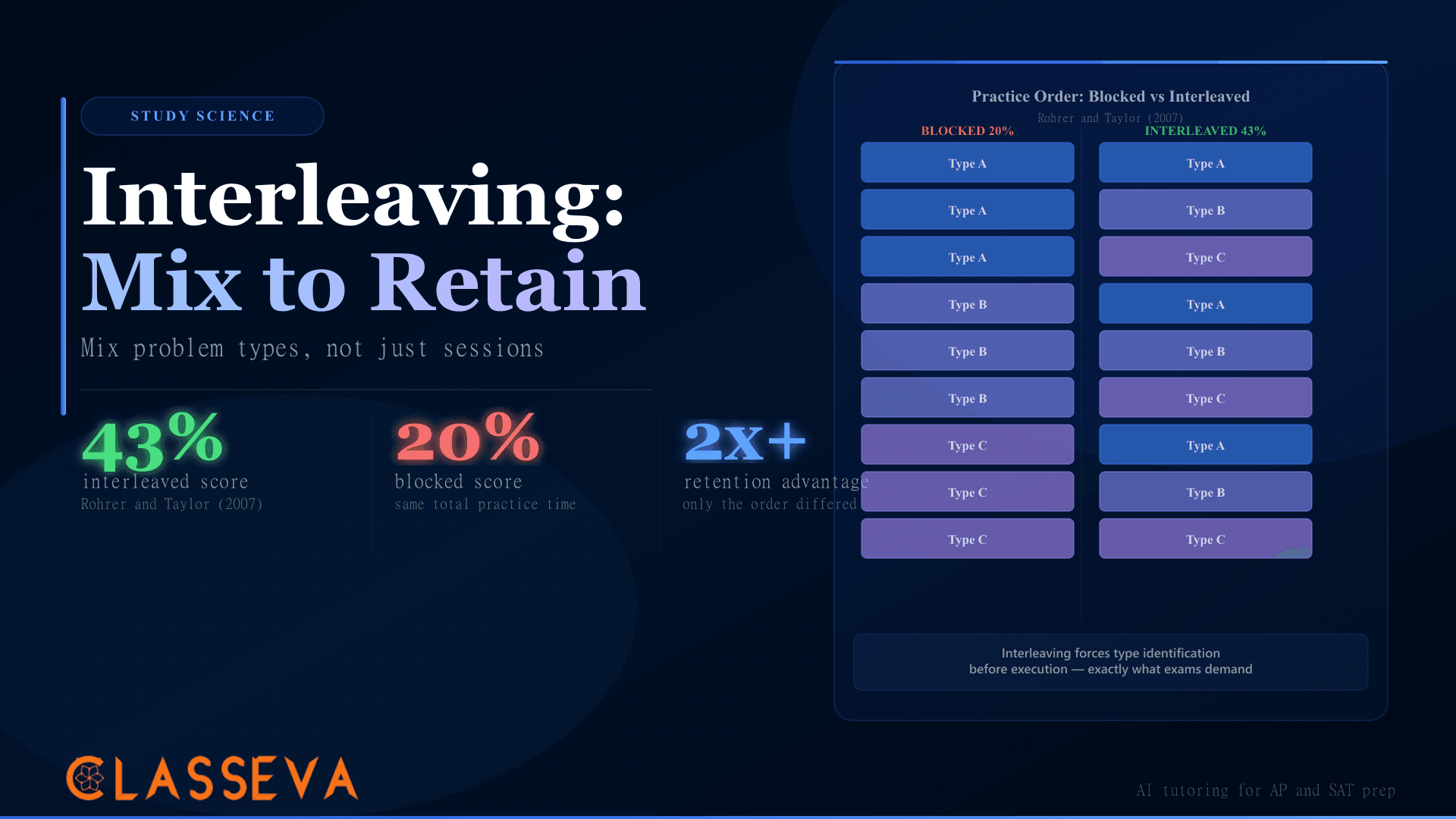
Students who blocked their practice sessions, all derivatives first, then all integrals, then all series, felt more prepared going into the test. The group that interleaved the same problems (rotating through derivatives, integrals, and series) performed worse during practice. They scored more than twice as high on the final transfer test: 43% versus 20% in Rohrer and Taylor's 2007 study in Instructional Science. That reversal, feeling less productive but retaining far more, is what makes the interleaving study technique both counterintuitive and reproducible.
Building Classeva's practice question sequencing, the research on interleaving was foundational. The algorithm that decides which questions to serve next draws directly on the discrimination hypothesis behind interleaving: students need to identify problem types before executing procedures, not just execute procedures they already know are coming. This post walks through the research, the mechanism, and the practical application for AP, SAT, and ACT prep.
What Is the Interleaving Study Technique?
The interleaving study technique means alternating between different types of problems or concepts within a single study session, instead of completing all examples of one type before moving to the next. Rather than practicing 20 derivatives in a row, an interleaved session would rotate: three derivatives, two integrals, two applications, three more derivatives, two more integrals.
Interleaving vs Blocked Practice
Blocked practice organizes sessions by category. All quadratic equations first, then all linear equations, then all exponential functions. The structure feels logical because it mirrors how textbooks present material, and how most courses sequence instruction. Master one concept before the next. Most AP teachers, most prep books, and most commercial courses default to this structure.
Interleaved practice disrupts that sequence deliberately. Instead of all quadratics then all linears, the session rotates: one quadratic, one linear, one exponential, one quadratic again. The rotation forces a step blocked practice skips entirely: the student must identify what type of problem they are looking at before applying the correct procedure.
The Metacognitive Illusion
This mismatch produces what researchers call the metacognitive illusion. Students who complete blocked practice sessions rate their own comprehension higher. Each problem reinforces the same pattern they just saw, sessions feel productive, and confidence rises. Students who interleave feel the opposite: switching gears constantly, every problem slightly harder to start, confidence lower.
The problem is that perceived preparation and actual preparation diverge. The blocked group in Rohrer and Taylor's study reported higher confidence before the test. They scored 20%. The interleaved group felt less prepared. They scored 43%. The feeling is real. The inference from that feeling, that blocked practice is more effective, is not.
What the Rohrer and Taylor Research Actually Shows
Rohrer and Taylor's 2007 paper, published in Instructional Science (vol. 35, no. 6, pp. 481-498), tested whether interleaved math practice produced better transfer than blocked practice using identical total practice time. The interleaved group scored 43% on the final test. The blocked group scored 20%. Both groups practiced the same problems; only the order differed.
The 2007 Experiment: 43% vs 20%
The study used college students practicing unfamiliar math problems: volume, surface area, and slope calculations. The blocked group completed all volume problems first, then all surface area problems, then all slope problems. The interleaved group worked through the same problems with types randomly mixed across each practice set.
One week after practice, both groups took the same transfer test. The retention gap appeared even though the interleaved group performed worse during practice. Their in-session accuracy was lower. They struggled more per problem. They rated their sessions as less effective. And they outperformed the blocked group by more than two to one on the actual retention measure.
Subsequent Research: Does It Hold Up?
The basic finding has replicated. Rohrer's 2014 classroom study with seventh-grade math students over 9 weeks produced a similar advantage for interleaved over blocked practice on a final exam. A 2019 study by Sana and colleagues on statistics problem types found the same pattern. The Dunlosky et al. (2013) review in Psychological Science in the Public Interest examined interleaving alongside nine other study techniques and identified it as a practice supported by a meaningful evidence base.
The effect is most reliable for similar-but-distinct problem types that require discrimination, not for completely unrelated subjects. That boundary matters for how you apply the research to AP prep.
Why Interleaving Feels Worse But Produces Better Results
Interleaving is more effective precisely because it is harder. The additional difficulty does not come from more content or longer sessions. It comes from a cognitive requirement blocked practice eliminates: deciding what type of problem you are facing before deciding how to solve it.
The Discrimination Hypothesis
With blocked practice, after 10 consecutive derivative problems, your brain knows the next problem is a derivative before you read it. The identification step costs nothing. You can focus entirely on executing the procedure.
With interleaved practice, each problem requires two cognitive moves: identify the problem type, then execute the procedure. That identification step feels inefficient session by session. The long-term payoff is a student who can look at a novel AP exam problem, where the type is never labeled, and identify it correctly.
AP exams never announce what kind of problem you are solving. An AP Calculus FRQ mixes function analysis, derivative applications, and integral calculations across parts (a) through (d). A student who trained only on blocked practice has solved many derivatives but has never had to identify one from scratch against other problem types. That student faces a gap on exam day that all the blocked practice in the world cannot fix.
Desirable Difficulties
Robert Bjork and Elizabeth Bjork at UCLA's Learning and Forgetting Lab coined the term desirable difficulties for conditions that slow apparent learning but improve actual retention and transfer. Interleaving sits alongside spacing and retrieval practice as canonical examples of desirable difficulties.
The insight is that cognitive difficulty is not the enemy of learning. The specific difficulty of identifying a problem type before solving it engages the same cognitive process that AP and SAT exams demand. Practice sessions that feel effortless may build procedural speed within a known category while leaving that identification skill undeveloped.
How Interleaving Compares to Spacing and the Testing Effect
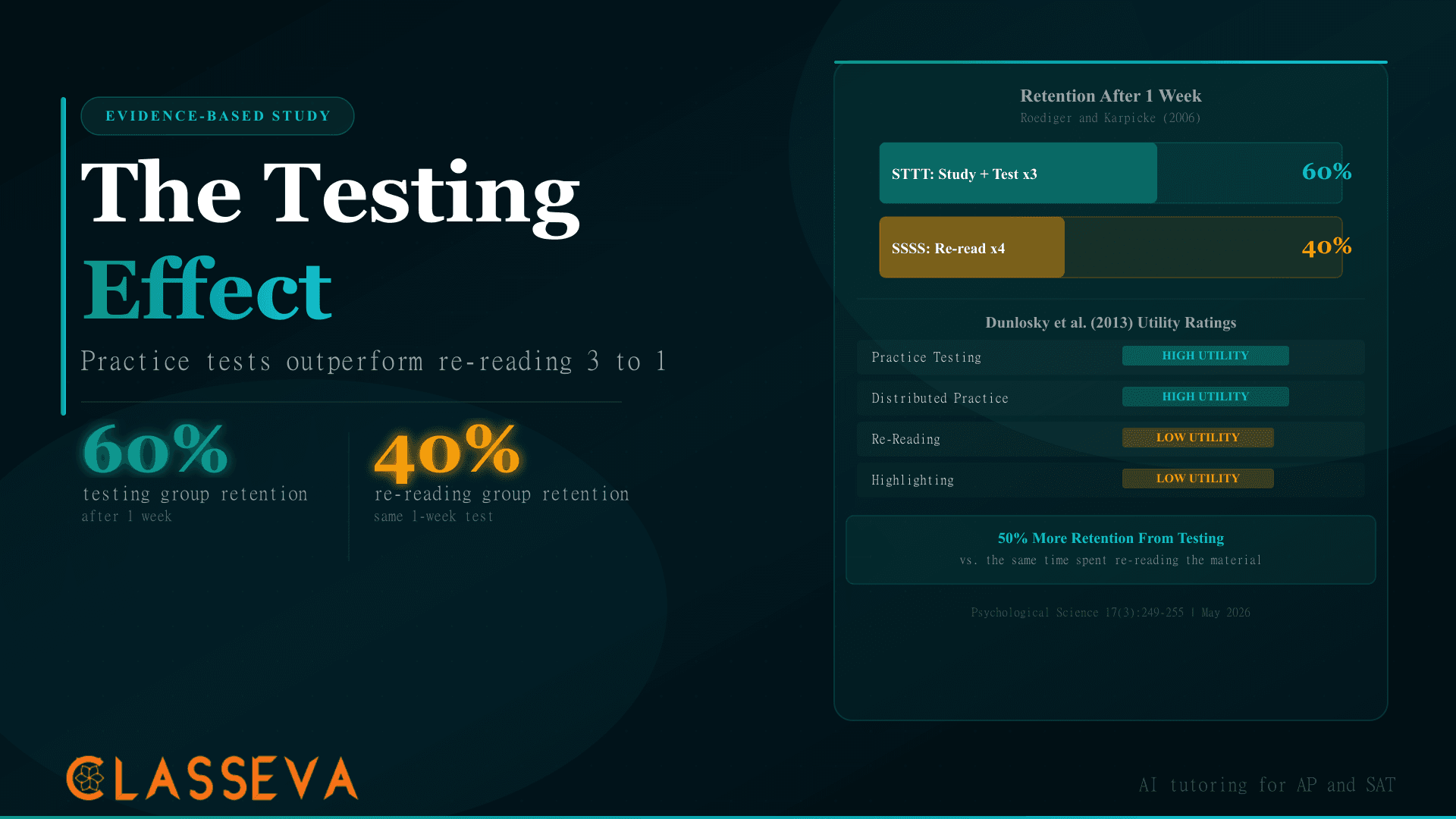
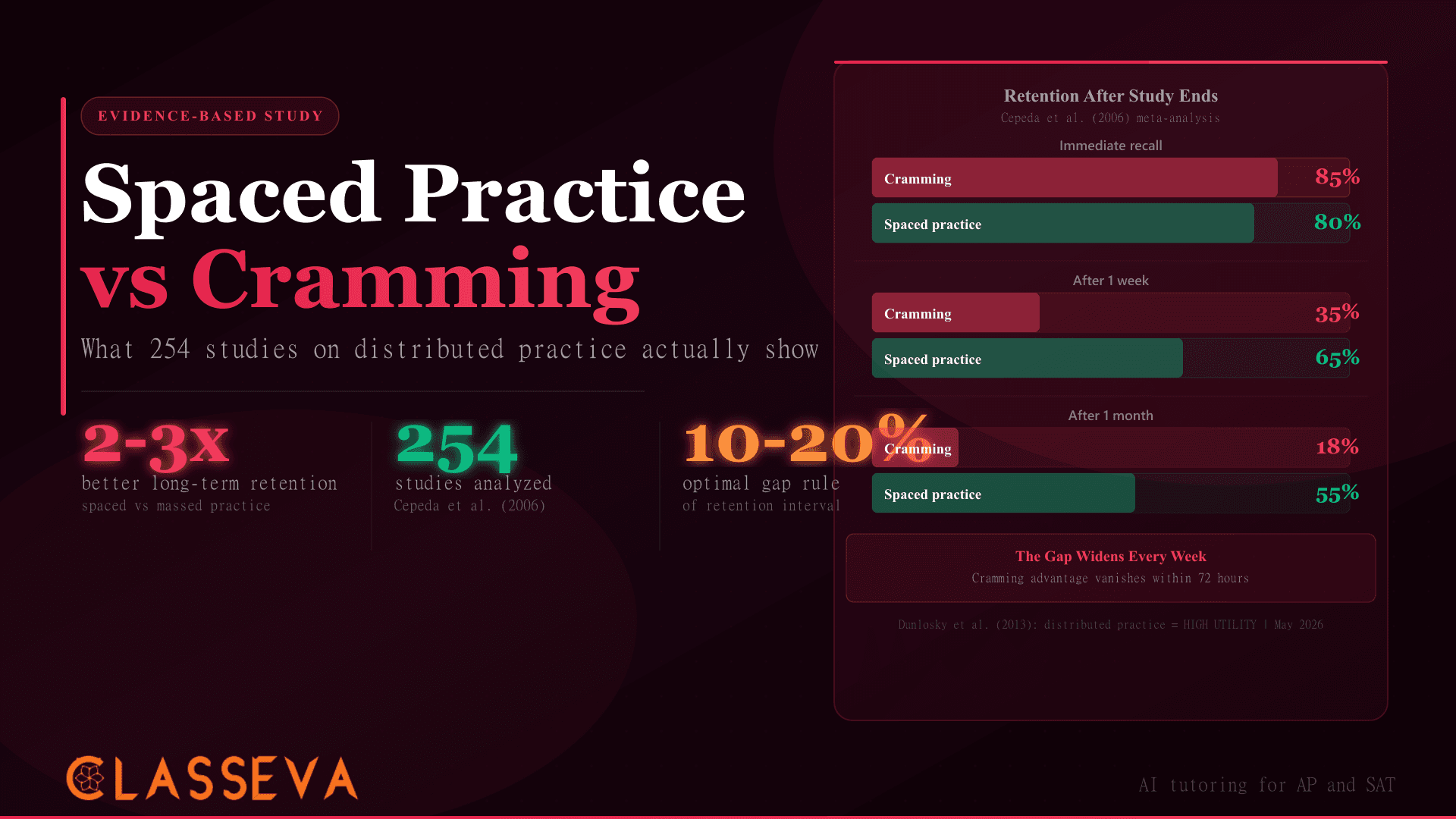
Three study techniques dominate the evidence base for durable learning: the testing effect (retrieval practice), spacing (distributed practice), and interleaving. All three qualify as desirable difficulties. All three produce better long-term retention than their intuitive alternatives, re-reading, cramming, and blocked practice. But they target different mechanisms.
| Technique | What It Changes | Best For | Key Research |
|---|---|---|---|
| Testing effect | Type of activity within sessions: retrieval beats re-reading | Every subject; every session | Roediger and Karpicke (2006) |
| Spacing | Timing of sessions: distributed beats massed | All subjects; start 4-6 months before AP exam | Cepeda et al. (2006), 254 studies |
| Interleaving | Order of problems: mixed beats blocked by type | Subjects with distinct problem types requiring discrimination | Rohrer and Taylor (2007) |
The three evidence-based study techniques compared. They are complementary, not competing.
The techniques compound. Spacing your interleaved retrieval practice sessions produces stronger results than any single technique in isolation. The Bjork lab at UCLA has studied how these techniques combine, and the consistent finding is that all three together outperform any pair. For AP prep, that means: self-test (testing effect) across mixed problem types (interleaving) scheduled over months (spacing).
The companion posts on the testing effect and spaced practice vs cramming walk through the other two techniques in detail. This post focuses on interleaving because it is the least understood and the most directly actionable for students building their exam prep strategy.
How to Apply Interleaving to AP Exam Prep
For AP exam prep, interleaving means building practice sets that draw questions from multiple units within the same session, rather than completing one unit before starting the next. This applies most powerfully in the final 6-8 weeks before the AP exam, after you have worked through each unit's core content at least once.
Use blocked practice for the first one or two sessions on any new AP unit. Once you can execute the core procedure without constantly referencing notes, integrate that unit into your rotating sessions. Interleaving a concept before you understand it produces confusion, not consolidation.
Which Concepts to Interleave Within AP Subjects
Not every AP subject benefits equally. Interleaving works when there are distinct problem types within the same course that require discrimination before execution:
AP Calculus AB/BC: Derivatives, integrals, area and volume applications, and differential equations all appear mixed in the FRQ section. Students who study these in blocks can execute each type but struggle to identify which applies to a novel problem. See the AP Calculus AB difficulty breakdown for where students lose the most points on this section.
AP Chemistry: Stoichiometry, equilibrium, electrochemistry, and acid-base calculations each require a different setup. The FRQ section mixes them within a single multi-part question, requiring students to shift approach from part to part.
AP Statistics: Inference for means, inference for proportions, and chi-square procedures use similar-looking calculations but require different conditions checks. Students who study them in isolation consistently struggle to select the correct test on the exam. The AP Statistics difficulty analysis covers exactly this pattern in score distributions.
AP Physics 1: Kinematics, forces, energy, and momentum require identifying which principle applies before choosing equations. Mixed practice sessions mirror what happens in the FRQ section, where a single problem often spans multiple units.
What an Interleaved AP Study Session Looks Like
A 90-minute interleaved AP Calculus AB session, roughly 8 weeks before the exam, might run like this:
20 minutes: four derivative problems mixing chain rule, product rule, implicit differentiation, and related rates (not four chain rule problems in a row). 20 minutes: three integration problems where the first task is identifying whether u-substitution or integration by parts applies. 25 minutes: two FRQ-style area and volume problems from past AP exams. 15 minutes: five quick identification problems where the goal is naming the technique, not fully solving the problem. 10 minutes: review of any identification errors.
The identification drill in the last 15 minutes is the piece most students skip. Rohrer and Taylor's data suggests it is the most valuable component. Students who can name the correct technique in 10 seconds do not leave points on the exam for timing reasons.
How to Apply Interleaving to SAT and ACT Prep
The SAT and ACT both serve questions from multiple content areas in a single section, without grouping or labeling them by type. Students who practiced those areas in blocks prepared themselves for tests that do not exist.
SAT Math: Four Content Areas Together
The Digital SAT Math section covers four content areas: algebra, advanced math (nonlinear functions and equations), problem-solving and data analysis (statistics and probability), and geometry and trigonometry. Both modules mix questions from all four areas. A student who worked through an entire practice test's algebra questions, then all the advanced math questions, then all geometry, has never experienced the actual sequence they will face.
An interleaved SAT Math session uses official Bluebook practice questions from all four content areas within a 30-45 minute block, in random order. The SAT's adaptive structure means Module 2 difficulty depends on Module 1 performance. Students who trained on mixed content are better equipped for that switching, because they never learned to rely on context clues about what type comes next.
ACT Math and Science
The Enhanced ACT Math section runs 60 questions across 60 minutes with no content grouping. Pre-algebra, algebra, geometry, trigonometry, and statistics appear throughout. Students who drilled blocked practice find the mid-test topic switches disorienting in a way that costs both time and accuracy.
ACT Science offers its own version of the discrimination problem. The section mixes three passage types: data representation (graph reading), research summaries (experiment comparison), and conflicting viewpoints (argument evaluation). Practicing all data representation passages in one session, then all research summaries, then all conflicting viewpoints, builds familiarity with each type in isolation. The actual test serves them interleaved. Practice accordingly.
The AP Score Predictor uses your current accuracy data to estimate your likely exam score. After two to three weeks of interleaved practice, run your updated accuracy numbers through the predictor to gauge whether the identification improvement is translating into score movement.
When Does Interleaving NOT Help?
Interleaving works for concepts you have already been introduced to. It is not a first-exposure strategy. Three conditions reduce its effectiveness:
When Interleaving Underperforms
- •First exposure to a new concept: beginners need blocked repetition to build initial fluency before mixing
- •Completely unrelated topics: mixing AP Chemistry stoichiometry with AP English rhetoric produces no discrimination benefit
- •Very short sessions (under 15 minutes): the switching cost is high relative to the session length
- •Pre-loaded procedural memory: if you already identify types instantly, blocking specific weak spots for targeted repair works better
When Interleaving Works Best
- •After initial concept exposure: once you can execute the core procedure, integrate it into rotation
- •Similar-but-distinct problem types: derivatives vs integrals vs applications; stoichiometry vs equilibrium
- •Final 6-8 weeks of AP prep: when all units have been covered at least once
- •Mixed FRQ practice: the FRQ section always interleaves units, so practice should too
The boundary matters for how you structure your study calendar. Use blocked sessions through your first pass of each AP unit. Switch to interleaved sessions for your second pass and all subsequent review. The comparison of AI tutors vs generative AI covers how intelligent tutoring systems automate this switching, serving problems from prior units as soon as a new unit's initial exposure is established.
A Practical Interleaved Study Schedule
For an AP exam 10 weeks out, a sustainable interleaved schedule uses the first two weeks for blocked review of any weak units, then switches fully to interleaved sessions.
Assess your baseline with a timed mixed set
Take one untimed practice set drawing 2-3 questions from each AP unit you have covered. Note which problem types you struggle to identify, not just which ones you get wrong. Identification errors and execution errors require different remediation.
Complete blocked repair sessions for any units below baseline
For any unit where you could not recognize the problem type in 10 seconds, run two to three blocked sessions specifically on that unit. Build the pattern until type identification is automatic. Then add that unit to your rotating sessions.
Build 90-minute rotating sessions with 4-5 unit types
Structure each session around rotation rather than unit completion. Aim for 15-20 minutes per unit type, cycling back to earlier units in the final 20 minutes. Never let two consecutive problems share the same technique.
Run a full mixed FRQ block every third session
Every third session, work through 45-60 minutes of past AP FRQ questions from any unit, in the order they appear on the original exam. This mirrors actual test conditions more closely than any structured rotation. Track which FRQ parts required rereading the question to identify the approach.
Add identification drills in the final two weeks
With two weeks remaining, add a 10-15 minute identification drill to every session: problems where you name the technique within 10 seconds without solving. Students who can consistently identify problem types under time pressure rarely leave AP exam points on the table for pacing reasons.
If you are working with an AI tutor or a prep course, verify that it serves mixed problem sets rather than unit-by-unit review. The distinction is not cosmetic. A platform that serves you 20 derivatives in a row, regardless of how adaptive it claims to be, is delivering blocked practice.
Tutoring ROI Calculator
Calculate whether adding structured AI tutoring to your interleaved study schedule produces enough score improvement to justify the cost in AP credit and college outcomes.
Key Takeaways
- Rohrer and Taylor (2007) found interleaved math practice produced a 43% score on the transfer test; blocked practice produced 20%. The same total practice time. Only the problem order differed.
- The metacognitive illusion is real: students consistently rate blocked practice as more effective. Measured retention consistently contradicts that rating.
- Interleaving works because it forces type identification before execution, the same cognitive demand AP and SAT exams place on every problem.
- The interleaving study technique works best for similar-but-distinct concepts within one subject: AP Calculus (derivatives, integrals, applications), AP Chemistry (stoichiometry, equilibrium, electrochemistry), AP Statistics (means, proportions, chi-square).
- Use blocked practice for first exposure to any new unit. Switch to interleaved sessions once you can execute the core procedure without references.
- Combine interleaving with spaced practice and retrieval practice. All three techniques are complementary and compound when used together.
- Track identification errors, not just wrong answers. A student who identified the problem type correctly but executed poorly has a different gap than one who could not recognize the type at all.