Is AP Calculus AB Hard? Pass Rate, 5-Rate, and Exam Guide
AP Calculus AB's 5-rate of 20.3% in 2025 sits nearly two percentage points above AP Biology's — which itself surprised most students who assumed biology was the friendlier AP science. The math-person myth collapses when you study the score data. One in five students earns a 5. The separating factor is not talent; it is consistent procedural practice, concentrated on the right units, over the right timeline. Here is what the 2025 College Board data and the AP Calculus AB Course and Exam Description actually reveal.
Is AP Calculus AB Hard?
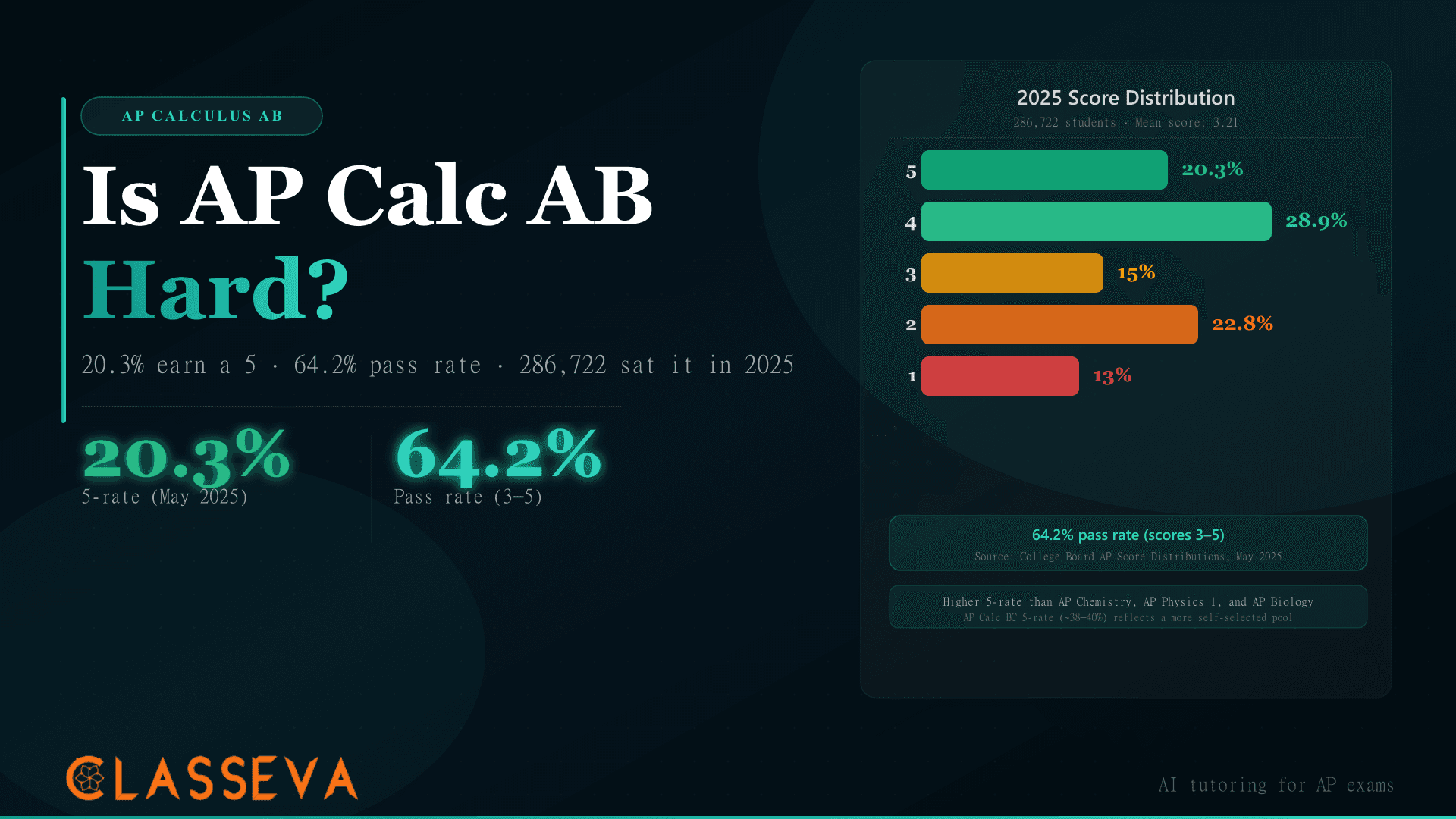
AP Calculus AB has a pass rate of 64.2% and a 5-rate of 20.3% in 2025, placing it in the moderate difficulty range among AP exams. It sits harder than AP Statistics in terms of abstract reasoning demands, but its 5-rate runs higher than AP Chemistry (around 11-13%), AP Physics 1 (around 7%), and AP Biology (18.9%). For most students, the difficulty is not the conceptual complexity of calculus — it is building the procedural fluency to execute correctly under timed pressure.
The 2025 Score Distribution
In 2025, 286,722 students sat the AP Calculus AB exam. The full score breakdown from College Board's official score distribution data:
| Score | Percentage | What It Means |
|---|---|---|
| 5 | 20.3% | Exceptional — college credit at most schools |
| 4 | 28.9% | Strong — credit at many schools |
| 3 | 15.0% | Pass — credit at some schools |
| 2 | 22.8% | Below passing |
| 1 | 13.0% | No credit |
Source: College Board AP Calculus AB Score Distributions, May 2025. 286,722 test-takers. Mean score: 3.21.
The distribution's shape tells a specific story. Nearly half (49.2%) of all test-takers earn a 4 or 5, while 35.8% score a 1 or 2. The middle score of 3 accounts for only 15.0%. This is not a bell curve — it reflects a skills-based exam where preparation level, more than raw ability, drives whether students land in the top half or the bottom third.
How AP Calc AB Compares to Other AP Exams
The 20.3% 5-rate places AP Calculus AB above most AP science and history exams in top-score accessibility. The comparison that surprises most students: AP Calculus AB's 5-rate is higher than AP Chemistry (around 11-13%), AP Environmental Science (around 9%), AP Biology (18.9% in 2025), and every AP Physics exam except Physics C, whose test-taker pool is far more self-selected. Among large-enrollment AP math exams, only AP Statistics (with a 5-rate that has recently climbed toward 15-25%) sits in the same range.
What Does AP Calculus AB Actually Test?
AP Calculus AB tests two branches of calculus: differential calculus (derivatives — how quantities change instantaneously) and integral calculus (integrals — how quantities accumulate over an interval). The CED organizes this into eight units, each with an explicit exam-weighting range that tells you exactly where to focus your study time.
Unit Weightings and High-Stakes Zones
Studying the AP Calculus AB CED closely, what stands out is how uneven the unit weights are. Unit 6 alone carries 17-20% of the exam. Students who divide their preparation equally across all eight units allocate too much time to limits and basic differentiation and not enough to the integration units where the exam concentrates its points.
Unit 5 (Analytical Applications of Differentiation, 15-18%) and Unit 6 (Integration and Accumulation of Change, 17-20%) together represent roughly one-third of the AP Calculus AB exam. Build these two units first, revisit them last, and allocate at least half your practice problems there before expanding to the remaining six units.
The FRQ Section Explained
The free-response section carries 50% of the total AP Calculus AB score. It runs 90 minutes and splits into two parts with different calculator rules:
| Part | Questions | Calculator | Time | Points |
|---|---|---|---|---|
| Part A | 2 FRQs | Graphing calculator allowed | 30 minutes | ~30 of 54 pts |
| Part B | 4 FRQs | No calculator | 60 minutes | ~24 of 54 pts |
FRQ structure from the AP Calculus AB CED. Total FRQ section = 54 raw points, 50% of exam score.
The four no-calculator FRQs test algebraic fluency under timed pressure. Students who have depended on the calculator throughout the year to compute derivatives and definite integrals often discover in Part B that they cannot execute those procedures by hand at speed. That gap — not conceptual misunderstanding, but insufficient hand-computation practice — accounts for many scores that land at a 3 rather than a 4.
What the Calculator Policy Means for Your Score
The graphing calculator is permitted on specific sections, but knowing it is allowed differs from knowing how to use it for points. On Part A FRQs, the calculator can compute derivatives at a point, evaluate definite integrals numerically, find zeros of functions, and graph equations. Students who practice these calculator operations before exam day earn points that purely conceptual preparation misses.
When your calculator computes a definite integral or evaluates a derivative, write the mathematical expression first — the integral notation or limit definition — before giving the numerical result. AP graders award setup points separately from computation points. A correct setup with an arithmetic slip earns more credit than a bare numerical answer with no work shown.
How Much Should You Study for AP Calculus AB?
Most students who earn a 4 or 5 on AP Calculus AB study between 3 and 5 hours per week during the school year and add 30-50 focused hours in the 8 weeks before the May exam. That totals roughly 100-160 hours — somewhat less than AP Biology's typical 150-200 hours, because calculus builds on itself. Strong integration fluency transfers across units rather than requiring each unit to be learned from scratch.
During the School Year
Weeks 1-18 (September through January): Build procedural fluency unit by unit
Work through derivative rules and integration techniques until they become automatic, not just familiar. For every new procedure, practice it without looking at notes before checking your work. Algebraic errors — sign mistakes, chain rule omissions, improper substitution — cost more points on AP Calculus than conceptual gaps do. Catch them in September, not April.
Weeks 19-28 (February through March): Integration focus and mixed-practice sessions
Shift extra time toward Units 5 and 6. Work problems from multiple units in the same session — interleaving different topic types builds the pattern recognition the FRQ section tests. Research by Bjork on interleaved practice consistently shows it outperforms blocked (one-topic-per-session) practice for complex problem-solving.
Weeks 29-36 (April through May): Full practice exams and FRQ-specific work
Complete at least two full practice exams under timed conditions. After each, score your FRQs against the official College Board scoring guidelines — available free on AP Central for every exam year back to 1998. Understand which sub-points you missed and why. The rubric often requires a specific mathematical step or justification the student's answer omitted.
The Final 8 Weeks Before May
In the final two months, retrieve rather than re-read. Write out a derivative from memory, then check it. That active recall process encodes the procedure more reliably than rereading the rule ten times. Roediger and Karpicke (2006) identified retrieval practice as one of the highest-leverage study techniques in cognitive science — it outperforms re-reading even when students report that re-reading feels more productive.
Is AP Calc AB Harder Than AP Calc BC?
AP Calculus BC is not harder in the sense of more difficult individual problems. It covers more material. BC contains everything in AB plus parametric equations, polar functions, vector-valued functions, and infinite series. The AB topics appear on the BC exam at the same difficulty level — which is why College Board reports a separate AB subscore for every BC test-taker.
AP Calculus AB
- •8 units: limits through applications of integration
- •Equivalent to college Calculus 1
- •5-rate: 20.3% (2025)
- •Pass rate: 64.2% (2025)
- •Earns one-semester college credit
- •Pre-med, business, social sciences
AP Calculus BC
- •10 units: everything in AB plus series, polar, parametric, vectors
- •Equivalent to college Calculus 1 + Calculus 2
- •5-rate: ~38-40% (highly selective pool)
- •Pass rate: ~75-80%
- •Earns two-semester college credit
- •Engineering, physics, CS, mathematics
BC's higher 5-rate reflects its test-taker pool, not lower question difficulty. Students who self-select into BC tend to bring stronger math backgrounds before the course starts. If you are genuinely fluent in the AB material, the BC extension is achievable. If you are not yet fluent in AB topics, rushing to BC for a better-looking transcript rarely produces a better AP score.
What About Students Who Aren't “Math People”?
AP Calculus AB's 20.3% 5-rate is higher than AP Chemistry, AP Physics 1, AP Environmental Science, and AP Biology. Those 286,722 test-takers in 2025 were not a self-selected honors cohort. Most took AP Calculus AB as part of their school's standard senior math sequence.
What the data shows is that calculus performance correlates with algebra fluency, not innate math identity. A student who enters with weak algebraic manipulation — sign errors, improper factoring, shaky fraction arithmetic — will struggle, but that weakness is fixable before the course starts. A student who arrives with solid algebra and practices derivative and integral procedures daily will converge on a 4 or 5 faster than the “math person” label predicts.
The pattern holds in cognitive science as well. Research on skill acquisition consistently shows that procedural fluency (the ability to execute a procedure quickly and accurately) builds through repetitive, low-stakes practice — not through studying harder or thinking more carefully. Calculus rewards the student who does 15 derivative problems tonight over the one who reads the chapter twice.
What Calculator Do You Need?
The AP Calculus AB exam requires a graphing calculator for certain sections. College Board maintains an approved calculator list that covers most standard graphing calculators sold today. The most commonly used approved models:
| Calculator | Notes |
|---|---|
| TI-84 Plus CE | Most common in US high schools; widely supported by AP teachers |
| TI-Nspire CX (non-CAS) | Powerful graphing and numerical integration; CAS version not allowed |
| Casio fx-9750GIII | Budget-friendly alternative with full AP Calculus functionality |
| HP Prime (non-CAS mode) | Allowed; CAS mode must be disabled before the exam begins |
Computers, tablets, phones, and calculators with QWERTY keyboards are prohibited. Always check the current approved list on apstudents.collegeboard.org before exam day.
Students who borrow a graphing calculator for the first time during exam week lose Part A time fumbling with keystrokes. Learn these five operations months ahead: storing a function, graphing it, finding zeros, computing a definite integral numerically, and evaluating a derivative at a point. Those five operations cover nearly every calculator-specific task the exam tests.
How to Know If You're Ready for AP Calculus AB
AP Calculus AB requires a specific algebraic foundation. Students who enter without it spend the first two months catching up rather than learning calculus. These four factors genuinely predict success:
Algebra II proficiency
Comfortable with functions, function composition, factoring polynomials, solving equations involving multiple variables, and working with rational expressions. Calculus procedures break down at the algebraic manipulation step for students who are not yet fluent here. A student who cannot factor a polynomial confidently will make that error repeatedly on derivative and integration problems.
Pre-calculus familiarity with transcendental functions
Comfort with trigonometric functions, exponential functions (e^x), and logarithmic functions (ln x) and their graphs. AP Calculus AB tests derivatives and integrals of all these function types. Students encountering sin, cos, e^x, and ln x for the first time mid-semester face a compounding difficulty.
Willingness to practice daily rather than weekly
Calculus is a procedural skill that degrades without regular use. One three-hour weekly session falls behind 30 minutes daily, because the shorter sessions reinforce the procedures while they are still fresh. Spaced practice over time outperforms massed practice in total hours, a finding supported by decades of cognitive science research (Cepeda et al. 2006).
Familiarity with College Board's released FRQs
College Board posts free-response questions with scoring guidelines from every AP Calculus AB exam back to 1998 at no cost on AP Central. Students who work through five or more years of FRQs before the exam develop a strong intuition for what the graders expect, including the specific mathematical justifications each sub-point requires.
The AP Credit Savings Calculator can show you exactly how much tuition a 4 or 5 on AP Calculus AB saves at a specific college — useful framing for the study investment ahead. For a broader look at your AP score targets, the AP Calculus AB resources hub collects past FRQs, scoring guidelines, and Chief Reader Reports in one place. For comparison, the AP Biology difficulty breakdown covers the same framework for the most popular AP science exam.
Where Do You Stand? Use the AP Score Predictor
If you have completed AP Classroom progress checks or a full practice exam, Classeva's AP Score Predictor maps your raw score to a projected AP score band — accounting for the specific scoring curve of AP Calculus AB rather than using a generic conversion.
AP Score Predictor
Enter your AP Calculus AB practice test results to see your projected score and what you need to improve to reach the next band.
Key Takeaways
- AP Calculus AB posted a 20.3% 5-rate and a 64.2% pass rate in 2025 — both figures confirm it is achievable for students who study strategically, not exclusively for students with innate math ability.
- Unit 6 (Integration) carries the heaviest exam weight at 17-20%, followed by Unit 5 (Analytical Applications of Differentiation) at 15-18%. Together they represent roughly one-third of the exam. Build these first.
- The FRQ section carries 50% of the score and includes four no-calculator questions. Algebraic fluency by hand determines your FRQ ceiling — calculator dependence is not enough.
- AP Calc AB covers Calculus 1; AP Calc BC covers Calculus 1 plus Calculus 2. Choose BC if you plan more than one college calculus course. Choose AB if calculus is a one-time requirement.
- Daily 30-45 minute practice sessions outperform weekly three-hour blocks for building the procedural fluency calculus demands — consistent with spaced practice research (Cepeda et al. 2006).
- A graphing calculator is required for specific sections. Learn the five core calculator operations months before exam day, not the week of.
- Algebra proficiency is the prerequisite that matters most. Students who enter AP Calc AB with weak algebraic manipulation spend the semester catching up rather than learning calculus.
Frequently Asked Questions
What percentage of students get a 5 on AP Calculus AB?
20.3% of AP Calculus AB test-takers earned a 5 in May 2025, according to College Board score distribution data. That means roughly one in five students who sit the exam earns the top score, placing AP Calc AB among the AP exams with higher 5-rates relative to its large test-taker pool of 286,722 students.
Is AP Calculus AB harder than AP Biology?
By 5-rate, AP Calculus AB (20.3% in 2025) posts a slightly higher rate than AP Biology (18.9% in 2025), meaning the top score is fractionally more common on the calculus exam. The difficulty differs in kind: AP Biology demands breadth across eight content units; AP Calculus AB demands procedural fluency and abstract reasoning about rates of change and accumulation.
Do I need a graphing calculator for AP Calculus AB?
Yes. A graphing calculator is required for Part A of the free-response section (2 of 6 FRQs) and for a portion of the multiple-choice section. College Board approves most standard graphing calculators including the TI-84 Plus CE, TI-Nspire CX (non-CAS), and Casio fx-9750GIII. Computers, tablets, and calculators with QWERTY keyboards are not permitted.
Can I self-study AP Calculus AB and still pass?
AP Calculus AB is self-studyable with the right structure. College Board publishes the full Course and Exam Description and every released FRQ with scoring guidelines at no cost. The challenge in self-study is building procedural fluency without a classroom pace to keep you accountable. Students who work through problems daily, rather than reading concept reviews in batches, fare significantly better.
Should I take AP Calculus AB or BC?
Take AP Calculus AB if calculus is a one-time college requirement (pre-med, business, social sciences). Take AP Calculus BC if you plan to take more than one college calculus course (engineering, physics, computer science, math). BC covers everything in AB plus series, parametric equations, polar functions, and vector-valued functions, and earns credit for two college semesters instead of one.
What's a good AP Calculus AB score for college credit?
Most universities award college credit for a score of 4 or 5 on AP Calculus AB, which typically covers a first-semester college calculus course. Some schools accept a 3. Policies vary significantly between institutions and between STEM and non-STEM programs, so check each university's AP credit policy directly before assuming a given score earns credit.
How many FRQs are on the AP Calculus AB exam?
The AP Calculus AB exam has 6 free-response questions. Part A includes 2 FRQs where a graphing calculator is allowed (30 minutes). Part B includes 4 FRQs with no calculator permitted (60 minutes). The FRQ section counts for 50% of the total exam score, making it equal in weight to the 45 multiple-choice questions.
When is the AP Calculus AB exam in 2026?
The AP Calculus AB exam is scheduled for Tuesday, May 5, 2026, in the morning session. College Board publishes the complete AP exam schedule on apstudents.collegeboard.org each fall. Register through your school's AP coordinator; the registration deadline is typically in late October or November of the preceding school year.
Score data sourced from College Board AP Calculus AB Score Distributions (May 2025). CED unit weightings and exam structure from the AP Calculus AB Course and Exam Description. Calculator policy from AP Students: Approved Calculators.