ACT Writing Section Optional: Take the Essay in 2026?
The ACT writing section, optional since the format change, sits at the center of a decision most students overthink. For the 2026 application cycle the honest recommendation runs against the standard advice: skip the essay unless a specific target school asks for it. Most prep services still tell students to take the essay “just in case,” a holdover from a decade ago when selective colleges required it. That world is gone. When I went through current admissions policies school by school, the count of major universities still requiring ACT Writing rounded to zero.
ACT Writing Section Optional: Should You Take the Essay?
For most students in 2026, no. The ACT writing section optional policy is near universal, and the essay produces a score that never enters your composite. Take the essay only when a college on your list explicitly requires or recommends it. If your application list contains no such school, the 40-minute essay buys you nothing and costs you both money and test-day stamina.
The Default Answer for 2026
Default to skipping. The case for the essay rested on a single premise: that some college you might apply to would demand it. That premise collapsed as schools dropped the requirement through the 2010s and into the 2020s. Today the burden of proof flips. Instead of taking the essay in case a school wants it, you skip it unless you can name the specific school that does. Most students cannot name one, because for their list, none exist.
Older guidance says take the ACT essay just in case. In 2026 that logic is backwards. The default is to skip the writing section and only add it when a specific college on your list requires or recommends it. Verify each policy yourself on the school admissions page, because a third-party list can lag behind a policy change by a full cycle.
The One Exception Worth Checking
The exception is narrow but real. A small number of schools still ask for the essay, and at least one service academy requires it. If even one school on your list requires or recommends ACT Writing, you take it. The cost of skipping the essay for a school that wants it (an incomplete application, or a scramble to retest) dwarfs the cost of writing one essay you might not have needed. The rule is simple: one required-or-recommended school flips your answer to yes.
Which Colleges Require the ACT Essay in 2026?
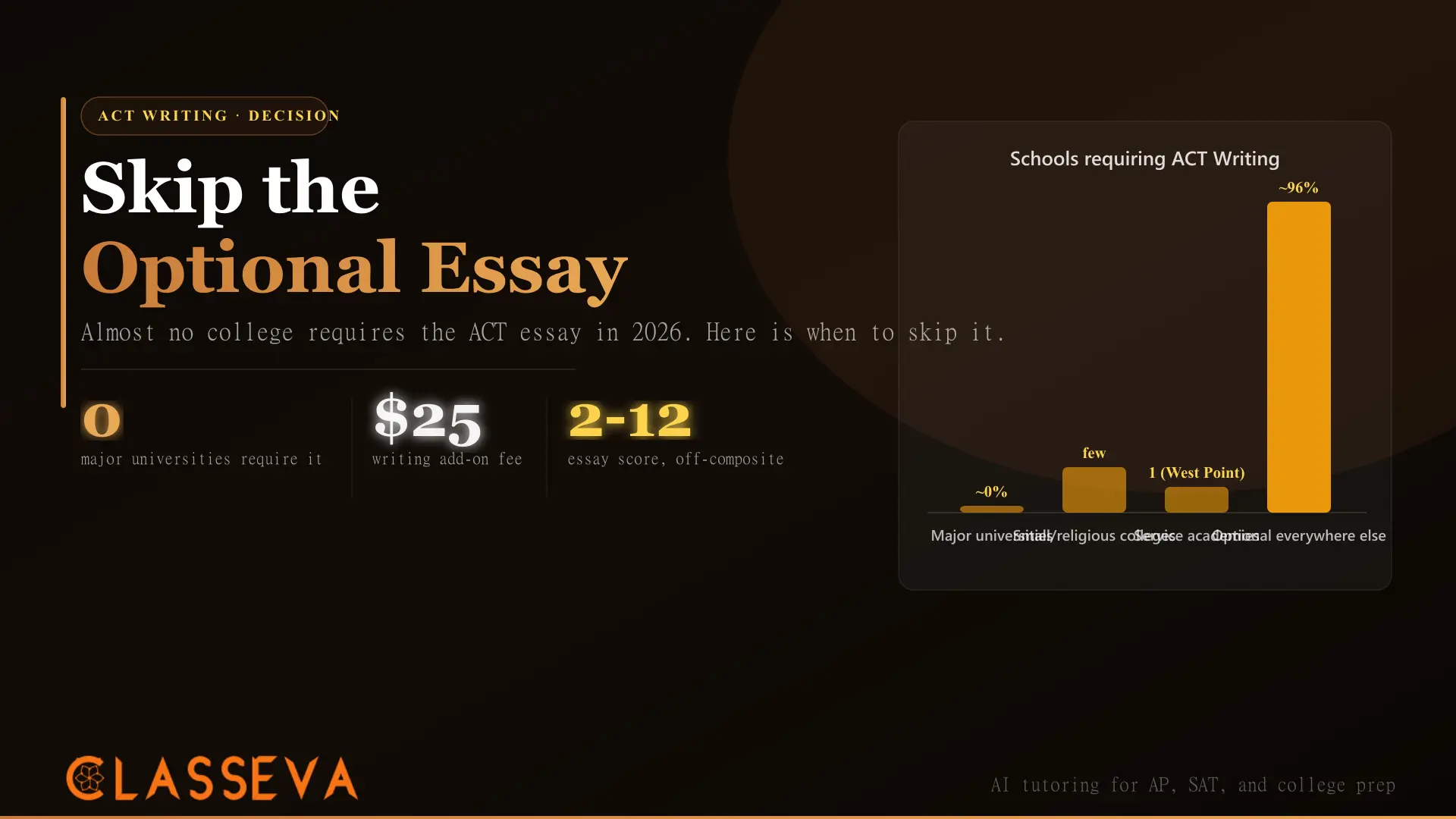
Almost none. As of the 2025-26 admissions cycle, no major US university publicly requires the ACT writing section as a standalone admissions criterion. The schools that still ask for it form a short, niche list: a handful of small religious colleges and the US Military Academy at West Point. [VERIFY: act.org and individual school admissions pages]
The Short List of Schools That Ask for It
The schools where the ACT essay colleges require still share a profile: small enrollment, a faith-based mission, or a service academy structure. Reported examples in recent cycles include the US Military Academy at West Point alongside several small colleges. [VERIFY: each school admissions page, since lists circulate online and lag behind policy changes] Treat any third-party list as a starting point, not a verdict. A school can change its policy between application cycles, and the only authoritative source is that school official admissions page.
| Policy Category | What It Means | Your Action |
|---|---|---|
| Required | You must submit an ACT writing score | Take the essay; non-negotiable for this school |
| Recommended | The school suggests but does not mandate it | Take the essay to avoid a weaker application |
| Optional / Considered | Submitted if you have it, ignored if you do not | Skip unless your score is genuinely strong |
| Not used | The school disregards the writing score entirely | Skip the essay |
How to read a college standardized testing policy for the ACT writing section. Verify each policy on the school official page.
What Major Universities Actually Say
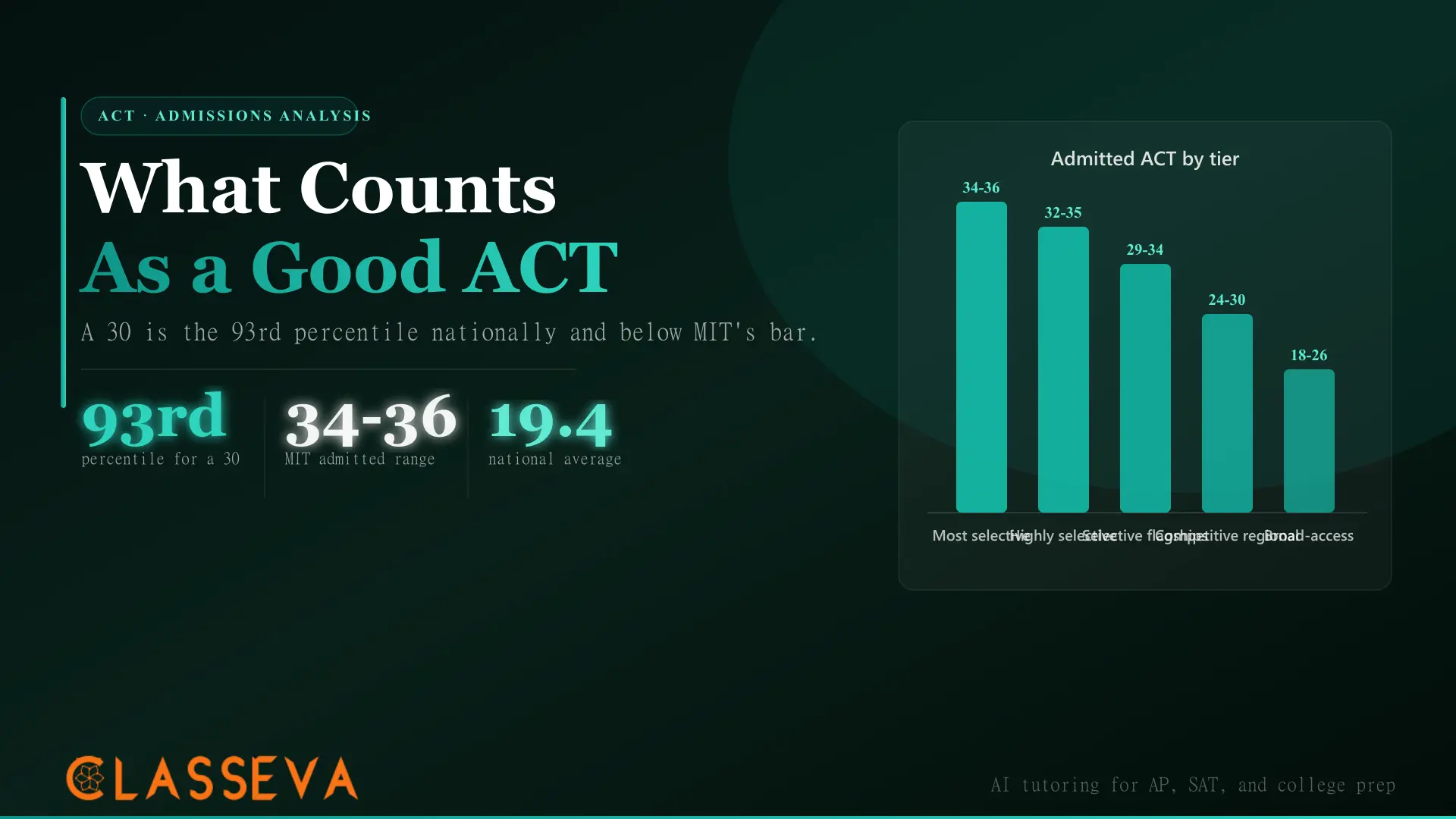
Major universities have moved decisively away from the essay. MIT requires either the SAT or the ACT from first-year applicants but does not require the ACT writing section or the old SAT essay. Selective schools across the Ivy League and the public flagships accept the ACT without writing. When a competitive university wants stronger evidence of your writing, it reads your application essays, not a 40-minute timed argument scored by an algorithm. The takeaway lands clean: for the schools most students dream about, the essay is dead weight, and what those schools weigh instead is your composite, covered in the guide to a good ACT score for college admissions.
Do not assume a school requires the essay because it is selective. Selectivity and essay requirements have nothing to do with each other in 2026. The most selective schools in the country, including engineering powerhouses, accept the ACT without writing. Treating “hard to get into” as a proxy for “needs the essay” leads students to pay for a section no school on their list will read.
How Is the ACT Writing Test Scored?
The ACT writing test produces five numbers: one subject-level writing score on a 2 to 12 scale, plus four domain scores, also 2 to 12, drawn from an analytic rubric. The subject-level score is the rounded average of the four domains. Critically, none of these numbers touch your ACT composite. According to ACT scoring documentation, taking the writing test does not affect your subject-area scores or your composite.
Why the Essay Never Touches Your Composite
Your ACT composite averages English, Math, and Reading, plus Science if you sit it. The writing score lives outside that calculation entirely. A perfect 12 on the essay cannot lift a composite of 28, and a weak 5 cannot drag it down. This separation matters for the decision: because the essay cannot improve the number colleges weigh most, the only reason to write it is that a specific school wants to see the standalone score. For the broader optional-section landscape, the same principle applies to the optional ACT Science section, though Science does fold into the composite when included.
The Four Scoring Domains
The essay earns scores in four domains: Ideas and Analysis, Development and Support, Organization, and Language Use and Conventions. On paper, two trained raters score each domain and their ratings combine into the final number. Online, an automated scoring engine assigns the score when it can do so with high confidence; essays that fall below that confidence threshold route to human review. Knowing the four domains tells you what graders reward: a clear argument, specific support, logical structure, and clean mechanics.
What Does the ACT Essay Prompt Look Like?
The ACT essay gives you one prompt that frames a complex issue and lays out three perspectives on it. Your task: develop your own perspective and analyze how it relates to one or more of the three given. You get 40 minutes to read, plan, and write a full argumentative essay. The prompts skew toward debatable social and policy questions, the kind with no single correct answer, so graders can judge how you reason rather than what you happen to know.
The format rewards a specific move. You are not just stating an opinion; you are positioning your view against the supplied perspectives, agreeing with one, refuting another, or carving out a more nuanced stance. A strong essay names the tension between perspectives and explains why your position holds up. ACT publishes official sample essays and prompts with scored examples, which is the only practice resource you need if you do decide to write.
Spend your first 5 to 8 minutes planning, not writing. Pick a clear perspective, decide which of the three given views you will engage directly, and outline two or three supporting points with concrete examples. The four domains reward a planned argument over a long unfocused one. A tight, well-organized essay scores higher than a sprawling one that never commits to a position.
The Time and Cost Trade-Off
The essay costs money, time, and energy at the worst possible moment. The writing add-on runs about $25 on top of the roughly $68 base ACT fee, and the 40-minute essay sits at the very end of the test, after hours of multiple-choice work, when concentration is already drained. [VERIFY: current fees at act.org] For a section no college on your list requires, that is a poor trade.
What the Writing Add-On Actually Costs
The dollar cost is the smallest part. The real cost is the prep time you spend learning a timed argumentative format you may never need, plus the test-day fatigue that can bleed into your final multiple-choice section if you sit the essay. Students who skip the essay walk out of the test 40 minutes earlier and arrive at the multiple-choice sections that feed their composite with more in reserve. The math favors skipping for anyone whose college list does not demand the essay.
Take the ACT With Writing
- •Costs about $25 extra on top of the base fee [VERIFY: act.org]
- •Adds a 40-minute essay at the end, when fatigue peaks
- •Produces a separate 2 to 12 score, not part of your composite
- •Worth it only if a target school requires or recommends it
- •Requires learning the three-perspectives argument format
Take the ACT Without Writing
- •Saves the writing add-on fee entirely
- •Ends the test 40 minutes sooner with energy to spare
- •Loses nothing for the vast majority of 2026 applicants
- •Frees prep hours for English, Math, and Reading
- •The correct default unless a school explicitly asks for the essay
If you are weighing how to spend a fixed number of prep hours, the comparison gets sharper. Hours spent on essay strategy do not raise your composite. Hours spent on the ACT English strategy or ACT Math strategy raise the number every college reads, and the four-point ACT improvement plan shows where those hours pay off fastest. For students still choosing between the two main tests, the Digital SAT versus Enhanced ACT comparison lays out the broader trade-offs, and neither test requires an essay for admission anymore.
A Decision Framework for the ACT Essay
The ACT optional essay decision reduces to one question asked across your whole college list: does any school require or recommend the essay? Work the framework below in order. It takes under 30 minutes and gives you a definitive answer grounded in each school own policy, not in a generic recommendation.
Project Your ACT Composite First
Before you spend a minute on the essay decision, get a clear read on the score that actually drives admissions: your composite. The optional essay is a footnote. Your English, Math, Reading, and Science performance is the headline, and knowing where your composite sits tells you where to spend prep time.
ACT Score Predictor
Enter your practice section results to project your ACT composite band and see whether your prep hours belong in English, Math, Reading, or Science rather than the optional essay.
Once you know your composite trajectory, the essay decision becomes obvious. If no school on your list requires writing, every hour you would spend on essay drills is better spent lifting the composite the predictor projects. For a wider view of how the 2026 test changed, the Enhanced ACT 2026 changes guide covers the optional sections, the shorter format, and what shifted from the older exam.
Key Takeaways
- The ACT writing section is optional, and almost no college requires it in 2026. Major universities, including MIT, accept the ACT without the essay. The default decision is to skip it.
- The essay score is fully separate from your composite. It produces a 2 to 12 number that never enters the 1 to 36 composite colleges weigh most, so it cannot raise the score that matters.
- A short list of schools still asks for the essay. Mostly small religious colleges and the US Military Academy at West Point. Verify each policy on the school official admissions page, not a third-party list. [VERIFY: target school pages]
- One required-or-recommended school flips your answer to yes. If even a single college on your list wants the essay, take it. Otherwise, skip it.
- The writing add-on costs roughly $25 and 40 minutes of test-day energy. [VERIFY: current fees at act.org] For a section no school on your list reads, that is a poor trade.
- The essay is one 40-minute prompt with three perspectives. You develop your own view and analyze it against the supplied perspectives, scored across four domains.
- Redirect skipped-essay time to English, Math, and Reading. Those sections feed your composite, the number every college reads.