Digital SAT vs Enhanced ACT 2026: How to Pick the Right Test
Admissions offices at every US college treat a 1400 on the Digital SAT and a 31 on the Enhanced ACT as equivalent. The decision between these two tests has nothing to do with college preference and everything to do with pacing, format structure, and how your brain handles timed testing conditions. When I examined years of score research and the concordance data published jointly by College Board and ACT, one finding kept surfacing: students who score significantly higher on one test over the other almost always point to timing, not content. The test that fits is the one where you stop racing the clock.
What Changed About Both Tests?
Most SAT vs ACT comparison articles online were written before 2024. They describe a pencil-and-paper SAT with 3-hour runtime and a separate Essay section, alongside an ACT with 5 answer choices on Math. Both tests look different now, and the comparison requires starting from scratch.
The Digital SAT Transition (2024)
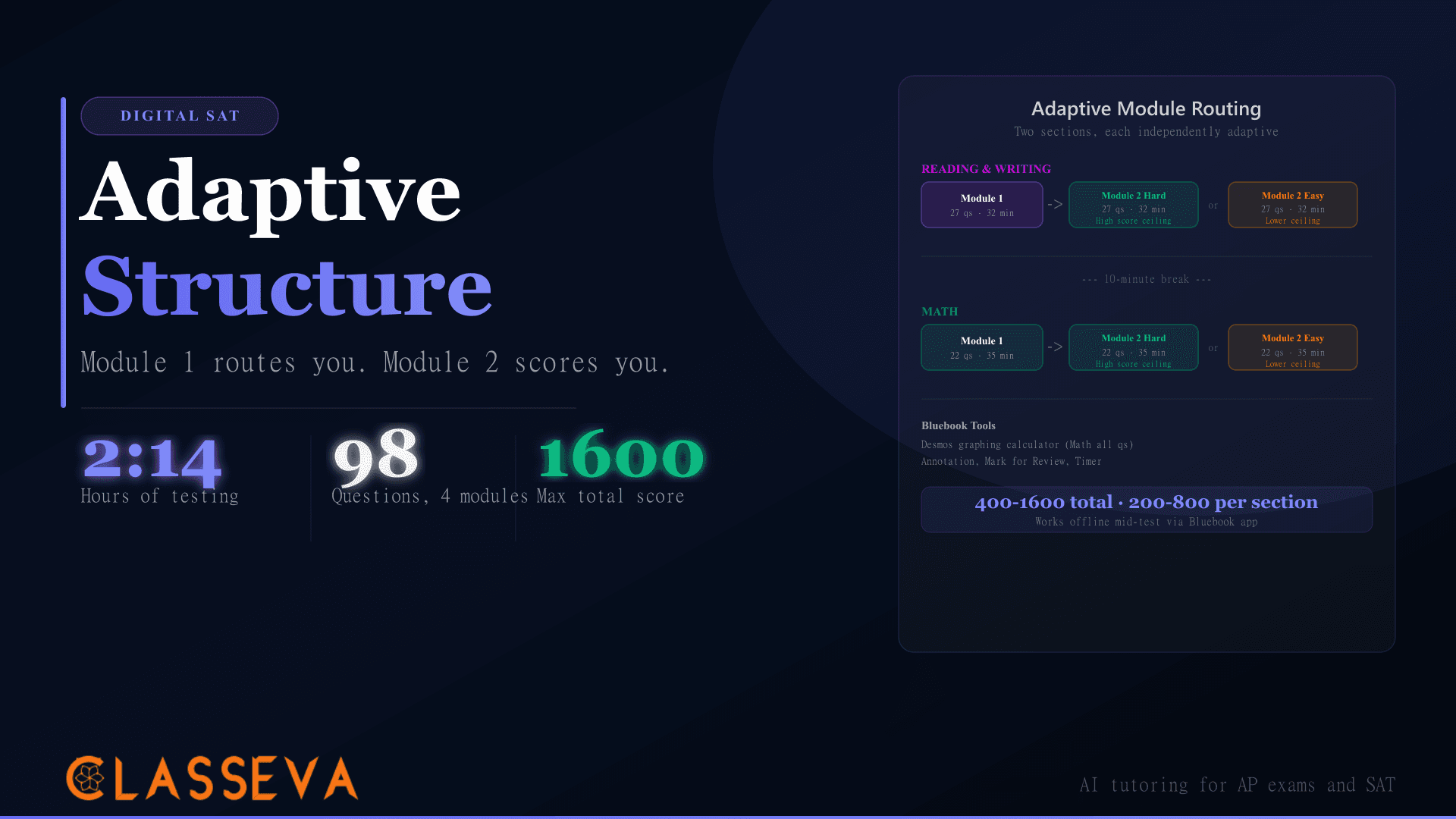
College Board launched the Digital SAT for US students in spring 2024. Every aspect of the test changed. The paper format is gone; the Bluebook app delivers the test on a laptop or tablet. The test shortened from about 3 hours to 2 hours and 14 minutes. The Reading and Writing section replaced long 700-word passages with short 25-to-150-word excerpts, one question per passage. And the scoring became adaptive: Module 2 difficulty in each section adjusts based on your Module 1 performance.
The Desmos graphing calculator now appears on all Digital SAT Math questions, embedded directly in Bluebook. Students can also bring an approved handheld calculator. The Essay section no longer exists. Total question count dropped from 154 to 98.
The Enhanced ACT Changes (2025)
ACT's Enhanced format, rolled out in 2025, trimmed question counts across every section. English dropped from 75 to 50 questions; Math from 60 to 45 questions with 4 answer choices (previously 5); Reading from 40 to 36 questions. The Science section became optional. Students can now choose whether to include Science when registering. ACT still offers both paper and computer delivery, unlike the SAT's computer-only format.
The Enhanced ACT remains available on paper at most test centers. The Digital SAT runs exclusively through the Bluebook app on a laptop or school-issued device. If your testing environment makes computer-based testing difficult, that alone can tip the decision toward the ACT.
Format at a Glance: Structure, Timing, Scoring
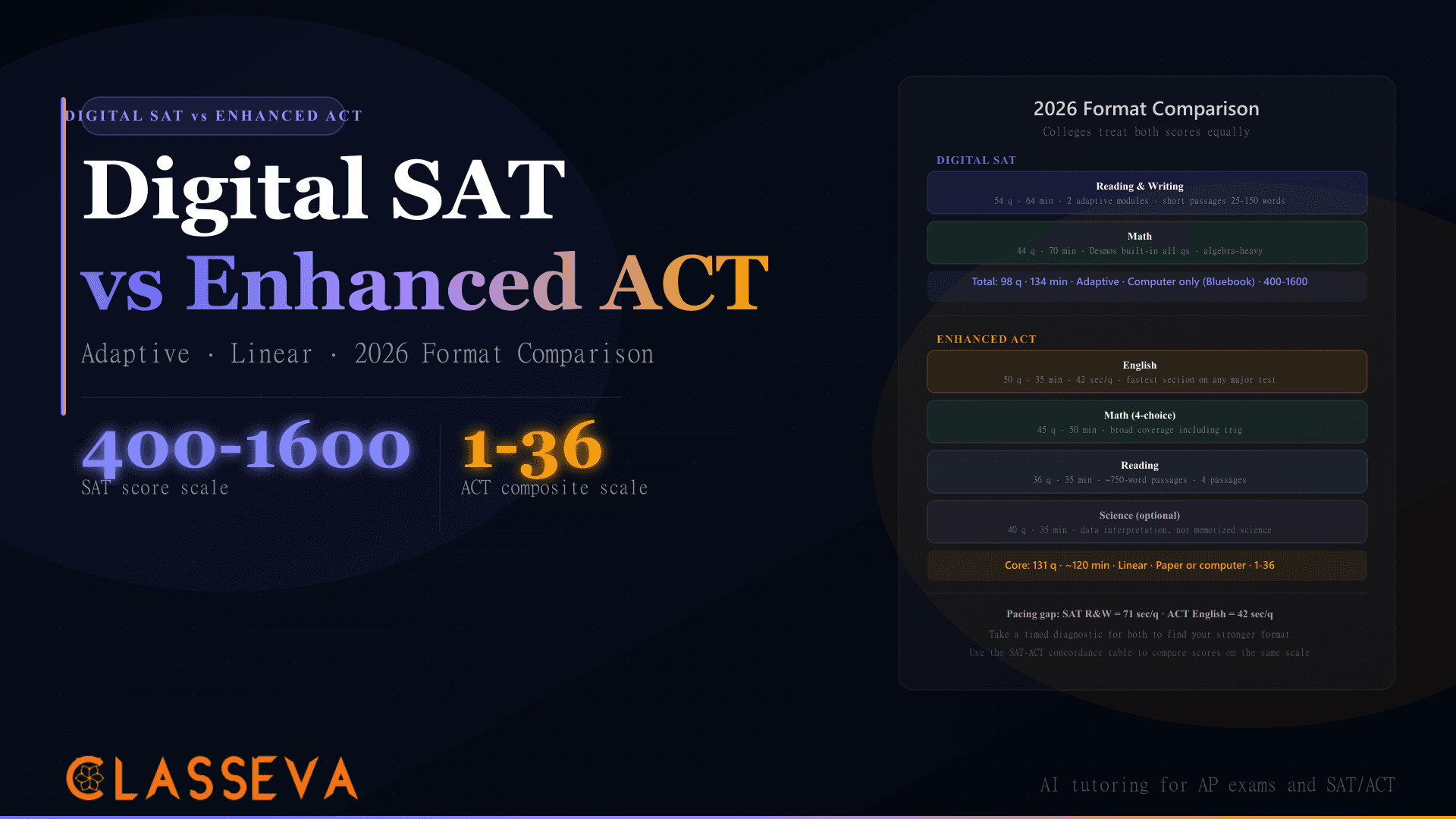
Laid side by side, the two tests share almost no structural similarities beyond the fact that both produce a single composite score colleges use to compare applicants.
Score Scales and Superscoring
The Digital SAT scores on a 400-1600 scale, split evenly into a 200-800 Reading and Writing score and a 200-800 Math score. The Enhanced ACT scores on a 1-36 composite, averaging the four section scores (English, Math, Reading, Science). Both College Board and ACT support superscoring: most selective colleges will take your highest section scores across multiple test dates and combine them into a superscore. You can superscore each test independently.
Seconds Per Question
This is where the tests diverge most sharply. The Enhanced ACT English section gives students 42 seconds per question. The Digital SAT Reading and Writing section gives 71 seconds per question. That 29-second gap is enormous at scale: a student who comfortably paces through SAT passages may consistently run out of time on ACT English, and vice versa. SAT Math offers about 95 seconds per question; ACT Math offers about 67 seconds.
| Section | Digital SAT (sec/q) | Enhanced ACT (sec/q) |
|---|---|---|
| English / Reading & Writing | 71 sec | 42 sec (English) / 58 sec (Reading) |
| Math | 95 sec | 67 sec |
| Science (ACT only) | N/A | 53 sec |
Approximate seconds per question. SAT R&W: 32 min / 27 questions per module. ACT English: 35 min / 50 questions.
How the SAT Adaptive Structure Works
The Digital SAT uses a two-stage adaptive design that no previous version of the SAT employed. Understanding it matters because it changes how scoring works and what strategy to use in Module 1.
What Module 2 Routing Means for Your Score
On the Digital SAT, every section splits into two modules. Module 1 is the same for everyone. Based on your Module 1 performance, the test routes you into either a harder or easier Module 2. Students who land in the harder pool can access scores above roughly 650 per section. Students routed to the easier pool face a score ceiling.
This matters for strategy: guessing on Module 1 questions to save time is riskier on the Digital SAT than it was on the old paper SAT. Demonstrating competence through Module 1 is necessary to access the score range most selective colleges want to see.
Treat every Module 1 question as high-stakes. A strong Module 1 performance unlocks Module 2 Hard across both sections. You can afford occasional uncertainty in Module 2, but Module 1 sets your ceiling. The full Digital SAT adaptive structure breakdown goes deeper on module scoring mechanics.
The ACT's Linear Format Advantage
The ACT's linear structure gives some students a genuine advantage: every question is worth the same amount, and you can skip around freely within each section. There is no routing consequence for leaving a hard question blank and returning to it. Students who find adaptive testing psychologically stressful or who prefer predictable question flow often perform better on the ACT specifically because the format removes uncertainty about how current performance affects future questions.
SAT Math vs ACT Math
Both tests cover algebra, geometry, and data analysis. The similarity ends there. The flavor of math tested and the pace required diverge significantly.
Digital SAT Math: Algebra-Heavy and Wordy
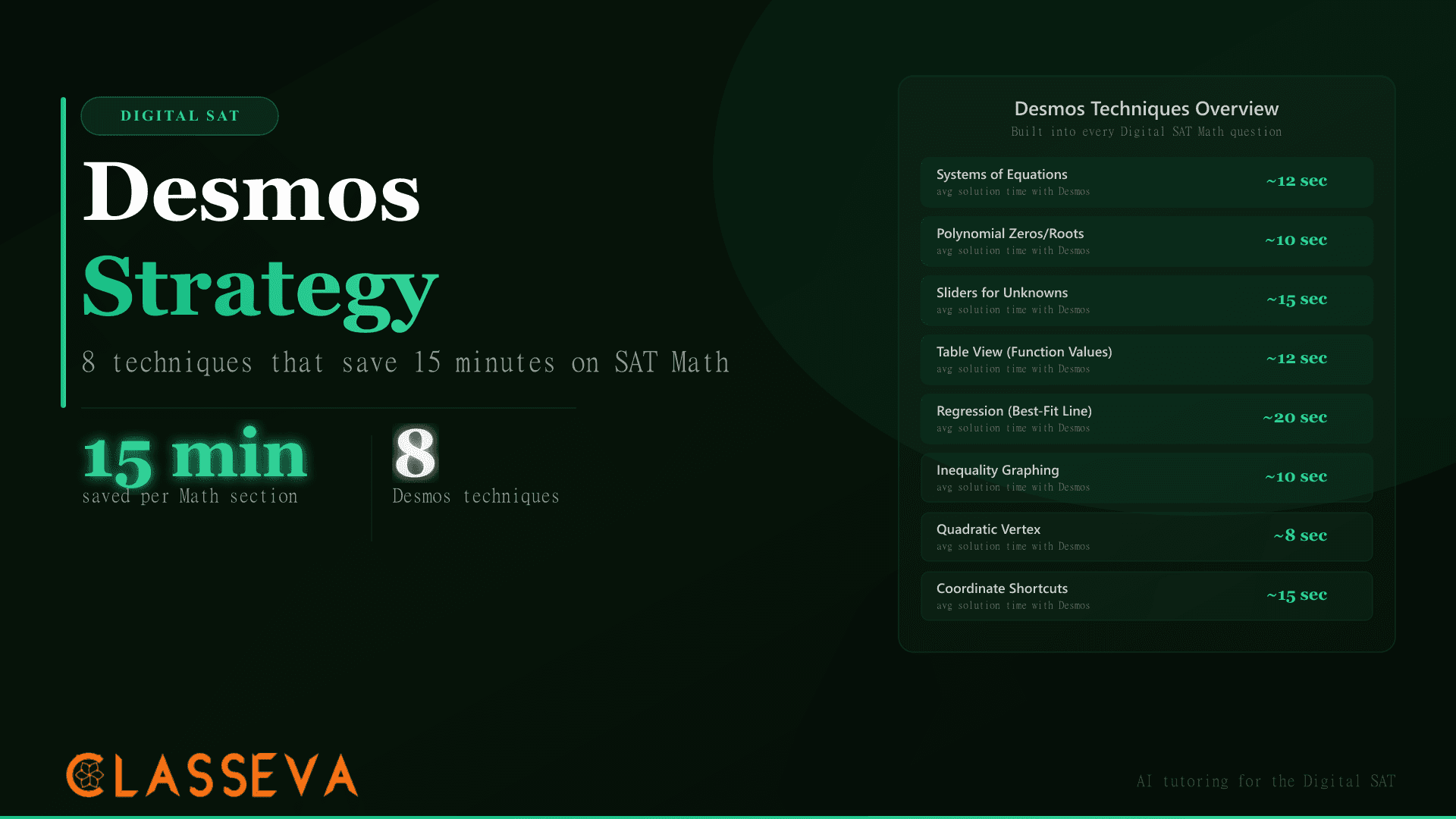
The Digital SAT Math sections lean heavily on algebra: linear equations, systems of equations, quadratics, and functions dominate the question pool. Problems appear as multi-step word problems set in real-world contexts. You rarely see a bare equation; instead, a problem might describe a business scenario and ask you to write and solve a system of equations from it. The Desmos graphing calculator appears on every Math question, including those in Module 1.
The upside: Desmos can solve or verify many questions visually. Students who know how to graph a function and read its zeros, intersections, and transformations save time on problems that would otherwise require algebraic manipulation. The Desmos strategy guide covers this in full.
Enhanced ACT Math: Faster and Broader
ACT Math covers a wider content range. Trigonometry appears more prominently on the ACT than on the SAT. Geometry and pre-calculus topics take up a larger share. The Enhanced ACT dropped to 4 answer choices on Math (from the old format's 5), which marginally improves guessing odds. Questions tend to be more direct: fewer multi-step word problems, more straightforward applications of formulas and procedures.
The pace is the catch. At 67 seconds per question, ACT Math requires fast procedural execution. A student who processes problems deeply but slowly will run out of time, even if they know the material. Students who are fast at arithmetic and formula application often excel here.
SAT Reading vs ACT Reading
This is probably the most structurally distinct difference between the two tests.
SAT Short Passages (25-150 Words)
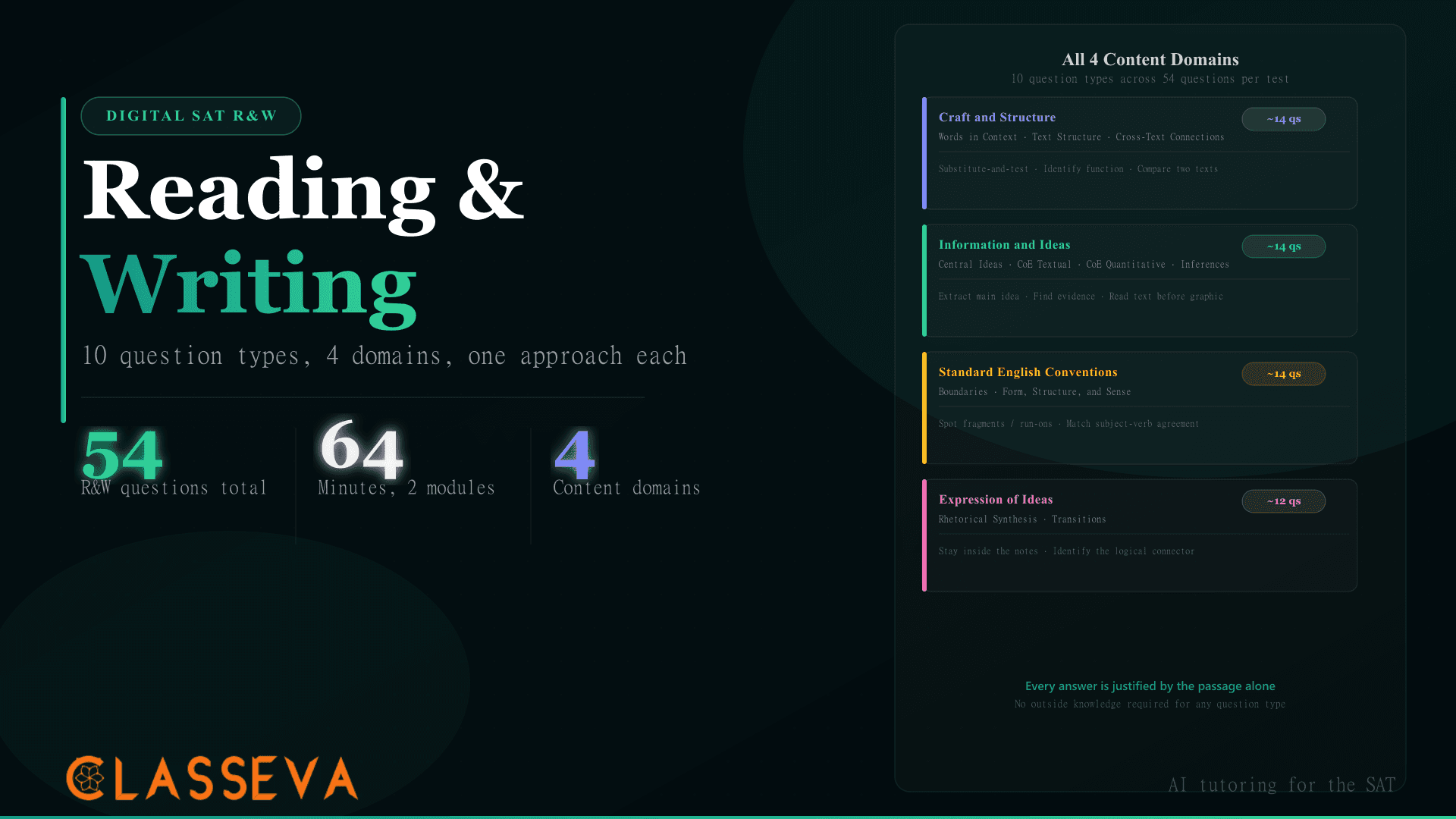
The Digital SAT Reading and Writing section replaced the old 700-word paired passages with short, focused excerpts. Each passage runs 25 to 150 words and carries exactly one question. Question types include vocabulary in context, claims and evidence, rhetorical purpose, and transitions. The skill tested is precision: can you identify exactly what a specific sentence accomplishes or what a word means in that specific context? The Digital SAT Reading and Writing strategy guide breaks down each question type.
Students who find long-passage reading exhausting or who lose focus over sustained reading often perform better on the SAT's short-passage format. Each passage is self-contained and requires only a few seconds of reading before the question makes sense.
ACT Full-Length Passages (~750 Words)
ACT Reading uses four full-length passages of roughly 750 words each, with 9 questions per passage. The passages span literary narrative, social science, humanities, and natural science. Students must track arguments, identify main ideas, make inferences, and answer detail questions based on sustained reading. The pace (58 seconds per question) includes the time needed to read each passage.
Students who read fast and retain comprehension over longer texts tend to score well on ACT Reading. Those who struggle to skim effectively or who need re-reading time often find the ACT Reading pace punishing.
The ACT Science Section: Do You Need It?
The Enhanced ACT Science section is optional in 2026 and does not test science content knowledge. It tests data literacy: reading graphs, interpreting experimental results, and identifying conflicting viewpoints across research summaries. A student who never studied biology or chemistry can score a 36 on ACT Science by reading charts accurately and quickly.
ACT Science does not require you to know the periodic table, cell biology, or physics formulas. It asks you to read a graph, compare two researchers' findings, or identify which experimental variable was controlled. If data interpretation is a strength, Science can improve your composite. If it strains your focus after English, Math, and Reading, skip it.
When deciding whether to take Science, run the numbers. If your English, Math, and Reading scores average a 28, adding a 32 on Science raises your composite to 29. If Science drops to a 24, it pulls your composite to 27. A poorly paced Science section can hurt more than it helps.
How Colleges Treat SAT vs ACT Scores
College Board and ACT publish a joint SAT-ACT concordance table used by virtually every admissions office to compare scores across tests. A student with a 1400 SAT and a student with a 31 ACT are treated as having equivalent test scores in holistic review. NACAC has documented through surveys that admissions officers do not favor one test over the other. Submitting one vs the other carries no signal beyond the score itself.
Most selective colleges superscore both tests independently. Harvard, MIT, Stanford, and the other highly selective schools list the SAT and ACT on equal footing in their Common Data Set score-range disclosures. The score range matters; the test vehicle does not.
How to Choose the Right Test for You
The most reliable way to pick a test is to take a timed diagnostic for both. Two hours invested in diagnostics will narrow the decision faster than any research. But if you want a framework before running diagnostics, here is how the two tests map to student profiles:
Take the Digital SAT If...
Digital SAT Fits You When...
- •You prefer computer-based testing and are comfortable with a laptop during exams
- •You work better with more time per question (71 sec on R&W, 95 sec on Math)
- •Short focused passages (25-150 words) feel easier to parse than 750-word essays
- •Your algebra and equation-solving skills are stronger than your trig knowledge
- •You are comfortable with Desmos and want to use graphing to verify answers
- •You test well under adaptive conditions where difficulty shifts mid-section
Enhanced ACT Fits You When...
- •You read quickly under pressure and handle long-passage comprehension well
- •You prefer a predictable linear format with no adaptive routing uncertainty
- •You want the option of paper testing at your test center
- •Your math strength spans geometry, trig, and pre-calc more than algebra
- •You want to use a strong ACT Science score to improve your composite
- •You perform better when you know every question has the same difficulty weight
How to Make the Final Call
Take one official diagnostic for each test
Complete a full Khan Academy SAT practice test and one ACT practice test from ACT.org. Strict timing, no pauses. Both within the same two-week window.
Convert and compare using the concordance table
Check your concordant scores. A difference of 3 or more ACT points (or 130+ SAT points) in one direction is a meaningful signal. Smaller differences may be noise from a single diagnostic.
Assess your pacing honestly
Did you run out of time on either test? Note which section caused the most pressure. Pacing is harder to train than content, so favor the test where timing felt manageable.
Decide on the ACT Science section
If taking ACT, sit the Science section during your diagnostic. Score it. If it raises your composite by 1 point or more, include it on test day. If it drags your composite down, register without it.
Use the Optimal Test Date Selector for scheduling
Once you pick a test, check Classeva's Optimal Test Date Selector at /us/parent-resources/optimal-test-date-selector to plan your test window around school deadlines and college application timelines.
SAT-ACT Score Converter
Before committing to one test, compare your current score estimates using the official concordance scale. Classeva's SAT-ACT Converter lets you input any SAT score and instantly see the equivalent ACT range, or reverse the lookup. Use it alongside your diagnostic scores to make the clearest comparison.
SAT-ACT Score Converter
Enter your SAT score to see the equivalent ACT score range, or reverse the lookup. Uses the official College Board and ACT concordance table.
If the converter shows your scores are within one concordance band of each other, other factors like pacing preference, available test dates, or subject strengths should drive the decision. For a broader view of your score targets, the Test Score Goal Setter maps both SAT and ACT targets to specific college admission ranges.
Key Takeaways
- Colleges treat Digital SAT and Enhanced ACT scores identically. Use the joint concordance table to compare scores on the same scale.
- The Digital SAT is adaptive: Module 2 difficulty and your score ceiling depend on Module 1 performance. The ACT is linear.
- Pacing is the primary differentiator. ACT English runs at 42 seconds per question; SAT R&W runs at 71 seconds per question.
- SAT Reading uses short 25-to-150-word passages with one question each. ACT Reading uses full ~750-word passages with 9 questions.
- SAT Math rewards deep algebra and Desmos proficiency. ACT Math rewards broad, fast execution across algebra, geometry, and trigonometry.
- The Enhanced ACT Science section is optional. Include it only if it raises your composite based on a practice diagnostic.
- Take a timed diagnostic for both tests, then use the SAT-ACT concordance table to find which format produces your higher score before committing to a prep cycle.