What Is a Good ACT Score for College Admissions in 2026?
Defining a good ACT score college admissions target starts with one rule: aim for whatever clears the 25th percentile at the schools you actually want to attend. That makes the question harder than the standard answer of “aim for a 30.” A 30 ranks near the 93rd percentile nationally, and at most colleges that reads as outstanding. At MIT, where the admitted 25th percentile composite sits at 34, that same 30 lands below the bottom quarter of the class. The whole skill here is matching one number to a specific list of schools rather than chasing a national average that almost no selective college uses.
What Is a Good ACT Score?
A good ACT score is one that places you at or above the 25th percentile of admitted students at your target colleges. Nationally, anything above the 19.4 average already beats most test-takers, but selective admissions runs on a different scale. The practical answer: a 24 opens broad-access and many regional schools, a 30 clears most state flagships, and a 34 reaches the most selective universities in the country.
The National Average and Why It Misleads
The national average ACT composite for the class of 2024 was 19.4, down from 19.5 for the class of 2023, according to ACT national score data. Roughly 1.4 million seniors sat the exam. That average describes the full national pool, including students at schools that test every junior by state mandate. Selective colleges draw from the top slice of that pool, so their admitted ranges start where the national distribution thins out. Treat 19.4 as the midpoint of everyone, not a finish line for anyone targeting a competitive school.
Percentile Anchors You Can Memorize
Four percentile anchors carry most of the weight. A composite of 22 ranks near the 72nd percentile, a 30 near the 93rd, a 32 near the 95th, and a 36 sits at the 99th, per the ACT National Ranks tables. The compression at the top matters: moving from 30 to 32 climbs only two percentile points but shifts you from competitive to strong at top-30 schools. Two raw composite points near the ceiling do more for an application than four points near the middle.
One more reason the anchors matter: admissions readers think in percentiles, not raw points. When a 30 and a 32 both land in the 90s, an officer treats them as close, and the rest of your file decides between two strong applicants. The raw-point gap that feels large to a student barely registers to a reader scanning thousands of applications. That is why a good ACT score college admissions plan targets a percentile band rather than a single magic number.
How Do ACT Score Percentiles Work?
An ACT percentile reports the share of recent test-takers who scored at or below your composite. A national rank of 93 for a 30 means 93% of graduates scored 30 or lower and you outscored them. ACT recalculates these ranks each year from the three most recent graduating classes, so the table you use should match your testing year.
Composite vs Section Percentiles
Admissions officers read your composite percentile, but your four section scores (English, Math, Reading, Science) each carry their own percentile. The composite averages the sections and rounds, which hides imbalance. A 30 composite built on a 34 Reading and a 26 Math reads differently to an engineering program than a flat 30 across all four. STEM-heavy programs scrutinize the Math and Science lines; humanities programs weigh English and Reading. The chart below shows how the composite percentile climbs as scores rise.
What ACT Score Do You Need by College Tier?
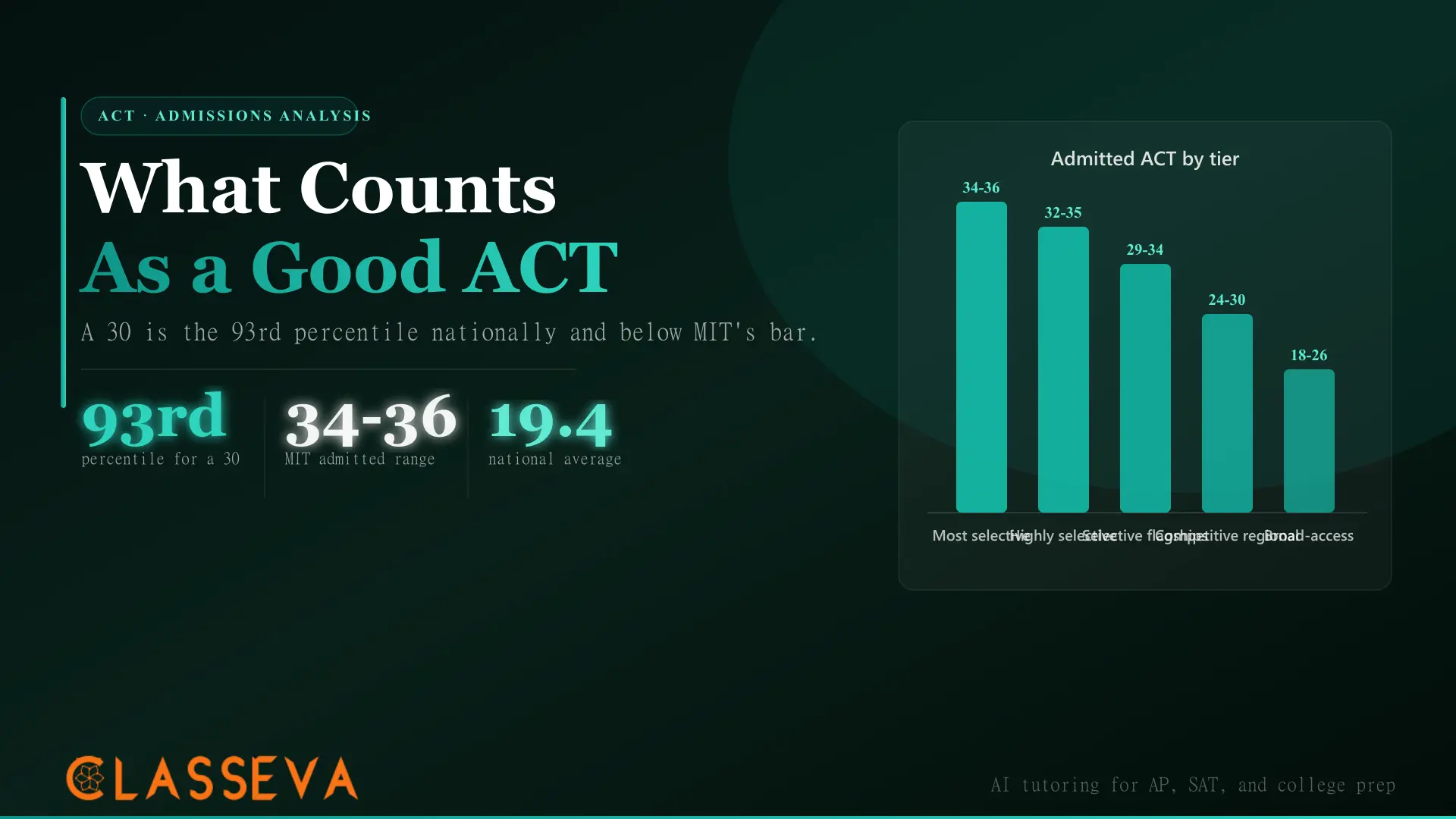
The ACT composite you need rises with selectivity. The most selective universities admit a middle 50% of 34 to 36; strong flagships and selective privates cluster around 29 to 34; broad-access and regional schools admit students across the 18 to 26 band. The table below maps each tier to its admitted middle 50% so you can place your own list.
| College Tier | Admitted Middle 50% (ACT Composite) | Example Schools | Approx. Percentile of 25th %ile |
|---|---|---|---|
| Most selective (top 20) | 34 - 36 | MIT, Ivy League, Stanford | ~97th |
| Highly selective | 32 - 35 | Top-30 privates, elite flagships | ~95th |
| Selective flagships and privates | 29 - 34 | Michigan, UCLA, strong state flagships | ~88th |
| Competitive regional | 24 - 30 | Mid-tier privates, many public universities | ~74th |
| Broad-access | 18 - 26 | Open and lightly selective campuses | ~52nd |
Admitted middle 50% ranges by tier. Confirm each school exact figures in its Common Data Set Section C9. [VERIFY: latest CDS per school]
Every college that publishes a Common Data Set reports its 25th and 75th percentile ACT composite in Section C9. Search the school name plus “Common Data Set,” open the latest year, and read C9. That single number pair tells you more than any ranking list, because it is the school own report of who actually enrolled.
The Most Selective Schools (Top 20)
At the most selective universities, the admitted ACT composite runs 34 to 36. MIT reports a middle 50% of 34 to 36 for its Class of 2029, per MIT Admissions statistics. A 34 clears the 25th percentile; a 35 sits at the median. This is the tier where a 30, excellent everywhere else, reads as a red flag rather than a strength. The differentiation is stark: a 30 is the 93rd percentile nationally and roughly the bottom of MIT admitted class.
Strong State Flagships and Selective Privates
Strong flagships and selective private colleges admit a middle 50% near 29 to 34. The University of Michigan reports an enrolled middle 50% around 31 to 34; UCLA enrolls a wide band that runs roughly 29 to 34 depending on the reporting year. A 30 to 32 makes you competitive across most of this tier. A 33 or 34 moves you toward the top of the admitted pool and strengthens merit-aid candidacy at schools that award it.
Broad-Access and Regional Schools
Broad-access and regional public schools admit students across the 18 to 26 composite band, with many setting automatic-admission or scholarship thresholds rather than competitive cutoffs. A 24 clears most of these schools and frequently unlocks merit money. Several state systems publish fixed ACT thresholds for guaranteed admission and tiered scholarships, so a single point can move a student into a higher award bracket. Here the question shifts from “will I get in” to “what does this score pay.”
That payment math rewards precision. A student sitting at a 25 who pushes to a 27 may cross a scholarship line worth several thousand dollars per year, even though both scores read as solid nationally. Before writing off a retake at this tier, pull the school posted award grid. The dollar value of two more composite points often dwarfs the cost of one more test date, which flips the usual cost-benefit logic of retaking entirely.
For a deeper read on individual schools, the MIT admissions breakdown and the University of California admissions guide walk through how each one weighs test scores inside a holistic file. The pattern repeats across tiers: the score gets you a full read, and the rest of the application decides the result.
Is an ACT 30 Good? Is a 32 Good?
Yes to both, with a caveat tied to your list. A 30 ranks at the 93rd percentile and a 32 at the 95th, so both beat the overwhelming majority of test-takers. At state flagships and most selective privates, a 30 is competitive and a 32 is strong. At the top 20, both sit below the admitted 25th percentile of 34, which reframes them from “great score” to “below the bar for this specific tier.”
ACT 30 (93rd percentile)
- •Outscores roughly 93% of national test-takers
- •Competitive at most state flagships and selective privates
- •Strong merit-aid candidate at many regional schools
- •Below the 25th percentile (34) at MIT and the Ivies
- •Maps to roughly an SAT 1360 to 1370
ACT 32 (95th percentile)
- •Outscores roughly 95% of national test-takers
- •Clears the 25th percentile at many top-30 universities
- •Strong across selective flagships and privates
- •Still a stretch below the 34 floor at the most selective 20
- •Maps to roughly an SAT 1430
A score is good if it clears the 25th percentile of every school you genuinely want to attend, and excellent if it clears their median. Anything framed without a school list is marketing, not advice.
How Does the ACT Compare to the SAT?
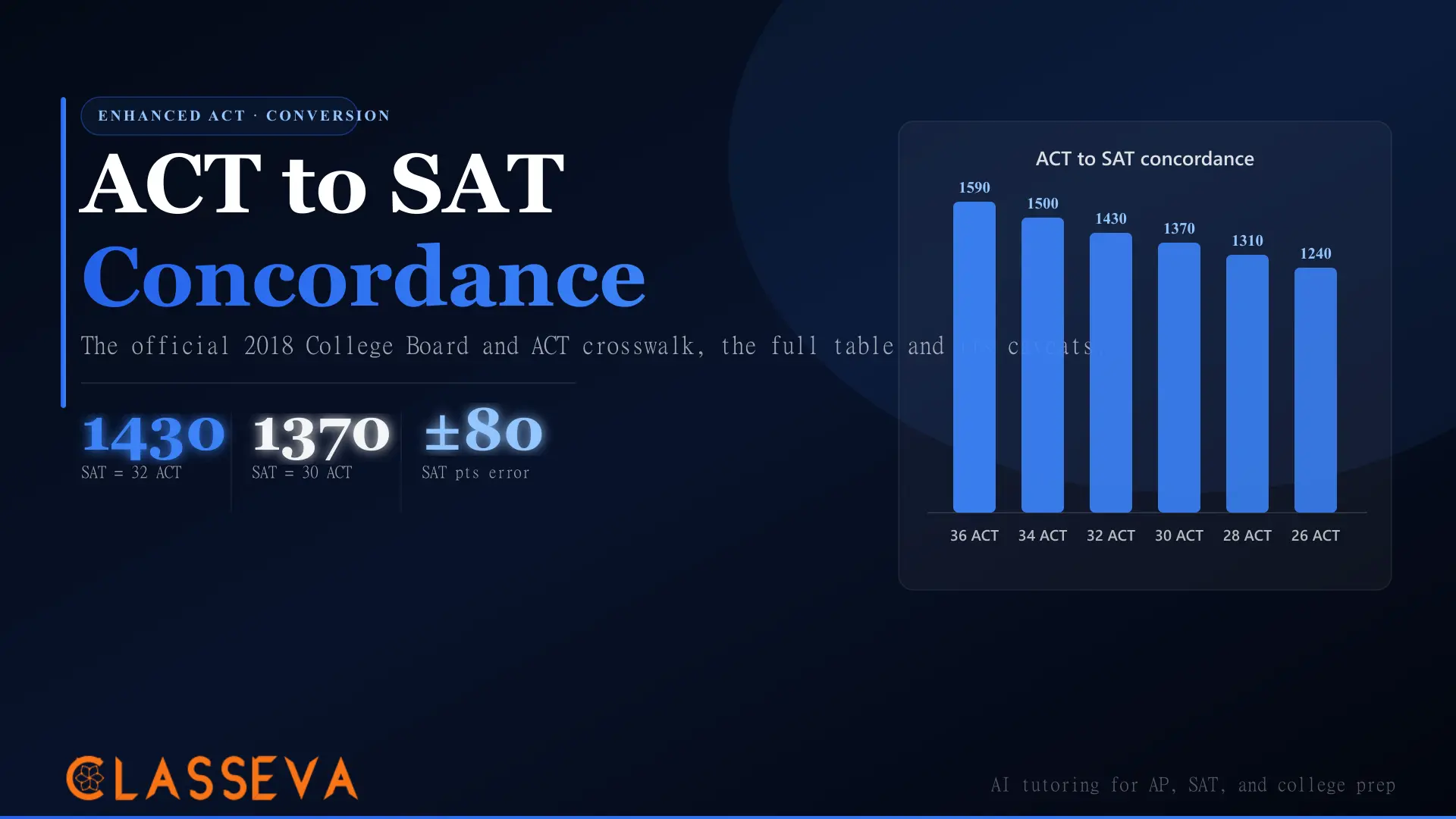
The ACT and SAT measure the same percentile bands in different units, and colleges accept both with no stated preference. The ACT runs 1 to 36; the SAT runs 400 to 1600. An ACT 30 maps to an SAT near 1360, an ACT 32 to about 1430, and an ACT 34 to about 1500, per the College Board and ACT concordance. Take whichever test fits your strengths, then judge the score against the same school percentile ranges.
| ACT Composite | Approx. SAT (1600 scale) | National Percentile (ACT) |
|---|---|---|
| 36 | 1590 - 1600 | 99th |
| 34 | 1490 - 1510 | ~97th |
| 32 | 1420 - 1440 | ~95th |
| 30 | 1360 - 1370 | ~93rd |
| 26 | 1230 - 1250 | ~81st |
| 22 | 1100 - 1120 | ~72nd |
Approximate ACT-to-SAT concordance. Use official College Board and ACT concordance tables for exact conversions. [VERIFY: latest ACT/SAT concordance]
The takeaway: a good ACT score and a good SAT score describe the same applicant in different notation. If you have already studied for one test, the ACT to SAT score conversion guide and the good SAT score breakdown let you translate your number into the other scale before deciding whether to switch tests or sit both.
Should You Superscore and Retake?
Retake when your current composite sits below the 25th percentile of your target schools and the calendar allows time to study. Most colleges either superscore the ACT, combining your best section scores across sittings, or consider your single highest composite, so a lower retake rarely counts against you. Students who add 10 to 20 focused study hours per weak section between sittings commonly raise their composite by 1 to 3 points.
Superscoring rewards uneven scores. If you posted a 33 English on one date and a 32 Math on another, a superscoring school may build a composite from your best of each, lifting your reported number above any single sitting. Check each school superscore policy before you skip a retake, because the policy decides whether a second sitting can only help. The ACT score sending strategy guide covers which scores to send and when.
Retaking without a study plan repeats the same score. The ACT measures specific skills (Math through trigonometry, dense Reading under time pressure, data interpretation in Science), and a cold retake reproduces your prior result within a point. Diagnose which section dragged your composite, drill that section, then sit again. Random retakes burn fees and test dates without moving the number.
How to Set Your Own ACT Target
Build your target from your school list, not a national benchmark. The method takes under an hour and produces a single composite number to aim for. Work through the five steps below in order.
- List 6 to 10 target schools grouped into reach, match, and safety, so each tier carries a different score expectation.
- Open each school Common Data Set and read Section C9 for the 25th and 75th percentile ACT composite of enrolled students.
- Set your floor at the 25th percentile of your reach schools and the 75th percentile of your safety schools, whichever is higher.
- Convert that floor to a percentile using the ACT National Ranks table so you know the gap from your current score.
- Schedule retakes with at least three to four weeks of section-specific study before your earliest deadline if you sit below your floor.
This produces a target that means something. A student aiming at a flagship with a 30 to 32 admitted range sets a floor near 30; a student aiming at the top 20 sets a floor at 34. Neither floor comes from the national average, and that is the point. For broader planning context, the junior year college planning timeline shows where ACT prep fits against the rest of the application calendar, and the safety, match, and reach list guide helps you group schools before you read a single CDS.
Predict Your ACT Score
If you have taken a practice ACT and want to know where your current performance lands, Classeva ACT Score Predictor converts your section results into a projected composite and percentile so you can measure the gap to your target before booking a real test date.
ACT Score Predictor
Enter your ACT practice section results to project your composite score and national percentile, then compare it against the admitted ranges of your target schools.
Key Takeaways
- A good ACT score is school-specific. The right target is the 25th percentile of the colleges you genuinely want, not the 19.4 national average.
- A 30 ranks at the 93rd percentile nationally yet falls below the admitted 25th percentile of 34 at MIT and the Ivies. The same number reads as excellent or below average depending on the list.
- The percentile curve flattens above 30. Moving from 30 to 32 climbs two percentile points but shifts you from competitive to strong at top-30 schools.
- Tier ranges are predictable: 34-36 for the most selective 20, 29-34 for strong flagships and selective privates, 18-26 for broad-access schools.
- ACT and SAT scores convert cleanly. A 30 maps to roughly an SAT 1360, a 32 to about 1430, and a 34 to about 1500; colleges accept both with no preference.
- Superscoring and retakes usually help. Most schools take your best sections or highest sitting, so a planned retake with section-specific study rarely backfires.
- Read Section C9 of each Common Data Set. It reports who actually enrolled and gives you a better target than any ranking list.