Enhanced ACT Science: Should You Take the Optional Section?
ACT Science sat at the end of the test for 66 years. Students took it, colleges received it, and almost nobody questioned whether it belonged there. Starting in 2025, ACT made it optional. One of the biggest structural changes to the test in decades. Most students still do not know what to do with it.
The short answer for most applicants: you can skip it. But the right answer depends on your intended major, your target school list, and your actual Science score potential relative to your other sections. This post walks through the math, the college policy landscape, and a decision framework you can apply to your own situation.
What Changed with ACT Science in 2025?
The ACT Science section has always tested scientific reasoning (graphs, experiments, competing hypotheses) rather than specific biology or chemistry knowledge. What changed in 2025 was not the section itself but its status: ACT reorganized the test so Science shifts from a required fourth section to an optional add-on. [VERIFY: exact year and effective date of this change at act.org]
From Required to Optional
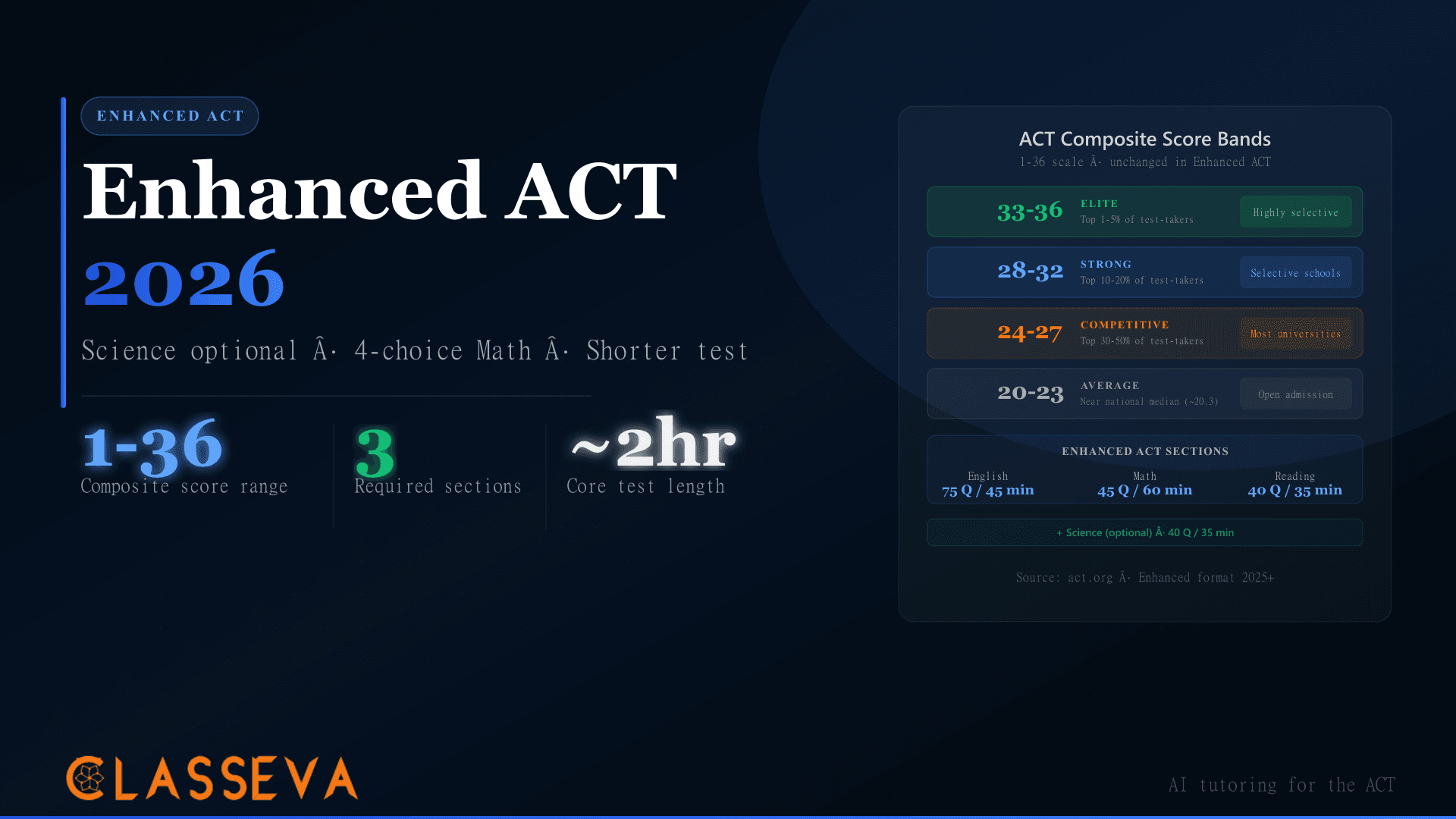
Under the classic ACT, every student took four required sections: English (45 min), Math (60 min), Reading (35 min), and Science (35 min), with an optional Writing (40 min) available at the end. Total testing time ran close to three and a half hours with breaks.
The Enhanced ACT restructured this. The Enhanced ACT format kept Math, English, and Reading as the scored sections that produce your composite. Science became a separate optional section you register for explicitly. Writing remains optional as well. For the strategic rundown of all Enhanced ACT format changes, see the Enhanced ACT overview post.
Does Skipping Science Change Your Composite?
Yes, and the direction it shifts depends entirely on your individual scores. When all four sections are taken, the ACT composite is the average of English, Math, Reading, and Science scores, rounded to the nearest whole number. When Science is skipped, the composite averages only three sections. [VERIFY: confirm composite calculation methodology at act.org]
A student with a 32 English, 30 Math, 28 Reading, and 34 Science gets a 4-section composite of 31. Skip Science, and the same student's 3-section composite drops to 30. The Science score was helping. Flip those numbers (32 English, 30 Math, 28 Reading, 24 Science) and the 4-section composite falls to 28.5 (rounds to 29), while the 3-section composite holds at 30. Here, skipping Science raises the composite by one point.
Take one full ACT Science practice section before your registration deadline. Average your other three section scores. If your practice Science score is below that average, skipping Science will produce a higher composite. If it is above, include it.
What Does ACT Science Actually Test?
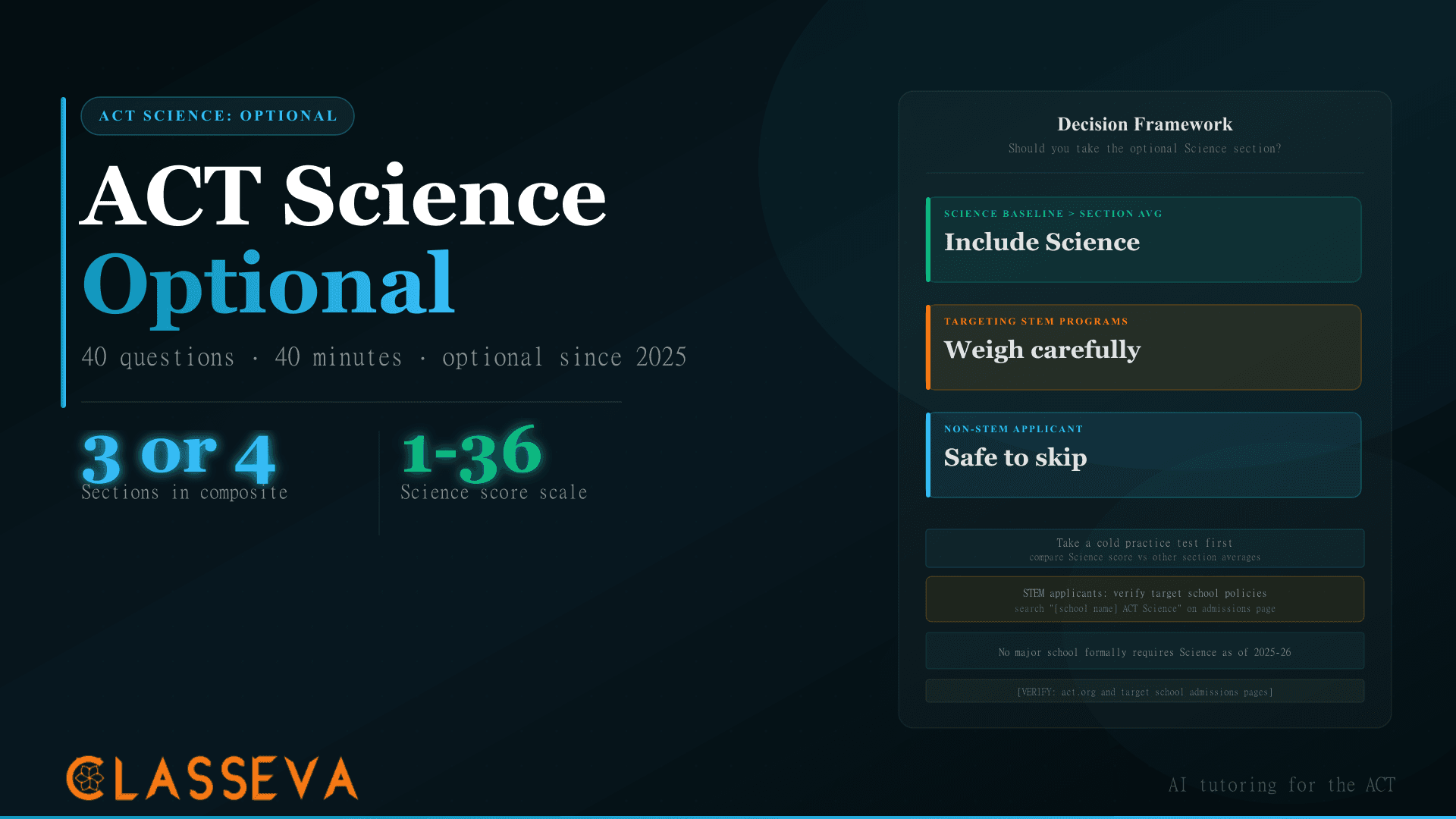
ACT Science tests scientific reasoning across 40 questions in 40 minutes. No prior knowledge of biology, chemistry, physics, or earth science is required. All information needed to answer every question appears in the passage or data set within the section. [VERIFY: confirm current Enhanced ACT Science format and question count at act.org]
The Three Question Formats
ACT Science organizes its questions across three distinct formats, each requiring a different reading approach. Understanding which format you are looking at before reading saves significant time.
Scientific Reasoning, Not Science Knowledge
The ACT is explicit about this: outside knowledge harms more than it helps on Science. A student who remembers that photosynthesis requires chlorophyll and tries to use that fact on a conflicting viewpoints passage about a fictional biochemical process will chase the wrong answer.
This distinction matters for your decision. ACT Science does not reward AP Biology, AP Chemistry, or AP Physics preparation directly. It rewards data literacy: reading tables quickly, locating evidence in dense text, and comparing two arguments without confusing them. Students who score well in standardized reading tests often score well in ACT Science without any dedicated prep.
Do Any Colleges Require ACT Science?
As of the 2025-26 admissions cycle, no major US university has publicly stated that ACT Science scores are required. Colleges that accept the Enhanced ACT understand that Science is optional and evaluate applicants who skip it on the same basis as those who include it. [VERIFY: confirm with ACT.org's college policy guidance and check MIT, Harvard, Yale, Stanford, and Caltech admissions pages directly]
Most Universities Accept Either Format
The ACT sends score reports that clearly show which sections a student completed. Admissions offices at selective schools (Harvard, Yale, Princeton, Stanford, Columbia, MIT) receive both 3-section and 4-section ACT scores regularly. Their holistic review processes account for this. None of these schools list ACT Science as a separate requirement in their published test policies. [VERIFY: confirm at each school's admissions page]
| School | Overall ACT Policy | Science Specifically |
|---|---|---|
| Harvard | Test optional through 2026-27 | No separate Science requirement [VERIFY] |
| MIT | Test required (SAT or ACT) | No separate Science requirement [VERIFY] |
| Caltech | Test required | No separate Science requirement [VERIFY] |
| Georgia Tech | Test optional | No separate Science requirement [VERIFY] |
| UChicago | Test optional | No separate Science requirement [VERIFY] |
| Vanderbilt | Test optional | No separate Science requirement [VERIFY] |
Verify each school's current policy at their official admissions page before making your Science decision. Policies can change between application cycles.
What STEM Programs Actually Say
School-level test policies and program-level admissions guidance can differ. An engineering school that is test-optional at the university level may have a specific note in its engineering admissions FAQ recommending Science scores for applicants to its most quantitative programs. That is a different signal than a formal requirement.
When I look at the publicly available admissions pages for top engineering programs, the pattern I see consistently is this: Science is mentioned as "helpful" or "recommended for STEM programs" rather than listed as a requirement. The distinction matters. A recommendation means your application is competitive without it; it means a strong Science score can strengthen a technical profile if you have one.
Go to the admissions page of each target school. Search their site for "ACT Science" or look in the FAQ section under test requirements. Read for words like "required," "recommended," or "optional." Never rely on third-party sources for this. Policies change mid-cycle, and only the school's own page reflects current guidance.
Strategic Implications for STEM Applicants
If you plan to apply to engineering, pre-med, computer science, or other STEM-intensive programs at highly selective schools, the Science decision deserves more weight. Not because admissions offices formally require it, but because a strong Science score sends a clear signal. A 33 or 34 on ACT Science says you read technical content fast, distinguish experimental variables under time pressure, and stay organized across competing hypotheses. Those are exactly the skills STEM programs believe they need in students.
When Skipping Science Could Work Against You
Two scenarios make skipping Science a real cost rather than a neutral choice.
First: your practice Science score is above your current average on the other three sections. Skipping it in that case means leaving composite points on the table. If you are targeting MIT or Caltech with a 32 composite and a 35 Science score in practice, submitting the 4-section 32.5 (rounds to 33) versus the 3-section 32 is a difference worth the extra preparation.
Second: a specific program's admissions page mentions Science scores. This is rare but possible, especially for state flagship engineering honors programs and some pre-health professional programs with a stated quantitative benchmark. If you see it, treat it seriously.
Include Science
- •Practice Science score above your other section average
- •Targeting selective STEM programs (engineering, pre-med, CS)
- •Time to prep Science without sacrificing other sections
- •No target school lists Science scores specifically
Skip Science
- •Practice Science score below your other section average
- •Applying primarily to non-STEM programs
- •Limited prep time and other sections need more work
- •No target school mentions Science in their test policy
Strategic Implications for Non-STEM Applicants
For students targeting humanities, social sciences, education, business, or arts programs, the case for taking Science weakens considerably. Admissions readers in those programs focus on your English and Reading scores, your essays, and your activities. A 31 Science score adds one point to a 30.3 composite average and does not speak to any of the skills those programs screen for.
Skipping Science saves 40 minutes of test-day fatigue, removes a section you would need to prepare for separately, and does not change your admissions picture at any school that has not explicitly named Science in its requirements. The SAT-ACT score converter shows that a 30 ACT composite is roughly equivalent to a 1400 SAT, a score that opens the door at most selective schools without any Science section attached to it.
The Honest Math: Time vs Marginal Value
Science prep is not free. A student starting from zero on ACT Science, with no prior exposure to the format and no familiarity with reading scientific passages against the clock, typically needs 8-12 hours of focused practice to move from a cold-start score to something competitive. [VERIFY: estimate from ACT prep materials and score improvement research]
What Science Prep Time Actually Buys
Here is the practical calculation. Suppose your current section averages are: English 30, Math 28, Reading 29. Your 3-section composite is 29. You take a cold Science practice test and score 27, below your average. Including Science would produce a 4-section composite of 28.5, which rounds to 29 (same composite). You prep for 10 hours and raise Science to 30. Now the 4-section composite is 29.25, still rounding to 29. The composite is unchanged.
Those same 10 hours applied to Math (your weakest section in this example) could raise a 28 Math to a 30. That makes the 3-section composite (English 30, Math 30, Reading 29) = 29.67, rounding to 30. A full point gained. For most students whose Science baseline sits below their other section averages, Math prep delivers more composite impact per hour of work than Science prep does.
The exception: students whose Science baseline already sits above their other section averages. For that student, registering for Science costs 40 minutes on test day and little additional prep, while adding 1-2 composite points.
Track your current section averages and your Science practice baseline. Use the Test Score Goal Setter to model where composite improvement produces the most impact before committing your prep hours.
Test Score Goal Setter
Enter your current ACT section scores and your target composite to see which section offers the most efficient path to your score goal before you decide where to spend your prep time.
Should You Take ACT Science? A Decision Framework
The decision comes down to four variables: your Science baseline, your target school list, your intended major, and your available prep time. Work through them in order.
Take a timed Science practice section cold
Sit through 40 questions in 40 minutes without any preparation. Your cold-start score is the most reliable data point for this decision. Compare it to your current average on English, Math, and Reading.
Check every target school's admissions page directly
Search each school's official site for ACT Science in their test policy or FAQ section. This step takes 10 minutes per school and eliminates guesswork. Do not rely on admissions aggregator sites for this.
Estimate your prep time budget
If your Science baseline is below your other section averages, calculate whether 10+ hours of Science prep would move Science above that average. If not, those hours likely produce more composite impact applied to Math or Reading.
Register with or without Science before the deadline
You choose whether to include Science at ACT registration, not on test day. Confirm your choice aligns with what you found in steps 1-3. You can typically update your registration before the deadline for a fee. [VERIFY: confirm registration modification policy at act.org]
Key Takeaways
- The Enhanced ACT made Science optional starting in 2025. It is a separate registered section, not something you can decide on test day.
- Skipping Science changes your composite from a 4-section to a 3-section average. If your Science baseline sits below your other section average, skipping Science raises your composite.
- No major US university formally requires ACT Science as a separate admissions criterion as of the 2025-26 cycle. Verify any specific program guidance directly on the school's admissions page.
- STEM applicants targeting engineering or pre-med programs at highly selective schools should weigh Science more seriously. A strong Science score (33-36) reinforces a quantitative profile even when not required.
- For non-STEM applicants, skipping Science is almost always the right call: 40 minutes saved, no composite penalty if your Science baseline is below average, and no admissions cost at any school whose requirements you have verified.
- The 10-12 hours of Science prep time is often better spent raising a weaker required section. Run the composite math before committing that time to Science.
- Take a timed practice Science section before your registration deadline. That score, compared to your other section averages, tells you more than any general framework.
Frequently Asked Questions
Is ACT Science required for all colleges?
No. Since the Enhanced ACT made Science optional, colleges receive scores with or without a Science section and evaluate applicants accordingly. As of the 2025-26 admissions cycle, no major university has publicly stated that Science scores are required. Students applying to specialized STEM programs should verify the specific admissions page for that program. [VERIFY: act.org and target school admissions pages]
How is the ACT composite score calculated without Science?
When a student skips the Science section, the ACT composite score calculates as the average of three section scores: English, Math, and Reading. Each section scores 1-36, and the composite rounds to the nearest whole number. When Science is included, all four section scores average into the composite. [VERIFY: confirm composite calculation methodology at act.org]
How long is the ACT Science section?
The ACT Science section runs 40 questions in 40 minutes, giving you one minute per question on average. Questions draw from three formats: data representation, research summaries, and conflicting viewpoints. No specific science subject knowledge is required. [VERIFY: confirm current format at act.org]
What does ACT Science actually test?
ACT Science tests scientific reasoning, not specific subject knowledge. You read graphs, interpret experimental setups, and evaluate competing hypotheses. The content spans biology, chemistry, physics, and earth science, but the questions test whether you can extract information from data and passages rather than whether you remember facts from those subjects.
Does skipping ACT Science hurt my college application?
For most applicants to most schools, no. Colleges that accept the Enhanced ACT format understand that Science is optional and do not penalize students who skip it. The scenario where skipping Science could work against you: your practice Science score is higher than your other section scores (so including it would raise your composite), or a specific target program mentions Science scores in its admissions guidance.
Do engineering schools require ACT Science?
Engineering-focused schools like MIT, Caltech, and Georgia Tech have not publicly required ACT Science scores as a separate admissions criterion. However, strong STEM applicants may include Science scores to reinforce their technical profile. Before registering, check each school's current admissions FAQ directly, since policies can change. [VERIFY: gatech.edu/admissions, admissions.caltech.edu, mitadmissions.org]
Can I take the ACT Science section without retaking the other sections?
No. ACT Science is an optional section within a single test administration, not a standalone test. If you previously took the ACT without Science and want a Science score, you need to register for a full ACT test and opt into the Science section at that sitting. [VERIFY: confirm at act.org registration page]
What is the difference between ACT Science and AP science courses?
ACT Science and AP science courses test fundamentally different skills. AP Biology, AP Chemistry, and AP Physics test deep subject knowledge and application within a specific discipline. ACT Science tests cross-disciplinary data interpretation and reasoning regardless of your subject knowledge. A student who has never taken chemistry can still score a 34 on ACT Science if they're a skilled data reader. The two complement each other; they don't duplicate.