Enhanced ACT Test Day Walkthrough: Hour by Hour
Scrolling through ACT prep content while building Classeva, I kept hitting the same problem: test-day guides that still listed Science as required, Math timing built around 60 questions, and no mention that many test centers now offer a computer-based option alongside the paper test. The Enhanced ACT changed all three of those things. If your test date is in 2026, most of what you find through a quick search is outdated.
This walkthrough covers exactly what you need on enhanced ACT test day, whether you will bubble answers or click them, the section-by-section schedule, and what to do about the two optional sections. It runs parallel to the Digital SAT test day guide for students deciding between the two tests.
What Do You Need to Bring to Enhanced ACT Test Day?
Bring to enhanced ACT test day: a printed admission ticket, an acceptable photo ID, No. 2 pencils and a soft eraser (for paper test) or a pencil for scratch paper (computer test), an approved calculator, and optionally a snack and sealed water bottle for the break. Nothing else enters the testing room.
If you forget your admission ticket or acceptable ID, staff may turn you away at the door. ACT policy treats missing identification as a test-day disqualifier, not an administrative inconvenience. Print two copies of the ticket and keep one in your bag.
The Complete ACT Test Day Checklist
The five items below cover every test center requirement for 2026. Nothing on this list is optional except the snack.
What to Leave at Home
Phones and smartwatches, even stored in your pocket, create a problem if they ring, buzz, or are seen. ACT policy treats any phone use during the test session, including during the break, as grounds for score cancellation. Mechanical pencils are often prohibited depending on the test center. Earbuds and headphones are not allowed.
Allowed in the Room
- •Printed admission ticket
- •Approved calculator (non-CAS)
- •No. 2 pencils and eraser
- •Valid photo ID
- •Snack and water for the break
- •Small analog wristwatch (no smart features)
Not Allowed
- •Phone (must stay off, in bag)
- •Smartwatch or fitness tracker
- •CAS calculators (TI-89, TI-Nspire CAS)
- •Mechanical pencils (check your center)
- •Earbuds or headphones
- •Tablet or laptop (unless provided for computer test)
Paper or Computer ACT: Which Format Will You Take?
Your testing format is decided at registration, not on test day. When you registered for the ACT, you selected a test center. Each test center specifies its available format for that test date; many centers in 2026 offer paper, computer, or both at different sittings. Your admission ticket confirms which format applies to you. You cannot switch after registering.
How to Check Your Testing Format
Log into your ACT account at act.org. Download and print your admission ticket. The ticket identifies whether your test is paper-based or computer-based. If you see “Online Testing” on the ticket, you will sit at a computer terminal provided by the test center. If you see nothing indicating online, your test is paper.
Does Format Affect Your Strategy?
Both formats present the same questions with the same time limits. Format changes two tactical realities: annotation and answer review. Paper test takers write in the test booklet directly; crosses, circles, and margin notes all work. Computer test takers receive scratch paper and can flag questions on screen to revisit before time expires.
For most students, neither format is objectively better. Pick the one your test center offers and practice in that format. Paper practice on a computer-based test, or vice versa, trains habits that do not transfer.
The Hour-by-Hour Enhanced ACT Schedule
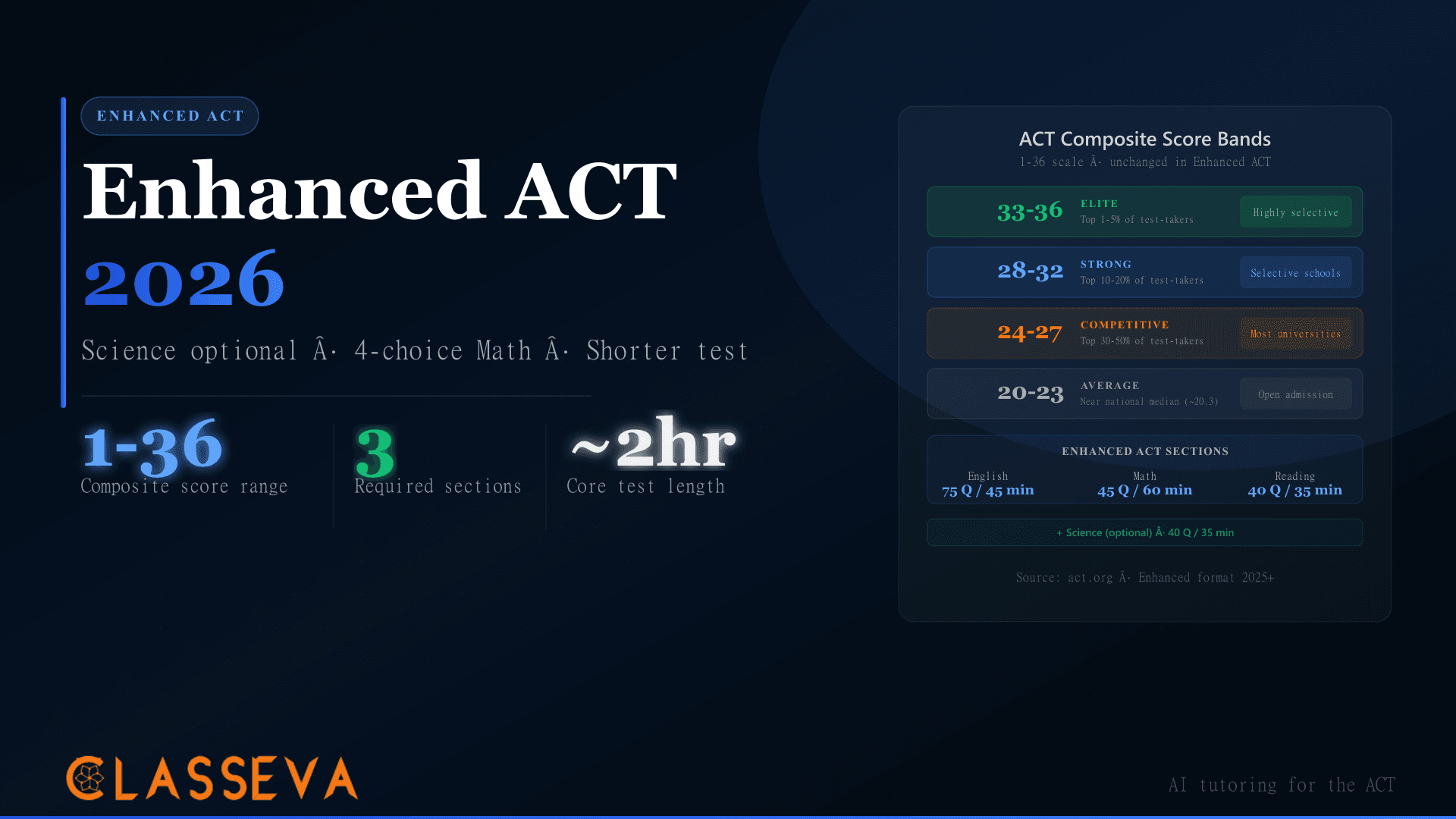
The Enhanced ACT begins around 8:00 AM at most test centers, with check-in starting at 7:30 to 7:45 AM. The three required sections total 140 minutes of testing time. Adding optional Science brings that to roughly 180 minutes, with the full session ending near 12:00 PM to 12:30 PM.
| Section | Questions | Time | Status |
|---|---|---|---|
| English | 75 | 45 min | Required |
| Math | 45 (4 choices) | 60 min | Required |
| Reading | 36 | 35 min | Required |
| Break (Math to Reading) | 10-15 min | ||
| Science | 40 | 40 min | Optional (pre-register) |
| Writing | 1 essay | 40 min | Optional (pre-register) |
| Core total (testing only) | 156 | 140 min | |
| With Science (testing only) | 196 | ~180 min |
Source: ACT.org Enhanced ACT format. Verify current timing at act.org before your test date.
Check-In to First Question
Staff verify admission tickets and IDs at the building entrance or registration table, not at the testing room door. Find your assigned seat, place your calculator and pencils on the desk, and store your bag as directed; most centers ask students to place bags under the seat or along a designated wall. Phones go into your bag, silenced, before you enter.
Proctors read standardized instructions covering each section's rules. Expect 15 to 20 minutes between the room opening and the first timed question. Students who arrive after the room opens may not be admitted.
Section Timing and Breaks
Sections run back to back: English first, then Math. A 10 to 15 minute break follows Math, then Reading runs. Students registered for Science remain for 40 additional minutes after Reading ends. The total session, from the first timed question through the end of Science, runs roughly 3 hours of clock time, including the break and short gaps between sections for distributing materials.
Use the Math-to-Reading break to eat, drink water, and stretch. Students who skip the break to keep studying tend to score lower on Reading. The brain needs glucose, not more review at that point in the session.
Most test centers close the check-in window 10 minutes after the published start time. Arriving 15 to 20 minutes early leaves buffer for parking, finding the room, and settling your materials before proctors begin reading instructions.
Should You Take the Optional Science Section?
Science is optional on the Enhanced ACT since 2025, but the decision does not happen on test day. You either registered for Science when you booked your test date, or you did not. Your admission ticket reflects what you registered for; that is what you test on.
The Science Decision Happens Before Test Day
When registering at act.org, you select which optional sections to add. You can add Science and Writing during registration or in the weeks leading up to test day through your ACT account, subject to availability. You cannot add either optional section on test day itself.
If you registered for Science and arrive planning to skip it, you can leave after Reading ends. You will receive no Science score, and you forfeited that portion of the registration fee. Most students who registered for Science complete it.
Does Skipping Science Hurt Your Score?
Skipping Science does not automatically lower your composite. The ACT composite averages the section scores you take. Without Science, your composite averages three sections: English, Math, and Reading. With Science, it averages all four. A Science score that falls below your other three section scores pulls your composite down; a Science score above your average lifts it.
Students targeting engineering programs, pre-med tracks, or merit scholarships at research universities should verify whether those programs reference ACT Science subscores before skipping. The full breakdown of the optional Science decision covers how to run that calculation before your test date.
What About the Optional Writing Section?
Writing is also optional and also requires pre-registration. The Writing section runs as the final session after all multiple-choice sections end, whether that is after Reading or after Science depending on which optional sections you registered for. It runs 40 minutes and consists of a single essay prompt.
Few colleges now require ACT Writing. The University of California system dropped the requirement, and most US institutions accept ACT composites without a Writing score. Some scholarship competitions and a small number of honors programs still list Writing as preferred or required. Check each school's admissions page directly. If none of your target schools require it, skipping Writing saves 40 minutes and testing fatigue.
Calculator Policy for the Enhanced ACT
Graphing calculators are permitted on the Enhanced ACT Math section. Scientific and four-function calculators also qualify. What ACT prohibits: CAS (Computer Algebra System) models such as the TI-89 and TI-Nspire CAS, any calculator with a QWERTY keyboard, calculators built into phones or tablets, and calculators requiring a wall outlet.
The TI-84 Plus, TI-84 Plus CE, TI-Nspire CX (non-CAS), and Casio FX-9750GIII are widely used and meet ACT requirements. You do not need a graphing calculator to score well on Math; a scientific calculator handles most of the computation. But if you have been practicing with a graphing calculator, bring it.
ACT maintains a calculator policy page at act.org with the permitted models listed explicitly. If your calculator is not on the approved list, staff can confiscate it at check-in. Bring extra batteries or charge any rechargeable models fully the night before.
When Do ACT Scores Come Out?
Multiple-choice scores for most Enhanced ACT national test dates appear in your ACT account approximately 10 business days after the test date. Scores release in batches across that window, not all at once. Writing scores, if you took optional Writing, arrive 3 to 7 days after the multiple-choice release.
Your scores appear in the ACT account you created at act.org. You cannot view them through a school portal or College Board account. If you designated schools to receive your scores during registration, ACT sends them automatically when scores release. You can also send additional score reports through your account after the release.
Planning your next test date before scores arrive is smart: ACT national test dates book up weeks in advance at popular centers. The SAT-ACT score converter maps your Enhanced ACT composite to a Digital SAT equivalent if you are weighing whether to retake the ACT or switch formats.
The Night Before and Morning of Test Day
The night before and morning of enhanced ACT test day matter more than the two hours of prep that most students try to squeeze in. Students who arrive rested, fed, and with every material ready outperform equivalent students who stayed up studying.
Night Before
Print your admission ticket
Print two copies. Place one in your bag and keep one on your desk as backup. Download the PDF to your phone as a second backup in case your printer fails.
Lay out every required item
Admission ticket, photo ID, three or more No. 2 pencils, eraser, calculator, snack, and sealed water bottle. Everything goes into your bag before you sleep.
Check your calculator battery
Replace AAA batteries even if the calculator seems fine. A low-battery warning mid-section with no replacement in your bag is an avoidable problem.
Confirm the test center address and parking
Look up the drive time from your home. Many test centers open their parking lots at 7:00 AM. Know which entrance to use; some large campuses route students to a specific building.
Sleep 8 hours
Studying past midnight the night before a standardized test does not move scores. Sleep consolidates what you already know and keeps working memory functioning at test time.
Morning of Test Day
Eat a real breakfast
Protein plus complex carbohydrates sustain mental focus better than coffee alone. A test that runs from 8:00 AM to noon spans four or more hours; your brain needs fuel throughout.
Leave for the test center on time
Most check-in windows open at 7:30 AM and close by 8:00 AM. Arrive by 7:45 AM at the latest. Build in buffer for parking and finding the room.
Keep your phone off from the moment you enter
Silence the phone, put it in the bottom of your bag, and do not take it out until you leave the building. A single vibration or ring during testing triggers review under ACT policy.
Follow the proctor's instructions for materials
Staff may ask you to place your bag along the wall or under your chair. Keep your pencils, calculator, and snack accessible on your desk once directed.
Optimal Test Date Selector
Enter your target score, current score, and application deadlines to map the best Enhanced ACT retake schedule for your college timeline.
Key Takeaways
- Your printed admission ticket and a valid photo ID are non-negotiable on enhanced ACT test day. Forgetting either one can result in being turned away at the door.
- Your testing format (paper bubbles or computer terminal) is fixed at registration and shown on your admission ticket. Practice in that format in the weeks before your test date.
- The three required sections total 140 minutes of testing time: English (45 min), Math (60 min, 45 questions, 4 choices), and Reading (35 min). With optional Science, plan for roughly 180 minutes of testing plus breaks.
- Science must be pre-registered. You cannot add it on the day of the test. Skipping it does not automatically hurt your composite; a below-average Science score would lower it, while an above-average one raises it.
- Graphing calculators are allowed, but CAS models (TI-89, TI-Nspire CAS) are prohibited. Verify your specific calculator at act.org before test day and arrive with fresh batteries.
- Multiple-choice scores arrive approximately 10 business days after the test date through your ACT account. Writing scores follow 3 to 7 days later if you took the optional Writing section.