Enhanced ACT Reading Strategy: Passage Types Decoded
ACT Reading gives you 52 seconds per question and no margin for the wrong approach. Most prep guides respond with generic “skim and find” advice that treats all four passage types the same way. That uniformity is the mistake. Prose fiction calls for close reading of character and emotion. Social science calls for argument mapping. Natural science calls for factual anchoring and direct retrieval. Apply prose fiction technique to a natural science passage and you waste 2-3 minutes hunting for emotional nuance that was never there. This post breaks each passage type down to its actual cognitive demands and gives you a strategy calibrated for each one.
What Is the Structure of Enhanced ACT Reading?
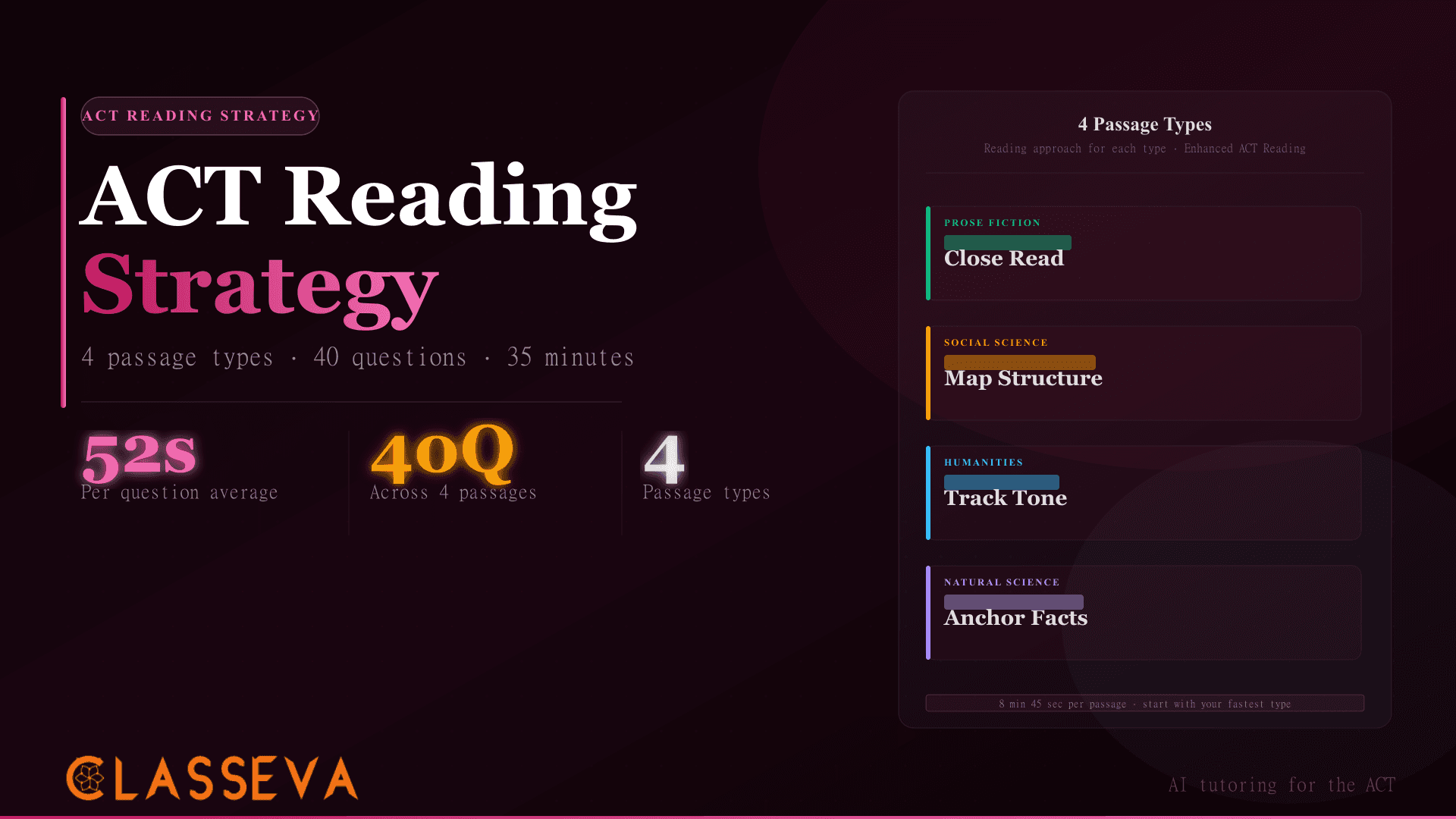
ACT Reading has 40 questions spread across 4 passages, with exactly 10 questions per passage. The section runs 35 minutes. [VERIFY: confirm current Enhanced ACT Reading format at act.org] That works out to 52 seconds per question on average, or 8 minutes and 45 seconds per passage including reading time and answering all 10 questions.
The 52-Second Clock
That 52-second average is tight. For comparison, the digital SAT's Reading and Writing module gives you roughly 71 seconds per question. ACT Reading asks you to read a full passage and answer 10 questions on it in under 9 minutes. The students who score above 30 on ACT Reading are not faster readers; they spend less time on re-reads. A passage-type-specific strategy reduces re-reads by telling you exactly what to track on the first pass.
The 52-second figure is an average, not a per-question target. Some questions take 20 seconds (line-reference retrievals). Some take 90 seconds (inference chains). The goal is managing the 8:45 per passage budget, not hitting 52 seconds on every individual question.
Passage Order and Flexibility
ACT does not require you to read passages in printed order. You can start with your strongest passage type, which saves time and builds confidence early in the section. Natural science is the type most students find fastest once they master the factual-anchoring approach. Prose fiction is the type most students find slowest because close reading genuinely takes longer. Knowing your personal speed by type lets you sequence the section strategically.
If you skip a passage and return to it, mark your answer sheet carefully. Filling in answers out of sequence is the most preventable timing error on ACT Reading.
What Are the 4 Passage Types on ACT Reading?
The four ACT Reading passage types are Prose Fiction (also called Literary Narrative), Social Science, Humanities, and Natural Science. Each appears once per test and carries 10 questions. [VERIFY: confirm the four passage type labels as of the Enhanced ACT at act.org] The order of passage types varies across test dates, so you cannot count on any fixed sequence.
| Passage Type | Typical Topics | Reading Approach | Key Question Types |
|---|---|---|---|
| Prose Fiction / Literary Narrative | Short stories, novel excerpts, first-person narratives | Close read: track character and emotion | Inference, character motivation, narrator voice, tone |
| Social Science | History, economics, sociology, political science | Map structure: locate thesis and evidence | Main idea, author purpose, evidence function, implication |
| Humanities | Memoirs, cultural essays, arts criticism | Perspective read: track author attitude | Tone, author purpose, perspective shifts, distinction between stated and implied |
| Natural Science | Biology, chemistry, physics, earth science | Fact anchor: mark claims for lookup | Direct retrieval, data interpretation, sequence of events |
[VERIFY: passage type labels and question distributions at act.org]
How Do You Approach Prose Fiction Passages?
Prose fiction and literary narrative passages reward close, sequential reading. The narrator's voice, the emotional register of specific scenes, the relationship between two characters — all of these live in sentence-level word choices that skimming destroys. Read prose fiction from start to finish, at a pace that lets you track what each character feels and why.
Character and Emotion Tracking
Before you read the first paragraph, note the character list at the top if one is provided. As you read, track three things: who the narrator is, what the narrator wants or fears, and how relationships between characters shift across the passage. These three threads answer the majority of prose fiction questions. You do not need to decode symbolism or interpret theme at a literary-analysis level. ACT stays close to the text — what the passage explicitly shows or clearly implies is the answer.
A useful habit: after each paragraph, pause for two seconds and ask “how does [main character] feel right now?” That internal check costs almost no time and keeps the narrative thread alive in your working memory. Students who skip this check often reach question 7 on a prose fiction passage and realize they have no idea what happened between paragraphs 3 and 6.
What Prose Fiction Questions Actually Test
Prose fiction questions cluster into four types: narrator voice and tone, character motivation, specific textual detail, and inference about unstated feelings or intentions. The textual detail questions are the fastest — they point you to a line number and ask what a word or phrase means in context. The inference questions take longer because they require synthesizing multiple paragraphs. Batch the quick line-reference questions first within the 10-question set, then return to the inference questions with whatever time remains.
Skimming prose fiction to save time. The time savings are real: 90 seconds faster to finish the passage. But prose fiction question distractors are engineered to catch skimmers. A question asking about the narrator's attitude toward a specific character will list four plausible attitudes, and only the student who read carefully enough to catch a two-word qualifier (“reluctantly admired,” not just “admired”) selects the right answer. Skimming prose fiction trades 90 seconds of reading for 3-4 minutes of question re-reads.
How Do You Tackle Social Science and Humanities Passages?
Social science passages build arguments; humanities passages express perspectives. The reading approach differs, but both types reward paying close attention to the opening and closing paragraphs. The middle paragraphs in social science carry evidence. The middle paragraphs in humanities carry emotional texture and supporting reflection. Knowing which type you are reading tells you which middle paragraphs to read closely versus skim.
Argument vs Perspective: The Structural Split
A social science passage typically opens with a claim or question, then marshals historical, economic, or sociological evidence to support a position. When you read the first paragraph, look for the thesis sentence, which usually appears in the first three sentences or the final sentence of the opening paragraph. Once you find it, the rest of the passage is evidence accumulation. Middle paragraphs are each one piece of evidence; skim them looking for topic sentences that tell you what each piece claims.
A humanities passage — a memoir excerpt, an essay about music, a piece of cultural criticism — does not argue as much as it reflects. The author's perspective is the point. Read these passages more like fiction: follow the author's emotional and intellectual journey, note where their attitude shifts (from skepticism to appreciation, from nostalgia to critique), and mark those shift points because questions frequently target them.
Tone and Author-Purpose Questions
Both social science and humanities passages generate tone and author-purpose questions. These questions ask things like “the author's primary purpose in the passage is to” or “the author's tone toward the subject can best be described as.” The answers always live in the passage, but they require synthesizing the whole passage rather than looking up a single line. Read the answer choices for tone questions carefully: the ACT uses precise tone adjectives (wistful, sardonic, cautious optimism) and the differences between adjacent wrong answers are subtle.
One pattern I notice when examining published ACT Reading question sets closely: tone questions on humanities passages often offer one correct answer that captures nuance (e.g., “tempered enthusiasm”) alongside three wrong answers that are each plausible but slightly off in one direction. The students who pick the wrong answer usually picked the simple positive or negative option without accounting for the qualifier.
How Do You Handle Natural Science Passages?
Natural science passages are the most misread passages on the ACT because students over-apply their science knowledge. Every answer to every natural science question lives in the passage text. You do not need to know anything about the topic beyond what the author wrote. In fact, applying outside science knowledge frequently produces wrong answers because the passage may describe a specific study or hypothesis that differs from general scientific consensus.
Factual Anchoring
The natural science approach: read the introduction to understand the subject and the author's framing. Then skim the body paragraphs, pausing at each factual claim to register where it lives. You do not need to memorize the claim, just know it is “in paragraph three, third sentence.” This mental map converts the passage into a lookup reference. When a question asks “according to the passage, what is true about X,” you already know where X is discussed.
The most common factual anchoring mistake: reading the passage continuously without marking where specific claims live. The student finishes reading, feels informed, then spends 45 seconds re-scanning to find the specific line a question targets. Anchoring during the read cuts that re-scan time to 8-10 seconds.
Data-Reference Questions
Some natural science passages include references to data, figures, or experimental results described in the text. ACT Reading (unlike ACT Science) does not include actual charts or tables inline with the passage, but passages may describe data trends in prose form: “the researchers found that temperature increased by 4 degrees Celsius per decade over the study period.” Questions about these data descriptions are pure retrieval questions — find the sentence, read the number, select the correct answer. They are among the fastest questions on the section once you know where to look.
Treat natural science passages like you would a legal document: you are the lawyer arguing a case using only the evidence in front of you. Your prior knowledge about how photosynthesis works or what a proton is does not matter. What matters is what this passage, on this test, claims about the topic. Students who follow this rule answer natural science questions faster than any other passage type.
Prose Fiction Reading Approach
- •Read every sentence for voice and emotion
- •Track character feelings after each paragraph
- •Note two-word qualifiers (reluctantly, cautiously)
- •Questions test inference from explicit text
- •4-5 minutes of close reading required
Natural Science Reading Approach
- •Read intro fully; skim body for claim locations
- •Mark where each factual claim appears
- •Ignore outside science knowledge entirely
- •Questions are direct retrieval, not inference
- •3-4 minutes with anchoring marks is enough
How Should You Pace Yourself Across 4 Passages?
Divide 35 minutes into four equal blocks of 8 minutes and 45 seconds each. Within each block, budget roughly 3-5 minutes for reading (depending on passage type) and the remaining 3-5 minutes for answering the 10 questions. The exact split shifts by passage type: natural science reads faster but question lookup takes longer; prose fiction reads slower but line-reference questions resolve faster.
The 8-Minute-45 Rule
The 8:45 rule is a ceiling, not a target. If you finish a passage and its questions in 7 minutes, bank the extra 105 seconds for a later passage. The rule enforces one specific discipline: do not let any single passage take 11 or 12 minutes just because it is hard. A student who spends 11 minutes on passage two will run out of time on passage four, leaving 10 questions partially unanswered. Distributing difficulty evenly — 8:45 per passage maximum — prevents the time collapse that ends most struggling test-takers' scores.
If you hit 8:45 and still have unanswered questions on a passage, do three things: fill in your best guess on each blank, mark those questions, and move on. Return with any leftover time after finishing all four passages. Guessing buys you a chance at points. A blank guarantees zero.
Choosing Your Passage Order
Start with your fastest passage type, which frees time for your slowest. Most students find natural science the fastest once they master factual anchoring, and prose fiction the slowest because close reading takes time. A recommended default order for students who have not yet identified their personal strengths: Social Science, Natural Science, Humanities, Prose Fiction. This front-loads the two argument-structure passages while your reading attention is freshest, and saves prose fiction for last since emotional engagement with a story tends to hold even when mental fatigue sets in.
Your order should reflect your actual timed practice performance, not a general recommendation. Track which passage type takes you longest across three or four timed practice sections, then put that type second-to-last, giving yourself comfortable time before potentially needing to rush.
Check the clock after finishing each passage
After completing a passage and its 10 questions, note your elapsed time. If you are ahead of your 8:45 target, bank the difference. If you are behind, increase your reading speed on the next passage or skip the most time-consuming questions and mark them for return.
Fill in a guess for every blank before moving on
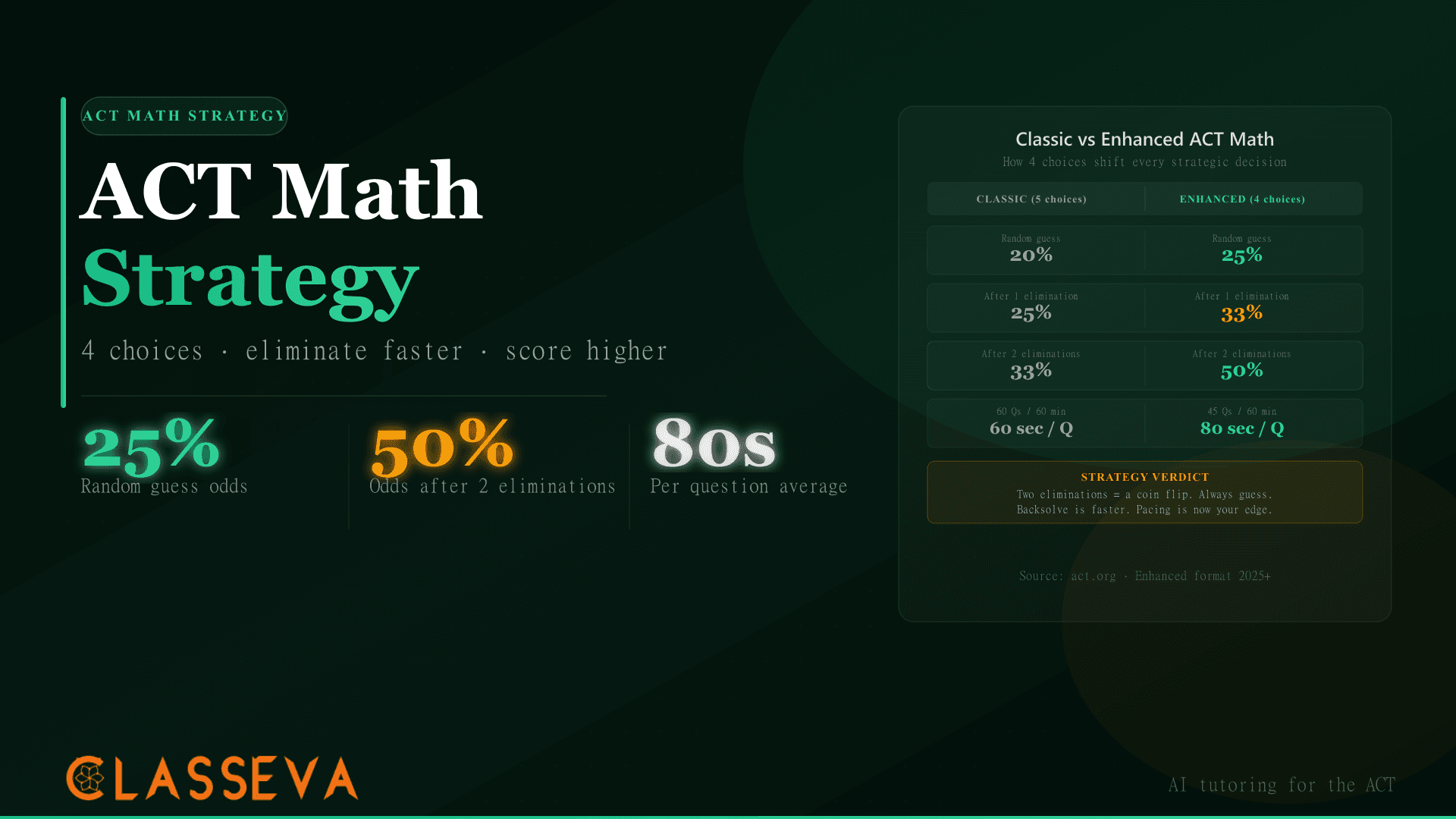
Any question you skip should still have an answer filled in. If you return to it, change the answer. If you do not return to it, the guess stands. An empty bubble scores zero. A random guess on ACT Reading gives you a 25% chance of a correct answer at no penalty.
Sequence passages by personal speed, not test order
You are not required to read the passages in the printed order. Start with your fastest type to bank time. End with your slowest type so any remaining time can absorb an overrun.
Use the final 60 seconds to fill in any remaining blanks
In the last minute, scan your answer sheet for any empty rows. Fill in answers for all remaining blanks. Do not spend more than 10 seconds reconsidering any single question at this stage.
If you want to see exactly how your current ACT Reading score compares to a target school's 75th-percentile score, and how many points you need to gain on the ACT, the calculator below sets that goal in concrete terms.
Test Score Goal Setter
Enter your current ACT Reading practice score and your target school's score range to see exactly how many points you need and which passage types to prioritize.
What Are Paired Passages and How Do You Handle Them?
Paired passages replace one standard ACT Reading passage with two shorter texts, each roughly 300-400 words, on a related topic. The 10 questions split across three categories: questions that refer only to Passage A, questions that refer only to Passage B, and comparison questions that ask you to relate or contrast the two authors. [VERIFY: confirm paired passage structure and question distribution at act.org]
Read both passages before answering any comparison question. Answering “how do the two authors differ in their approach to X” after reading only Passage A produces an incomplete, often wrong answer. Passage-specific questions (about only A or only B) can be answered after reading just that passage. The most time-efficient order: read both passages, answer all Passage A questions, then all Passage B questions, then tackle comparison questions last.
What Is the Best Practice Strategy for ACT Reading?
The best practice approach for enhanced ACT reading strategy starts with diagnosis: identify which passage type costs you the most time and produces the most wrong answers. Students who know their weakest type can direct 80% of their practice to that type, rather than running full 40-question timed sets where all four types dilute the feedback.
Passage-type drilling works like this: take 5-6 natural science passages from released ACT tests. Time each one at 8:45. After each passage, review every wrong answer by returning to the exact passage line the correct answer came from. Do not move on until you understand why your selected answer was wrong and why the correct answer was right. This review is where the skill improvement happens. Finishing practice passages without reviewing wrong answers is the reading equivalent of re-reading notes rather than using active recall.
For students targeting a 30+ on ACT Reading, the high-value drill is inference questions on humanities passages. These questions require synthesizing tone across multiple paragraphs, and they are the question type that most reliably separates 28s from 32s on the section. Pair that drill with the SAT-ACT Converter to track whether your ACT Reading progress translates to your SAT Reading and Writing score target, particularly useful if you plan to submit both.
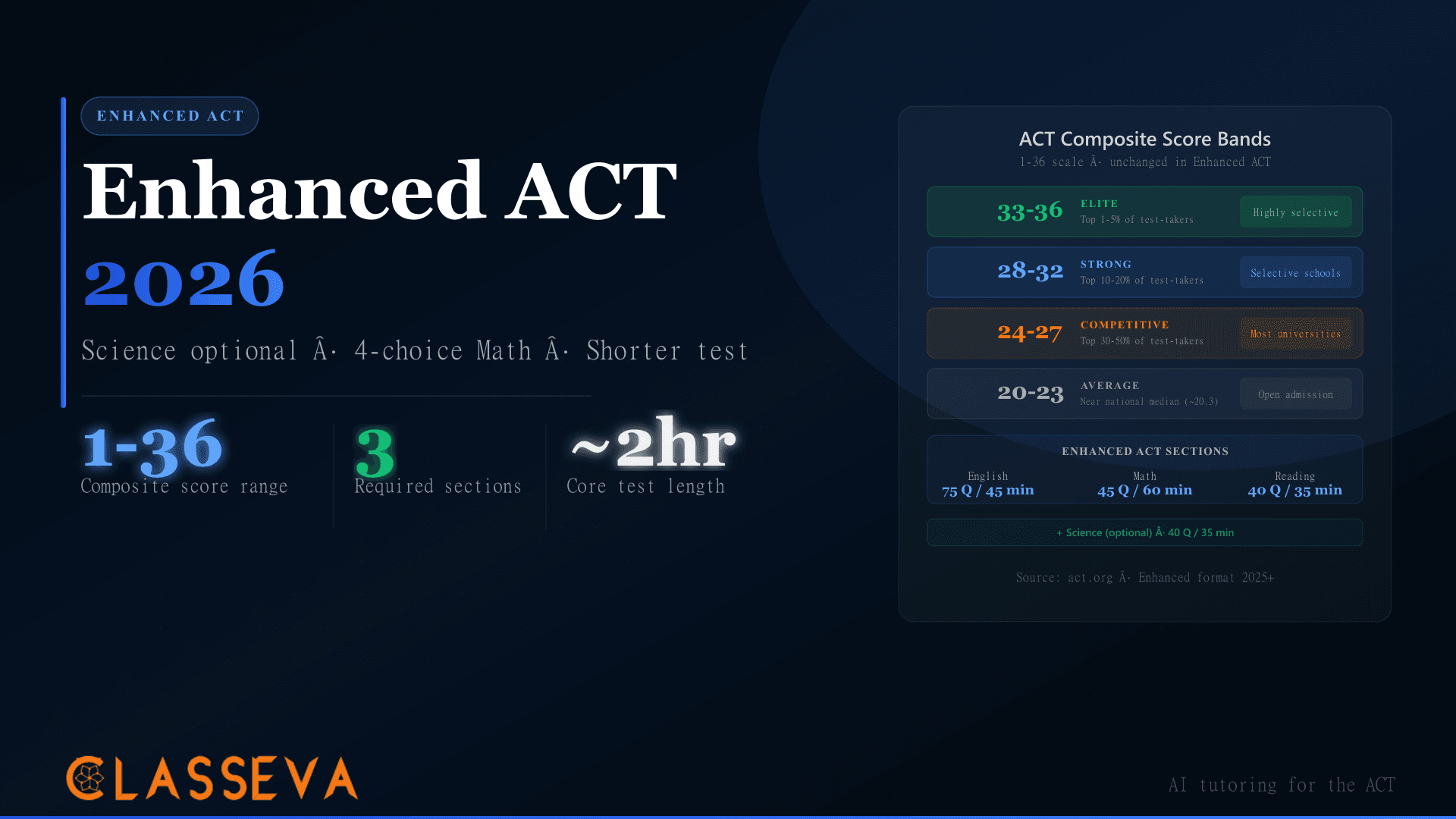
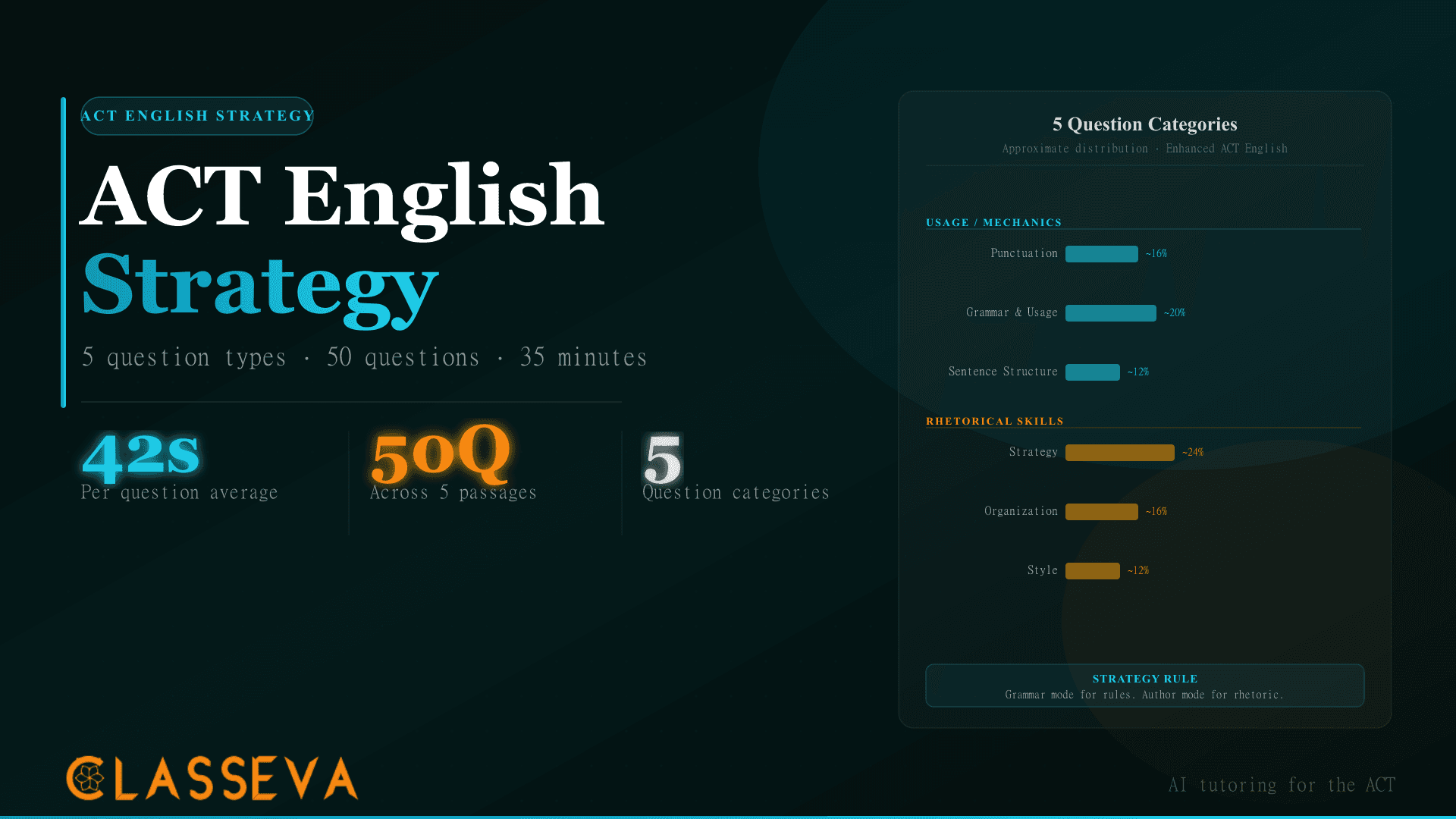
For additional context on how ACT Reading fits into the full enhanced format, including changes to the Math and optional Science sections, see the Enhanced ACT 2026 overview. The Enhanced ACT Math strategy and the Enhanced ACT English strategy complete the section-by-section strategy set for the core three sections.
Key Takeaways
- ACT Reading has 40 questions across 4 passages in 35 minutes: roughly 52 seconds per question and 8 minutes 45 seconds per passage.
- The four passage types (Prose Fiction, Social Science, Humanities, Natural Science) each reward a different reading approach. Applying one approach to all four types leaves points behind.
- Prose fiction demands close reading of character and emotion. Skim it and you miss the word-level nuance that inference questions test.
- Natural science requires factual anchoring and direct retrieval. Outside science knowledge is counterproductive. Every answer lives in the passage text.
- Social science rewards argument mapping: locate the thesis in the opening paragraph, then track how each body paragraph supports it.
- You can reorder passages. Start with your fastest type to bank time for harder passages. Never exceed 9 minutes on any single passage.
- For paired passages, read both texts fully before attempting any comparison question. Passage-specific questions can be answered after reading just one.