AP Calc AB Unit 3 Review: Chain, Implicit, Inverse
The chain rule is the most-tested skill on the entire AP Calc AB exam, and it lives in Unit 3. This AP Calc AB Unit 3 review treats Differentiation: Composite, Implicit, and Inverse Functions as the core engine of the course. The unit carries about 9-13% of the multiple-choice section on paper, but that number badly understates its reach. Trace any related rates problem, any motion free response, any optimization question, and you find a chain rule step buried inside.
Studying how the College Board structures its free response rubrics across recent years, the pattern that jumps out is this: examiners award partial credit for the derivative setup, not just the final number. A student who writes the chain rule and implicit differentiation steps cleanly banks points even when arithmetic goes sideways. A student who skips straight to a wrong answer banks nothing. That single habit, showing the Unit 3 machinery, explains a large share of the gap between a 3 and a 5. For the bigger picture on how hard this course runs, see the AP Calculus AB difficulty breakdown.
What Does AP Calc AB Unit 3 Cover?
AP Calc AB differentiation in Unit 3 teaches the techniques that handle functions you cannot differentiate with the basic rules alone. It covers six topic areas: the chain rule for composite functions, implicit differentiation, differentiating inverse functions, differentiating inverse trigonometric functions, the choice of procedures, and higher-order derivatives. Together these tools let you find a slope for almost any curve the exam can throw at you. The full topic list lives in the College Board AP Calculus AB course framework.
Topics 3.1 Through 3.6
| Topic | Skill | What You Differentiate |
|---|---|---|
| 3.1 | The Chain Rule | Composite functions like sin(x²) or (3x + 1)⁵ |
| 3.2 | Implicit Differentiation | Equations mixing x and y, like x² + y² = 25 |
| 3.3 | Differentiating Inverse Functions | g′(b) using the reciprocal-slope rule |
| 3.4 | Differentiating Inverse Trig Functions | arcsin(x), arctan(x), arcsec(x) and chained versions |
| 3.5 | Selecting Procedures | Choosing chain, product, quotient, or implicit |
| 3.6 | Higher-Order Derivatives | Second and third derivatives for concavity and motion |
Source: AP Calculus AB Course and Exam Description, College Board.
Why Unit 3 Decides Your Score
Unit 3 sits at the hinge of the course. Units 1 and 2 build the definition of a derivative and the basic rules. Units 4 through 8 apply derivatives to motion, related rates, optimization, and integration. Every one of those later applications routes through a chain rule or implicit step taught here. Weak Unit 3 fluency does not just cost you 9-13% of the multiple-choice section. It quietly drains points from half the free response questions too.
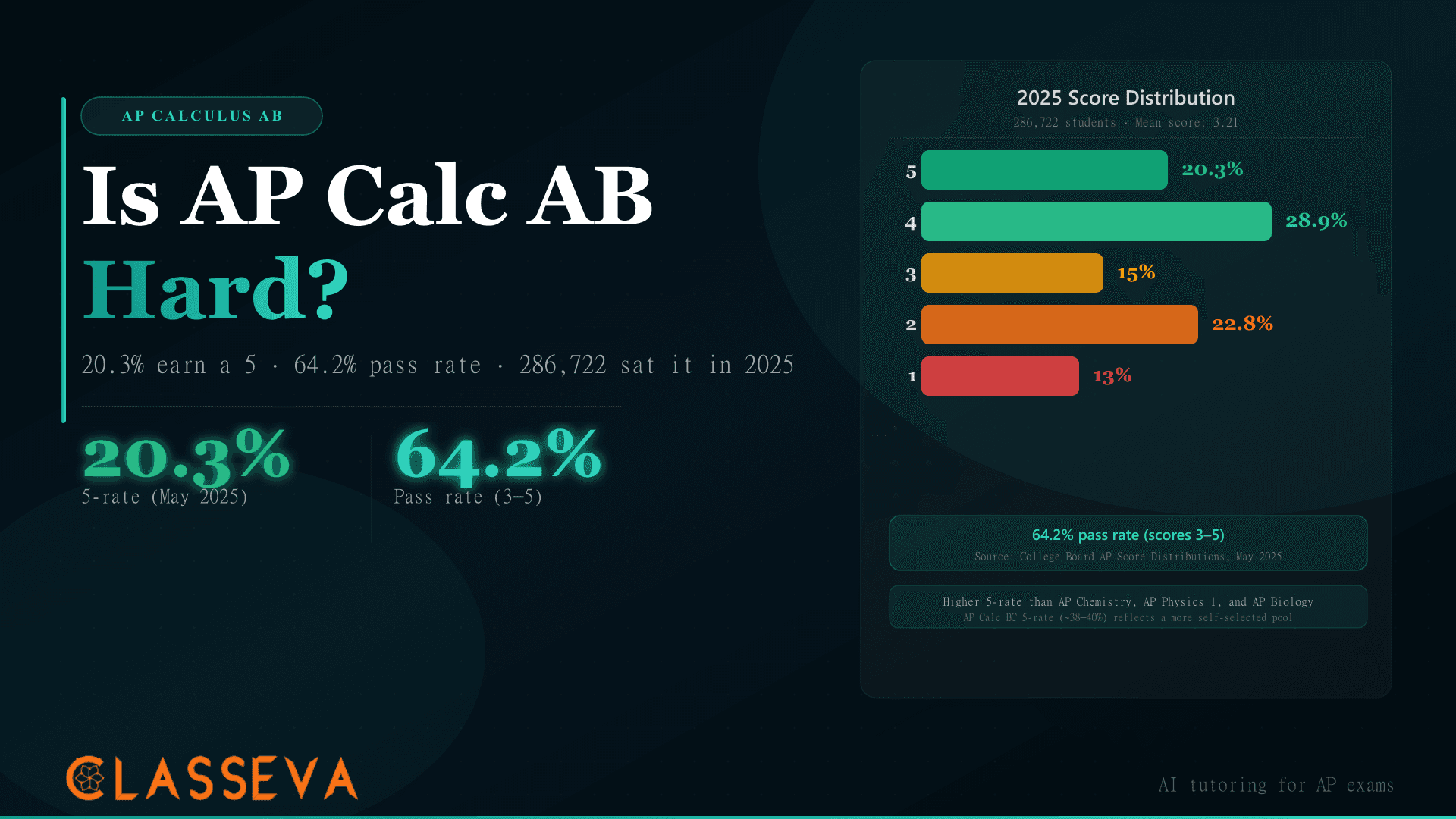
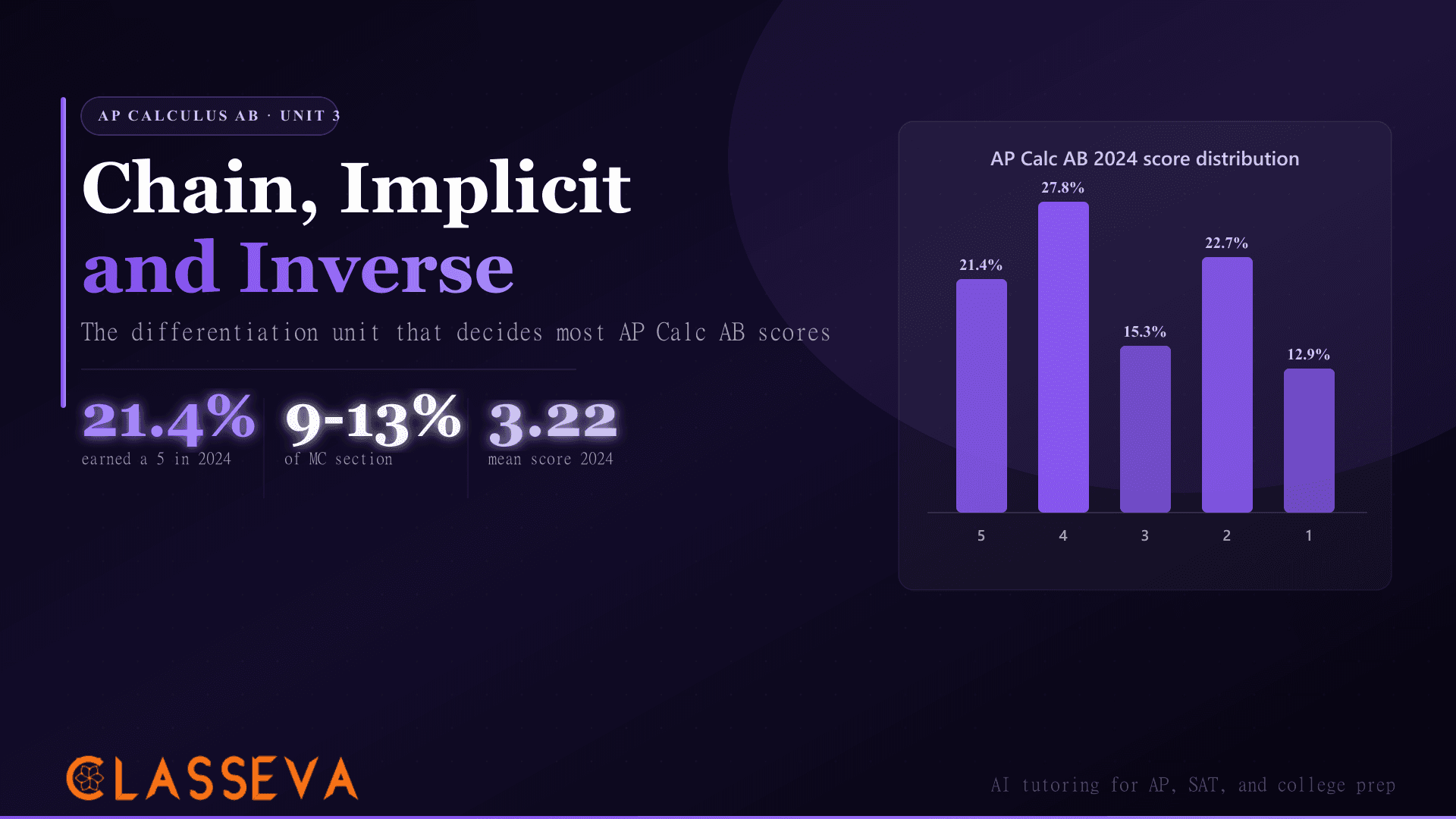
The score data backs this up. On the May 2024 exam, the College Board reported that 21.4% of AP Calc AB students earned a 5 and the mean score landed at 3.22 across roughly 279,000 test takers. The students clustered at 3 versus 5 rarely differ on limits. They differ on whether the chain rule and implicit differentiation feel automatic.
How Does the Chain Rule Work on AP Calc AB?
The chain rule differentiates a composite function by multiplying the derivative of the outer function by the derivative of the inner function. If a function nests one expression inside another, like sin(x²), you take the outer derivative while keeping the inside intact, then multiply by the inside derivative. Symbolically, the derivative of f(g(x)) equals f′(g(x)) times g′(x).
The Single Composition Case
Start with one layer of nesting. To differentiate sin(x²), treat sin as the outer function and x² as the inner function. The outer derivative gives cos(x²), holding the inside unchanged. The inner derivative of x² gives 2x. Multiply them: the derivative equals 2x·cos(x²). The order matters, and the inside stays frozen while you differentiate the outside.
Nested Compositions and Where Students Slip
The exam rarely stops at one layer. Consider differentiating (sin(3x))⁴, a function with three nested layers: a fourth power on the outside, a sine in the middle, and a 3x on the inside. You peel from the outside in, multiplying each layer's derivative as you go. The outer power gives 4(sin(3x))³. The middle sine gives cos(3x). The inner 3x gives 3. The full derivative chains them all: 12(sin(3x))³·cos(3x).
Most students handle the first two layers and forget the third. The factor of 3 from the inner 3x vanishes, and the answer reads 4(sin(3x))³·cos(3x), missing the multiplier. That dropped factor is the single most common chain rule slip on the multiple-choice section. Build a habit: count the layers before you start, then confirm you produced exactly that many derivative factors.
Three Chain Rule Errors That Cost Points
1. Dropping the inner derivative. Writing cos(x²) instead of 2x·cos(x²) forgets to multiply by the inside derivative. This is the error that appears most often.
2. Differentiating the inside too early. Changing sin(x²) to sin(2x) treats the inside as if it were the whole function. The inside stays frozen during the outer step.
3. Losing a layer in a triple nest. In a function like e^(sin(2x)), all three layers need a derivative factor. Skipping the 2 from the innermost 2x is a guaranteed point loss.
A quick verification trick: after you finish, count the distinct functions stacked inside one another in the original problem. A composite with three layers must produce three multiplied factors in the derivative. If your answer has fewer factors than the function had layers, you dropped one. This single check catches the majority of chain rule errors before you commit an answer.
What Is Implicit Differentiation and When Do You Use It?
Implicit differentiation finds dy/dx when y is not isolated, meaning the equation tangles x and y together. You differentiate both sides with respect to x, treat y as an unknown function of x, and apply the chain rule every time a y appears. The classic example is the circle x² + y² = 25, where solving for y first would force you to split the curve into two branches.
The Implicit Differentiation Procedure
The procedure runs in four moves. Differentiate every term on both sides with respect to x. Each y term picks up a dy/dx factor because y is a function of x, which is the chain rule working quietly underneath. Collect all dy/dx terms on one side. Then solve for dy/dx algebraically. For x² + y² = 25, you get 2x + 2y·(dy/dx) = 0, which solves to dy/dx = -x/y.
Notice that dy/dx = -x/y depends on both coordinates. At the point (3, 4) on the circle, the slope works out to -3/4. At (4, 3) it becomes -4/3. The same curve carries different slopes at different points, which is exactly why solving for y first would have been clumsy. Implicit differentiation hands you a slope formula that works everywhere on the curve at once.
Implicit Differentiation Sets Up Related Rates
Related rates problems are implicit differentiation in disguise, with time as the hidden variable. When a ladder slides down a wall or a balloon inflates, you differentiate a geometric relationship with respect to time t, attaching a rate like dx/dt or dr/dt to each variable. The mechanics match Unit 3 exactly: differentiate, attach the rate factor through the chain rule, then solve for the unknown rate.
This is why a strong Unit 3 foundation pays off in Unit 4. The College Board tests related rates on the free response section almost every year, and the setup step is pure implicit differentiation. Students who treat Unit 3 as a one-and-done topic struggle with related rates months later. Students who internalized the dy/dx mechanics recognize related rates as the same move with a new variable.
Prompt style: “Find dy/dx for the curve x³ + y³ = 6xy at a given point.”
Step-by-step: Differentiate every term with respect to x. The left side gives 3x² + 3y²·(dy/dx). The right side needs the product rule: 6xy differentiates to 6y + 6x·(dy/dx). Set them equal: 3x² + 3y²·(dy/dx) = 6y + 6x·(dy/dx). Collect the dy/dx terms on one side, factor, and divide. The result is dy/dx = (6y − 3x²) / (3y² − 6x). The chain rule and the product rule both appear inside one problem, which is the level the AP Calc AB exam expects.
How Do You Find Inverse Function Derivatives?
The derivative of an inverse function equals the reciprocal of the original function's derivative, evaluated at the matching point. If g is the inverse of f, then g′(b) = 1 / f′(g(b)). The slope of the inverse at a point is the reciprocal of the slope of the original function at the point that maps to it. Geometrically, the inverse is the original reflected across the line y = x, and reflection flips rise and run.
The General Inverse Derivative Formula
Picture the reflection. A function f and its inverse g mirror each other across y = x, so a point (a, b) on f corresponds to the point (b, a) on g. Reflecting a line across y = x swaps its rise and its run, which inverts the slope. That geometric fact is the whole reason the inverse derivative formula reciprocates: where f rises steeply, its inverse rises gently, and the two slopes multiply to one.
The exam tests this with a table or a known function rather than a full derivation. A common multiple-choice item gives f(2) = 5 and f′(2) = 3, then asks for the derivative of the inverse at x = 5. Because g(5) = 2, the answer is g′(5) = 1 / f′(2) = 1/3. The whole problem hinges on tracking which point maps to which. Read the question slowly and match the inputs before you reciprocate.
Inverse Trig Derivatives You Must Memorize
Three inverse trig derivatives appear on AP Calc AB, and you cannot derive them quickly under time pressure, so memorize them. The derivative of arcsin(x) is 1 over the square root of (1 − x²). The derivative of arctan(x) is 1 over (1 + x²). The derivative of arcsec(x) is 1 over the absolute value of x times the square root of (x² − 1). When the input is a function rather than plain x, the chain rule layers on top.
| Function | Derivative | With Chain Rule on u |
|---|---|---|
| arcsin(x) | 1 / √(1 − x²) | u′ / √(1 − u²) |
| arccos(x) | −1 / √(1 − x²) | −u′ / √(1 − u²) |
| arctan(x) | 1 / (1 + x²) | u′ / (1 + u²) |
| arccot(x) | −1 / (1 + x²) | −u′ / (1 + u²) |
| arcsec(x) | 1 / (|x|√(x² − 1)) | u′ / (|u|√(u² − 1)) |
The three highlighted rows (arcsin, arctan, arcsec) are the ones AP Calc AB tests most. Their co-function partners differ only by a negative sign.
The structure is worth noticing because it cuts your memorization in half. The co-function derivatives, arccos, arccot, and arccsc, match their partners with a negative sign in front. Learn arcsin, arctan, and arcsec, then add a minus sign for the others. On a chained version like arctan(3x), the answer is 3 / (1 + 9x²), where the 3 comes from differentiating the inner 3x. The chain rule never goes away.
What Are Higher-Order Derivatives?
A higher-order derivative is the derivative of a derivative. The second derivative, written f″(x), measures how the rate of change itself is changing. Take the derivative once to get f′(x), then differentiate again to get f″(x). On AP Calc AB this connects to concavity, where a positive second derivative means the graph curves upward, and to motion, where acceleration is the second derivative of position.
Higher-order derivatives also show up inside implicit differentiation, which is where they turn nasty. To find the second derivative implicitly, you differentiate the first-derivative expression again, and any dy/dx that remains gets substituted back in. The result often looks messy. The College Board rewards correct method here even when the final expression is unwieldy, so write each differentiation step explicitly rather than racing to a clean answer.
First Derivative f′(x)
- •Measures instantaneous rate of change
- •Sign tells you increasing vs decreasing
- •In motion: gives velocity from position
- •Zeros locate critical points
Second Derivative f″(x)
- •Measures how the rate of change changes
- •Sign tells you concave up vs concave down
- •In motion: gives acceleration from position
- •Sign changes locate inflection points
How Does the College Board Test Unit 3?
Unit 3 surfaces on both sections of the exam, but its weight is heaviest where you might not expect it. The multiple-choice section tests the chain rule and inverse derivatives directly, often through tables of values or composite functions. The free response section embeds Unit 3 inside related rates and motion problems, where implicit differentiation and the chain rule are the setup, not the headline.
The 2024 free response questions ran a mean of 3.55 out of 9 on Question 3 and 3.14 on Question 5, two of the lower-scoring prompts, per the College Board past exam questions and scoring statistics. Questions like these reward students who show the derivative setup cleanly. A correctly written chain rule line or implicit step banks partial credit even when the final number misses. That partial-credit habit is the difference Unit 3 fluency buys you. For more on how the whole course compares in difficulty, the AP Calculus BC difficulty guide and the AP Precalculus difficulty breakdown map the surrounding math sequence.
Although the CED tags the chain rule to Unit 3 at roughly 9-13% of the multiple-choice section, the skill reappears inside Units 4, 5, and 6 on every related rates, optimization, and accumulation problem. Counting its hidden appearances, the chain rule touches a much larger share of the test than its official weighting suggests. [VERIFY: confirm exact Unit 3 MC weighting band against the current AP Calculus AB CED at-a-glance table.]
Estimate Your AP Calc AB Score
Once you have drilled AP Calc Unit 3, the useful next question is what your current preparation projects to on the 1-to-5 scale. A score estimate turns a vague sense of readiness into a target you can plan around, and it tells you whether to push for a 5 or shore up the fundamentals first.
AP Score Predictor
Enter your practice performance to estimate your AP Calc AB score on the 1-to-5 scale and see how close you are to a passing or college-credit result.
Pair the estimate with a study plan that front-loads Unit 3. Because the chain rule and implicit differentiation feed so many later applications, time spent here compounds. A free active recall practice routine beats rereading notes, and spacing your sessions with spaced practice instead of cramming locks the derivative rules into long-term memory before exam day.
Key Takeaways
- The chain rule is the highest-leverage skill on the exam. It carries Unit 3 directly and hides inside related rates, motion, and optimization across later units.
- Count the layers before you differentiate a composite. A function with three nested pieces must produce three multiplied derivative factors, or you dropped one.
- Implicit differentiation attaches dy/dx to every y term. Differentiate both sides with respect to x, collect the dy/dx terms, then solve algebraically.
- Related rates is implicit differentiation with time as the variable. Mastering Unit 3 sets up the related rates free response questions in Unit 4.
- The inverse derivative reciprocates the original slope. Use g′(b) = 1 / f′(g(b)) and track which point maps to which before you reciprocate.
- Memorize arcsin, arctan, and arcsec derivatives. Their co-function partners differ only by a negative sign, and the chain rule layers on top of each.
- Show every derivative step on the free response. The rubric awards the setup, so a clean chain rule line earns points even when the arithmetic misses.