Is AP Calculus BC Hard? Pass Rate, 5-Rate, and BC vs AB
Spend an afternoon with College Board's score distribution archives and one number stands out: AP Calculus BC's 5-rate holds near 40% year over year, one of the highest figures across all AP exams with more than 50,000 annual test-takers. That number is accurate. The interpretation sometimes attached to it (that BC is easy, or that a 5 is a near-certainty) is not. BC covers a full year of college calculus in two distinct halves, and the students who sit the exam are not a representative cross-section of the AP population.
Is AP Calculus BC Hard?
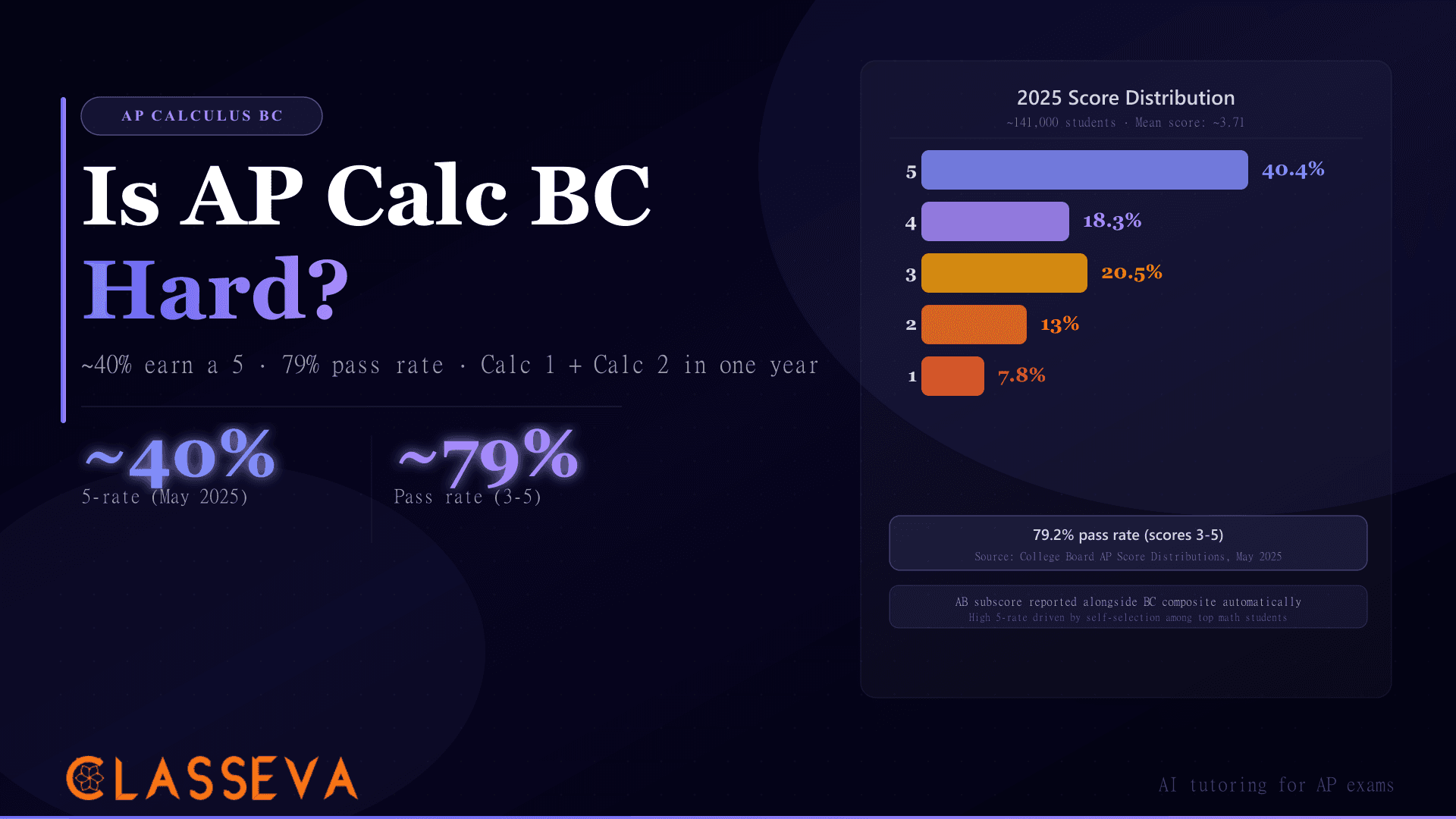
AP Calculus BC has a pass rate of approximately 79% and a 5-rate of roughly 40% in 2025, placing it near the top of College Board's AP performance data. Both figures sit well above AP Calculus AB (64.2% pass rate, 20.3% 5-rate). That comparison surprises most students encountering it for the first time. The explanation is not that BC rewards effort less rigorously, but that the pool taking BC is far more concentrated among high-achieving math students.
The 2025 Score Distribution
In 2025, approximately 141,000 students sat the AP Calculus BC exam, roughly half the test-taking pool of AP Calc AB. The full score breakdown from College Board's official score distribution data:
| Score | Percentage | What It Means |
|---|---|---|
| 5 | ~40.4% | Exceptional: college credit for Calc 1 + Calc 2 at most schools |
| 4 | ~18.3% | Strong: credit at many schools |
| 3 | ~20.5% | Pass: AB subscore may earn Calc 1 credit |
| 2 | ~13.0% | Below passing |
| 1 | ~7.8% | No credit |
Source: College Board AP Calculus BC Score Distributions, May 2025. Approximately 141,000 test-takers. Mean score: ~3.71.
Score 5 alone accounts for more test-takers than scores 2 and 1 combined. That inversion essentially never appears among large-enrollment AP exams in the social sciences or humanities. It reflects who enrolls in BC rather than what the exam demands.
How AP Calc BC Compares to Other AP Math
The ~40% 5-rate places AP Calc BC above every other large AP math exam by a wide margin. AP Calculus AB posted a 20.3% 5-rate in 2025. AP Statistics typically lands between 15-25% depending on the year. AP Statisticsand AP Precalculus both post 5-rates well below 25%. Among all AP exams with 100,000+ annual test-takers, BC's top-score rate has no peer.
The Self-Selection Effect
A ~40% 5-rate does not mean AP Calculus BC is easy. It means the students who enroll in BC are not a random sample of high school math students.
Who Takes AP Calculus BC?
The BC test-taking pool skews heavily toward accelerated tracks. Most BC students fall into one of three groups: they completed an accelerated math sequence (Algebra 2 by 9th grade, precalculus by 10th), they plan STEM degrees requiring Calculus 2, or they already took AP Calc AB and are extending into BC material. These students consistently outperform broader AP averages on every exam they sit. That performance advantage shows up in BC's score distribution as a massive bulge in the 5 bar.
The enrollment size difference is instructive. About 286,000 students took AP Calc AB in 2025. About 141,000 took BC, roughly half as many. When the less-prepared students opt for AB rather than BC, the BC distribution naturally concentrates at the top end.
What the 5-Rate Actually Tells You
The honest framing: AP Calc BC attracts students who are strong at math and motivated to earn two semesters of calculus credit. When that group takes any exam, the score distribution skews upward. Comparing BC's 5-rate to AP English Language's ~9% or AP US History's ~11% as though the exams draw from the same population is a category error.
If every high school student in the US were required to take AP Calculus BC, the 5-rate would drop sharply, probably below AP Calc AB's current 20.3%. The ~40% figure tells you about the students who choose BC, not about the exam itself.
What BC Covers That AB Does Not
AP Calculus BC adds an entire second semester's worth of material beyond the AB scope. The AP Calculus BC Course and Exam Description organizes the content into 10 units. Units 1-8 cover the same topics as AP Calc AB (with some additional BC sub-topics embedded). Units 9 and 10 are BC-only.
Series and Convergence Tests
Unit 10 covers infinite sequences and series, the topic most students identify as BC's steepest learning curve. You need to determine whether a series converges (sums to a finite value) or diverges, using up to seven distinct tests depending on the series structure. The ratio test, direct comparison, limit comparison, integral test, alternating series test, p-series recognition, and geometric series formula each apply in different scenarios, and knowing which test to reach for under timed pressure takes sustained practice.
Taylor and Maclaurin series require a separate layer of fluency. Constructing the power series representation of a function, finding the interval of convergence, and using Taylor polynomials to approximate function values all appear as FRQ topics. Unit 10 content contributes roughly 17-18% of the BC exam score.
Parametric, Polar, and Vectors
Unit 9 adds three coordinate systems and function representations that AB never covers. Parametric equations define position as (x(t), y(t)), requiring different derivative and arc-length formulas. Polar coordinates (r, theta) require converting between polar and Cartesian, finding polar area using integration, and computing derivatives in polar form. Vector-valued functions extend both to motion in the plane, combining position, velocity, and acceleration into a two-component framework.
Unit 9 contributes approximately 11-12% of the BC exam. Students who studied AP Physics are often surprised by how much parametric and vector content overlaps with kinematics. The calculus operations on those representations, though, are entirely new in BC.
How the AB Subscore Works
Every student who takes AP Calculus BC receives two scores from College Board: a BC composite score (1-5) reflecting performance across the full 10-unit exam, and an AB subscore (1-5) calculated from BC exam questions that fall within the AP Calculus AB scope. No separate exam is required.
What Colleges Do With the Subscore
The AB subscore matters most when a student earns a BC composite of 3 but a stronger AB subscore of 4 or 5. A student in that situation might not receive Calculus 2 credit at their target college, but they may still receive Calculus 1 credit via the subscore. That means saving a course worth of tuition, a seat in a large lecture class, and time for upper-level courses. Check our AP Credit Savings Calculator for college-specific credit award estimates.
College Board reports both scores automatically. Students do not request the subscore separately; it appears alongside the BC composite whenever scores are sent. Selective schools with clear AP credit policies (MIT, Stanford, Caltech) publish exactly which scores earn which credits. Check each school's website rather than assuming a blanket policy applies across institutions.
If you plan to attend a school that accepts AP Calculus BC scores for credit, the AB subscore adds real optionality. Even a BC composite of 3 plus an AB subscore of 4 can place you out of Calculus 1 at many schools, saving a course that costs thousands of dollars in tuition. See the AP credit savings breakdown for specifics.
AP Calc BC vs AP Calc AB: Which Should You Take?
For students planning to take more than one college calculus course, BC delivers substantially more value per AP exam. For students who need calculus once and will not advance beyond it, AB is the better use of preparation time. The AP Calc AB guide covers the AB-specific scope in detail.
Take AP Calc AB When...
- •Calculus is a one-time requirement (pre-med prerequisites, business, social sciences)
- •You want full depth on Calc 1 without doubling the workload
- •You have not completed a rigorous precalculus course
- •Your college does not require Calculus 2 for your major
Take AP Calc BC When...
- •You plan an engineering, physics, CS, or math degree requiring Calc 2
- •You want to earn two semesters of credit in one exam year
- •Your precalculus background is strong and you can handle a faster pace
- •You already completed AB and want to build directly on that foundation
How Much Should You Study for AP Calc BC?
Most students who earn a 4 or 5 on AP Calculus BC study 6-8 hours per week during the school year. That runs roughly double the typical AP Calc AB commitment, which reflects BC's doubled curriculum scope rather than BC being disproportionately harder per hour of content.
During the School Year
Daily 30-45 minute problem sessions outperform single weekly review blocks for calculus. Procedural fluency in derivatives, integration techniques, and convergence tests builds through repetition rather than through reading. Students who let classroom material accumulate for weeks before reviewing find themselves unable to execute procedures under timed pressure on practice exams.
Series content (Unit 10) rewards early attention. It sits late in the school year course sequence but carries 17-18% of the exam score. Students who start practicing convergence tests in February rather than April consistently outperform those who treat it as a last-month topic.
The Final 8 Weeks Before May
In the 8 weeks before the exam, shift from topic-by-topic review to full practice exams and FRQ drilling. College Board publishes released FRQs with scoring guidelines at AP Central's past exam archive. AP Calc BC FRQs frequently combine multiple topic areas (series approximation involving integration, parametric motion involving derivatives) in ways that require fluency across topics simultaneously, not just in isolation.
The no-calculator FRQ questions (Part B) are the section most students underestimate. Build hand-computation fluency throughout the year. Students who spent the whole year with a TI-84 handling derivatives and integrals numerically often find Part B the most difficult section of the exam.
Are You Ready to Take AP Calc BC?
Four questions worth answering honestly before committing to BC:
Can you factor and manipulate algebraic expressions fluently by hand?
Weak algebra is the most common predictor of struggle in calculus. BC adds more complexity per problem than AB, so algebraic gaps compound. If factoring, completing the square, and simplifying rational expressions feel slow or uncertain, address that before starting BC.
Have you completed precalculus including trigonometry?
Trig functions appear throughout AB and BC material: derivatives of sin, cos, tan and their inverses, trig substitution in integration, parametric motion with trig components. A solid precalculus background with trigonometry is not optional.
Are you planning a major that requires Calculus 2?
Engineering, physics, applied math, and computer science programs commonly require Calculus 2 or beyond. If BC credit lets you skip two college math courses, the time-and-cost savings are substantial. Use the AP Credit Savings Calculator to estimate the dollar value.
Can you commit 6-8 hours per week to math throughout the school year?
The honest answer separates students who will earn 4s and 5s from those who will earn 2s and 3s. BC is not unmanageable, but the doubled scope compared to AB requires proportionally more time. Students who take BC primarily for the college credit without allocating the time typically do not earn the credit.
AP Score Predictor
If you have worked through AP Classroom progress checks or full practice problems, Classeva's AP Score Predictor maps your raw score to a projected band for AP Calculus BC, accounting for BC's specific scoring curve rather than a generic conversion.
AP Score Predictor
Enter your AP Calculus BC practice test results to see your projected score band and identify where to focus in the final weeks before May.
Key Takeaways
- AP Calculus BC posts a ~40% 5-rate and ~79% pass rate in 2025. Both figures are driven significantly by self-selection among the strongest math students, not by exam leniency.
- BC covers everything in AP Calc AB plus Unit 9 (Parametric, Polar, Vectors) and Unit 10 (Infinite Series). That second semester of content carries roughly 22-28% of the BC exam score.
- The AB subscore is a distinct 1-5 score reported automatically alongside your BC composite. A strong AB subscore can earn Calculus 1 college credit even when the BC composite falls short.
- A score of 4 or 5 on BC typically earns two semesters of college calculus credit; AB earns one. For STEM majors needing both, BC delivers double the credit per AP exam.
- Unit 10 (series and convergence) is the most common difficulty spike in BC. Start practicing convergence tests early in the year, not in April. It carries 17-18% of the exam and requires sustained new skill development.
- Most students earning 4s and 5s study 6-8 hours per week. That commitment reflects the doubled curriculum scope compared to AP Calc AB.
- The no-calculator FRQ section tests algebraic fluency under time pressure. Relying on a graphing calculator throughout the school year leaves a gap that shows up clearly in Part B.
Frequently Asked Questions
What percentage of students get a 5 on AP Calculus BC?
Approximately 40% of AP Calculus BC test-takers earned a 5 in 2025, according to College Board score distribution data. This is one of the highest 5-rates across all AP exams, but it reflects a self-selected pool of stronger math students rather than an inherently easy exam.
Is AP Calculus BC actually easier than AP Calculus AB?
AP Calculus BC is not easier than AB. BC covers everything in AB plus two additional topic areas: Unit 9 (Parametric Equations, Polar Coordinates, and Vector-Valued Functions) and Unit 10 (Infinite Sequences and Series). The high 5-rate reflects self-selection: students who enroll in BC are typically the strongest math students in their school, many of whom have already completed AB.
What topics are on AP Calc BC that are not on AP Calc AB?
AP Calc BC adds Unit 9 (Parametric Equations, Polar Coordinates, and Vector-Valued Functions) and Unit 10 (Infinite Sequences and Series) beyond the AB scope. Unit 10 includes convergence and divergence tests (ratio, comparison, integral, alternating series), Taylor series, Maclaurin series, and power series interval of convergence.
What is the AP Calculus BC AB subscore and how does it work?
College Board reports an AB subscore alongside the BC composite score for every AP Calculus BC exam taker. The AB subscore reflects performance on BC exam questions that cover only AB-scope material. It uses the same 1-5 scale. Students who earn a lower BC composite score may still use a strong AB subscore to receive Calculus 1 college credit at schools that accept it.
Should I take AP Calc AB before AP Calc BC, or skip straight to BC?
Both paths work. Many students take AB in 11th grade and BC in 12th, building procedural fluency before tackling BC's additional topics. Others with strong precalculus foundations skip AB and take BC directly. The AP Calculus BC CED is designed to be taken without prior AB, but the pacing is significantly faster since AB and BC content are condensed into one year.
Do you need to know all of AP Calc AB before taking BC?
AP Calculus BC assumes no prior AP Calculus AB credit and covers the full AB scope as part of its curriculum. Students who take BC directly need a strong precalculus background covering trigonometry, algebraic manipulation, and function analysis. BC teaches limits, derivatives, and integrals from scratch alongside the BC-specific topics, but at a faster pace than a standalone AB course.
Does AP Calc BC count for more college credit than AP Calc AB?
Yes. A score of 4 or 5 on AP Calculus BC typically earns credit for both Calculus 1 and Calculus 2 at most colleges, equivalent to two semesters. AP Calculus AB typically earns credit for Calculus 1 only. For engineering, physics, and math majors who need both courses, BC delivers significantly more credit per AP exam.
When is the AP Calculus BC exam in 2026?
The AP Calculus BC exam is scheduled for Tuesday, May 5, 2026, in the morning session, the same day as AP Calculus AB. Students cannot sit both AP Calculus AB and AP Calculus BC in the same year. Register through your school's AP coordinator; deadlines typically fall in late October or November of the preceding school year.